Portable Solar Panels with Battery Storage: Complete Guide
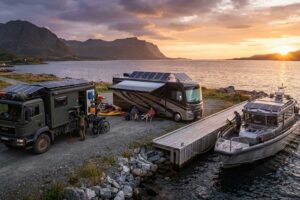
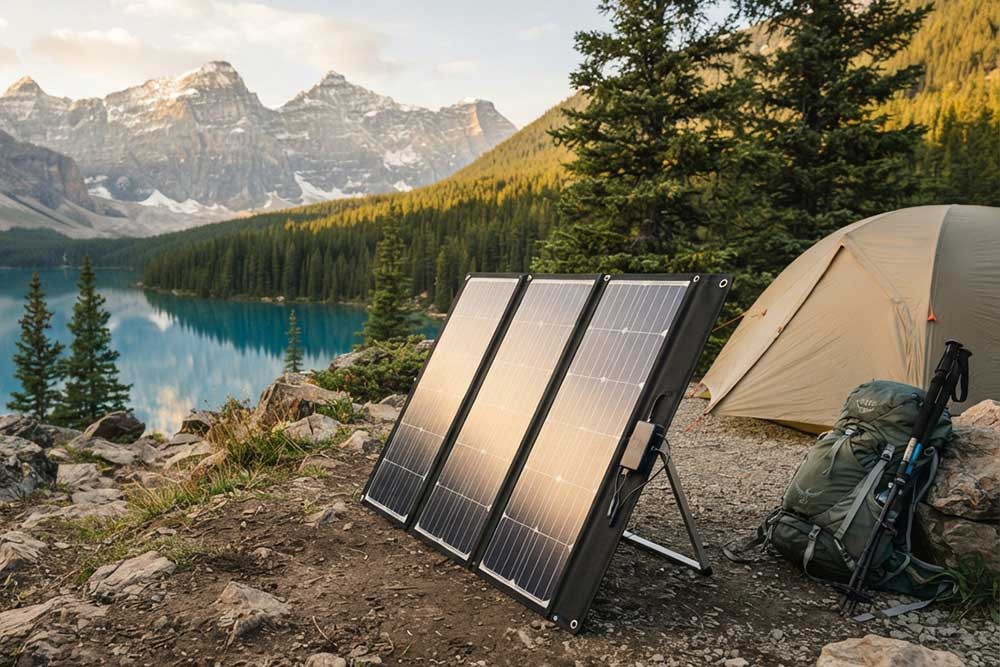
Portable solar panels with battery storage combine solar generation and stored energy in a mobile system. The panels produce electricity during daylight, while the battery saves usable energy for evening, cloudy periods, or short power interruptions. For RVs, camping, work sites, boats, and emergency backup, this arrangement provides more flexibility than portable panels alone.
What Are Portable Solar Panels with Battery Storage?
A portable solar setup has two jobs that should not be confused.
The solar panel produces energy. The battery stores energy.
During the day, sunlight reaches the photovoltaic cells and creates DC electricity. That electricity passes through a solar charge controller or the integrated solar input of a portable power station. The battery stores the energy, and an inverter can later convert DC battery power into AC electricity for conventional appliances.
The U.S. Department of Energy describes the same fundamental relationship in larger solar-plus-storage systems: solar generation is intermittent, while storage makes generated electricity available at a different time. DOE also points out that energy storage is not 100% efficient, meaning some energy is lost during charging, storage, conversion, and discharge.
For a portable system, this matters more than the marketing label on the box.
A “1,000W solar panel system,” for example, does not automatically mean you can store 1,000W or run a 1,000W appliance continuously. Panel wattage, battery capacity, inverter output, solar-input limits, and actual sunlight all describe different parts of the system.
The basic energy flow
Sunlight → Portable Solar Panel → Charge Controller → Battery → Inverter → Appliance
Some modern portable power stations combine the charge controller, battery-management electronics, inverter, displays, and outlets inside one enclosure.
That makes installation easier, but the electrical limits still matter.
| Component | Main specification | What it determines |
|---|---|---|
| Solar panel | Watts (W) | Maximum solar generation under rated conditions |
| Battery | Watt-hours (Wh) | Amount of stored energy |
| Inverter | Continuous watts (W) | Appliances that can run continuously |
| Surge rating | Peak watts | Short startup loads |
| Solar input | Voltage/current/watts | How much PV the battery system can accept |
| Charge controller | MPPT/PWM and input range | How solar energy is converted and managed |
The most common sizing mistake is choosing the battery first and treating the solar panels as an afterthought.
For frequent off-grid use, I recommend starting with the loads, estimating daily energy consumption, then matching the battery and solar array to those loads. It prevents the familiar situation where a large battery takes several days to recharge from a small portable panel.
How Portable Solar Panels Charge a Battery
A portable solar panel does not normally connect directly to an appliance battery without appropriate charging electronics.
The solar module generates variable DC power. Its voltage and current change with sunlight, temperature, shading, and electrical loading. The charge controller regulates that input so the battery can be charged within its permitted voltage and current range.
DOE notes that solar production can change because of season, time of day, clouds, dust, haze, shadows, rain, snow, and dirt. That variability becomes particularly noticeable with portable panels because the user often changes the panel’s position during the day.
Why MPPT matters for portable systems
Many quality portable power stations use MPPT, or Maximum Power Point Tracking, on their solar input.
An MPPT controller continuously works around the panel’s operating point to extract useful power while converting it into a voltage suitable for battery charging.
This becomes useful when:
- sunlight changes as clouds move across the panel;
- the panel operates at a different voltage from the battery;
- the panel is placed farther away from the battery unit;
- morning and afternoon temperatures change panel operating conditions.
The practical point is simple: do not compare portable solar systems only by panel wattage.
Check the power station’s permitted solar-input voltage, current, and maximum PV wattage.
For example, a 400W portable panel arrangement connected to a power station that accepts only 200W of solar input cannot magically deliver 400W into the battery. The unused potential is limited by the receiving equipment.
How Much Battery Storage Do You Need?
Battery capacity is usually expressed in watt-hours (Wh) or kilowatt-hours (kWh).
A 1,000Wh battery theoretically stores 1kWh of energy. Actual usable energy will be lower because battery-management limits and conversion losses prevent the entire nameplate capacity from becoming usable AC energy.
A useful first calculation is:
Daily energy requirement = Appliance watts × operating hours
For example:
| Appliance | Approx. load | Daily use | Energy |
|---|---|---|---|
| LED lights | 20W | 4 hours | 80Wh |
| Laptop | 60W | 5 hours | 300Wh |
| Portable refrigerator | 50W average* | 10 hours | 500Wh |
| Phone/tablet charging | 15W | 3 hours | 45Wh |
| Total | — | — | 925Wh |
*Actual refrigerator consumption varies significantly with ambient temperature, insulation, thermostat cycling, and compressor operation.
A system designed around approximately 925Wh of daily loads should not automatically use a 925Wh battery. Some headroom is sensible, particularly when the battery must also support inverter losses and periods of weak solar production.
DOE distinguishes energy capacity from power capacity: capacity describes how much energy can be stored, while power describes how quickly it can be delivered. That distinction is essential when selecting a portable battery.
A large battery with a small inverter may store plenty of energy but still be unable to operate a high-power appliance.
Battery size examples
| Use case | Suggested battery range | Typical loads |
|---|---|---|
| Weekend camping | 300–700Wh | Phones, lights, cameras |
| Basic RV use | 700–1,500Wh | Refrigerator, lights, electronics |
| Extended off-grid use | 1,500–3,000Wh+ | Multiple appliances |
| Emergency home backup | 2,000Wh+ | Selected essential circuits |
These are planning ranges rather than universal specifications. Your actual requirement depends on appliance consumption and how long each load operates.
Choosing the Right Portable Solar Panel Size
The panel array needs to replenish the energy you expect to consume.
A rough planning calculation is:
Solar energy = Panel wattage × effective sun hours × system efficiency
Suppose a portable system uses 400W of solar input and receives an equivalent of four productive sun hours:
400W × 4h = 1,600Wh theoretical solar energy
The battery will receive less than that because real systems experience conversion losses, temperature effects, wiring losses, panel positioning errors, and periods below rated output.
This is why a 400W panel should not be described as a guaranteed 1.6kWh-per-day generator.
NREL and DOE both emphasize that PV output varies with environmental conditions and system configuration. Solar resource is affected by location, weather, season, orientation, shading, and other conditions.
100W, 200W, 400W or larger?
100W:
Useful for lightweight camping, small electronics, battery maintenance, and low-energy loads.
200W:
A practical middle ground for weekend trips and smaller portable battery systems.
400W:
Much more useful for RVs and longer off-grid stays, particularly when refrigeration and several electronic loads are involved.
600W–1,000W+:
Better suited to larger battery banks and high daily energy consumption, provided the battery system accepts the required solar-input voltage and current.
There is no benefit in carrying a very large panel array if the battery system cannot accept the input.
The opposite problem is just as common: a 2,000Wh battery paired with a tiny 100W panel can take a long time to replenish after substantial use.
Portable Solar Panels with Battery Storage for RVs
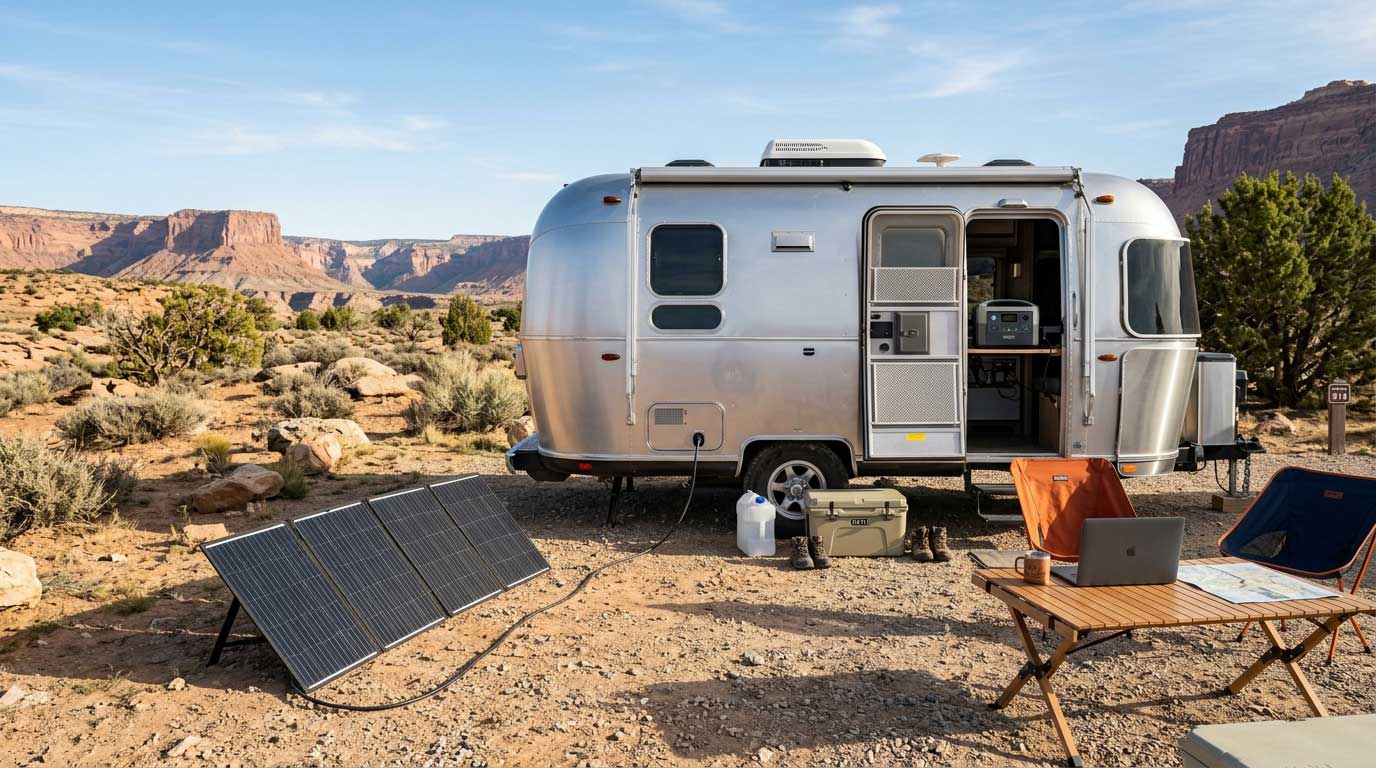
RV applications are one of the clearest use cases for portable solar and battery storage.
EnergySage notes that RV owners generally choose between permanent roof-mounted solar and portable panels. Portable systems avoid permanent installation and can be positioned separately from the vehicle, which can be useful when the RV is parked in partial shade.”Learn more about the Flexible Solar Panel Installation Guide“
That last point is easy to underestimate.
Imagine an RV parked under trees. The vehicle roof may be shaded while a portable panel can be moved 20 or 30 feet into an open patch of sunlight. A roof-mounted system cannot make that adjustment without moving the entire vehicle.
For a weekend camper, that flexibility can be worth more than a higher theoretical panel rating.
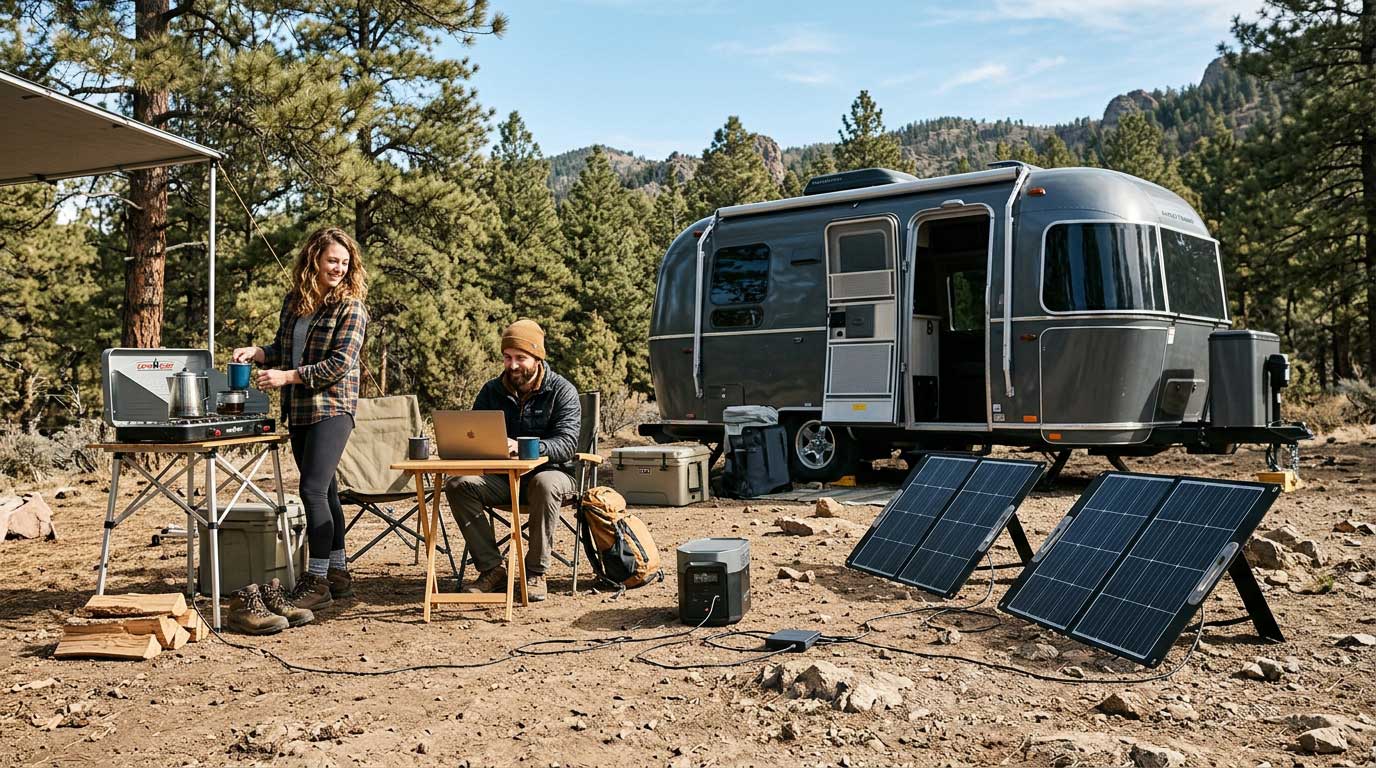
A realistic RV example
Consider a couple using a travel trailer for three nights without campground hookups.
Their approximate daily loads might look like:
- refrigerator: 500Wh
- lighting: 80Wh
- phones and tablets: 60Wh
- laptop: 250Wh
- water pump: 60Wh
- small kitchen electronics: 150Wh
That gives approximately 1,100Wh per day before accounting for system losses.
A practical configuration could use:
- 1,500–2,000Wh battery storage
- around 400–600W of portable solar
- MPPT solar charging
- inverter sized according to the largest AC load
- appropriate DC cables and connectors
The important detail is not the exact numbers. It is the relationship between daily consumption, storage capacity, and solar recovery.
If the battery is repeatedly drained to a low level but the solar array cannot replace the previous day’s energy, the system gradually becomes less useful even though every component is technically working.
Portable Solar Panels for Camping and Outdoor Work
Camping loads tend to be smaller than RV loads, but portability becomes more important.
A useful setup might include a folding or semi-flexible panel, compact battery, charging cables, and a small inverter.
For field work, the priorities change slightly.
A construction or maintenance crew may need:
- cordless tool battery charging;
- phones and radios;
- laptops;
- LED work lights;
- inspection cameras;
- small networking equipment.
In that situation, the battery’s continuous inverter rating and available AC/DC outputs may matter more than having the largest possible solar panel.
A 1,500Wh battery does not mean a 1,500W appliance can run from it. You need to check the inverter’s continuous rating and surge capability.
Portable does not mean fragile
Outdoor use exposes panels and cables to repeated folding, transportation, dust, moisture, and accidental handling.
For a commercial or professional product, I would evaluate:
- frame or laminate construction;
- connector quality;
- cable flexibility;
- junction-box protection;
- water resistance;
- mechanical durability;
- operating-temperature range;
- ease of deployment;
- storage dimensions.
The best portable panel is not necessarily the lightest one. A panel that is awkward to deploy, difficult to clean, or vulnerable to repeated handling may perform poorly over a season despite an attractive specification sheet.
Portable Solar Battery Storage: What Specifications Matter Most?
When comparing systems, I would put less emphasis on a single headline number and inspect the electrical specifications together.
Battery chemistry
Lithium-ion batteries are widely used in portable storage because they offer substantial energy storage in a relatively compact package. DOE identifies lithium-ion as one of the major electrochemical storage technologies and explains that rechargeable batteries store electrical energy through reversible chemical processes.
For portable applications, weight and physical size are often important enough to influence the battery choice.
Usable battery capacity
Look beyond the advertised Wh number.
Ask:
- What is the usable capacity?
- What battery-management limits apply?
- Can the unit be expanded?
- What charging temperature limits apply?
- How does the manufacturer specify cycle life?
- Is the battery replaceable or serviceable?
Inverter output
The inverter converts battery DC power into AC power for compatible appliances. DOE describes this DC-to-AC conversion as a fundamental role of inverters in PV systems.
Check both:
Continuous output: what the inverter can sustain.
Surge output: what it can briefly provide for starting loads.
A compressor, pump, or motor can demand considerably more power during startup than its normal operating wattage.
Solar input rating
This is particularly important when pairing Bright Solar panels with a third-party battery.
Check:
- maximum PV input watts;
- MPPT operating voltage range;
- maximum solar input current;
- connector type;
- maximum open-circuit voltage;
- whether multiple panels can be connected in series or parallel.
Never assume that two 200W panels will automatically work simply because the battery accepts 400W.
The panel voltage and current must fall inside the power station’s specified input window.
How to Build a Portable Solar System Step by Step
A practical system can be planned without overcomplicating the process.
Step 1: List the loads
Write down every appliance you actually expect to use.
Do not start with “I want 1,000W of solar.”
Start with:
What needs electricity, how many watts does it use, and for how many hours?
Step 2: Calculate daily energy
Multiply watts by operating hours and add the individual loads.
For devices that cycle, such as refrigerators, use estimated daily energy consumption rather than assuming the compressor runs continuously.
Step 3: Select battery capacity
Choose enough storage to cover the expected period without sunlight while leaving practical reserve.
For overnight use, the battery may need to carry most evening and early-morning loads.
Step 4: Size the solar array
The solar array should be large enough to replace typical daily consumption under realistic site conditions.
If the system is intended for winter use, frequent cloudy weather, or shaded campsites, conservative sizing is preferable to designing around perfect midday sunshine.
Step 5: Check electrical compatibility
Before connecting anything, compare the solar panel’s:
- Voc;
- Vmp;
- Isc;
- Imp;
- maximum power;
with the battery system’s solar-input limits.
This is not a cosmetic specification check. An incompatible PV voltage can damage equipment or cause the system to reject the solar input.
Step 6: Position the panels properly
Put the panels where they receive the strongest practical sunlight.
Avoid:
- tree shadows;
- vehicle shadows;
- building shadows;
- partially covered cells;
- unnecessary cable loops.
A panel producing 400W in full sun can produce dramatically less when partially shaded.
Step 7: Monitor actual performance
After installation, record:
- solar input watts;
- battery state of charge;
- daily Wh generated;
- daily Wh consumed;
- peak inverter load.
After several days, the numbers become more useful than the original specification sheet.
That is one of the simplest ways to determine whether the system is correctly sized.
Portable Solar Panels with Battery Storage: Practical Sizing Table
| Application | Solar panel range | Battery range | Typical priority |
|---|---|---|---|
| Phone/camera camping | 50–150W | 200–500Wh | Lightweight setup |
| Weekend camping | 100–300W | 500–1,000Wh | Easy transport |
| Small RV | 200–400W | 1,000–1,500Wh | Refrigerator + electronics |
| Medium RV | 400–600W | 1,500–2,500Wh | Longer off-grid stays |
| Worksite backup | 400–800W | 1,500–3,000Wh | Tools + electronics |
| Larger off-grid loads | 600–1,000W+ | 3,000Wh+ | Higher daily consumption |
These figures are planning ranges, not universal design standards. Local solar conditions, appliance efficiency, battery chemistry, inverter losses, and user behavior can change the final sizing substantially.
Where Portable Solar and Battery Storage Make the Most Sense
Portable solar storage is particularly attractive when permanent installation is impractical.
Good applications include:
- RV and camper travel;
- van life;
- remote cabins;
- camping;
- boats;
- outdoor events;
- field research;
- temporary job sites;
- emergency communications;
- backup charging during outages.
DOE specifically identifies portable power units as one of the smaller-scale applications that can benefit from solar and storage.
For emergency use, there is another advantage: solar charging does not require fuel deliveries. DOE notes that solar-plus-storage can provide resilience and continue supplying power during an outage when properly configured.
That does not mean every portable battery is a whole-home backup system. Most are not.
The distinction is important.
A portable unit may comfortably run a refrigerator, router, lights, medical electronics, or communication equipment while being completely unsuitable for a central air-conditioning system or electric range.
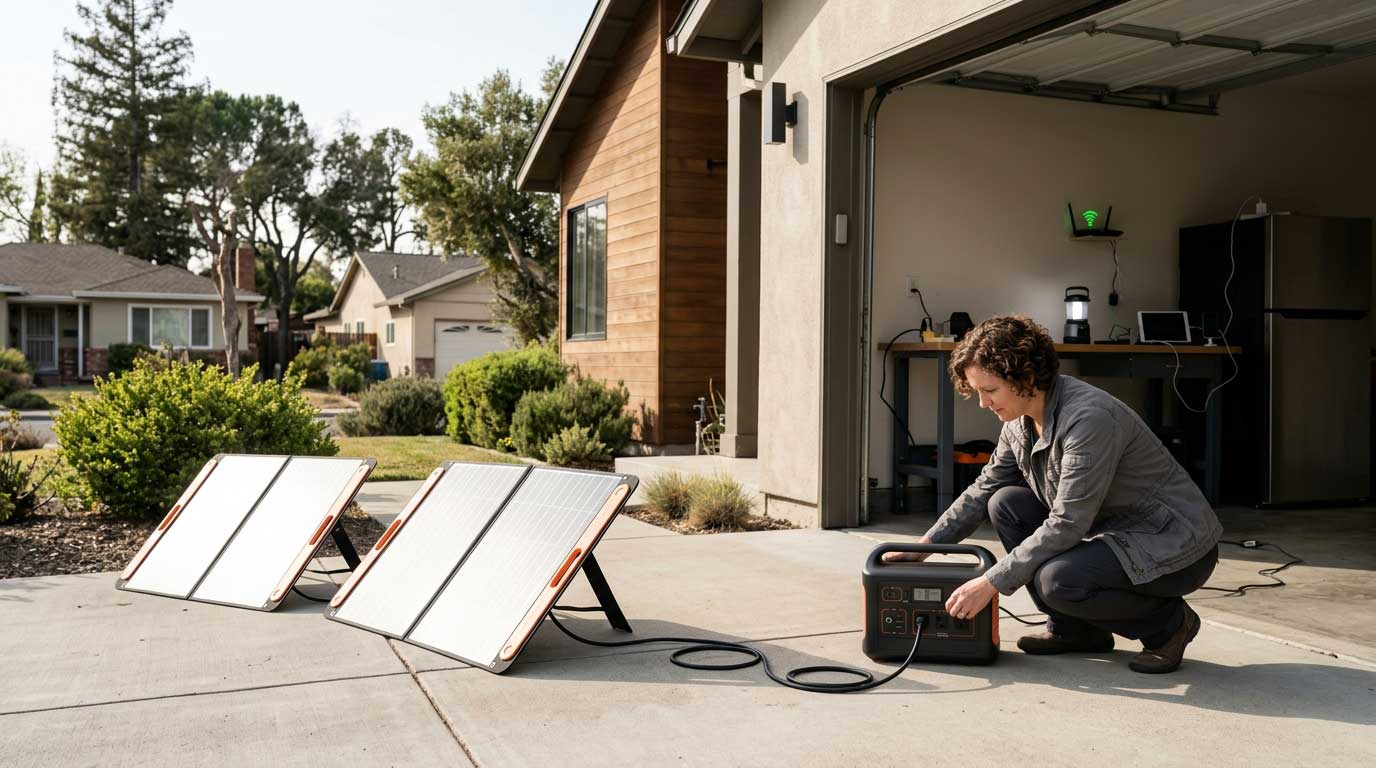
Why Portable Solar Panels Alone Are Not Enough
A solar panel produces energy when sunlight is available. It does not automatically provide electricity after sunset.
That is where storage changes the operating pattern.
During the day, the system can charge the battery while also supporting active loads. In the evening, stored energy can operate appliances after solar production has fallen.
DOE describes this as one of the fundamental benefits of solar-plus-storage: stored energy can be discharged when solar generation is no longer available.
For portable applications, this is especially useful.
A camper might have strong sunlight at 1 p.m. but need lighting, refrigeration, internet access, and laptop power at 8 p.m. Without a battery, the afternoon solar energy cannot simply be saved for later.
With storage, it can.
Bright Solar Portable Panel Considerations
For a portable battery system, panel selection should be based on more than nominal wattage.
Bright Solar’s flexible and semi-flexible solar products can be considered where low weight, unusual mounting surfaces, or transport convenience matter. In practical system design, the key is matching the panel’s electrical characteristics with the receiving battery or power station.
For example, a panel specification should be checked against:
- the battery’s MPPT voltage range;
- maximum PV input current;
- maximum PV input power;
- expected cable length;
- connector requirements;
- operating environment;
- required portability.
A flexible panel can also be useful when a rigid framed panel is inconvenient to transport or store. For RVs, boats, vans, and temporary outdoor installations, the physical form factor can become a design constraint just as important as wattage.
The right panel is the one that fits the electrical system and the physical job.
Real-World Design Example: A 600W Portable RV System
Consider a medium-size travel trailer used for several days of dry camping.
The owner has a 2,000Wh lithium battery and wants to operate a refrigerator, LED lights, laptops, phones, a Wi-Fi hotspot, and a small appliance.
A 600W portable solar array could provide substantially more daytime charging capability than a 100W panel, assuming the battery system accepts that input.
On a theoretical four-hour equivalent-sun day:
600W × 4 hours = 2,400Wh
That is the theoretical panel-side energy before real-world losses.
If clouds, panel temperature, imperfect orientation, wiring, and conversion losses reduce the actual energy delivered, the usable daily charge may be significantly below 2,400Wh.
That distinction is exactly why field monitoring matters.
After a week, the owner might discover:
- average daily solar input: 1.4–1.8kWh;
- daily consumption: 1.1–1.5kWh;
- battery usually returns to a high state of charge before evening;
- one shaded campsite produces noticeably less solar energy.
That information is more useful for future system sizing than simply saying “600W solar.”
Common Mistakes When Buying Portable Solar Panels with Battery Storage
Buying the biggest battery without enough solar
A large battery is attractive because the capacity number looks impressive.
But if the solar array cannot replenish the energy used each day, the battery becomes increasingly dependent on AC charging.
Comparing watts and watt-hours as if they were the same
Watts describe power.
Watt-hours describe energy.
A 500W solar array and a 2,000Wh battery answer completely different questions.
Ignoring inverter surge requirements
Motors and compressors can require high startup power.
Always check both continuous and surge ratings.
Using the panel’s rated output as a daily guarantee
Solar ratings are not promises of daily energy production. Weather, temperature, shading, orientation, and system losses all matter. DOE specifically identifies clouds, dirt, shadows, weather, and seasonal variation as factors affecting solar production.
Forgetting the battery’s solar-input limit
More panels are not automatically better.
The receiving equipment has a maximum solar input. Exceeding its specified voltage or current range is not a valid way to increase charging speed.
FAQs About Portable Solar Panels with Battery Storage
Are portable solar panels with battery storage worth it?
Yes, they are particularly useful for RVs, camping, emergency backup, field work, and other applications where grid power is unavailable or permanent solar installation is impractical. Their main advantage is that solar energy generated during the day can be stored for later use.
How many solar panels do I need for a portable battery?
It depends on the battery capacity, daily energy consumption, available sunlight, and the battery’s maximum solar-input rating. A 1,000Wh battery used lightly may work with 200W of solar, while heavier daily loads may justify 400W, 600W, or more.
Can portable solar panels charge a 1,000Wh battery?
Yes. A compatible solar panel system can charge a 1,000Wh battery, provided its voltage, current, connector, and power output are within the battery system’s solar-input specifications. Actual charging time depends on solar conditions and conversion losses.
Can portable solar panels run an RV refrigerator?
Yes, when the solar panels and battery are correctly sized. Refrigerators cycle rather than drawing their rated power continuously, so daily energy consumption is more useful for sizing than simply multiplying the refrigerator’s maximum wattage by 24 hours.
Can I connect flexible solar panels to a portable power station?
Potentially, yes. The Flexible Solar Panel‘s voltage, current, open-circuit voltage, connectors, and maximum power must match the power station’s permitted PV input. Compatibility should be verified before connection rather than assumed from wattage alone.
How long will a portable solar battery last?
Runtime depends on battery capacity and load. As a simplified example, a 1,000Wh battery supplying a 100W continuous load could theoretically provide about 10 hours before losses and battery-management limits. Actual AC runtime will be shorter because the inverter consumes energy.
Can portable solar battery storage replace a gas generator?
For some loads, yes. Portable solar storage is well suited to quiet backup power, electronics, refrigeration, lighting, and communication equipment. It is not automatically a substitute for a fuel generator when very high continuous power or long-duration heavy loads are required.
Conclusion
Portable solar panels with battery storage are best understood as a complete energy system rather than a panel-and-battery shopping list. The panel determines how quickly energy can be harvested, the battery determines how much can be saved, and the inverter determines which AC loads can use it.
For RVs, camping, emergency backup, boats, and mobile work, the most reliable approach is to calculate real daily consumption first, select adequate battery storage, then size the portable solar array around actual sunlight and the battery’s charging limits.
For buyers and system integrators, the practical specification check is straightforward: panel voltage, panel current, solar-input limit, battery capacity, inverter output, and real operating conditions must work together.
That is the difference between a portable solar setup that looks good on a specification sheet and one that keeps producing useful energy when the campsite is shaded, the weather changes, or the grid goes down.
Portable solar panels with battery storage give users that flexibility without requiring a permanent solar installation, making them a practical option for mobile and off-grid energy applications.
Related recommendations
-

800w flexible solar panel (Ultra High Power Off-Grid Energy System Guide from Bright Solar)
177800w flexible solar panel explained with real off grid field data, RV and marine case studies, installation insights, and system design performance analysis.
View details -
Lightweight Portable Solar Panels: How to Choose the Right One
43Lightweight portable solar panels provide mobile electricity for camping, RV travel, outdoor work, and off-grid use. Choose by total carrying weight, rated p...
View details -
300 w solar panels: Output, Sizing and Installation Guide
279300W solar panels provide 300W of rated DC power under STC, while actual daily energy depends on sunlight, temperature, shading, orientation, system losses, ...
View details -
Flexible RV Solar Panels: Complete Guide to Choosing, Installing, and Using Solar Power for RVs
236Discover flexible RV solar panels for campers and motorhomes. Learn benefits, installation, sizing, and how to choose reliable solar solutions for off-grid travel.
View details