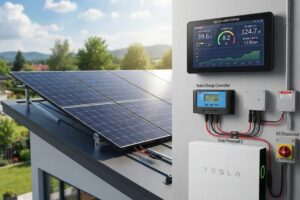
Solar Panel Wiring Series vs Parallel: Which Is Better?
Solar panel wiring series vs parallel depends on the system voltage, controller limits, cable distance, and shading. Series wiring increases voltage; parallel wiring increases current. The right choice is the configuration that keeps PV voltage and current inside the equipment’s operating limits.
That is the short answer.
The longer answer is where most installations become interesting.
A solar array is not designed by looking at the wattage printed on the panel and joining cables until the number looks right. I have seen perfectly reasonable-looking 800W arrays create problems because the installer checked watts but never checked cold-weather Voc. I have also seen RV systems wired entirely in parallel where a higher-voltage string would have reduced the PV cable current substantially.
The U.S. Department of Energy describes the fundamental relationship clearly: series connections increase the voltage of a PV string, while parallel connections increase the current delivered by the array.
For Bright Solar applications, especially RV, marine, flexible-panel and off-grid systems, I normally start with the charge controller and installation conditions, then work backward toward the panel wiring.
Solar Panels in Series vs Parallel: The Basic Difference
The easiest way to understand the difference is to forget the wattage for a moment.
Look at voltage and current.
Suppose one 200W panel has:
- Vmp: 20V
- Voc: 24V
- Imp: 10A
- Isc: 10.5A
Connect two panels in series:
20V + 20V = 40V
Current stays approximately:
10A
So the operating power is approximately:
40V × 10A = 400W
Now connect the same two panels in parallel:
Voltage stays approximately:
20V
Current becomes:
10A + 10A = 20A
Again:
20V × 20A = 400W
The theoretical power is similar. The electrical characteristics are not.
NREL‘s photovoltaic array model treats the array as modules connected in series and strings connected in parallel, with the resulting array voltage and current determined by those configurations.
Series Wiring: Higher Voltage
In series, the positive terminal of one panel connects to the negative terminal of the next.
For two identical panels:
Varray = V1 + V2
Iarray ≈ Ipanel
For four identical panels:
Varray ≈ 4 × Vpanel
Iarray ≈ Ipanel
This is useful when the charge controller needs a higher PV input voltage or when you want to reduce current through a long PV cable.
Parallel Wiring: Higher Current
In parallel, positive terminals are joined together and negative terminals are joined together.
For two identical panels:
Varray ≈ Vpanel
Iarray = I1 + I2
Four identical panels would produce approximately four times the panel current while retaining roughly the same operating voltage.
The trade-off is physical.
Higher current requires appropriately sized conductors, connectors, protection devices and controller input capacity.
Solar Panel Wiring Series vs Parallel: Side-by-Side Comparison
| Feature | Series Wiring | Parallel Wiring |
|---|---|---|
| Voltage | Increases | Stays approximately the same |
| Current | Stays approximately the same | Increases |
| PV cable current | Lower | Higher |
| Cable size pressure | Usually lower | Usually higher |
| Effect of partial shading | Can affect string output | Can offer more independent string behavior |
| Long cable runs | Often advantageous | Requires closer attention to voltage drop |
| Controller voltage | Must not exceed maximum | Usually easier to keep low |
| Controller current | Lower | Higher |
| Common application | Higher-voltage MPPT systems | Low-voltage/smaller systems |
| Series-parallel option | Combines both benefits | Combines both benefits |
The U.S. Department of Energy’s federal solar guide describes the same practical design approach: installers establish the allowable DC voltage, build series strings close to but below that limit, then connect strings in parallel for larger arrays.
How Solar Panel Series Wiring Works
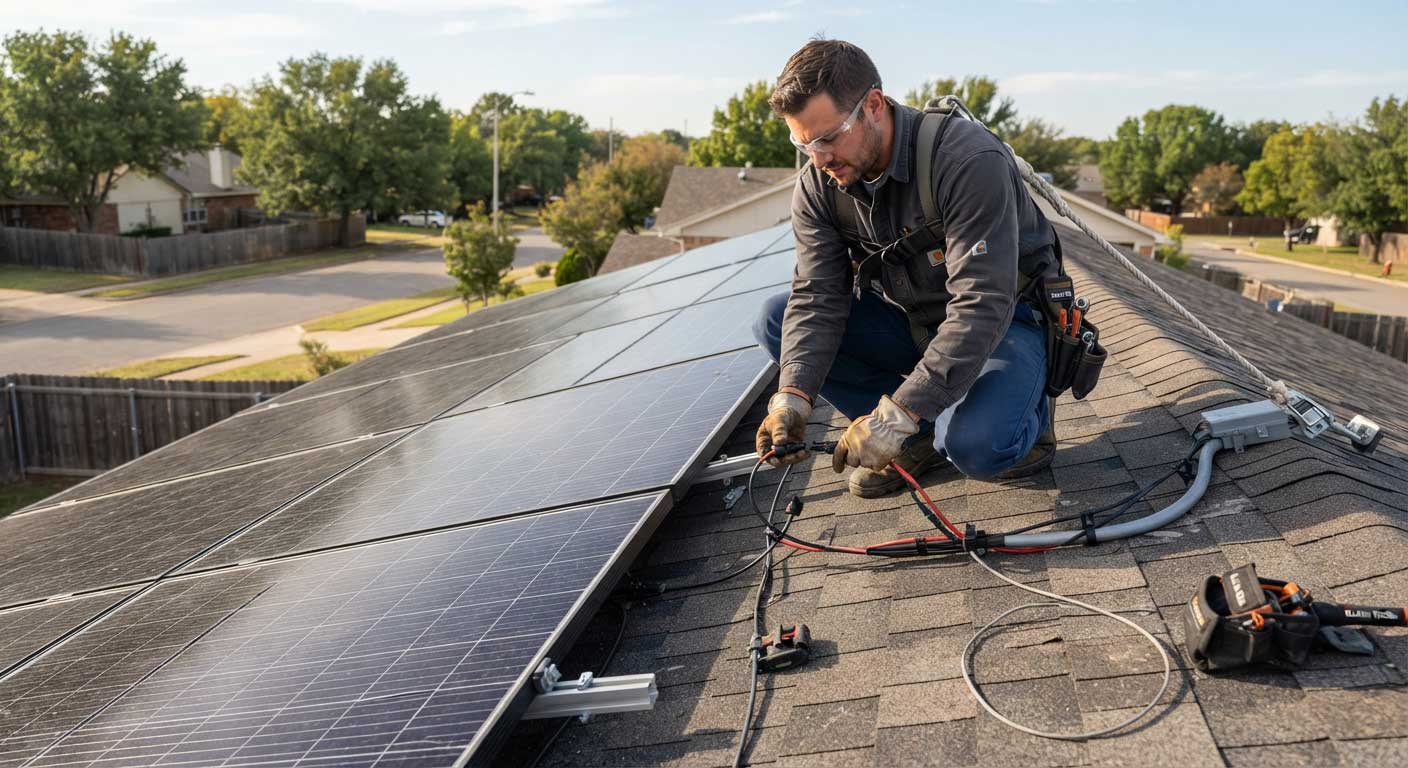
Series wiring is often the cleaner solution when a system needs more PV voltage.
Imagine four 200W panels rated around 20V Vmp and 10A Imp.
A four-panel series string would theoretically operate around:
80V × 10A = 800W
The current remains around 10A.
That matters because cable loss is strongly influenced by current.
For a resistive conductor:
P_loss = I²R
So if current is cut in half, resistive loss drops to one-quarter for the same cable resistance.
For example, compare an 800W array operating at:
40V → 20A
with the same 800W operating around:
80V → 10A
The second arrangement has half the current.
That does not mean the higher-voltage system automatically produces more solar energy. It means the electrical distribution can be more efficient when the rest of the system is designed for that voltage.
This is one reason series wiring becomes attractive on longer cable runs.
The Catch: Voc
This is the number I would check before connecting anything.
Panel Voc is normally specified under standard test conditions, not under the coldest morning your installation will experience.
As temperature falls, PV open-circuit voltage rises. The Department of Energy also notes that temperature has a strong effect on PV voltage, with higher temperatures causing a much larger reduction in voltage than the corresponding current increase.
Victron specifically instructs installers to account for both Voc and the temperature coefficient when calculating how many panels can be placed in series. Its documentation notes that Voc becomes higher at ambient temperatures below 25°C.
So:
Do not calculate maximum series panels from Vmp alone.
Use the manufacturer’s Voc and temperature coefficient.
How Solar Panel Parallel Wiring Works
Parallel wiring keeps voltage roughly constant and adds current.
Using the same 200W panel:
- Vmp = 20V
- Imp = 10A
Two in parallel:
- Vmp ≈ 20V
- Imp ≈ 20A
- Power ≈ 400W
Four in parallel:
- Vmp ≈ 20V
- Imp ≈ 40A
- Power ≈ 800W
That can be useful for smaller systems where the controller is designed around a lower PV voltage.
But there is a price.
A 40A PV array is not the same wiring problem as a 10A array.
You need to consider:
- PV conductor ampacity
- voltage drop
- connector ratings
- combiner equipment
- fusing
- controller maximum PV current
- disconnect requirements
For example, some Victron MPPT models specify a 30A maximum current per MC4 connection. That is a real equipment limit, not an abstract design suggestion.
Series vs Parallel Solar Panels for RV Systems
RV solar is where the answer is rarely “always series.”
An RV roof is full of obstacles:
- air conditioners
- vents
- skylights
- satellite equipment
- roof racks
- curved surfaces
- antennas
The physical layout can matter more than the panel count.
Consider four 200W panels on an RV.
A 4S configuration might produce roughly:
80V Vmp / 10A Imp
A 4P configuration might produce:
20V Vmp / 40A Imp
A 2S2P arrangement might produce:
40V Vmp / 20A Imp
All three theoretically represent approximately 800W at the module level.
But the controller sees three very different electrical inputs.
For an RV with a relatively long roof-to-controller cable, the 2S2P arrangement can be an attractive middle ground if the MPPT voltage window supports it.
For an RV parked beneath trees, however, shading patterns may change the decision.
The U.S. Department of Energy has documented how conventional series-string arrangements can make the array dependent on its weaker modules under shading or damage, while alternative parallel architectures can give modules more independent operation.
That does not mean parallel wiring eliminates shading losses.
It means shading should be evaluated before choosing the topology.
When Series Wiring Is Usually the Better Choice
I would normally investigate series wiring first when:
- the MPPT controller supports a higher PV voltage;
- the PV cable run is relatively long;
- reducing cable current is useful;
- the array has limited available roof space;
- the system is designed around 24V or 48V batteries;
- shading is relatively uniform across the string;
- the series-string Voc remains safely below the controller limit.
A higher PV voltage can also help an MPPT controller start and track effectively.
For example, Victron specifies that certain MPPT controllers require PV voltage to exceed battery voltage by a defined amount for startup, with the exact limits depending on the controller model.
That is why “my panel is rated 12V” is not enough information to select a wiring configuration.
When Parallel Wiring Is Usually the Better Choice
Parallel wiring can make sense when:
- the controller accepts the resulting current;
- PV voltage must remain relatively low;
- panels have different shading exposure and the system architecture supports independent operation;
- cable distances are short;
- the panel voltage is already appropriate for the controller;
- the system designer needs additional array current.
It can also be useful where the controller has a relatively low maximum PV voltage.
But the current can become surprisingly large.
Four panels at 10A each create approximately 40A of array current.
Eight panels create approximately 80A.
At that point, combiner design, overcurrent protection and conductor sizing stop being minor details.
Solar Panel Series Parallel Wiring: The Middle Ground
Series-parallel wiring is often the practical compromise.
Take four 200W panels:
Panel Vmp = 20V
Panel Imp = 10A
Wire two panels in series:
40V / 10A
Build a second identical string:
40V / 10A
Then connect those two strings in parallel:
40V / 20A
Total:
800W
This is called 2S2P.
NREL’s PV performance modeling explicitly treats arrays in terms of series modules and parallel strings, which is the engineering basis behind configurations such as 2S2P.
Victron’s MPPT documentation also provides examples of series, parallel and series-parallel PV configurations and emphasizes staying within the controller’s maximum PV voltage.
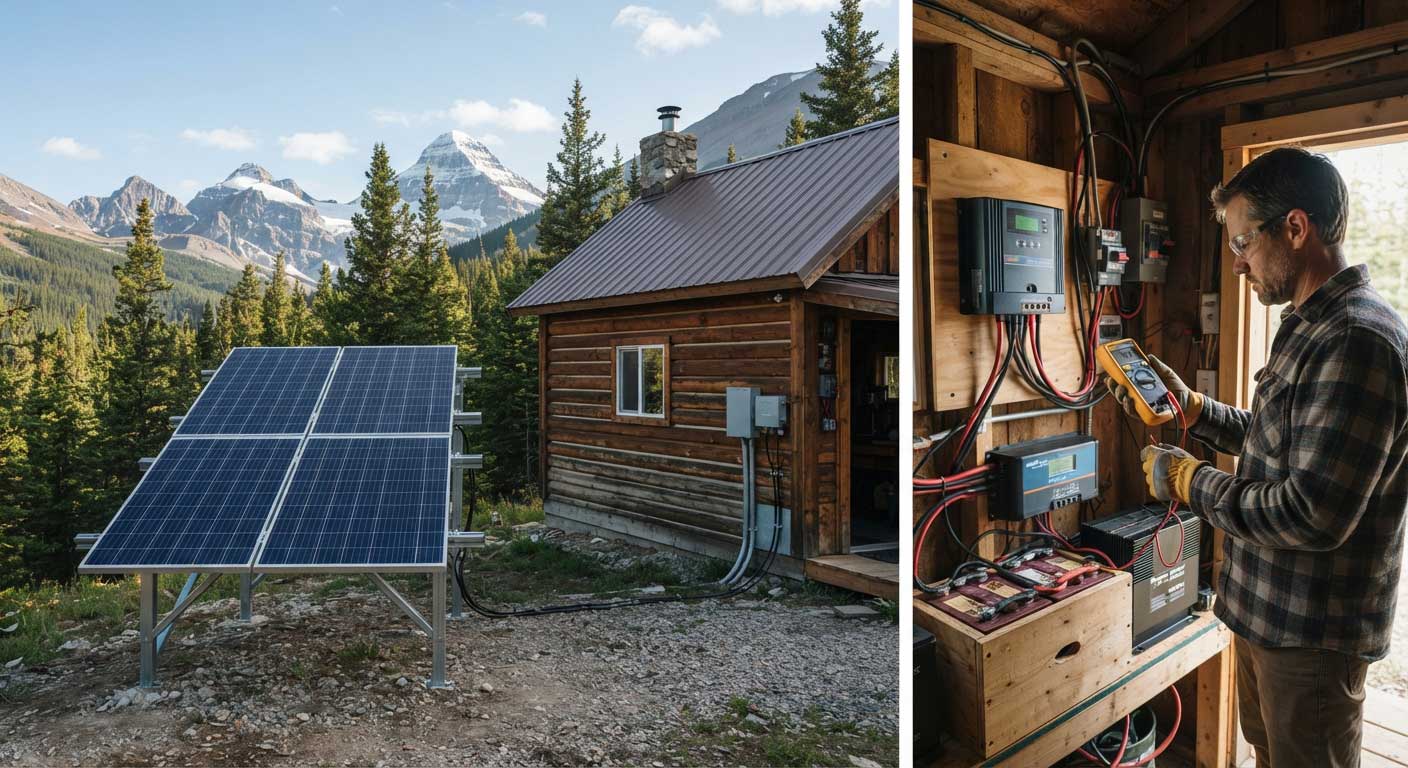
How to Choose Series or Parallel Wiring Step by Step
Step 1: Read the Panel Datasheet
Record:
- Voc
- Vmp
- Isc
- Imp
- voltage temperature coefficient
- power rating
Do not use the marketing description alone.
Step 2: Check the MPPT or Inverter
Find:
- maximum PV voltage
- MPPT operating range
- maximum PV current
- maximum PV power
- minimum startup voltage
Victron’s current MPPT documentation, for example, specifies maximum PV voltage values of 150V or 250V for different controller models and warns that PV voltage must remain within the product’s limits.
Step 3: Calculate Series Voc
If one panel has:
Voc = 24V
and you use four panels in series:
24V × 4 = 96V
That is only the starting point.
Now apply the temperature coefficient for the expected cold condition.
The corrected value must remain below the controller’s maximum PV voltage.
Step 4: Calculate Parallel Current
If one panel has:
Isc = 10.5A
and four strings are paralleled:
10.5A × 4 = 42A
Check whether the controller, connectors, fuses and conductors can accommodate that configuration.
Step 5: Look at the Roof, Not Just the Spreadsheet
This is the step that gets skipped most often.
Walk around the roof.
At 9 a.m., where does the shadow from the vent fall?
At 2 p.m.?
What happens in winter?
A technically perfect series arrangement can perform poorly if one string spends half the day behind a roof obstruction.
NREL provides tools and datasets specifically for modeling PV performance, including irradiance, module temperature and soiling conditions.
A Realistic 800W Wiring Comparison
Consider a small off-grid system using four identical 200W panels.
| Configuration | Vmp | Imp | Rated Power |
|---|---|---|---|
| 1 panel | 20V | 10A | 200W |
| 4S | 80V | 10A | 800W |
| 4P | 20V | 40A | 800W |
| 2S2P | 40V | 20A | 800W |
The first thing I would notice is not the power.
It is the current.
A 4P array sends approximately 40A through the PV wiring under the assumed operating conditions.
The 4S array sends approximately 10A.
For the same 800W theoretical output, the current difference is fourfold.
That changes conductor selection and voltage-drop behavior.
But the 4S option also has the highest string voltage, so its cold-weather Voc must be checked carefully.
The 2S2P option sits between them.
That is often why it ends up being a practical choice rather than an arbitrary compromise.
Common Solar Panel Wiring Mistakes
Using Wattage Instead of Electrical Parameters
Two 200W panels do not tell you enough.
You still need their voltage and current specifications.
Ignoring Cold Temperature
This is one of the most serious series-wiring mistakes.
Victron explicitly warns that Voc increases below 25°C and requires temperature coefficient information when determining the maximum number of panels in series.
Putting Unequal Strings in Parallel
If one string contains two panels and another contains three, their operating voltages are different.
Do not treat:
2S + 3S
as if it were:
2S + 2S
For a normal single-MPPT design, parallel strings should have compatible voltage characteristics.
Assuming More Current Is Always Better
A controller may have a current limit.
Connectors may have a current limit.
Cable has a current-carrying capacity.
A larger number is not automatically an improvement.
Connecting MC4 Cables Without Checking Polarity
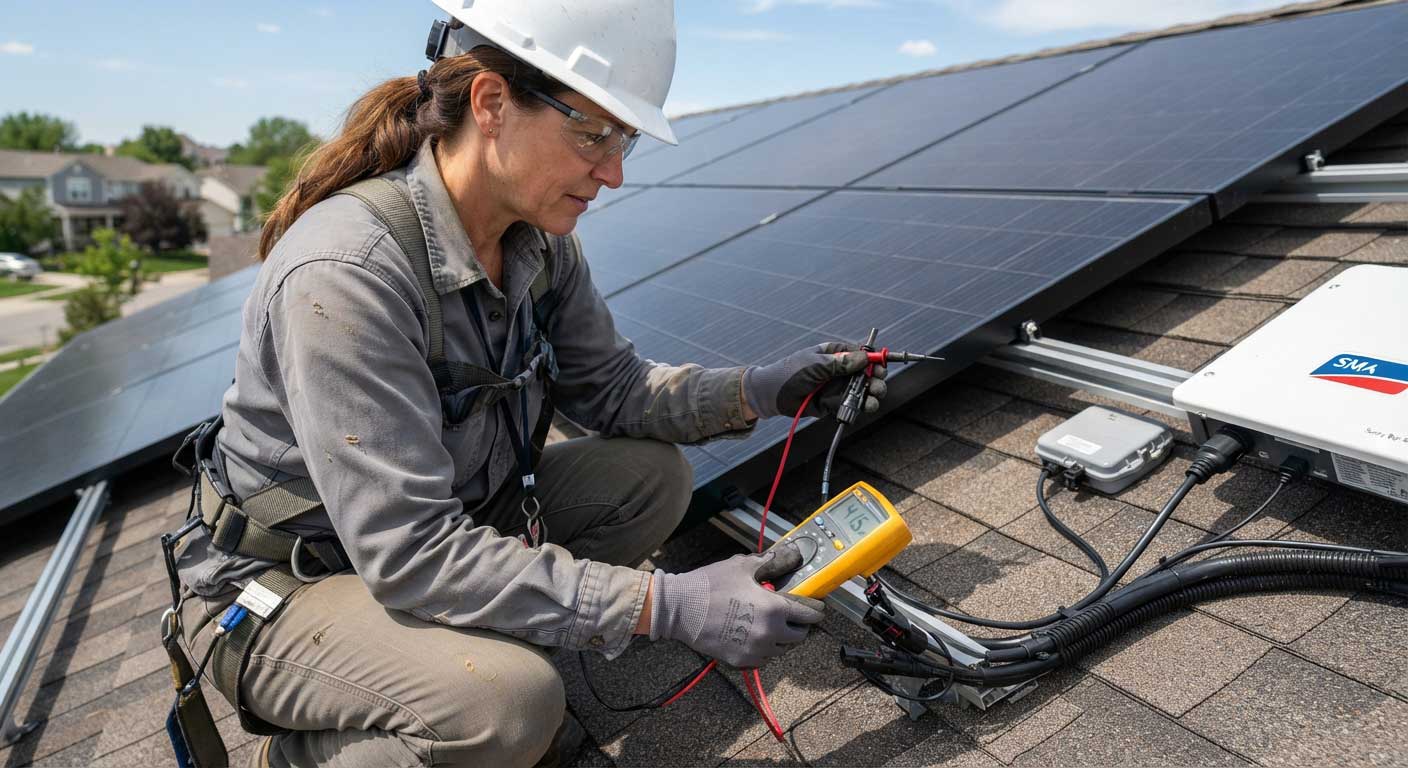
Before the final connection, verify polarity and open-circuit voltage with appropriate test equipment and procedures.
Victron’s installation guidance explicitly calls for confirming correct PV polarity before connecting the solar array.
How Shading Changes the Series vs Parallel Decision
Shading is not simply an argument for parallel wiring.
It is an argument for better system design.
Suppose four panels are mounted on an RV roof and one panel sits directly beside a tall air-conditioning unit.
If the air conditioner shades that panel every afternoon, putting all four panels into one series string deserves careful consideration.
The better solution might be:
- separate strings;
- 2S2P;
- multiple MPPT inputs;
- module-level power electronics;
- or a different physical panel arrangement.
The correct answer depends on the equipment.
I would rather move one panel 30 cm during installation than spend years compensating for a poor string layout.
Series vs Parallel for Flexible Solar Panels
Flexible panels introduce another practical consideration: installation temperature.
A flexible module mounted directly to an RV, van or curved roof can experience substantial heating because airflow behind the panel is limited.
The Department of Energy notes that higher temperatures produce a much larger decrease in PV voltage than the associated current increase.
That matters for MPPT operating voltage.
A configuration that looks excellent on a datasheet may behave differently on a hot RV roof.
For Bright Solar flexible-panel applications, I would therefore check:
- panel Vmp at operating temperature;
- controller MPPT range;
- cable length;
- roof shading;
- ventilation;
- panel placement;
- expected cold-weather Voc.
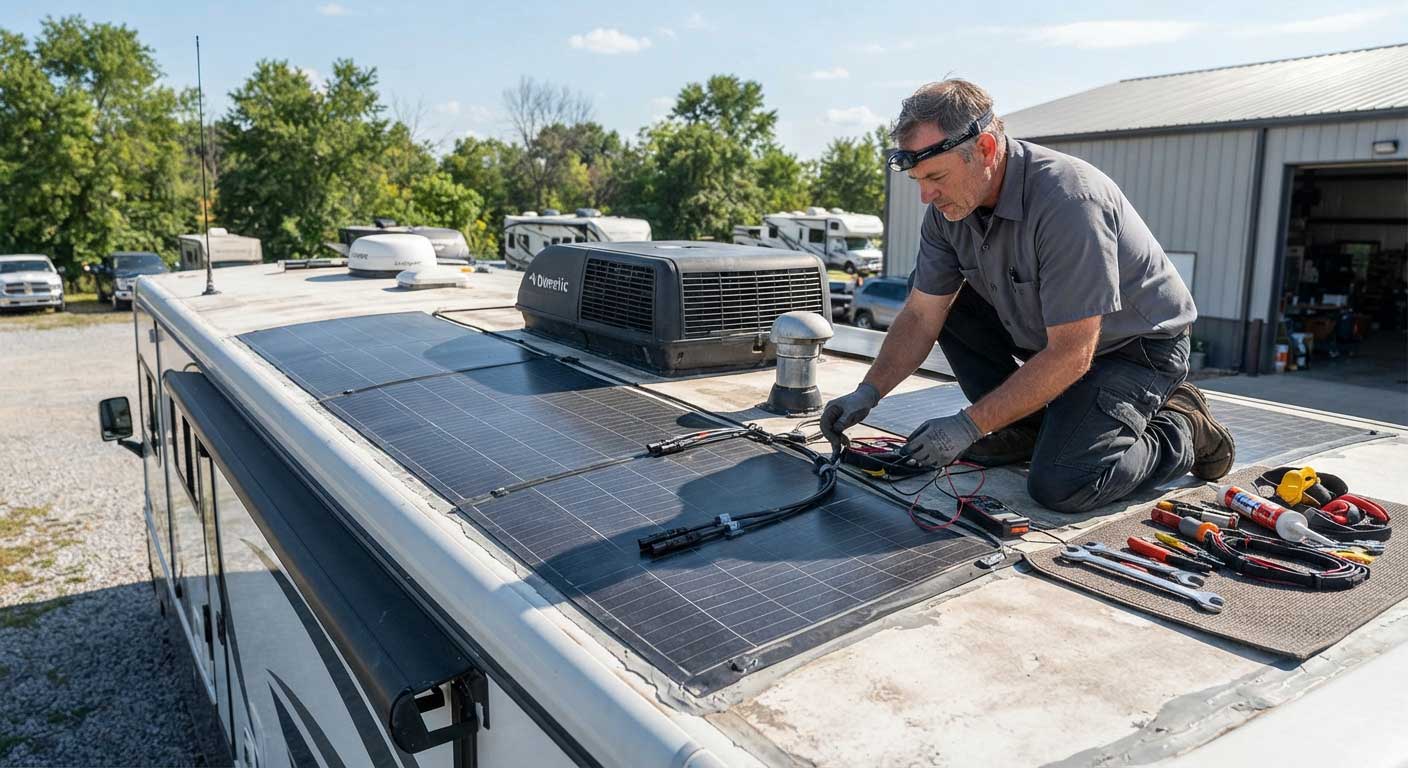
Series vs Parallel: Which Is Better for MPPT Controllers?
An MPPT controller generally benefits from receiving PV voltage that sits comfortably within its specified operating window.
But there are two separate limits:
Maximum PV voltage
and
maximum PV current/power.
Do not confuse them.
A controller can have a high current rating but a relatively low PV voltage limit.
Another controller may accept a much higher PV voltage while handling a different current range.
For example, Victron’s published MPPT specifications show different maximum PV voltage ranges across models, from 75V and 100V units to 150V and 250V units.
This is why the panel count should never be selected independently of the controller.
Quick Decision Guide
Choose series when:
- you need higher PV voltage;
- cable runs are longer;
- the controller accepts the resulting Voc;
- current reduction is useful.
Choose parallel when:
- the controller needs lower PV voltage;
- higher current is acceptable;
- cable runs are short;
- the array layout benefits from separate current paths.
Choose series-parallel when:
- you need both higher voltage and higher current;
- the controller supports the configuration;
- identical strings can be created;
- the physical installation suits multiple strings.
There is no magic topology.
The panel datasheet, controller specification and roof conditions decide it.
Solar Panel Wiring Series vs Parallel FAQ
Is it better to wire solar panels in series or parallel?
Neither is always better. Series wiring increases voltage and parallel wiring increases current. The better configuration depends on the MPPT or inverter limits, cable length, battery voltage and shading conditions.
Do solar panels produce more power in series or parallel?
With identical panels under comparable conditions, the theoretical rated power can be essentially the same. The wiring changes the voltage-current combination rather than magically increasing the panel’s rated wattage.
Is series or parallel better for an RV?
It depends on the RV roof and charge controller. Series or 2S2P can be attractive for longer cable runs, while parallel can be useful when lower PV voltage is required. Roof shading should be evaluated before choosing.
Can I connect four solar panels in series?
Yes, if the resulting cold-weather Voc remains below the controller or inverter’s maximum PV voltage and the operating voltage remains inside its MPPT range.
Can I mix solar panels in series and parallel?
Different panels can sometimes be combined, but matching electrical characteristics is strongly preferred. Unequal voltage or current characteristics can reduce array performance and complicate MPPT operation.
Does parallel wiring work better with shaded solar panels?
It can provide more independent current paths, but it does not eliminate shading losses. The best solution depends on bypass diodes, MPPT architecture, panel layout and the location and duration of the shade.
What is 2S2P solar panel wiring?
2S2P means two panels are connected in series to form one string, a second two-panel string is built the same way, and the two strings are then connected in parallel. It increases both array voltage and current.
Bright Solar’s Practical Approach to Solar Panel Wiring
At Bright Solar, I would not start a wiring recommendation with “series is better” or “parallel is better.”
I start with four numbers:
Voc. Vmp. Isc. Imp.
Then I look at the controller.
Then the roof.
Then the cable distance.
Only after those checks do I choose the wiring configuration.
That order matters.
A 4S array can be electrically elegant but unsafe if its cold-weather Voc exceeds the controller rating. A 4P array can keep voltage comfortably low but create unnecessary current through the PV conductors. A 2S2P configuration can land in the useful middle when the equipment and physical layout support it.
For flexible RV and off-grid systems, installation conditions can be particularly important because panel temperature, roof obstructions and cable routing are rarely identical from one project to the next.
NREL maintains PV modeling and field-performance tools specifically because real photovoltaic performance depends on more than the nominal module wattage printed on a datasheet.
Final Answer: Solar Panel Wiring Series vs Parallel
solar panel wiring series vs parallel is ultimately a voltage-and-current decision, not a wattage decision.
Series wiring raises PV voltage and keeps current approximately unchanged. Parallel wiring keeps voltage approximately unchanged and adds current. Series-parallel combines both approaches.
The safest and most useful configuration is the one that fits the actual panel specifications, cold-weather Voc, MPPT operating range, maximum PV voltage, current capacity, cable distance and shading pattern.
For a real installation, calculate first.
Connect second.
Related recommendations
-

Are Solar Panels Flexible? Types, Bending Limits, and Uses
192Some solar panels are flexible, but conventional glass panels are rigid. Flexible panels allow controlled bending for curved, lightweight, and mobile install...
View details -
Solar Panel Voltage vs Current Explained: Understanding Volts, Amps, and Power
302Understand solar panel voltage vs current explained with clear examples of volts, amps, watts, series and parallel wiring to design efficient solar systems.
View details -
Best flexible solar panels for boats: Lightweight Marine Solar Solutions
232Find the best flexible solar panels for boats with Bright Solar. Learn marine installation tips, durability factors, power output, and real-world sailing applications.
View details -
Solar Power Flexible Panels for Modern Off-Grid Energy
197Solar power flexible panels deliver lightweight off-grid electricity for RVs, boats, campers, and rooftops. Discover durable ETFE solar solutions from Bright Solar.
View details