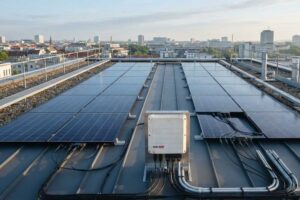
Biggest Flexible Solar Panel: Size, Power, and Applications
The biggest flexible solar panel is not simply the panel with the largest physical dimensions. The practical choice depends on usable surface area, module weight, bending radius, electrical output, transport requirements, and how securely the panel can be installed. For large RVs, boats, vehicles, curved roofs, and custom off-grid systems, panel size must be matched to the structure.
What Is the Biggest Flexible Solar Panel?
There is no single universal dimension that can honestly be called the biggest flexible solar panel.
Flexible PV modules are produced in different formats, and manufacturers can design large-area modules around specific cell layouts, substrates, encapsulation methods, and installation requirements. A large flexible panel may therefore be substantially longer or wider than a portable consumer panel without belonging to a single standardized “largest size” category.
That distinction matters for B2B buyers.
A customer looking for a large panel may actually mean one of several things:
- The largest single module by physical area
- The highest wattage flexible module
- The largest lightweight module
- The longest custom flexible panel
- The widest panel for a roof
- The largest flexible panel that can follow a curved surface
- The largest module that can be transported and installed efficiently
These are not the same engineering problem.
NREL research on vehicle-integrated PV makes the point particularly well: vehicle PV needs flexibility to follow aerodynamic contours, while specific power must be high enough to provide meaningful energy relative to the available surface area and vehicle weight.
For this reason, Bright Solar evaluates large flexible panel projects according to the available installation surface rather than treating physical size alone as the deciding specification.
Why Are Large Flexible Solar Panels Different?
Scaling a flexible solar module is not equivalent to simply making a small panel larger.
As module dimensions increase, mechanical handling becomes more important. A large sheet can be easier to bend across a broad roof curve, but it can also be more difficult to align, transport, support, laminate, and install without creating unwanted stress.
The electrical layout changes too.
More cells may be connected within one module, requiring careful attention to:
- Cell string configuration
- Bypass diode arrangement
- Module voltage
- Operating current
- Cable location
- Junction-box placement
- Shading behavior
- Thermal conditions
- Structural support
This is one reason large-area flexible PV deserves a project-specific approach.
NREL has documented flexible, lightweight CIGS module development for applications including transportation and building-integrated PV, demonstrating that flexible module manufacturing can use large-area substrates and specialized module construction rather than simply adapting a conventional framed panel.
Biggest Flexible Solar Panel: Size vs. Wattage
When customers first ask for the biggest flexible solar panel, wattage is often the first number mentioned.
It should not be the only one.
Consider two hypothetical modules:
| Specification | Panel A | Panel B |
|---|---|---|
| Rated power | 400 W | 500 W |
| Length | 2.0 m | 2.4 m |
| Width | 1.0 m | 1.1 m |
| Approx. area | 2.0 m² | 2.64 m² |
| Weight | Lower | Higher |
| Installation | Smaller curved roof | Larger roof |
| Main advantage | Easier handling | More power per module |
Panel B is physically larger and produces more rated power, but it is not automatically the better product.
If the installation surface is 2.1 m long, the 2.4 m panel cannot be installed simply because its wattage is higher.
This sounds basic, yet large-panel procurement often goes wrong at exactly this point. The product specification is evaluated before the mounting surface is properly measured.
How Large Can a Flexible Solar Panel Be?
The practical maximum depends on the technology and manufacturing process.
Rigid glass modules are constrained by glass dimensions, frame construction, transportation, lifting requirements, and structural loading. Flexible modules can use lighter substrates and laminates, which opens different design possibilities.
However, flexibility does not remove mechanical limitations.
A very large flexible panel still has to survive:
- Factory handling
- Packaging
- Shipping
- Unloading
- Positioning on the roof
- Installation
- Thermal expansion
- Wind exposure
- Repeated vibration on mobile platforms
- Long-term outdoor operation
IEC 61215-1:2021 specifically added test methods required for flexible modules, including the MQT 22 bending test. The standard also includes provisions for applying IEC 61215 design qualification and type approval to bifacial PV modules.
IEC 61215-2:2021 similarly added test methods for flexible modules and includes MQT 22 bending testing.
The implication for a large module is straightforward: flexibility should be demonstrated through appropriate testing and documented installation limits, not inferred from the panel’s appearance.
Large Flexible Solar Panel for RVs
A large RV provides one of the clearest reasons to consider a large flexible module.
The roof can have considerable usable area, but it is interrupted by air-conditioning units, vents, skylights, antennas, roof rails, and other equipment.
A single large module can sometimes simplify the visual layout and reduce the number of separate panel-to-panel connections.
But there is a tradeoff.
A single large panel may be more difficult to handle on a windy roof. If the RV is being assembled on a production line, however, a repeatable large-format installation may be attractive because technicians can position one module rather than several smaller units.
For an OEM project, this changes the question from:
“What is the biggest panel you sell?”
to:
“What module dimensions give the highest usable power within our actual roof geometry?”
That is a much more useful specification.

Large Flexible Solar Panels for Boats and Yachts
Marine applications create an interesting size problem.
A yacht may have a relatively large cabin roof, but the available mounting surface is rarely a perfect rectangle. Curved edges, hatches, handrails, radar equipment, masts, antennas, and walking areas interrupt the usable space.
A large flexible module can follow the available surface more closely than a framed Rigid Solar Panels.
That can increase usable coverage.
But there is a point at which one oversized panel becomes inconvenient. If the panel covers a service hatch or extends into a walking path, the nominal wattage becomes irrelevant.
For marine buyers, the ideal large flexible panel is often the largest module that can be installed without compromising access, drainage, equipment clearance, or mechanical security.
Saltwater exposure adds another requirement. The module construction, encapsulation, connector system, cable routing, and mounting materials need to be selected for the environment rather than assumed from the word “flexible.”
How to Measure the Installation Area First
Before selecting the biggest flexible solar panel, measure the surface.
For a curved roof, take measurements at several points rather than relying on one maximum dimension.
Step 1: Map the usable rectangle
Record the maximum length and width.
Then subtract areas occupied by:
- Air-conditioning units
- Vents
- Hatches
- Antennas
- Rails
- Drainage channels
- Service access
- Walking paths
Step 2: Record curvature
If the surface curves, determine whether it is:
- Flat
- Single-axis curved
- Compound curved
- Irregular
A single-axis curve is generally easier to describe and reproduce than a compound curve.
Step 3: Check the bending limit
Do not ask only whether the panel is flexible.
Ask for the manufacturer’s documented bending radius or allowable curvature.
Step 4: Measure height restrictions
A large panel may fit in plan view but interfere with roof equipment or create unacceptable wind exposure if mounted on raised hardware.
Step 5: Record the cable exit position
This detail is frequently ignored until installation.
For a large module, the cable exit location can determine whether the panel works with the existing wiring route.
Biggest Flexible Solar Panel and Weight
Size and weight have to be considered together.
A large rigid module may require several people or lifting equipment during installation. A flexible module can dramatically reduce handling weight, but a large sheet still has physical inertia and can catch wind.
This is particularly relevant on vehicles.
NREL’s assessment of vehicle-integrated PV notes that vehicle applications require flexibility for aerodynamic contours and sufficient specific power relative to surface area and weight.
That gives us a useful B2B metric:
Specific power = rated power ÷ module weight
For example, a hypothetical 500 W module weighing 8 kg has a specific power of:
500 W ÷ 8 kg = 62.5 W/kg
This number does not replace module efficiency or structural analysis, but it provides a better way to compare lightweight mobile solar products than weight alone.
For an RV, van, trailer, boat, or commercial vehicle, every kilogram saved may have value beyond installation convenience.
Large Does Not Mean More Efficient
A large flexible solar panel can provide more total wattage because it contains more active area. That does not mean the underlying cells are automatically more efficient.
The U.S. Department of Energy defines PV conversion efficiency as the fraction of solar energy converted into usable electricity. It also notes that temperature, reflection, and other physical factors affect cell performance.
This creates three separate measurements buyers should keep apart:
| Measurement | What it tells you |
|---|---|
| Module size | How much physical roof area it occupies |
| Rated power | Nominal electrical capacity under defined test conditions |
| Efficiency | How effectively the active area converts incident solar energy |
A larger module can have higher total wattage while having similar efficiency to a smaller module.
For space-limited roofs, efficiency becomes increasingly important because every square meter has value.
Why Bright Solar Treats Large Flexible Panels as a Custom Engineering Question
Bright Solar’s flexible solar panel work is focused on applications where conventional rigid modules are not always practical.
That includes curved surfaces, RVs, boats, outdoor structures, mobile systems, and customized installations.
For a large-format project, the first technical discussion should establish:
- Required rated power
- Maximum available dimensions
- Surface curvature
- Weight target
- Cell technology
- Electrical voltage and current
- Connector location
- Installation method
- Operating environment
- Required quantity
- Packaging and shipping constraints
This is where a manufacturer’s engineering experience becomes more useful than a generic catalog.
A large module has to work after it leaves the factory.
That means the dimensions on the drawing, the cable exit, the bending limit, the mounting surface, and the installation procedure all need to make sense together.
How to Choose the Biggest Flexible Solar Panel for a Real Project
The right large-format module should be selected from the installation backward, not from the highest wattage in a product catalog.
For a B2B project, start with the physical envelope. If a roof provides 2.2 m of usable length but the proposed module is 2.4 m long, the extra power is irrelevant. The same applies to curved surfaces: a panel that technically fits the footprint may still exceed its allowable bending radius.
A practical specification sheet should therefore contain at least these fields:
| Design item | What to confirm |
|---|---|
| Usable length | Clear area after roof equipment is excluded |
| Usable width | Maximum width without interfering with edges |
| Surface curvature | Flat, single-axis, compound, or irregular |
| Rated power | Nominal module output |
| Module efficiency | Useful when roof area is limited |
| Weight | Important for mobile and marine applications |
| Bending radius | Mechanical installation limit |
| Voc | Maximum open-circuit voltage for system design |
| Vmp | Operating voltage |
| Isc | Short-circuit current |
| Imp | Operating current |
| Cable position | Must match the planned wiring route |
| Operating temperature | Relevant to hot roofs and enclosed spaces |
| Environmental protection | Important for outdoor and marine exposure |
A large module that satisfies all of these requirements is more useful than one that wins on a single specification.
When One Large Panel Is Better Than Several Smaller Panels
There are situations where one large flexible solar panel has a clear practical advantage.
A single module can reduce the number of physical panel boundaries across a roof. That may simplify the appearance and, depending on the product and wiring arrangement, reduce the number of module-to-module connections.
For an RV manufacturer producing the same roof configuration repeatedly, this can also improve installation consistency.
A production technician can position one predefined module against known reference points rather than deciding how several smaller panels should be arranged.
There is a catch.
One large panel creates one large handling operation. If the installation is being performed by one person on a windy roof, a large lightweight sheet can be awkward even when its mass is low.
This is why the largest possible panel is not always the best panel.
A useful procurement question is:
What is the largest module that two installers—or the intended production process—can reliably position without damaging the panel or creating alignment problems?
That answer is usually more practical than a theoretical maximum.
When Several Flexible Panels Are Better
Multiple smaller modules can be preferable when the installation surface is heavily interrupted.
For example, consider an RV roof with an air-conditioning unit near the center and several vents toward the front. Two or three panels may be arranged around these obstacles with less unused space.
The same principle applies to boats.
A yacht cabin roof may have a hatch in the middle, leaving two elongated sections on either side. A single large rectangular module might cover the hatch, while two smaller modules can use both sections efficiently.
Multiple modules also provide more flexibility during future maintenance. A damaged module can potentially be isolated or replaced without redesigning the entire array, subject to the system architecture.
The choice should therefore be based on usable area per module, not simply module area.
Custom Size Flexible Solar Panels
Custom dimensions become especially valuable when standard module sizes leave substantial unused roof space.
A custom flexible solar panel can be developed around requirements such as:
- Specific length and width
- Non-standard aspect ratio
- Cable exit position
- Connector requirements
- Target voltage
- Target current
- Target wattage
- Cell arrangement
- Mounting constraints
- Curved installation surfaces
For a manufacturer, customization is not simply cutting a finished panel to size.
The electrical architecture, cell layout, interconnection, encapsulation, lamination, mechanical behavior, and testing all need to remain appropriate for the new format.
This is particularly important for large modules because changing dimensions can affect how the finished product is handled and supported.
A B2B buyer should ask for an engineering drawing before mass production begins. The drawing should identify overall dimensions, active area where relevant, cable exits, connector locations, and any defined installation limitations.
Case Study: Large Flexible Solar Panel for a Commercial RV
Consider a hypothetical fleet operator purchasing solar modules for 100 premium camper vans.
Each vehicle has a roof section approximately 2.1 m long and 1.2 m wide after the air-conditioning unit and roof vent are excluded.
The original concept uses several small portable-style flexible panels.
During installation planning, the team identifies three problems:
- Too many individual cable runs
- Irregular use of the available roof area
- More installation alignment points
A large-format flexible module designed around the usable roof envelope becomes an alternative.
The engineering team compares:
| Requirement | Small-panel arrangement | Large-format module |
|---|---|---|
| Roof coverage | Moderate | High |
| Number of modules | Several | One |
| Cable routing | More complex | Potentially simpler |
| Handling | Easier per piece | More demanding |
| Alignment | Multiple positions | One main position |
| Customization | Limited | Higher |
| Fleet installation consistency | Variable | Easier to standardize |
For a one-off recreational vehicle, the small-panel approach may still be perfectly reasonable.
For 100 vehicles with essentially identical roofs, the calculation changes. A custom module can justify engineering effort because the same installation is repeated many times.
This is one of the strongest business cases for large flexible solar modules: repeatability.
Electrical Design for Large Flexible Solar Panels
Increasing module size can change the electrical characteristics of the panel.
A large module may contain more cells in a series string, increasing operating voltage. Alternatively, the design may use a different internal arrangement to meet a specified voltage and current target.
The system designer must therefore check the complete electrical chain:
PV module → combiner/protection where required → charge controller or inverter → battery/system load
For example, a module with a high Voc may not be appropriate for a low-voltage charge controller simply because its wattage is suitable.
Similarly, increasing current can create larger cable-sizing and protection requirements.
When designing a large flexible solar array, verify:
- Module Voc at the expected lowest cell temperature.
- Vmp within the controller’s usable MPPT range.
- Isc against controller and protection limits.
- Imp against the planned cable and connector system.
- Total string voltage.
- Number of modules per string.
- Parallel-string current.
- Maximum PV input power of the controller or inverter.
The U.S. Department of Energy notes that PV system performance is affected by temperature, irradiance, shading, reflection, and system characteristics, so rated module power should not be treated as a direct prediction of daily energy production.
Large Flexible Solar Panels and Partial Shading
Large modules deserve careful shading analysis.
A roof-mounted panel can be partially shaded by an air-conditioning unit, vent, antenna, mast, roof rack, or even a nearby panel.
The physical effect depends on the cell-string layout and bypass diode configuration.
This is one area where module dimensions and electrical architecture intersect.
Imagine a long rectangular panel installed beside a roof-mounted air conditioner. The shadow moves across the panel during the day. The panel’s electrical response will depend on where that shadow falls relative to the internal cell strings.
Therefore, do not assume that one large panel will always outperform several smaller modules simply because it has a higher nameplate rating.
For complicated roofs, a shading map can be more informative than a product brochure.
Large Flexible Solar Panels and Heat Management
Large surface area can create a substantial thermal footprint.
The U.S. Department of Energy explains that photovoltaic cell voltage decreases as temperature rises, which reduces conversion efficiency under hot conditions.
For a flexible panel installed close to a roof, airflow beneath the module may be restricted.
This is especially relevant for:
- Dark RV roofs
- Metal vehicle roofs
- Yacht cabin roofs
- Industrial curved roofs
- Enclosed structures
- Hot climates with intense solar exposure
Installation design therefore needs to consider both optical exposure and thermal conditions.
If a large panel is raised enough to receive rear-side light in a bifacial configuration, the resulting airflow may also alter its thermal environment. That does not guarantee a specific temperature reduction, but it demonstrates why mounting geometry should be evaluated as a whole rather than one variable at a time.
Installation of a Large Flexible Solar Panel
Large panels require more attention during installation than small modules.
Before final placement:
- Clean and inspect the mounting surface.
- Confirm the panel dimensions against the approved drawing.
- Mark the panel position.
- Confirm cable-exit locations.
- Check the bending radius.
- Keep the panel supported during handling.
- Avoid folding or sharply creasing the module.
- Prevent tools from contacting the active surface.
- Follow the manufacturer’s adhesive or mechanical-mounting instructions.
- Inspect the finished edges and cable routing.
For a large module, two installers may be preferable even when the panel itself is lightweight. The additional person helps maintain alignment and prevents the flexible sheet from dragging across the substrate.
The installation team should also avoid lifting the panel from a single corner.
A large flexible module behaves differently from a rigid framed panel. Its weight is distributed over a broad area, so uncontrolled handling can introduce bending or twisting that is not representative of the final installed condition.
Maintenance of Large Flexible Solar Panels
Maintenance is straightforward when the panel is accessible, but large surface area means dirt and environmental contamination can become more noticeable.
Inspect the panel periodically for:
- Edge lifting
- Surface damage
- Cracks or unusual marks
- Cable deterioration
- Connector contamination
- Water intrusion
- Adhesive failure
- New shading
- Accumulated dirt or salt
For marine systems, salt deposits should be checked regularly.
For RVs, inspect the panel after major roof maintenance. An HVAC replacement, satellite installation, roof coating, or new antenna can introduce shading or alter the mounting surface.
One practical habit is to photograph the panel and cable exits after installation. A dated reference photograph makes later inspections much easier.
What Makes a Large Flexible Panel Suitable for B2B Procurement?
For distributors and system integrators, the product itself is only part of the purchasing decision.
The manufacturer should be able to provide a clear technical package.
Technical Documentation
Look for:
- Electrical datasheet
- Mechanical drawing
- Bending specification
- Installation instructions
- Connector information
- Temperature information
- Product construction details
- Applicable testing documentation
Manufacturing Support
For larger projects, also consider:
- Prototype availability
- Sample approval
- Engineering communication
- Production consistency
- Packaging design
- Quality inspection
- Batch traceability
- Delivery planning
- Custom labeling where applicable
A large flexible solar panel is a physical product with unusual handling requirements. Packaging deserves more attention than it receives in many early-stage quotations.
The panel should arrive flat and protected, with the active surface and cable exits secured against transport damage.
Bright Solar Large Flexible Solar Panel Solutions
Bright Solar develops flexible solar panel solutions for applications where available installation space does not behave like a conventional flat rooftop.
For large-format requirements, the project can be evaluated around the actual roof or deck dimensions rather than forcing the installation into a standard panel format.
This is particularly useful for:
- RV and camper manufacturers
- Boat and yacht builders
- Van conversion companies
- Off-grid system integrators
- Mobile power equipment
- Specialty vehicle projects
- Custom outdoor structures
Bright Solar’s existing flexible panel portfolio includes configurations designed around lightweight construction, curved-surface installation, and outdoor use. For project-specific requirements, dimensions, electrical parameters, and installation conditions should be reviewed before the final configuration is selected.
The useful starting point is simple: send the available dimensions, desired power, surface curvature, and application environment.
From there, the manufacturer can determine whether a standard module or a custom large-format design is more appropriate.
FAQ About Biggest Flexible Solar Panel
What is the biggest flexible solar panel available?</h3>
There is no single globally standardized “biggest” flexible solar panel. Maximum dimensions depend on module technology, manufacturing capability, cell layout, substrate, encapsulation, handling requirements, and the intended application.
Are bigger flexible solar panels more powerful?</h3>
Usually, a larger active area allows greater total rated power, but physical size alone does not determine output. Cell efficiency, electrical design, available sunlight, temperature, shading, and installation conditions also affect usable energy.
What is the largest flexible solar panel for an RV?</h3>
The appropriate maximum size depends on the usable roof area and roof curvature. A large RV may accommodate a large-format module, but roof equipment, service access, handling, cable routing, and bending limits must be checked first.
Can a large flexible solar panel be custom made?
Yes. B2B manufacturers can develop flexible modules around specified dimensions, power, voltage, current, cable positions, and installation requirements. Customization should be engineered as a complete module design rather than simply trimming a standard finished panel.
Is one large flexible solar panel better than several smaller panels?
Not always. One large module can simplify roof coverage and repeated production-line installation, while several smaller modules can work better around vents, air conditioners, hatches, and irregular roof geometry.
How do I measure a curved roof for a large flexible solar panel?
Measure the usable length and width after excluding roof equipment, then determine the surface curvature and compare it with the manufacturer’s bending-radius specification. Cable-exit location and installation clearance should also be included in the drawing.
Can Bright Solar provide custom large flexible solar panels?
Bright Solar can evaluate B2B flexible solar panel requirements based on application, dimensions, electrical targets, curvature, and environmental conditions. Custom projects should be reviewed with the required technical parameters before production.
Conclusion
The biggest flexible solar panel is not necessarily the one with the greatest dimensions or the highest wattage. The useful maximum is the largest module that fits the available surface, stays within its mechanical limits, can be handled safely, matches the electrical system, and remains practical throughout installation and service.
For a large RV roof, that may mean one broad lightweight module. For a yacht with several interruptions, smaller modules may use the available area more effectively. For an OEM fleet, a custom-format panel can be valuable because the same roof geometry is repeated across many vehicles.
The best large-format design starts with measurements, not marketing claims.
For Bright Solar B2B projects, the most useful information to provide is the installation area, curvature, target power, system voltage, weight requirement, application, and operating environment. Those details make it possible to determine whether a standard large flexible panel or a custom configuration is the better route.
The goal is not simply to install the biggest flexible solar panel. It is to make the available surface produce useful power without creating mechanical, electrical, or installation problems.
Related recommendations
-

ETFE Solar Panel Flexible: Benefits, Uses and Buying Guide
100An ETFE solar panel flexible uses an ETFE front surface and a bendable module construction. It can suit RV, marine, and off-grid projects, but selection depe...
View details -
100W Flexible Solar Panel 12V: Complete Guide for RV, Marine and Off-Grid Use
168A 100W flexible solar panel 12V is a lightweight PV solution for RVs, boats, vans, and off-grid systems. It provides 100W rated power under standard conditio...
View details -
Best Solar Panel for RV: How to Choose the Right One
189Find the best solar panel for rv use. Compare flexible and rigid panels, wattage, batteries, shading, wiring and installation for reliable off-grid travel.
View details -
Solar Series vs Parallel: Which Wiring Setup Is Better?
207Solar series vs parallel explained with wiring examples, voltage and current calculations, MPPT limits, shading effects, and setup tips from Bright Solar.
View details