Solar Panels for AC Units: How Many Do You Need?
solar panels for ac units can power an air conditioner when the solar array is sized for the AC’s actual running wattage, startup or inverter requirements, daily operating hours, and local solar production. A typical 1.5-ton AC may need roughly 1,500–2,000W while running, but the exact solar requirement depends on the unit’s efficiency and operating conditions.
Air conditioning is a particularly good load to pair with solar because the two demand patterns naturally overlap. Cooling demand usually rises during the hottest part of the day, precisely when a properly oriented solar array is producing substantial power.
The U.S. Energy Information Administration reports that air conditioning accounted for about 19% of U.S. residential electricity consumption in 2020, or approximately 254 billion kWh. EIA also reports that around 87% of U.S. homes use air conditioning.
That makes AC one of the most relevant household loads when evaluating a solar system.
The mistake I see most often is sizing solar panels from the AC’s BTU rating alone. BTU tells you cooling capacity. It does not directly tell you how many watts the compressor and fan will draw from the electrical system.
For a useful design, I start with the AC nameplate, not the BTU number.
How Many Solar Panels Are Needed to Run an AC Unit?
The number of solar panels depends primarily on the AC’s electrical consumption.
A practical starting point is:
Required solar capacity = AC running power ÷ expected solar utilization
For example, if an air conditioner consumes approximately 1,800W while operating, a 2,000W solar array is only a starting point. Real systems experience temperature losses, inverter losses, wiring losses, dust, imperfect orientation, clouds and changes in AC load.
For a grid-connected system, the calculation is different from an off-grid system.
For battery-backed operation, the battery must also carry the load when solar production falls.
Example: 1.5-Ton AC
Assume:
- AC running power: 1,800W
- Solar panel rating: 400W
- Four panels: 1,600W
- Five panels: 2,000W
Five 400W panels provide:
5 × 400W = 2,000W DC nameplate capacity
That does not mean the AC will receive a constant 2,000W all afternoon.
A 2,000W array might produce substantially less at 9 a.m., during high panel temperatures, under haze, or when the roof is shaded.
This is why I generally leave some design margin rather than matching the panel nameplate to the AC’s rated input wattage exactly.
Solar Panels for AC Units: AC Size vs Solar Capacity
The following numbers are useful for preliminary planning, not final engineering.
| AC Type | Approx. Running Power | Suggested Starting Solar Range* |
|---|---|---|
| Small window AC | 500–900W | 800–1,200W |
| 9,000 BTU mini-split | 600–1,000W | 1,000–1,500W |
| 12,000 BTU mini-split | 800–1,300W | 1,200–2,000W |
| 18,000 BTU mini-split | 1,200–1,800W | 1,800–2,700W |
| 24,000 BTU mini-split | 1,500–2,400W | 2,300–3,500W |
| 1.5-ton central AC | 1,500–2,000W+ | 2,500–4,000W+ |
| 3-ton central AC | 2,500–4,000W+ | 4,000–6,000W+ |
*These are preliminary sizing ranges. Actual AC electrical input varies significantly by model, SEER2/EER2 rating, outdoor temperature, compressor speed, duct conditions and operating mode.
The U.S. Department of Energy provides an instructive comparison for residential central air conditioners. In one FEMP example for hot-humid/Southeast conditions, a 36,000 Btu/h system with a SEER2 of 23.5 was modeled at 5,222 kWh/year, compared with 8,074 kWh/year for a SEER2 15.2 ENERGY STAR model and 9,159 kWh/year for a less-efficient SEER2 13.4 model.
That difference is important.
A more efficient AC does not merely lower the electricity bill. It can reduce the solar array and battery capacity required to operate the cooling system.
Why AC Efficiency Matters When Sizing Solar Panels
BTU capacity and electrical consumption are two different measurements.
A 12,000 BTU/h air conditioner can have very different electrical requirements depending on its efficiency.
ENERGY STAR defines SEER2 as the total heat removed during the cooling season divided by the electrical energy consumed during that season. A higher SEER2 indicates greater cooling efficiency.
That gives you a useful way to compare AC models before buying.
For example, if two units provide similar cooling capacity but one consumes noticeably less electricity, the more efficient unit reduces the required solar generation.
I have found this especially important in RV and off-grid applications. There is little value in adding another 400W panel to compensate for an inefficient air conditioner when upgrading the AC itself could reduce the load every hour it operates.
Running Watts Are More Important Than BTUs for Solar Sizing
When evaluating an AC, look for:
- Rated input power
- Rated current
- Maximum input current
- Cooling capacity
- SEER2
- EER2
- Voltage
- Frequency
- Compressor type
- Inverter or fixed-speed compressor
If the nameplate says:
208–230V, 9A
a rough electrical estimate is:
230V × 9A = 2,070W
But do not automatically treat that number as the exact continuous consumption.
The manufacturer’s specifications and actual measured operating load are more useful.
How to Calculate Solar Panels for an AC Unit
I use a five-step approach when evaluating an AC solar application.
Step 1: Find the AC’s Actual Electrical Input
Check the equipment nameplate or technical manual.
Do not estimate from BTU alone.
Record:
- Voltage
- Rated current
- Maximum current
- Rated input power
- Cooling capacity
For an inverter-driven mini-split, actual power can vary considerably because the compressor does not necessarily run at full capacity continuously.
Step 2: Estimate Daily AC Energy Consumption
Use:
Daily AC energy = average operating power × operating hours
For example:
1,500W × 6 hours = 9,000Wh
or:
9 kWh/day
This is a much more useful number for battery and solar-energy sizing.
Step 3: Estimate Solar Production
If the site receives an average of five effective peak-sun-hours per day:
2,000W × 5 hours = 10kWh/day
This is a theoretical energy estimate before system losses.
A practical design should account for inverter efficiency, temperature, wiring, dirt, orientation and other losses.
Step 4: Add System Margin
If the calculated requirement is 2,000W, I would not automatically install exactly 2,000W.
Depending on the location and system architecture, additional PV capacity may be useful.
For example:
2,000W × 1.20 = 2,400W
That provides a 20% nominal capacity margin.
It does not guarantee 2,400W of real-time output. It simply gives the system more headroom when actual conditions are less favorable than the panel’s laboratory rating.
Step 5: Check the Inverter
This is particularly important for compressor-driven AC equipment.
The inverter must support:
- Continuous AC output
- Surge or transient demand where applicable
- Correct voltage
- Correct frequency
- AC waveform requirements
- Battery voltage
- DC input current
A solar array can be large enough on paper and still fail to start the air conditioner if the inverter is undersized.
How Many 400W Solar Panels Does an AC Need?
400W panels are convenient for illustrating the calculation.
If your AC requires approximately 1,600W while operating:
1,600W ÷ 400W = 4 panels
That gives a nominal 1,600W array.
For an AC drawing 2,000W:
2,000W ÷ 400W = 5 panels
For 3,000W:
3,000W ÷ 400W = 7.5 panels
Since panels are installed as whole modules, that means approximately:
8 × 400W = 3,200W
Again, this is a capacity comparison, not a guarantee that the AC will operate directly from the panels at all times.
Solar production changes continuously.
At 1 p.m. on a clear day, the array may produce close to its useful operating range. At 6 p.m., the same array may produce a fraction of that output.
That difference becomes critical when the goal is air conditioning after sunset.
Can Solar Panels Run an AC at Night?
Not directly from solar panels alone.
Solar panels require sunlight to generate electricity. If the AC needs to operate after solar production falls, the system needs another energy source.
Usually that means:
- Grid electricity
- Battery storage
- Generator
- A hybrid combination
For an off-grid system, battery storage is normally the critical component.
Suppose an AC averages 1,500W for four hours after sunset:
1,500W × 4h = 6kWh
If the battery system is 48V:
6,000Wh ÷ 48V ≈ 125Ah
That is only the theoretical battery energy required before considering battery reserve, inverter losses, usable depth of discharge and other loads.
A practical battery bank would therefore need considerably more nominal capacity.
Solar Panels for AC Units: Grid-Tied vs Off-Grid
The same AC can require very different solar system designs depending on whether the property remains connected to the grid.
Grid-Tied Solar
This is the simpler arrangement.
During the day:
Solar → Home loads → Grid
If solar production is lower than the AC demand, the grid supplies the difference.
If solar production exceeds the home’s demand, excess electricity may be exported according to the local utility rules.
This means you do not necessarily need enough panels to run the AC entirely by themselves at every moment.
Off-Grid Solar
The design is more demanding:
Solar → Charge controller → Battery → Inverter → AC
The solar array must produce enough energy to recharge the battery as well as supply daytime loads.
The battery must also provide enough energy when clouds pass or the AC operates after sunset.
This is why an off-grid AC system can require substantially more equipment than simply adding panels equal to the AC’s running wattage.
A Practical 12,000 BTU Mini-Split Case
Consider a small workshop in Arizona using a 12,000 BTU inverter mini-split.
Assume the measured average electrical consumption during a typical summer afternoon is:
900W
The owner wants to run it for approximately:
8 hours/day
Daily energy requirement:
900W × 8h = 7.2kWh/day
Suppose the location receives approximately five peak-sun-hours on a good summer day.
A theoretical 2,000W solar array could generate:
2kW × 5h = 10kWh/day
That appears sufficient for the AC’s 7.2kWh daily consumption.
But the actual design still needs to account for:
- inverter efficiency;
- PV temperature losses;
- wiring losses;
- dust;
- cloudy periods;
- battery charging losses;
- other workshop loads.
A 2kW array therefore looks plausible for the AC energy requirement, but I would not approve the final design without checking actual solar resource, inverter specifications and the owner’s required operating hours.
This is the difference between a useful preliminary calculation and a final system design.
Why Summer Is Actually Helpful for Solar-Powered AC
There is a useful natural alignment here.
AC demand rises when solar production is generally strongest.
EIA reports that U.S. electricity demand typically reaches its highest levels during summer afternoons, when air-conditioning use rises with temperature. In its analysis, summer electricity consumption reaches a maximum around 5 p.m. or 6 p.m. on average.
That does not mean solar production peaks at exactly the same time.
Solar output generally reaches its strongest period around the middle of the day, while AC demand can continue increasing into the afternoon.
That creates a timing gap.
A properly sized battery, thermal storage strategy, or grid connection can help bridge it.
For a grid-tied home, the gap is usually easy to manage.
For an off-grid cabin, it becomes one of the central design questions.
How AC Efficiency Changes Solar Panel Requirements
The difference between efficient and inefficient cooling equipment can be substantial.
The Department of Energy’s FEMP example for a 36,000 Btu/h central air conditioner in hot-humid conditions gives annual energy use of:
- 5,222 kWh/year at SEER2 23.5
- 8,074 kWh/year at SEER2 15.2
- 9,159 kWh/year at SEER2 13.4
The most efficient example therefore uses roughly 43% less electricity than the least-efficient example in that comparison.
That has direct consequences for solar sizing.
If an inefficient AC requires a larger PV array to cover its annual cooling energy, improving the AC efficiency can sometimes be more economical than adding additional modules.
This is one of the less obvious lessons when designing solar for cooling loads.
Should You Use Flexible Solar Panels for AC Units?
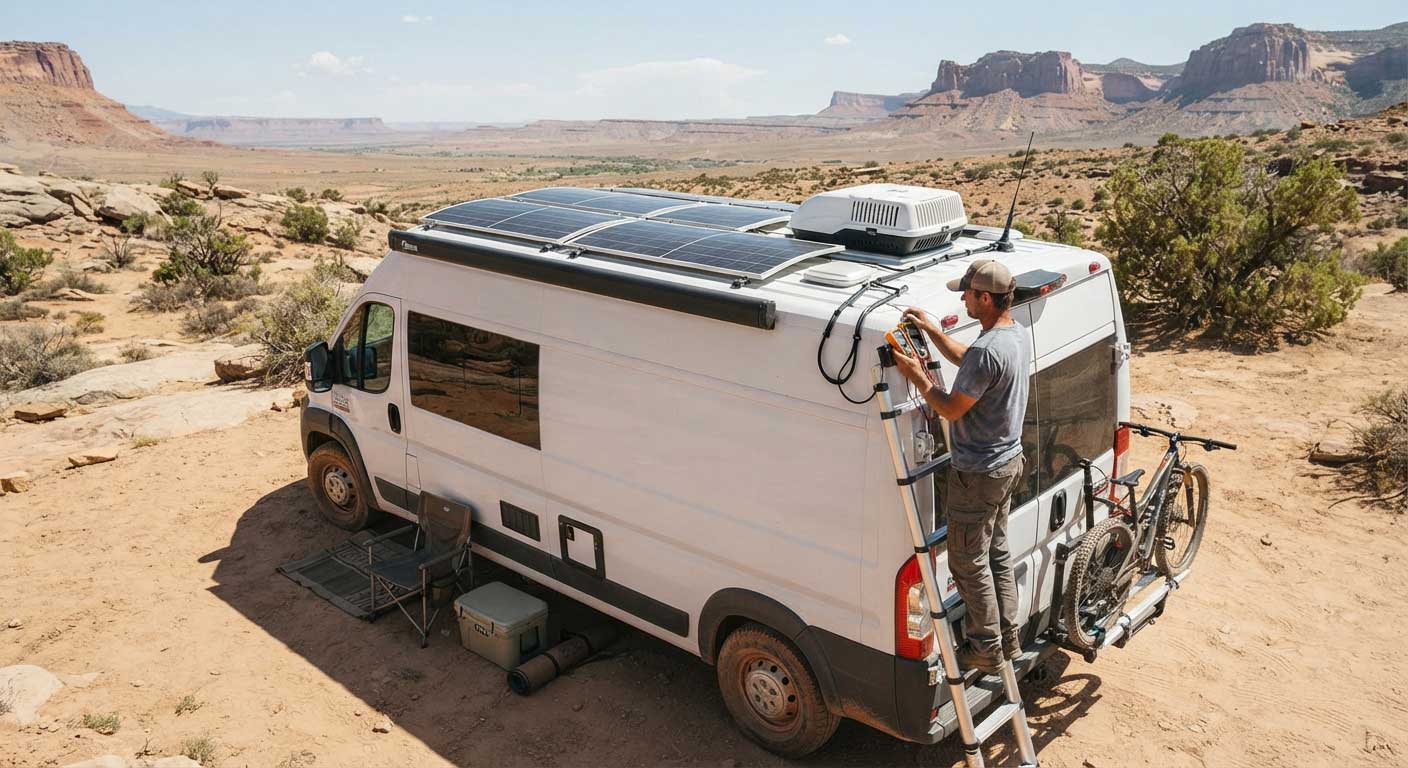
Flexible solar panels can be useful where conventional rigid modules are difficult to install.
Typical applications include:
- RV air conditioning
- camper vans
- boats
- mobile workspaces
- lightweight structures
- curved roofs
- temporary off-grid systems
The limitation is available surface area.
An RV roof may have enough space for several flexible modules, but an AC unit itself can consume substantial power.
A 400W flexible panel does not become a 400W panel simply because it is flexible. The electrical design still depends on irradiance, temperature, installation angle and operating conditions.
For an RV AC system, I would calculate the available roof area first, then the daily AC energy demand.
Trying to force a 3kW solar system onto a roof that physically cannot hold 3kW of modules is not a wiring problem.
It is a system-design problem.
How Large Should the Battery Be for an AC?
For off-grid solar panels for AC units, battery sizing is just as important as panel sizing.
A simple starting formula is:
Battery energy = AC average power × required operating hours
For example:
1,500W × 6h = 9kWh
If the system requires 9kWh of usable AC energy, the nominal battery capacity must be larger than 9kWh because the inverter and battery system are not 100% efficient.
A practical design also considers:
- battery chemistry;
- allowable depth of discharge;
- inverter efficiency;
- ambient temperature;
- battery age;
- other household loads;
- required reserve.
For a 48V system, a nominal 10kWh battery represents approximately:
10,000Wh ÷ 48V = 208Ah
But again, that does not mean the entire 10kWh is necessarily available to the AC.
Battery manufacturers specify their own operating limits.
Solar Panel and AC Inverter Sizing
The inverter is the bridge between the solar/battery system and the AC unit.
For example, if the AC requires approximately 1,800W continuously, a 2,000W inverter may appear adequate.
I would still look carefully at:
- continuous output rating;
- surge rating;
- compressor starting behavior;
- DC input current;
- battery voltage;
- ambient operating temperature;
- manufacturer recommendations.
Modern inverter-driven mini-splits can behave differently from older fixed-speed compressors because compressor speed can vary with cooling demand.
That can reduce the severity of startup demand, but it should never be assumed without checking the actual equipment specifications.
Solar Panels for AC Units: Installation Checklist
Before finalizing an AC solar system, check all of the following:
- AC rated input power
- Maximum AC current
- AC voltage and frequency
- Daily cooling hours
- AC efficiency rating
- Solar resource at the installation site
- Roof orientation
- Roof shading
- Available panel area
- Solar panel rated power
- PV operating voltage
- PV open-circuit voltage
- MPPT voltage range
- Maximum controller input current
- Inverter continuous output
- Inverter surge capability
- Battery capacity for off-grid operation
- Cable size and voltage drop
- Required electrical protection
The biggest practical mistake is treating the solar array and AC as two independent products.
They are a single electrical system once connected.
Solar Panels for AC Units FAQ
How many solar panels do I need to run an AC unit?
It depends on the AC’s actual electrical consumption. A 1,500W AC might require approximately four 400W panels as a starting point, while larger systems may require 2–6kW or more of PV capacity.
Can a 1000W solar panel system run an AC?
It can run a small, efficient AC under favorable conditions, but a 1,000W array cannot reliably provide 1,000W continuously. Real solar output varies with sunlight, temperature, orientation and system losses.
Can solar panels run a 12,000 BTU air conditioner?
Yes. A 12,000 BTU mini-split can be powered by solar when the PV array, inverter and—if required—battery are correctly sized. The electrical input should be checked rather than sizing the system from the 12,000 BTU figure alone.
How many 400W solar panels are needed for an AC?
A 1,600W AC would require four 400W panels by nameplate capacity. A larger array, such as five or six 400W panels, may provide useful operating margin depending on location, AC usage and system losses.
Can solar panels run AC at night?
Solar panels cannot generate electricity without sunlight. An AC can operate at night from solar energy stored in batteries or through a grid-connected system.
Is battery storage necessary for solar-powered AC?
Not necessarily. Grid-tied systems can use the utility grid when solar production is insufficient. Off-grid systems generally need batteries if the AC must operate when solar generation is unavailable.
Are flexible solar panels suitable for RV air conditioners?
Yes, provided the RV roof has enough usable area and the electrical system is correctly sized. Flexible panels are particularly useful where low weight, curved surfaces or walkable roof layouts make rigid modules less practical.
Bright Solar’s Practical Approach to Solar Panels for AC Units
When designing solar panels for AC units, I would not begin by asking how many panels fit on the roof.
I begin with the AC.
What does it actually consume?
How many hours will it run?
Is the compressor fixed-speed or inverter-driven?
Then I look at the site.
A 12,000 BTU mini-split in a well-insulated workshop is a very different solar load from a poorly insulated house in the Gulf Coast.
The EIA’s data makes the broader point clear: air conditioning is the largest single residential electricity end use in its latest RECS data, accounting for about 19% of U.S. household electricity consumption.
For Bright Solar applications, particularly flexible solar panels for RVs, vans and off-grid systems, I prefer to leave enough design margin to deal with real conditions rather than relying on the panel’s laboratory rating.
The most useful question is not:
“How many solar panels can run my AC?”
It is:
“How much electrical energy does my AC actually need, when does it need it, and how much solar energy can my site reliably produce during those hours?”
That question produces a much more dependable system.
Final Answer: Solar Panels for AC Units
solar panels for ac units can be an effective way to offset or supply air-conditioning electricity, but the correct array size must be based on actual AC input power, daily operating hours, efficiency, solar resource, inverter capacity and battery requirements.
For a preliminary example, a 1,600W AC might start with around 2,000W of solar capacity, while a larger 3,000W AC could require approximately 4,000W or more depending on operating conditions.
The final design should always be checked against the actual AC nameplate and the electrical specifications of the inverter, charge controller, battery and PV modules.
Related recommendations
-

Solar Panels for Tiny House: Complete Guide to Off-Grid Energy Solutions
252Solar panels for tiny house provide clean, reliable power. Learn system sizing, costs, installation tips, batteries, and flexible solar solutions from Bright Solar.
View details -
Solar Panel Voltage vs Current Explained: Understanding Volts, Amps, and Power
302Understand solar panel voltage vs current explained with clear examples of volts, amps, watts, series and parallel wiring to design efficient solar systems.
View details -
Off Grid Solar Power System: Complete Guide for Energy Independence
212Explore an off grid solar power system with complete guidance on components, sizing, installation, cost, and benefits for homes, RVs, farms, and remote energy solutions.
View details -
Flexible solar panels 300w: Lightweight High-Power Solar Solution for RV and Off-Grid Use
190Explore flexible solar panels 300w from Bright Solar. Learn power output, installation methods, applications, and why 300W flexible solar panels are ideal for RV, marine, and off-grid systems.
View details