
48v Solar Panels: Voltage, Wiring and System Design
48v solar panels are commonly used in larger off-grid and battery-based solar systems because a 48V battery architecture can transfer the same power at lower current than 12V or 24V systems.
That distinction is important.
A “48V solar panel” is not necessarily a panel that operates at exactly 48 volts. In practice, the phrase is often used to describe a solar setup designed around a 48V battery bank, while the PV array itself may operate at a considerably higher voltage.
This is where many first-time system designs go wrong.
A solar module might have a Vmp around 40V, 42V or 45V. Two modules in series could therefore create an operating voltage around 80–90V. An MPPT controller then converts that higher PV voltage down to the voltage required by a 48V battery.
For example, Victron’s documentation explicitly describes MPPT controllers that accept a higher PV voltage and charge lower-voltage batteries, including 48V battery banks. Its MPPT RS platform is specifically designed for large PV arrays charging 48V battery systems, with PV input ranges of 65–450V DC on supported models.
So when evaluating 48v solar panels, I do not start by asking, “Is this panel 48V?”
I start with:
What is the module’s Vmp and Voc, what is the battery voltage, and what does the charge controller accept?
That is the engineering question that actually matters.
What Are 48v Solar Panels?
The term 48v solar panels is used commercially in several different ways.
It can refer to:
- Solar panels used in a 48V battery system
- Higher-voltage PV modules connected to a 48V MPPT controller
- Solar arrays configured to provide suitable voltage for a 48V battery bank
- Commercial or off-grid systems built around a nominal 48V DC architecture
A conventional PV module does not simply produce a fixed 48V.
Its voltage changes with:
- Sunlight intensity
- Cell temperature
- Electrical load
- Module construction
- Operating point
The important specifications are therefore Vmp, Voc, Imp and Isc, not just the marketing phrase “48V solar panel.”
The U.S. Department of Energy explains that PV module ratings are measured under Standard Test Conditions of 1,000 W/m² irradiance and 25°C cell temperature. Real operating conditions are normally different, particularly because module temperatures can be considerably higher.
That is why a panel advertised for a “48V system” can have a significantly higher or lower actual operating voltage.
48V Solar Panels for Off-Grid Systems
A 48V architecture becomes increasingly attractive as system power grows.
Consider a simple 4,800W load.
At 12V:
4,800W ÷ 12V = 400A
At 24V:
4,800W ÷ 24V = 200A
At 48V:
4,800W ÷ 48V = 100A
The arithmetic is basic, but the installation consequences are not.
Lower current can make it easier to manage conductor sizing, voltage drop, busbars, fusing and inverter connections.
This is one reason 48V battery systems are common in larger off-grid installations.
Victron, for example, publishes MPPT equipment supporting 12V, 24V, 36V and 48V battery systems, with substantially greater nominal PV power allowed at 48V than at lower battery voltages on the same controller family. One 150/70 model is specified for up to 4,000W nominal PV power with a 48V battery system.
That does not mean every 48V system needs 4kW of solar.
It means the architecture scales differently.
48V Solar Panel Voltage Explained
There are three electrical values I check first on a solar module datasheet.
Vmp — Voltage at Maximum Power
Vmp is the voltage where the module produces its rated maximum power under the specified test conditions.
This is the number that helps determine the normal operating voltage of the PV array.
Voc — Open-Circuit Voltage
Voc is the voltage measured when the circuit is open and no current is flowing.
This number is particularly important for series-connected panels.
Why?
Because voltage adds in series.
If one module has a Voc of 50V, two modules theoretically produce approximately:
50V + 50V = 100V Voc
Three modules:
150V Voc
But this is not the end of the calculation.
Temperature matters.
PV module Voc generally rises as temperature falls. Therefore, the coldest expected conditions must be considered when checking the maximum PV input voltage of the controller.
This is not a detail I would leave until installation day.
48V Solar Panels Series Wiring
Series wiring is often useful in 48V solar systems because it increases array voltage while keeping current approximately at the level of one module or string.
For example, assume a hypothetical module has:
- Vmp: 40V
- Voc: 48V
- Imp: 12A
- Pmax: 480W
Two modules in series produce approximately:
80V Vmp
and:
96V Voc
while current remains approximately:
12A
The nominal power is:
80V × 12A = 960W
This higher PV voltage gives an MPPT controller room to convert solar-array voltage into the charging voltage required by a 48V battery.
Victron’s MPPT documentation describes exactly this operating principle: the controller can accept a higher PV voltage and automatically adjust it to charge a lower nominal-voltage battery.
But Do Not Ignore Cold-Weather Voc
Suppose three modules have a nominal Voc of 48V.
A simple calculation gives:
3 × 48V = 144V
That might look acceptable for a 150V controller.
But if the actual cold-weather Voc rises above the nominal value, the array could approach or exceed the controller’s maximum PV voltage.
That is why a proper design uses the module’s temperature coefficient and the site’s minimum expected temperature.
48V Solar Panels Parallel Wiring
Parallel wiring behaves differently.
Voltage remains approximately the same while current increases.
Using the previous hypothetical 480W module:
One module:
40V × 12A = 480W
Two in parallel:
40V × 24A = 960W
Four in parallel:
40V × 48A = 1,920W
Parallel configurations can be useful when the system architecture calls for lower PV voltage, but conductor current rises quickly.
That affects:
- Wire size
- Voltage drop
- Fuse requirements
- Combiner boxes
- Disconnects
- Controller input current
For larger systems, increasing voltage can often be more practical than simply increasing current.
There is no universal “series is better” rule.
The controller specifications decide the boundary.
48V Solar Panels vs 12V and 24V Systems
| Feature | 12V System | 24V System | 48V System |
|---|---|---|---|
| Battery nominal voltage | 12V | 24V | 48V |
| Current at 4,800W | 400A | 200A | 100A |
| Typical use | Small RV/camping | Medium systems | Larger off-grid systems |
| Cable current | Highest | Medium | Lowest |
| Scaling potential | Limited | Moderate | High |
| Inverter compatibility | Small loads | Medium loads | Larger loads |
These are simplified electrical comparisons, not design recommendations.
Real battery voltage is not exactly the nominal label.
A “48V” lithium battery, for example, operates across a voltage range determined by its cell configuration and battery-management system.
That is another reason not to design the PV array by dividing everything by exactly 48.
48V Solar Battery System Sizing
Solar panels and batteries should be designed as one system.
Consider a hypothetical 48V 200Ah battery bank.
Nominal stored energy is approximately:
48V × 200Ah = 9,600Wh
or:
9.6kWh
But that does not mean 9.6kWh should automatically be treated as usable energy.
Actual usable energy depends on:
- Battery chemistry
- Depth-of-discharge limit
- BMS settings
- Temperature
- Inverter efficiency
- Battery age
- Manufacturer specifications
Now suppose the system consumes 5kWh per day.
A 9.6kWh nominal battery may provide useful overnight storage, but the solar array must replace the energy consumed.
A 1kW solar array receiving four equivalent peak-sun hours produces a simple theoretical:
1kW × 4h = 4kWh
before system losses.
NREL‘s PVWatts model accounts for soiling, shading, mismatch, wiring, connections, availability and other losses. Its default combined system-loss assumption is approximately 14%, calculated multiplicatively rather than by simply adding every individual loss percentage.
Real system design needs site-specific modeling rather than a generic “four hours of sun” assumption.
Case Study: Designing a 48V Off-Grid Solar System
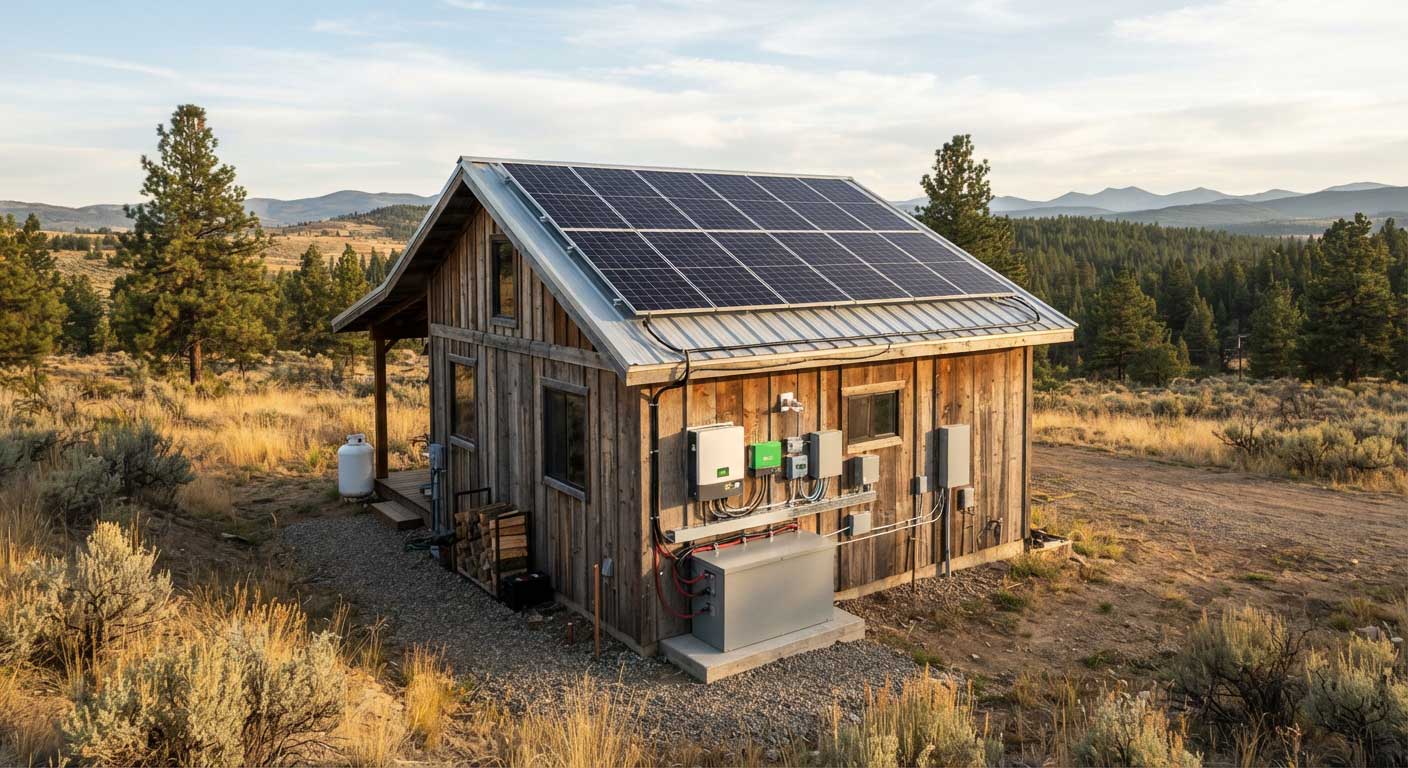
Consider a small workshop in the western United States.
The owner has:
- Refrigerator
- LED lighting
- Wi-Fi equipment
- Power tools
- Small air compressor
- Battery charging station
The estimated daily consumption is around 7kWh.
The workshop also has a 48V battery bank.
Instead of beginning with “How many panels can I fit?”, the design process starts with the energy requirement.
Suppose the proposed array is:
4 × 450W panels = 1,800W
A simple four-hour equivalent-sun estimate gives:
1.8kW × 4h = 7.2kWh
That looks close to the 7kWh daily requirement.
But it leaves almost no margin.
A cloudy day, shading, module temperature and normal system losses can push production below the target.
NREL’s documentation specifically identifies shading, soiling, wiring, mismatch and other losses as contributors to real-world production differences.
So I would not call this a comfortable design.
I would either increase the array, reduce the expected load, or model the site with actual solar-resource data.
That is a small distinction on paper.
It becomes a large distinction in January.
48V MPPT Solar Charge Controller
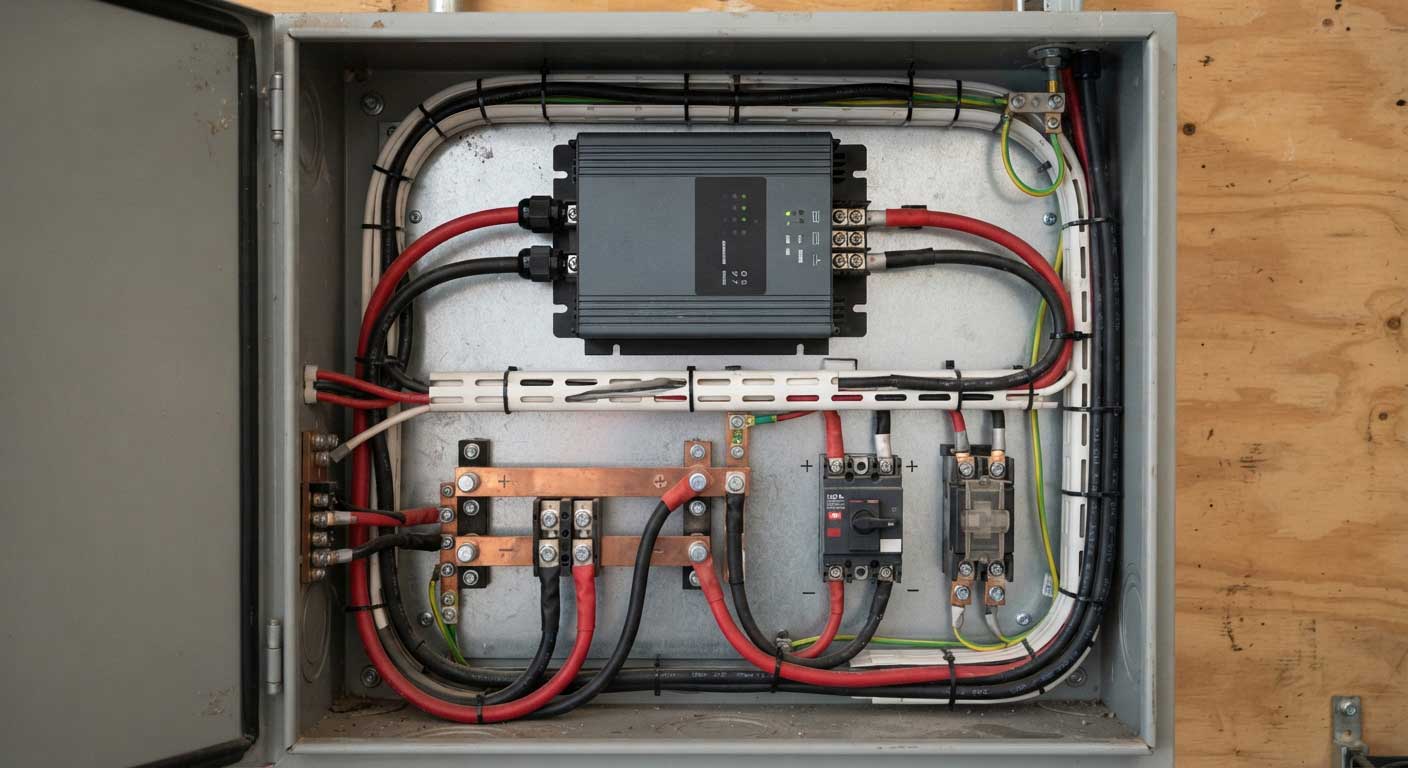
The charge controller is where the PV array and battery architecture meet.
For a 48V battery system, the controller must support:
- 48V battery charging
- Maximum PV voltage
- Maximum PV current
- Maximum PV power
- Appropriate battery charging profile
Do not select a controller based only on wattage.
Check the electrical limits.
For example, Victron’s SmartSolar MPPT 150/70 documentation specifies:
- 12/24/48V battery compatibility
- 70A maximum battery current
- Up to 4,000W nominal PV power at 48V
- 150V maximum PV open-circuit voltage under specified conditions
Its 150/60 model is specified at up to 3,440W nominal PV power for a 48V battery.
Those numbers demonstrate something useful:
The same controller can accommodate substantially more PV power as battery voltage increases.
That is one of the practical advantages of a 48V architecture.
Victron SmartSolar MPPT technical specifications
48V Solar Panels for RV and Mobile Systems
48V solar systems can also make sense for larger RVs, mobile workshops and specialty vehicles.
The limiting factor is usually not the battery voltage.
It is available roof area.
For example, a large RV may have enough roof space for several high-power modules but still need to accommodate:
- Air-conditioning
- Roof vents
- Skylights
- Satellite equipment
- Antennas
- Walkways
- Service clearances
A higher-voltage PV array can reduce current between the array and controller, particularly when panels are configured in series.
However, the vehicle environment introduces vibration, movement and temperature swings that need to be considered during cable routing and mounting.
Flexible solar modules can be useful where weight and curved surfaces are important, while rigid modules generally provide a more conventional mounting solution.Visit product page:Flexible Solar Panels
The panel format should follow the roof.
Not the other way around.

48V Solar Panel Wiring: A Practical Design Process
When I review a 48V solar design, I use the module datasheet before touching the wiring diagram.
Step 1: Record Module Values
Write down:
- Pmax
- Vmp
- Voc
- Imp
- Isc
- Temperature coefficient of Voc
Step 2: Determine Battery Voltage
Confirm whether the storage system is actually designed as a 48V nominal battery system.
Step 3: Select the Controller
Check:
- Maximum PV Voc
- Maximum PV current
- Maximum PV power
- 48V battery compatibility
Step 4: Calculate Series Strings
Add Vmp and Voc for modules in series.
Then check the cold-weather maximum Voc.
Step 5: Calculate Parallel Strings
Add current for parallel strings.
Then check controller current limits and protection requirements.
Step 6: Check Cable Voltage Drop
Long cable runs can make voltage drop significant.
This is especially important between remote solar arrays and the controller.
Step 7: Verify Protection
Use appropriate disconnects, fuses, breakers and overcurrent protection according to the equipment manufacturer’s instructions and applicable electrical requirements.
48V Solar Panels and Power Output
One of the most persistent misconceptions is that a 48V system automatically produces more energy than a 12V system.
It does not.
A 500W solar array is still a 500W array regardless of whether the battery system is nominally 12V, 24V or 48V.
What changes is the current required to transfer that power.
For example:
500W ÷ 12V ≈ 41.7A
500W ÷ 24V ≈ 20.8A
500W ÷ 48V ≈ 10.4A
The actual operating values differ because batteries and power electronics operate across voltage ranges.
But the relationship illustrates why higher-voltage architectures become attractive as system power increases.
It is not free energy.
It is a more manageable electrical architecture.
48V Solar Panel Efficiency and Real-World Performance
A module’s efficiency tells you how much incoming solar energy is converted into electrical power.
For space-constrained systems, higher efficiency can be useful because more rated power can fit into the same physical footprint.
Still, efficiency is only one specification.
When comparing two modules, I would also examine:
- Power tolerance
- Temperature coefficient
- Mechanical dimensions
- Weight
- Warranty
- Degradation characteristics
- Connector compatibility
- Maximum system voltage
- Operating temperature range
The DOE states that PV module efficiency naturally declines over time and cites approximately 0.5% per year as a typical degradation rate.
NREL’s PVWatts documentation similarly uses approximately 0.5% per year as a typical long-term degradation assumption in its model.
The number is useful for planning.
But actual field performance is more informative.
If a system is monitored continuously, you can compare production against weather and historical performance rather than relying entirely on a theoretical degradation curve.
48V Solar Panels: When Should You Use Them?
A 48V architecture becomes particularly attractive when:
- The solar array is relatively large
- Battery storage is substantial
- Inverter power is high
- Cable runs are long
- The system is permanently installed
- Off-grid operation is required
- Future expansion is expected
It may be unnecessary for a tiny camping setup.
For a small 12V load, adding complexity simply to use a 48V battery architecture can make little sense.
For a multi-kilowatt cabin, workshop or backup-energy system, the situation changes.
This is where system scale matters more than marketing terminology.
Advantages and Limitations of 48V Solar Panels
Advantages
- Lower current for the same power
- Better suited to larger battery systems
- Efficient architecture for higher-power inverters
- Well suited to off-grid applications
- Allows higher-voltage PV arrays with MPPT
- Can reduce voltage-drop concerns on appropriately designed wiring
- Easier to scale than many small 12V systems
Limitations
- More complex than small 12V systems
- Requires compatible 48V battery equipment
- PV voltage must be carefully calculated
- Series strings require cold-weather Voc calculations
- Controller limits cannot be exceeded
- Higher system voltage requires appropriate safety procedures and equipment
FAQ: 48V Solar Panels
What are 48v solar panels?
48v solar panels usually refers to PV modules or arrays intended for use with a 48V nominal battery system. The actual panel voltage may be considerably higher, particularly when modules are connected in series.
Can solar panels directly charge a 48V battery?
Usually, a suitable solar charge controller should be installed between the PV array and battery. An MPPT controller can accept an appropriate PV voltage and regulate it for the battery’s charging requirements.
How many solar panels do I need for a 48V battery?
There is no single number. The calculation depends on battery capacity, daily energy consumption, solar resource, panel wattage, controller limits and desired charging time.
Are 48V solar panels better than 12V solar panels?
Not automatically. A 48V architecture is generally more useful for larger systems because higher system voltage reduces current for a given power level. Small portable systems may not need that complexity.
Can I connect 48V solar panels in series?
Yes, compatible modules can be connected in series. However, the total cold-weather Voc must remain within the charge controller or inverter’s maximum PV input voltage.
What size MPPT controller do I need for 48V solar panels?
The controller must be sized according to maximum PV voltage, PV current, PV power and battery charging current. For example, Victron publishes different maximum PV power ratings for its controllers depending on whether the battery system is 12V, 24V or 48V.
Are 48V solar systems good for off-grid homes?
Yes. A 48V battery architecture is well suited to larger off-grid systems because it can handle higher power with lower current than comparable 12V or 24V architectures.
Conclusion: 48v Solar Panels
48v solar panels are best understood as part of a higher-voltage solar and battery architecture rather than as panels that simply output a fixed 48 volts.
For small systems, 12V or 24V may be perfectly adequate.
As power increases, 48V becomes much more interesting.
A 4,800W load illustrates why: the theoretical current falls from 400A at 12V to 100A at 48V. That difference affects cable sizing, voltage drop, distribution equipment and inverter architecture.
For Bright Solar projects, the important specifications are therefore not just the panel wattage.
We look at:
- Vmp
- Voc
- Imp
- Isc
- Temperature coefficient
- Panel dimensions
- Array configuration
- MPPT limits
- Battery voltage
- Expected site conditions
The U.S. Department of Energy emphasizes that rated PV performance is measured under controlled STC conditions and that real production depends on sunlight, temperature, orientation, system age and other site factors.
NREL’s PVWatts model provides another useful reference point by explicitly accounting for real-world system losses such as shading, soiling, mismatch and wiring.
That is the practical way to approach 48v solar panels: start with the energy requirement, check the electrical limits, model the site, and only then decide how many panels belong on the roof.
Related recommendations
-

solar panel 100w flexible (Real Compact Off-Grid Guide from Bright Solar)
182solar panel 100w flexible explained with RV installation cases, real output data, mounting insights, and off-grid performance analysis for travel and camping use.
View details -
flexible solar panel 100w: Lightweight Solar Solution for RV, Marine and Off-Grid Applications
178Discover flexible solar panel 100w solutions from Bright Solar with lightweight design, durable materials, and reliable solar power for RV, marine, camping, and off-grid use.
View details -
200 Watt Flexible Solar Panel for RV, Marine, and Off-Grid Applications
170200 watt flexible solar panel solutions provide lightweight, durable off-grid energy for RVs, boats, cabins, and mobile systems with reliable solar efficiency.
View details -
Mounting Solar Panels on RV: Complete Installation Guide for Secure Solar Power
202Mounting solar panels on RV made simple. Learn installation methods, brackets, flexible panels, waterproofing tips, and expert solutions from Bright Solar.
View details