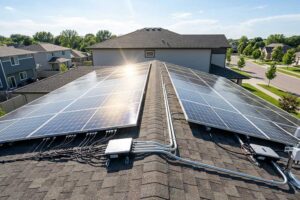
450w Solar Panels: Output, Size and Applications
450w solar panels are high-output PV modules rated to deliver up to 450 watts under standard test conditions, making them useful when you want more solar capacity from limited roof or ground space.
That is the short answer.
The number on the label, however, is not the number you should expect to see on a controller every afternoon.
Solar modules are rated under Standard Test Conditions using 1,000 W/m² irradiance and a 25°C cell temperature. In actual installations, sunlight is usually lower and module temperatures are commonly higher. The U.S. Department of Energy also identifies solar resource, temperature, system age and other conditions as factors affecting real PV production.
This matters when comparing 450W modules.
A panel can be rated at 450W and still produce 330W, 380W or occasionally close to its rated output depending on the moment and the installation.
I have found that the most useful way to evaluate a high-wattage module is to stop looking at the wattage first.
Look at the roof area, electrical voltage, module dimensions and expected daily energy requirement.
The 450W rating comes after that.
What Are 450w Solar Panels?
A 450W solar panel is a photovoltaic module with a maximum power rating of approximately 450 watts DC under defined test conditions.
The advantage is straightforward: each module contributes more nameplate capacity than a 300W or 400W panel.
For example:
| Module Rating | 10 Panels | Total Rated Capacity |
|---|---|---|
| 300W | 10 | 3.0kW |
| 400W | 10 | 4.0kW |
| 450W | 10 | 4.5kW |
| 500W | 10 | 5.0kW |
Ten 450W modules therefore provide 500W more capacity than ten 400W modules.
That difference becomes meaningful when roof space is tight.
The global market is also moving toward increasingly large solar deployment. According to the International Energy Agency, solar PV additions exceeded 600 GW in 2025, while cumulative global solar PV capacity reached around 2,800 GW.
But bigger module wattage does not automatically mean a better installation.
A 450W module that is too large for the available roof, difficult to handle, or incompatible with the electrical equipment can create more problems than it solves.
450W Solar Panel Output: How Much Electricity Can It Produce?
A simple starting calculation is:
450W × peak sun hours = theoretical daily energy
Using four equivalent peak-sun hours:
450W × 4 = 1,800Wh
or:
1.8kWh per day
This is a theoretical estimate before system losses.
It should not be presented as a guaranteed daily output.
Clouds, temperature, shading, orientation, soiling, wiring and power electronics all affect production.
NREL’s PVWatts model is specifically designed to estimate PV production using location and system information. Its documented loss model includes soiling, shading, mismatch, wiring, connections, availability and other factors. The commonly used default system-loss assumption is approximately 14%, calculated by combining individual loss mechanisms rather than simply adding their percentages.
So a better workflow is:
- Identify the installation location.
- Determine usable solar area.
- Select the 450W module.
- Enter the proposed system size into a production model.
- Account for orientation and tilt.
- Review monthly production.
- Compare production with actual energy demand.
- Size storage or grid interaction accordingly.
For serious projects, location-specific modeling is much more useful than multiplying panel wattage by an assumed number of daylight hours.
Why a 450W Panel Does Not Produce 450W All Day
This is one of the most common misunderstandings around solar panels.
A 450W rating does not mean:
450W × 24 hours = 10.8kWh/day
That calculation treats the panel as if it were receiving maximum test-condition sunlight continuously.
It isn’t.
At 8:00 in the morning, the sun angle may be poor.
At noon, irradiance may be strong.
At 2:00 PM, the module may be hot.
At 4:00 PM, the roof may be partly shaded.
The output moves with the environment.
The DOE explains that PV module ratings use 1,000 W/m² and 25°C cell temperature, while actual sunlight intensity is normally lower and cell temperatures are often higher.
There is another detail worth watching.
PV modules become less productive as cell temperature rises, depending on the module’s temperature coefficient.
That is especially relevant for:
- RV roofs
- Van roofs
- Low-clearance installations
- Dark rooftops
- Direct-mounted flexible modules
A 450W panel on a hot roof is not operating in a laboratory.
It is operating in July.
That difference is real.
450W Solar Panel Specifications to Compare
When I compare two 450W modules, the first thing I do is open the electrical datasheets.
Not the product photograph.
Not the marketplace listing.
The datasheet.
Important values include:
| Specification | What It Tells You |
|---|---|
| Pmax | Rated maximum output |
| Vmp | Operating voltage at maximum power |
| Voc | Maximum open-circuit voltage |
| Imp | Operating current |
| Isc | Short-circuit current |
| Efficiency | Power generated per unit area |
| Dimensions | Whether the panel physically fits |
| Weight | Handling and structural requirements |
| Temperature coefficient | Output response to temperature |
| Maximum system voltage | Series-array compatibility |
| Connector type | Electrical compatibility |
| Mechanical load | Mounting suitability |
A 450W panel with a high efficiency rating can be valuable when available installation area is limited.
But efficiency should never be viewed alone.
A module with excellent efficiency but unsuitable dimensions is still unsuitable.
450W Solar Panel Efficiency
Panel efficiency describes how effectively the module converts incoming solar energy into electrical power.
In simple terms:
Efficiency = electrical output ÷ solar energy received
For the same 450W rating, a higher-efficiency panel can potentially achieve the required output using less physical area.
That is useful for:
- RV roofs
- Camper vans
- Small homes
- Commercial rooftops with obstructions
- Boats
- Tiny homes
- Limited ground-mount areas
Why Power Density Matters
Suppose two modules are both rated at 450W.
Module A needs more physical area.
Module B achieves 450W in a smaller footprint.
If the roof is already crowded with vents, skylights and HVAC equipment, Module B may be the more useful option.
This is why I recommend comparing watts per square meter, not just watts per panel.
The practical question becomes:
How much solar capacity can I install in the space I actually have?
That is a much better design question than:
Which panel has the biggest wattage number?
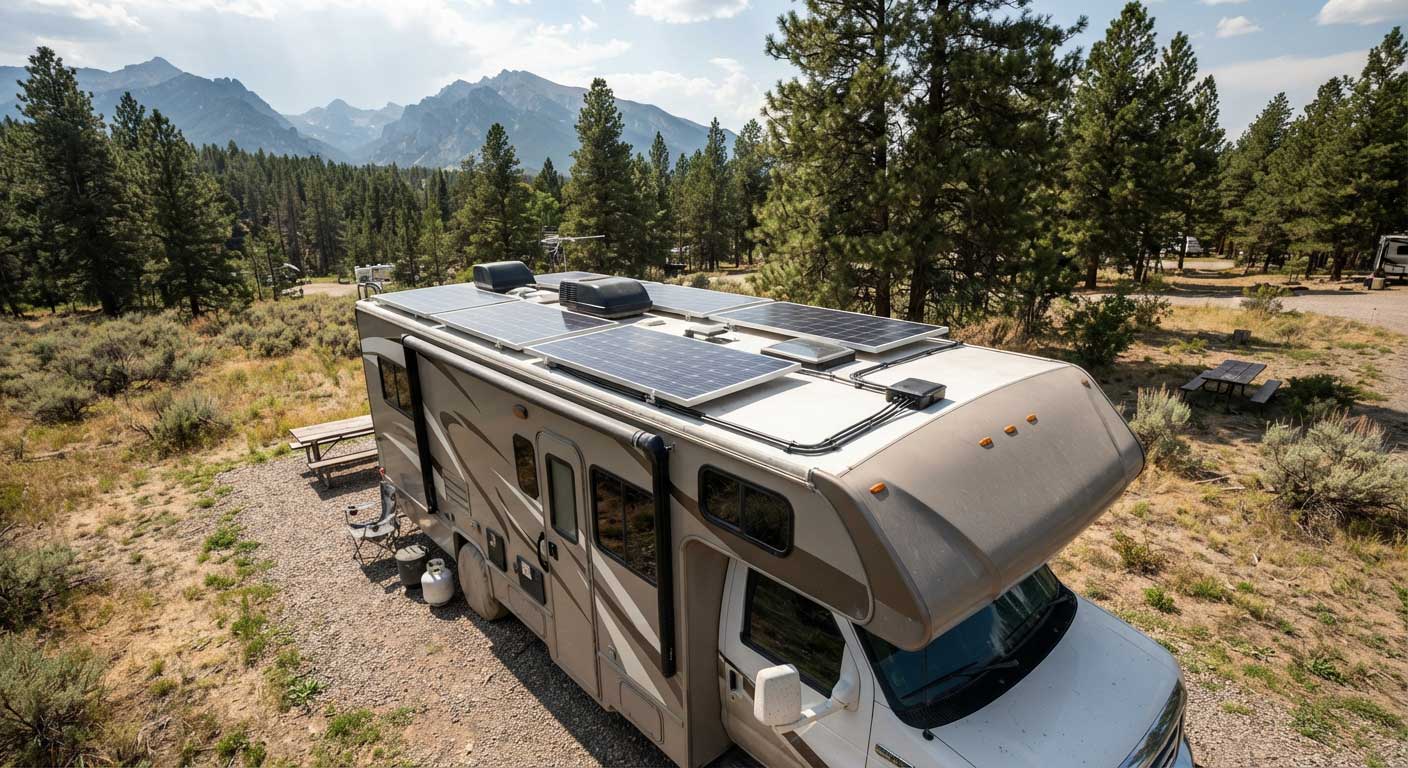
450W Solar Panels for RVs
A 450W solar panel can be useful for RV solar systems, particularly when the goal is to generate more energy from a limited roof.
But RV installation creates a physical problem that residential rooftops often do not have.
Everything is already crowded.
An RV roof may contain:
- Air-conditioning units
- Roof vents
- Antennas
- Skylights
- Plumbing vents
- Satellite equipment
- Roof racks
- Storage equipment
One large 450W module may fit beautifully on one RV and be completely impractical on another.
Rigid vs Flexible 450W Modules
Rigid 450W modules generally provide a conventional framed construction with established mounting methods.
Flexible modules can be more attractive where:
- Roof weight is important
- A low-profile installation is preferred
- The mounting surface is curved
- Conventional mounting hardware is inconvenient
But flexible does not mean unlimited bending.Visit product page:Flexible Solar Panels
Always follow the manufacturer’s bending radius and mounting instructions.
For RVs, I would also inspect the roof before selecting the module.
Measure first.
Buy second.
450W Solar Panels for Home Use
Residential solar is where 450W modules become particularly interesting.
Suppose a homeowner wants approximately 9kW of DC solar capacity.
With 400W modules:
9,000 ÷ 400 = 22.5
A practical design would require 23 modules for 9.2kW.
With 450W modules:
9,000 ÷ 450 = 20
Exactly 20 modules provide:
20 × 450W = 9,000W
That means the same nominal system capacity can be achieved with three fewer modules in this simplified comparison.
Fewer modules can mean:
- Fewer physical mounting positions
- Fewer interconnections
- More flexible roof layout
- Potentially simpler array planning
But it does not automatically mean lower installation cost.
Labor, mounting hardware, module dimensions, inverter architecture and roof complexity still matter.
450W Solar Panel Dimensions and Roof Planning
There is no single universal dimension for a 450W solar panel.
This point deserves emphasis.
450W describes electrical output, not physical size.
Different manufacturers can use different cell formats, layouts and module constructions.
Before finalizing a system, obtain the actual mechanical drawing.
Measure:
Usable roof length × usable roof width
Then mark:
- Vents
- Skylights
- Chimneys
- HVAC
- Roof edges
- Maintenance paths
- Shading zones
I prefer drawing the panel footprint to scale before ordering.
It catches mistakes early.
A roof sketch that takes 20 minutes can prevent a very expensive installation mistake.
Panel Orientation
The same modules can sometimes be arranged in portrait or landscape orientation.
That small decision can change whether an entire row fits.
On irregular roofs, orientation is often more important than squeezing out another few watts of module efficiency.
Case Study: 450W vs 400W Panel Layout
Consider a small commercial roof with enough usable area for approximately 20 medium-format modules.
The project target is around 9kW.
Using 400W panels:
20 × 400W = 8,000W
Using 450W panels:
20 × 450W = 9,000W
The same module count produces an additional:
1,000W of nameplate capacity
That is a 12.5% increase over the 8kW configuration.
This is where higher-wattage modules can make a genuine difference.
But there is a catch.
If the 450W modules are substantially larger and only 18 fit after roof setbacks and obstructions:
18 × 450W = 8.1kW
The advantage has almost disappeared.
This is why module wattage should be evaluated after physical layout, not before it.
450W Solar Panel Series vs Parallel
Multiple 450W modules can be wired in series or parallel, depending on the system architecture.
The two configurations behave differently.
Series Connection
In series:
Voltage increases
while current remains approximately the same.
For example, assume a hypothetical 450W module has:
- Vmp = 40V
- Imp = 11.25A
Two modules in series would be approximately:
80V × 11.25A = 900W
This can reduce current in the PV conductors.
But there is a critical design issue:
Voc increases in series.
The maximum PV voltage of the charge controller or inverter must not be exceeded.
Cold temperatures can increase Voc, so the lowest expected site temperature should be included in the calculation.
Parallel Connection
In parallel:
Current increases
while voltage remains approximately the same.
Using the same simplified example:
40V × 22.5A = 900W
Higher current can require larger conductors and appropriate protection.
Neither configuration is automatically better.
The correct choice depends on:
- Controller voltage limit
- Controller current limit
- Module Voc
- Module Vmp
- Battery voltage
- Cable length
- Minimum ambient temperature
- Array size
450W Solar Panel Charge Controller Sizing
A 450W array can be substantial for a small 12V system.
A basic nominal calculation is:
450W ÷ 12V = 37.5A
However, that is not a complete charge-controller calculation.
The battery does not necessarily charge at exactly 12V, and an MPPT controller converts PV voltage into the battery charging voltage.
The controller should therefore be selected according to its actual specifications.
Check:
- Maximum PV input voltage
- Maximum PV input current
- Maximum charging current
- Battery voltage
- Battery chemistry
- Manufacturer’s recommended PV capacity
For multiple 450W modules, calculate both the maximum current and maximum cold-weather Voc before selecting the controller.
This is one of those places where a five-minute datasheet check is worth much more than a guess.
450W Solar Panels for Off-Grid Systems
Off-grid systems require a different mindset.
A grid-connected system can draw electricity from the grid when solar production drops.
An off-grid system cannot.
That makes daily energy balance much more important.
Consider a small cabin:
| Load | Estimated Daily Energy |
|---|---|
| Refrigerator | 900Wh |
| LED lighting | 120Wh |
| Laptop | 250Wh |
| Internet equipment | 180Wh |
| Water pump | 150Wh |
| Small appliances | 250Wh |
| Total | 1,850Wh/day |
A simplified 450W × 4-hour calculation gives:
1,800Wh/day
That looks almost perfect.
It isn’t.
The margin is too small because real systems experience losses and variable weather.
NREL’s PVWatts documentation includes losses from soiling, shading, mismatch, wiring, connections and availability, among other factors.
For an off-grid system, I would rather have some production margin than design around a perfect-weather calculation.
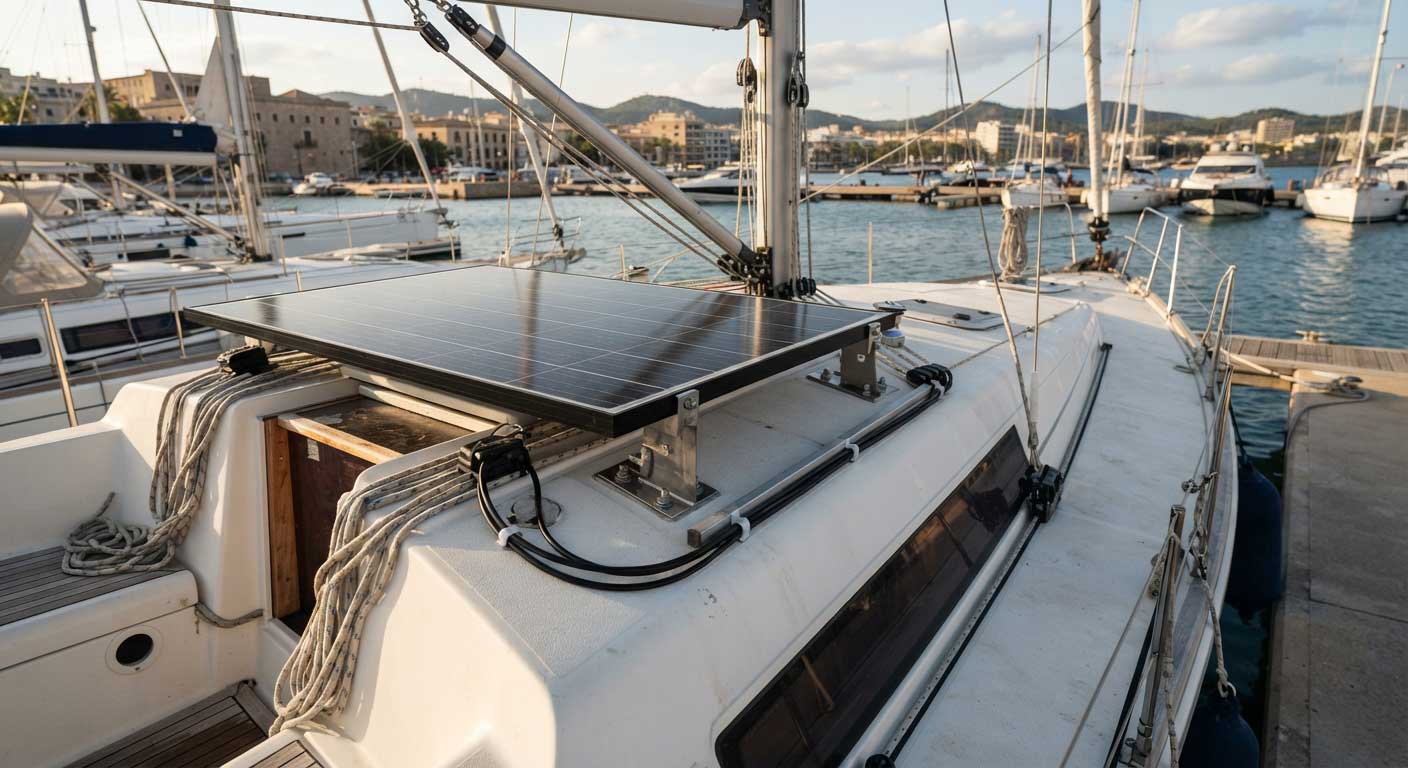
450W Solar Panels for Boats
Marine installations create another set of constraints.
The module has to coexist with:
- Salt spray
- UV exposure
- Limited deck space
- Curved surfaces
- Foot traffic
- Water
- Vibration
- Cable movement
A 450W rigid module may be suitable for a larger yacht or fixed mounting platform.
A flexible 450W-class module may be more practical where the surface is curved and weight is a concern.
But marine installation should never be treated as an ordinary rooftop installation.
Cable entries deserve particular attention.
A waterproof solar module can still be part of a poorly waterproofed installation if the deck penetration is badly sealed.
450W Solar Panel Battery Sizing
Solar array size and battery capacity should be designed together.
A simplified battery calculation for a 12V 200Ah battery is:
12V × 200Ah = 2,400Wh nominal
But nominal energy is not necessarily usable energy.
Actual usable capacity depends on:
- Battery chemistry
- Depth-of-discharge limits
- Temperature
- BMS restrictions
- Conversion losses
- Battery age
For lithium batteries, the manufacturer’s recommended operating limits should be used rather than assuming every watt-hour is available.
The solar array then needs to replenish the energy consumed.
This is why a 450W array paired with a huge battery does not automatically create an efficient system.
The array must have enough solar resource to recharge it.
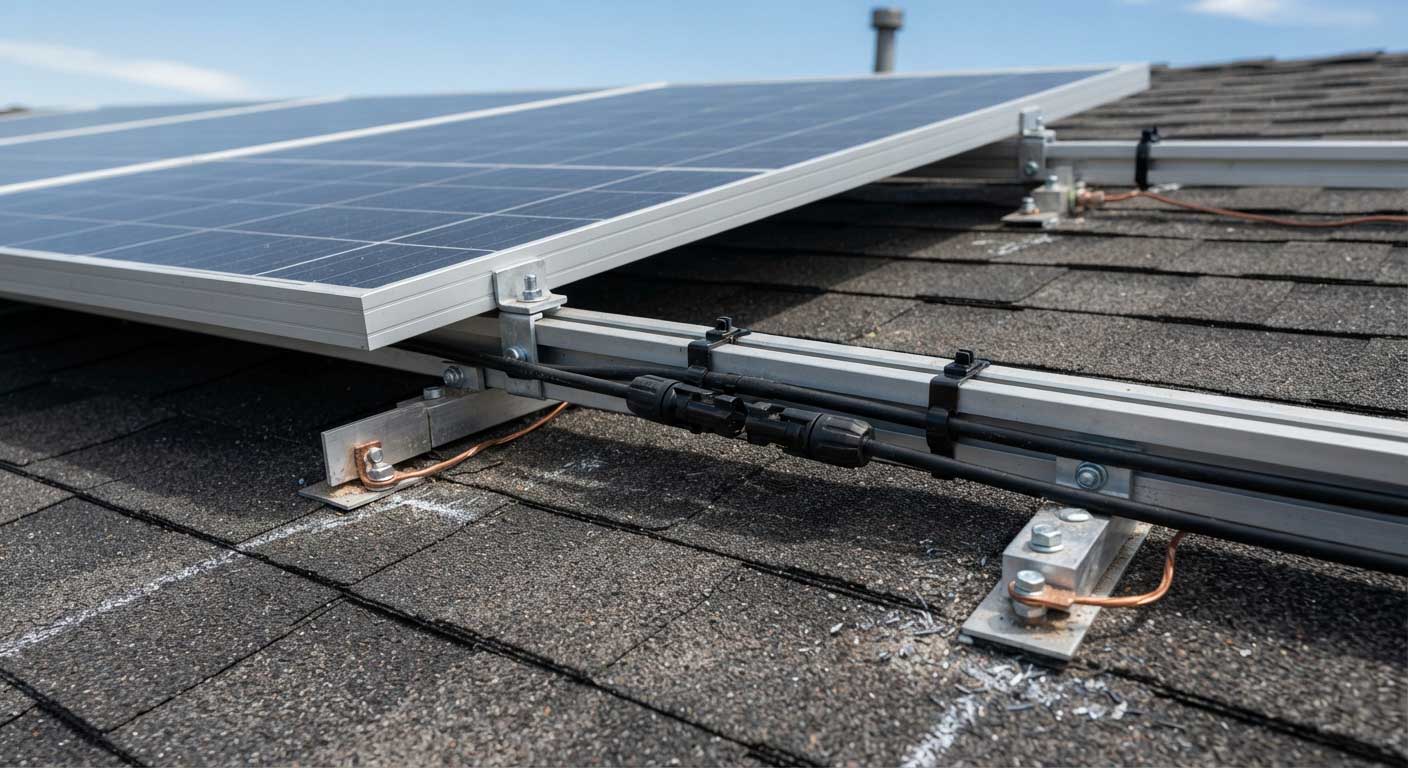
450W Solar Panel Installation: Practical Steps
For a rooftop installation, the process should start before the panel arrives.
Survey the Installation Area
Record:
- Roof dimensions
- Obstacles
- Shading
- Surface condition
- Cable-entry location
Check the Mechanical Drawing
Confirm that the actual panel dimensions fit the planned layout.
Do not rely on the marketing image.
Verify Electrical Parameters
Record:
- Voc
- Vmp
- Isc
- Imp
Then compare them with the controller or inverter.
Plan the Wiring
Decide whether the modules should be connected in series, parallel or separate subarrays.
Install the Mounting System
Use the manufacturer’s approved mounting method.
Protect the Cables
Avoid sharp edges, moving components, standing water and excessive heat.
Verify Polarity
Use a suitable meter before connecting the array to the electronics.
Commission and Monitor
Record the first few days of production.
A baseline is valuable.
If output changes significantly later, you have something to compare against.
450W Solar Panel Maintenance and Performance
Solar panels have no moving parts, but the installation still needs attention.
Inspect periodically for:
- Dirt accumulation
- Cracked module surfaces
- Loose hardware
- Cable abrasion
- Connector damage
- Water intrusion
- Sealant deterioration
- New shading
- Unexpected production decline
The DOE notes that PV module efficiency generally degrades at approximately 0.5% per year, although actual degradation depends on the technology and operating environment.
NREL’s PVWatts documentation also uses approximately 0.5% per year as a typical long-term degradation assumption in its modeling context.
The practical lesson is not to obsess over a single annual percentage.
Monitor your actual system.
If the same array produced 4.2kWh under similar weather last year and now produces 3.2kWh, that deserves investigation.
Advantages and Limitations of 450W Solar Panels
Advantages
- High output per module
- Fewer modules for a given DC capacity
- Good power density
- Useful for limited roof space
- Suitable for residential and commercial systems
- Can be used in off-grid systems
- Available in rigid and, depending on manufacturer, flexible formats
Limitations
- Larger modules can be harder to handle
- Dimensions vary between manufacturers
- Higher module voltage can affect system design
- Large modules may not suit every RV
- Real output is below the STC rating for much of the day
- Shading can reduce production
- Controller and inverter limits must be checked
The strongest argument for 450W is not simply “more watts.”
It is more watts per module when the physical layout supports it.
FAQ: 450W Solar Panels
How much power does a 450W solar panel produce?
A 450W solar panel has a maximum rated output of 450W under standard test conditions. Actual instantaneous output varies with irradiance, temperature, shading, orientation and system losses.
How much energy can a 450W solar panel produce per day?
A simple four-peak-sun-hour calculation gives 1.8kWh before losses. Actual daily energy depends on location, weather, tilt, orientation, shading, temperature and system efficiency.
Are 450W solar panels good for RVs?
Yes, provided the module’s dimensions and weight fit the RV roof. A 450W module can provide substantial capacity from limited roof area, but rooftop equipment and mounting requirements must be considered.
How many 450W panels do I need for a 5kW system?
5,000W ÷ 450W equals 11.11, so 12 panels would provide 5.4kW of nominal DC capacity. The final system size should also account for actual energy demand and available roof space.
Can 450W solar panels charge a 12V battery?
Yes. A suitable MPPT charge controller can convert the panel’s higher PV voltage to the battery’s charging voltage. Controller voltage, current and battery-chemistry limits must be checked first.
Are 450W solar panels better than 400W panels?
Not in every application. A 450W panel provides 50W more rated power per module, but dimensions, efficiency, weight, voltage, current and installation constraints determine whether it is the better choice.
Can 450W solar panels be connected in series?
Yes. Compatible modules can be wired in series, but the combined Voc must remain below the controller or inverter’s maximum PV voltage under the site’s coldest expected conditions.
Conclusion: 450w Solar Panels
450w solar panels are a practical high-output option for residential roofs, RVs, boats, commercial buildings and off-grid systems where usable space is limited.
Their biggest advantage is simple: more rated power from each module.
But the real design work starts after the 450W label.
Check the dimensions.
Check the Vmp and Voc.
Check current.
Check temperature coefficients.
Map the roof.
Calculate the array voltage.
Then estimate production using real location and weather data.
The IEA reports that solar PV added more than 600 GW globally in 2025, with solar accounting for more than three-quarters of new renewable capacity additions that year.
That scale of deployment makes module-level optimization increasingly important, particularly as available roof space becomes the limiting factor in many installations.
At Bright Solar, we view the 450W module as part of a complete PV system rather than an isolated wattage number.
The best 450W panel is the one that fits the available space, matches the electrical architecture, survives the installation environment and produces useful energy over the years.
That is what makes 450w solar panels worth considering.
Related recommendations
-

300 Watt Flexible Solar Panel: Serious Off-Grid Power Without Heavy Roof Loads
220Discover how a 300 watt flexible solar panel delivers lightweight, reliable off-grid energy for RVs, boats, vans, and mobile solar systems.
View details -
Series vs Parallel Solar Panels: Which Wiring Method Performs Better?
110Compare series vs parallel solar panels for RVs, homes, and off-grid systems. Bright Solar explains voltage, current, shading, and wiring efficiency.
View details -
flexible solar panels for rv roof: Lightweight Solar Power Solution for RV Travel
142Discover flexible solar panels for rv roof with lightweight design, easy installation, and reliable power output. Bright Solar provides durable solar solutions for modern RV travel.
View details -
Fitting Flexible Solar Panels to Van Roof: A Practical Guide
80Fitting flexible solar panels to a van roof requires a suitable surface, correct positioning, approved mounting, protected wiring, and compliance with the pa...
View details