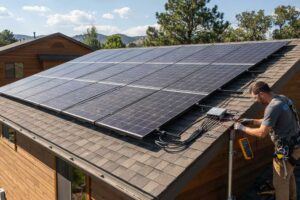
Flexible Solar Panel Price per Watt: Factory vs Distributor
Factory Price vs Distributor Price: Where Your Money Goes
The rule: there is no single solar panel price per watt — the same flexible module is $0.45-0.75/W at a factory gate in Shenzhen and $1.40-2.10/W on a retail shelf, and every step between them is a real cost, not a markup. This page is the buying side of that chain: what flexible panels cost per watt at each wattage, at what quantity a factory actually quotes you its factory price, and what freight does to the number you finally pay per watt. The chain arithmetic in full is in our solar panel price breakdown from factory gate to retail shelf; here we stay on the numbers you negotiate.
| Chain position | Flexible ETFE, 100-300W | What it covers | Typical multiplier | Factory FOB, China |
|---|---|---|---|---|
| $0.45-0.75/W | Module, packed, export carton | baseline | Landed at distributor | $0.85-1.25/W |
| Ocean freight, duty, import handling | +8-15% on goods, then distributor margin 30-50% | Retail shelf | $1.40-2.10/W | Storage, marketplace fees, slow-moving sizes |
| +60-100% on landed |

Three multipliers sit between the first and last row. Freight and duty add 8-15 percent depending on HS code and destination. The distributor adds 30-50 percent at container volume — that margin buys credit terms, mixed-SKU pallets and local warranty handling. Retail adds 60-100 percent on top, because a shelf has to carry sizes that sit in the warehouse for months. When a factory quote at $0.55/W and a retail tag at $1.80/W describe the same 100W panel, both are honest numbers for two different businesses.
Flexible Solar Panel Price per Watt by Wattage Band
Price per watt falls as wattage rises, and the reason is fixed hardware: a junction box, cable, connector and edge seal cost roughly $8-14 per panel whether the panel is 100W or 400W. Spread that over more watts and the $/W number drops. The bands below are factory FOB at order volumes of 200 pieces and up, consistent with our published cost guide.
| Wattage | Factory FOB per watt | Factory FOB per panel | Retail shelf per panel |
|---|---|---|---|
| 100W | $0.55-0.80 | $55-80 | $140-210 |
| 200W | $0.50-0.70 | $100-140 | $280-420 |
| 300W | $0.45-0.75 | $135-225 | $420-630 |
Two quotes outside these bands tell you something. A flexible quote under $0.40/W is built on B-grade cells — up to 6 percent of rated power missing, which is about 12 percent of the price the factory saved. A quote far above the retail band for the same wattage usually means a premium front sheet or a certification the buyer did not ask for. Surface material alone moves the price 15-20 percent: ETFE against PET, which is why we put the chemistry trade-off in a separate guide.
What Quantity Actually Gets You the Factory Price
The rule: below roughly 200 pieces you are paying for line changeover, not for cells — the price curve is flat at the bottom and steep in the middle. The tiers below are the ones we quote against; custom specifications carry an MOQ of 100-500 pieces depending on panel size, while a standard module with your branding only starts at 200 pieces.
| Order tier | Quantity | What gets customised | Lead time | Price position |
|---|---|---|---|---|
| Sample | 1-2 pcs | Standard spec, cable cut to length | 3-5 days | quoted per model |
| Trial | 10-49 pcs | Connector type, cable length, label | 7-10 days | base price, no discount |
| Batch | 50-199 pcs | Panel dimensions within the cell grid, junction box position | 12-15 days | 15-25% small-lot premium |
| Container | 200-499 pcs | OEM label, packaging, per-pallet EL report | 18-22 days | factory price |
| Full container | 500+ pcs | Carton artwork, private-label datasheet, dedicated IV curve file | 25-30 days | best $/W of the run |
Samples sit outside the ladder: prototype runs of 5-15 pcs carry no MOQ, and the sample cost is credited against your bulk order. What you cannot buy at factory price is a ten-piece order — at that size the factory is selling you setup time, and the premium is real.
What Freight Does to Your $/W
The rule: a flexible panel cubes out before it weighs out — you plan freight by carton volume, not by weight, and at container volume freight is small enough that a $5 FOB difference per unit matters more than anything your forwarder can shave. At current ocean rates ($4,200 per 40HQ) freight adds the following to a 100W flexible module packed in a 535 x 555 x 45 mm carton:
| Mode | What you ship | Freight per 100W panel | Freight per watt | When it makes sense |
|---|---|---|---|---|
| Ocean FCL, 20GP | 1,900-2,200 panels | about $0.55-0.63 | $0.006/W | batch and container tiers |
| Ocean FCL, 40HQ | 4,400-5,100 panels | about $0.82-0.95 | $0.009/W | 500+ pcs, mixed SKUs allowed |
| LCL | any quantity under a container | $5-8 (minimum charges dominate) | $0.05-0.08/W | trial orders 10-100 pcs |
| Air express | per shipment | $10-16 (2 kg packed at $5-8/kg) | $0.10-0.16/W | samples and deadline orders |

For contrast, the 300W module at the same ocean rate costs $2.0-3.7 per panel in freight ($0.007-0.012/W) — the bigger panel dilutes the fixed handling cost further. Duty and import VAT ride on top of the goods value: add 8-15 percent for freight and duty combined on most destinations, with VAT typically recoverable for registered importers. The number to remember: at container volume freight is under two cents per watt, but in the air it is a tenth of a dollar and more — which is why samples fly and containers float.


Worked Example: Landing a 200W L-Series Order at Three Sizes
All numbers below are indicative landing costs for the BS200-FT-M(E), the 200W module in our L Series: 1,572 x 702 x 3.1 mm, 3.9 kg, DuPont ETFE front sheet, IP67 junction box, S304 eyelets, 3-year warranty. The panel ships in a carton of roughly 0.062 cubic metres, so a 500-piece order fills a 20GP.
| Order size | FOB per panel | Freight per panel | Landed per panel (incl. duty) |
|---|---|---|---|
| 50 pcs (small lot) | $125-160 | $5-8 LCL | $135-175 |
| 200 pcs (container tier) | $110-130 | $5-7 LCL or shared | $120-145 |
| 500 pcs (full 20GP) | $100-120 | $2.4-3.0 | $112-130 |
Read the last column per watt: $0.56-0.68/W landed at 500 pieces against $1.40-2.10/W retail — that spread is the distributor margin you keep or the price advantage you pass on. The same panel at 50 pieces lands near $0.68-0.88/W, which is why serious private-label programs start at the container tier. If your application lives on an RV roof or a curved van surface, start from the L Series flexible solar panels for RV and work down by wattage; the BS200-FT-M(E) specification page carries the full electricals behind this example.
Costs That Hide Outside the $/W Quote
Four line items never appear in a per-watt quote but always appear in the invoice. First, tooling and samples: prototype runs are credited against the bulk order, but revisions beyond two free rounds carry an engineering fee. Second, cell grade: the B-grade trap is worth repeating — a $0.35/W flexible quote is built on cells that give back up to 6 percent of rated power. Third, custom dimensions: sizes are possible within the cell grid in roughly 80 mm steps on the long edge, and below that increment the factory is cutting cells, which costs more than it saves. Fourth, certification scope: CE and RoHS documents are part of the base quote, but destination-specific marks are priced per project. What each of these does to lead time and cost is set out in the custom solar panel process page, and the front-sheet chemistry decision is in what ETFE actually buys you.
FAQ: Flexible Solar Panel Price per Watt
What is a good price per watt for flexible solar panels?
At the factory gate for container quantities, $0.45-0.75/W for ETFE-front modules is the honest 2026 band, with 100W panels at the top of it and 300W at the bottom. On a retail shelf, expect $1.40-2.10/W. A factory quote under $0.40/W is a B-grade or PET-front build, and the watts you did not pay for come back as warranty claims.
How much does freight add per watt?
At container volume, $0.006-0.015/W for ocean freight depending on panel size — small enough that you negotiate the module price, not the shipping. LCL shipments run $0.05-0.08/W because minimum charges dominate. Air express costs $0.10-0.16/W, which is a sample-service price, not a bulk price.
At what quantity do you get the real factory price?
200 pieces is where the factory price starts and 500 pieces is where the best per-watt price of the run sits. Between 50 and 199 pieces expect a 15-25 percent premium over the MOQ price, and below 50 you are buying setup time. Custom specifications need 100-500 pieces depending on panel size; branding a standard module starts at 200.
Can I mix wattages in one container order?
Yes — mixed-SKU pallets are normal at container tier, and it is one of the reasons distributors buy at 500 pieces instead of 200. The loading plan is confirmed with a packing drawing before the contract is signed, so the mixed pallet costs you negotiation time, not freight surprise.
Conclusion: Buy on $/W, Ship on Volume
The solar panel price per watt you finally pay is three decisions, not one: which wattage band (bigger panels dilute the fixed hardware), which order tier (200 pieces opens the factory price, 500 opens the container price), and which freight mode (ocean FCL costs less per watt than the coffee you drink while it sails). The rule: get the FOB band, add 8-15 percent for freight and duty, and treat anything below $0.40/W as a question about cell grade rather than a bargain. Send wattage, quantity and destination port, and the quotation comes back with the loading plan attached — the same route every L Series and custom order follows.
Related recommendations
-

Solar Panel in Series: How to Wire Panels for Higher Voltage
538Learn how solar panel in series connections increase voltage, size strings safely, and match MPPT controllers. Practical wiring guidance for RV and off-grid solar.
View details -
Solar Panel Series Parallel: How to Wire Panels Correctly
386Solar panel series parallel wiring combines series and parallel connections to increase both PV voltage and current while staying within equipment limits.
View details -
Flexible solar panel for car: Lightweight Solar Energy Solution for Modern Vehicles
417Discover flexible solar panel for car solutions from Bright Solar. Learn how lightweight solar panels improve vehicle energy efficiency for EVs, RVs, and off-grid automotive applications.
View details -
Solar Panel Wiring Series vs Parallel: Which Is Better?
309Solar panel wiring series vs parallel depends on voltage, current, controller limits, cable distance, and shading conditions.
View details