Solar Panel Series Parallel: How to Wire Panels Correctly
Direct answer:
Solar panel series parallel wiring combines series and parallel connections to increase both array voltage and current. Series wiring adds voltage, parallel wiring adds current, and the final configuration must stay within the MPPT or inverter’s voltage and current limits.
What Is Solar Panel Series Parallel Wiring?
solar panel series parallel wiring means building two or more identical series strings and then connecting those strings in parallel.
For example, four 200W panels can be wired as 2S2P:
- Two panels connected in series = one string
- Another two panels connected in series = second string
- The two strings are then connected in parallel
- Total panel power remains 800W
- String voltage is doubled
- Array current is doubled
This arrangement is common when the system needs more voltage than a single panel can provide but also needs additional current without pushing the operating voltage too high.
The U.S. Department of Energy explains that PV modules are commonly connected in both series and parallel to meet required voltage and current levels.
Solar Panels in Series vs Parallel
The electrical behavior is straightforward, but it matters enormously when selecting a charge controller.
| Wiring method | Voltage | Current | Typical purpose |
|---|---|---|---|
| Series | Adds | Stays approximately the same | Increase PV voltage |
| Parallel | Stays approximately the same | Adds | Increase PV current |
| Series parallel | Adds within each string | Adds between strings | Increase both |
| 2S2P | 2× panel voltage | 2× panel current | Balanced array design |
The basic electrical relationship is:
Series:
Vtotal = V1 + V2 + V3…
Itotal ≈ Ipanel
Parallel:
Vtotal ≈ Vpanel
Itotal = I1 + I2 + I3…
Series parallel:
Varray ≈ number of panels in series × Vpanel
Iarray ≈ number of parallel strings × Ipanel
NREL’s photovoltaic modeling work likewise treats a PV array as modules connected in series and parallel, with the resulting array voltage and current determined by the number of series modules and parallel strings.
Why Series Wiring Increases Voltage
Imagine two panels rated at:
- Vmp: 20V
- Imp: 10A
- Power: 200W
Connect them in series:
20V + 20V = 40V
Current remains approximately:
10A
So the array is approximately:
40V × 10A = 400W
The important point is that the word “12V” printed in some portable or RV solar panel marketing does not necessarily mean the panel actually operates at 12V.
Actual electrical design should use the manufacturer’s Voc, Vmp, Isc and Imp values.
Why Parallel Wiring Increases Current
Using the same two 200W panels:
- Vmp = 20V
- Imp = 10A
Parallel wiring gives approximately:
20V
and:
10A + 10A = 20A
Power remains approximately:
20V × 20A = 400W
The U.S. Department of Energy describes the same fundamental behavior: in series, voltages add while amperage stays the same; in parallel, voltage stays the same while amperage adds.
How to Wire Solar Panels in Series Parallel
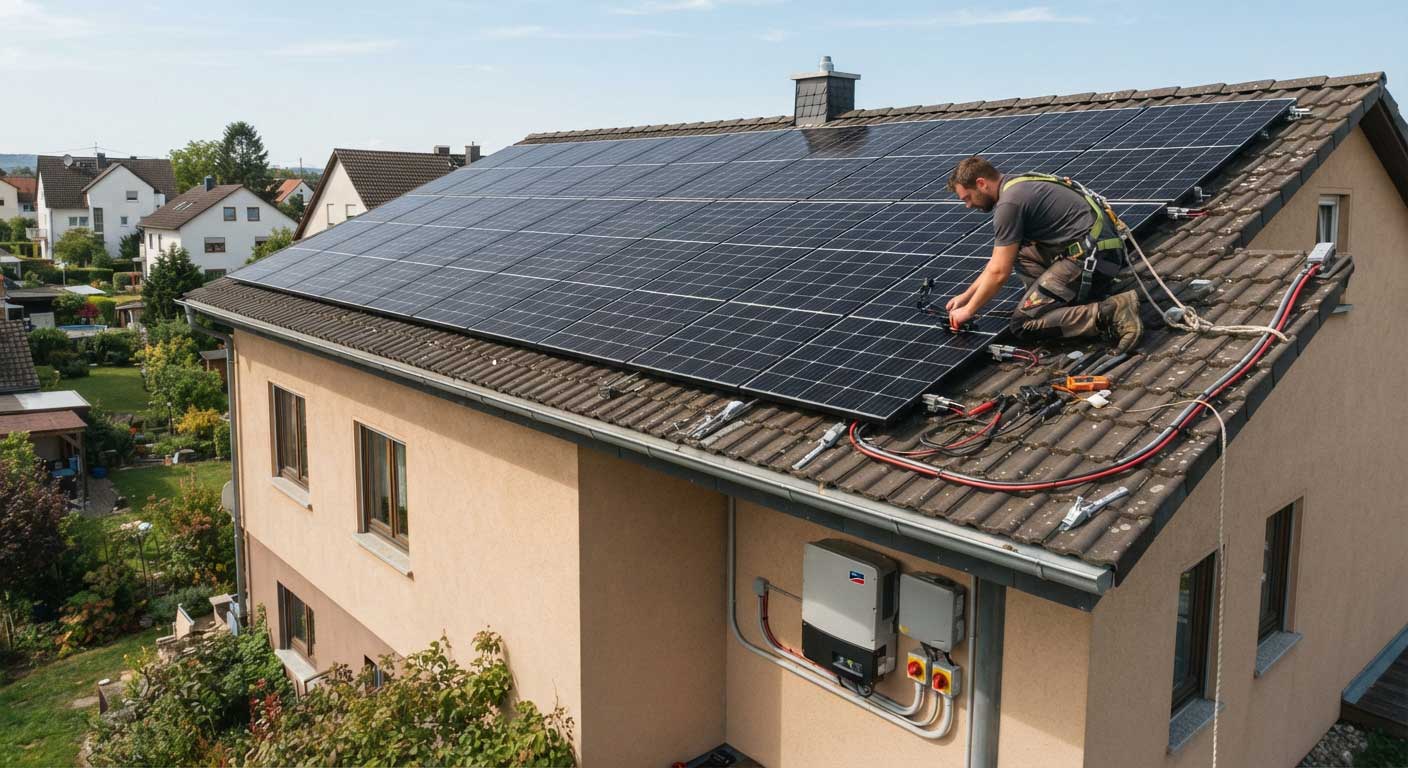
For a typical 2S2P solar array, I recommend calculating the electrical limits before touching the MC4 connectors.
The physical wiring is simple. The sizing is where installations usually go wrong.
Step 1: Check the Panel Electrical Specifications
Record these four numbers from the panel datasheet:
- Voc — open-circuit voltage
- Vmp — voltage at maximum power
- Isc — short-circuit current
- Imp — current at maximum power
Do not design a series string from the nominal “12V” or “24V” label alone.
A panel marketed as a 12V module can have a substantially higher Voc. Victron specifically warns that series-string calculations must use Voc and account for temperature because PV voltage rises as temperatures fall.
Step 2: Determine the Number of Panels in Series
Suppose a 200W panel has:
- Voc = 24V
- Vmp = 20V
- Isc = 10.5A
- Imp = 10A
Two panels in series produce approximately:
- Voc = 48V
- Vmp = 40V
- Imp = 10A
Three panels would produce:
- Voc = 72V
- Vmp = 60V
- Imp = 10A
But 72V is not automatically safe just because the MPPT is labeled “75V.”
Cold-weather Voc must be considered.
This is one of the most important details I check when reviewing solar wiring. A string that looks acceptable on a warm afternoon can exceed the controller’s maximum PV voltage during a cold morning.
Step 3: Determine the Number of Parallel Strings
If you build two identical 2-panel series strings and connect them in parallel:
String 1: 2 panels series
String 2: 2 panels series
Then:
- Array Vmp ≈ 40V
- Array Imp ≈ 20A
- Array power ≈ 800W
The voltage does not double again when the strings are paralleled.
Only the current increases.
Step 4: Check the MPPT Controller
This is where a theoretical wiring configuration becomes a real system design.
Check:
- Maximum PV open-circuit voltage
- Recommended PV operating voltage
- Maximum PV input current
- Maximum PV power
- Battery voltage
- Number of MPPT trackers
- Manufacturer’s wiring requirements
For example, Victron’s MPPT documentation specifies both maximum PV voltage and minimum PV voltage requirements. Its manuals also explicitly allow series, parallel and series-parallel PV configurations when the array stays within the controller’s limits.
Solar Panel Series Parallel Example: 2S2P
A 2S2P configuration is one of the easiest ways to understand the concept.
Assume four identical 200W panels:
| Specification | One Panel | 2 Panels Series | 2S2P Array |
|---|---|---|---|
| Rated power | 200W | 400W/string | 800W |
| Vmp | 20V | 40V | 40V |
| Imp | 10A | 10A | 20A |
| Voc | 24V | 48V | 48V* |
*The parallel strings retain approximately the same voltage.
So the final array is roughly:
40V × 20A = 800W
The power calculation looks almost too neat. Real operating output will not be exactly 800W because irradiance, cell temperature, wiring losses, mismatch and equipment efficiency affect production.
NREL notes that PV module behavior changes with irradiance and temperature, and that the array’s electrical characteristics depend on how modules are interconnected.
That is why I would never size a system from wattage alone.
When Should You Use Series Parallel Solar Panels?
A series-parallel configuration makes sense when a single series string cannot provide the desired power or when simply putting everything in series would push voltage too high.
1. Larger Off-Grid Battery Systems
For 24V or 48V battery systems, higher PV voltage can make the charge-controller input easier to manage.
A higher PV operating voltage can also reduce current on the PV wiring for the same power.
That matters when cable runs become longer.
For example, an 800W array operating around 40V requires approximately:
800W ÷ 40V = 20A
At 80V, the same theoretical power requires:
800W ÷ 80V = 10A
Lower current can reduce voltage drop and conductor losses, assuming the equipment is properly rated.
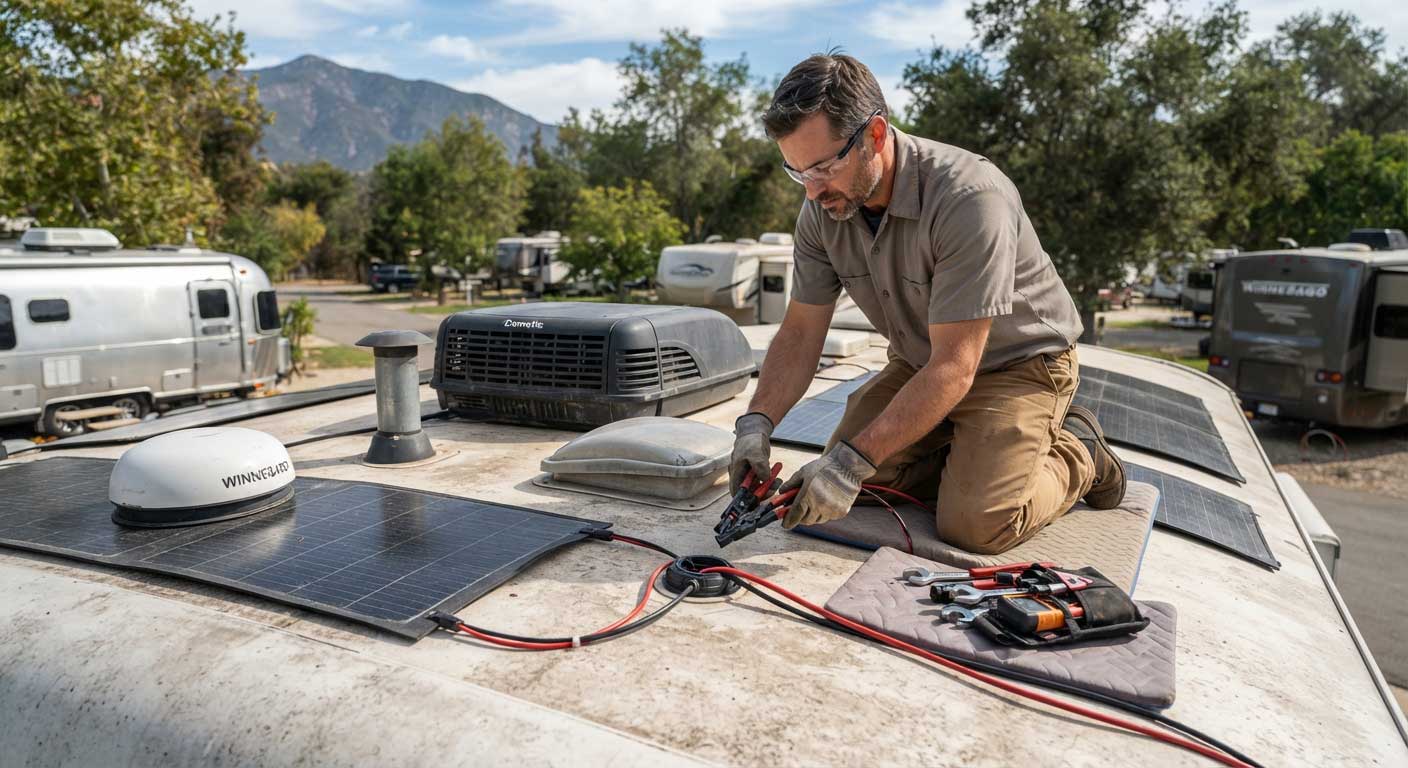
2. RV Solar Systems
RV roofs often create awkward wiring conditions.
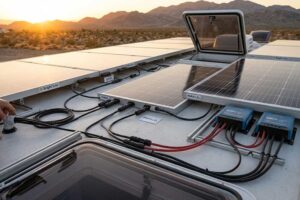
Panels may be physically separated by roof vents, air conditioners, skylights and antennas. A series-parallel configuration can sometimes provide a better electrical compromise than connecting every panel in one long series string.
However, shading deserves special attention.
A panel partly shaded by an air conditioner can affect the output of a series string. Parallel strings can sometimes offer more flexibility, but they do not magically eliminate shading losses.
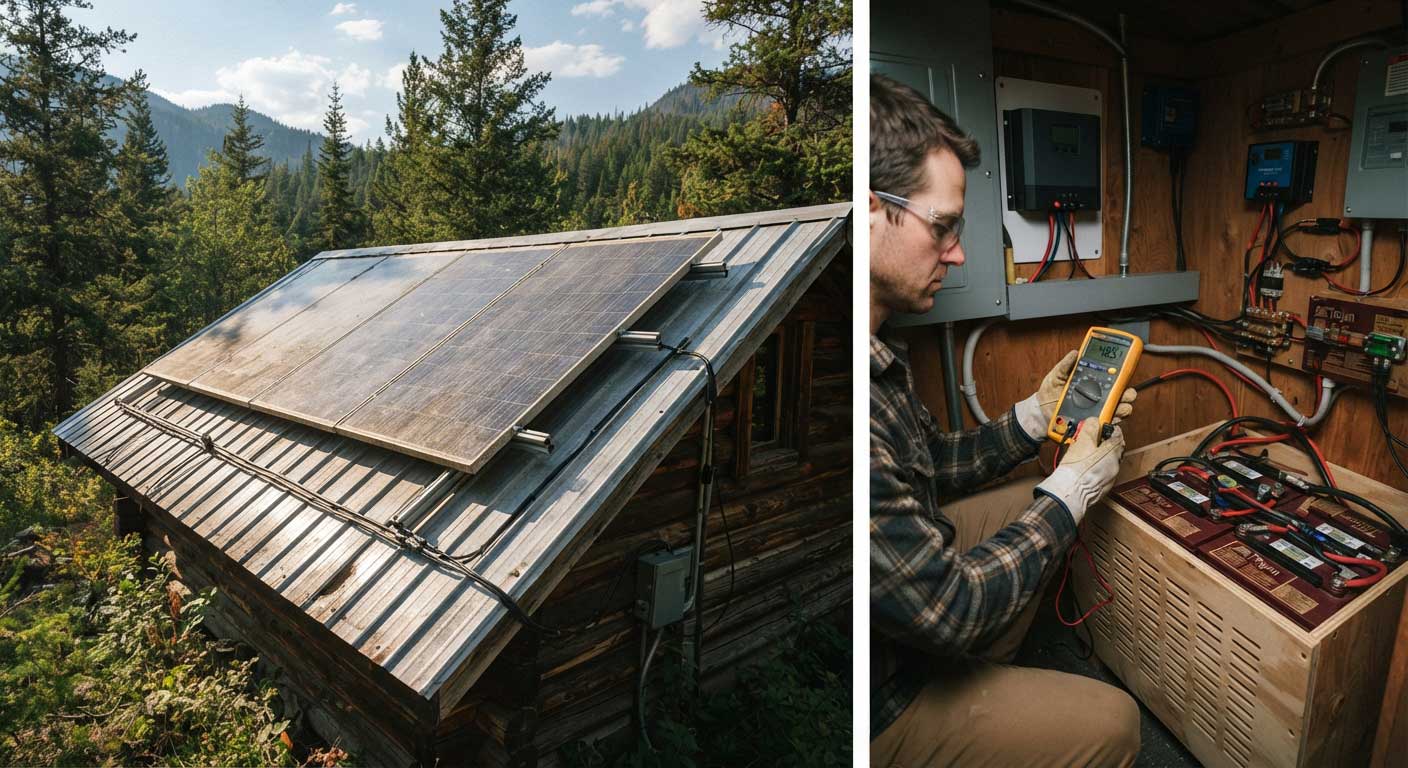
3. Off-Grid Cabins and Remote Loads
For a remote cabin, I usually look at the battery voltage, controller limits, cable distance and panel layout together.
A 2S2P arrangement can be particularly practical when four matching modules are available and the controller’s voltage/current window suits the configuration.
Series Parallel Solar Panels and Partial Shading
Partial shading is where the “series is always better” argument falls apart.
If one panel in a series string is heavily shaded, the string’s operating behavior can be affected because the same current flows through the series-connected modules.
Parallel strings provide another electrical path, but the actual result depends on module bypass diodes, shading location, MPPT behavior and system design.
This is why I prefer to look at the roof itself before deciding on wiring.
A chimney on paper is a small detail.
At 4:30 p.m. in November, it can become the most important detail on the roof.
NREL’s PV modeling documentation emphasizes that irradiance and module temperature affect PV current-voltage characteristics.
For complex roofs, multiple MPPT inputs can sometimes be more useful than forcing every panel into one large series-parallel array.
What Happens If You Mix Different Solar Panels?
This is one of the areas where DIY installations frequently become unnecessarily complicated.
Ideally, panels within the same series string should have closely matched electrical characteristics.
For parallel strings, operating voltage should also be compatible.
Consider two panels:
Panel A
- Vmp: 20.0V
- Imp: 10A
Panel B
- Vmp: 18.5V
- Imp: 8A
Putting mismatched modules together does not mean the system will simply operate at the sum of their nameplate wattages.
The MPPT operating point is determined by the combined electrical characteristics.
If you are expanding an existing array, I would first check:
- Vmp
- Voc
- Imp
- Isc
- temperature coefficients
- module technology
- manufacturer recommendations
Victron’s technical community guidance similarly recommends comparing Vmp for parallel connections and Imp for series connections when combining different panels.
When possible, use identical panels in each string.
Solar Panel Series Parallel Wiring Mistakes to Avoid
Using the Panel’s Nominal Voltage for Voltage Calculations
“12V panel” is not the number you should use when checking the controller’s maximum PV voltage.
Use Voc, then apply the appropriate temperature correction.
Ignoring Cold-Weather Voc
PV voltage rises when the module temperature drops.
This is particularly important in northern U.S. states, Canada and colder European climates.
The controller’s maximum PV voltage is an absolute electrical limit, not a target.
Connecting Unequal Series Strings in Parallel
Two parallel strings should normally have the same number of panels and closely matched electrical characteristics.
For example:
2S + 2S → reasonable configuration
while:
2S + 3S → generally not an appropriate pairing on one MPPT
unless the equipment and design specifically support the arrangement.
Forgetting Current Limits
Series wiring often gets attention because of voltage.
Parallel wiring can create the opposite problem: too much current.
For example, four 10A panels in parallel theoretically create approximately:
40A
That affects connectors, fuses, cable sizing, combiner equipment and controller input limits.
Victron lists a 30A maximum current per MC4 connector for certain of its MPPT products, illustrating why connector and equipment ratings must be checked rather than assumed.
Assuming More Panels Always Means More Usable Power
An MPPT controller may limit input power if the connected PV array exceeds its rated power.
Victron documents this behavior for several MPPT products.
Oversizing PV can be intentional on some systems, but it should be done according to the controller manufacturer’s specifications.
A Practical 800W Solar Panel Series Parallel Case
Here is a configuration I would consider for a small off-grid installation.
The system has:
- Four 200W monocrystalline panels
- 800W total rated PV
- 24V battery bank
- MPPT charge controller
- Moderate cable distance between roof and controller
Each panel:
- Vmp: 20V
- Voc: 24V
- Imp: 10A
- Isc: 10.5A
A 2S2P arrangement produces approximately:
- Vmp: 40V
- Voc: 48V
- Imp: 20A
- Isc: 21A
- Rated power: 800W
The advantage is balance.
The array is no longer sitting at roughly 20V with 40A of operating current, and it is not pushing four panels into a single approximately 80V string either.
But I would still check the controller’s cold-weather maximum Voc before approving the design.
If the project were in a colder climate, that calculation could change the number of panels per string.
How to Choose Between Series, Parallel and Series Parallel
There is no universal “best” wiring method.
The right choice depends on the equipment around the panels.
| Situation | Usually worth considering |
|---|---|
| Need higher PV voltage | Series |
| Need higher PV current | Parallel |
| Need higher voltage and current | Series parallel |
| Long PV cable run | Series or series parallel |
| Multiple roof orientations | Separate MPPTs may be preferable |
| Heavy partial shading | Analyze string layout carefully |
| 24V/48V off-grid system | Series or series parallel |
| Small 12V portable system | Parallel can be practical |
| Large PV array | Series strings + parallel strings |
For professional design, I would start with the controller and inverter specifications, then work backward to the panels.
Not the other way around.
Solar Panel Series Parallel Wiring Checklist
Before connecting the final PV cables, verify:
- Panel Voc is known
- Panel Vmp is known
- Panel Isc is known
- Panel Imp is known
- Number of panels in each series string is equal
- Parallel strings use compatible panels
- Maximum cold-weather Voc is below controller limit
- PV operating voltage is suitable for the MPPT
- Total PV current is within equipment limits
- Cable size is appropriate
- Connectors are properly rated
- PV fusing/disconnection requirements are satisfied
- Polarity has been verified before connection
Victron’s installation guidance specifically requires attention to maximum open-circuit PV voltage and also recommends considering temperature when calculating series-string voltage.
Solar Panel Series Parallel FAQ
Is it better to connect solar panels in series or parallel?
Neither is universally better. Series wiring increases voltage, while parallel wiring increases current. A series-parallel configuration is often useful when the system needs both higher voltage and higher current.
Can I connect solar panels in series and parallel at the same time?
Yes. This is exactly what a series-parallel array does. For example, four identical panels can be configured as two panels in series and two identical strings in parallel, commonly called 2S2P.
Does series or parallel produce more power?
With identical panels under the same conditions, properly designed series and parallel connections can produce approximately the same theoretical total power. The difference is how that power is distributed between voltage and current.
How many solar panels can I connect in series?
The number depends on the panel’s Voc, temperature coefficient, expected minimum temperature and the MPPT or inverter’s maximum PV voltage. Do not determine the number from the panel’s nominal 12V or 24V label.
Can different solar panels be connected in series parallel?
They can sometimes be combined, but matching electrical characteristics is strongly preferred. Panels in series should have compatible operating current, while parallel strings should have compatible operating voltage.
Does series wiring lose power when one panel is shaded?
Shading can reduce the output of a series string because current is constrained by the string’s electrical behavior. Bypass diodes and MPPT behavior can reduce some effects, but string layout should still be designed around real shading conditions.
Is series parallel good for RV solar panels?
Yes, when the charge controller supports the resulting voltage and current. Series-parallel wiring can be useful for larger RV arrays, particularly when a higher PV voltage is desirable, but roof shading and controller limits should be checked first.
Bright Solar’s Practical View on Series Parallel PV Design
At Bright Solar, the useful question is not simply “series or parallel?”
It is:
What voltage does the controller need, what current can it accept, how long is the cable run, and what will the panels experience at the coldest and hottest part of the year?
That approach prevents a surprisingly common design mistake: calculating an attractive wattage number first and discovering later that the PV voltage is outside the controller’s allowable range.
For flexible solar panels, RV applications and compact off-grid systems, physical installation conditions matter just as much as electrical calculations. Roof curvature, ventilation, shading, cable routing and surface temperature can all influence the final configuration.
Final Takeaway: Solar Panel Series Parallel
A properly designed solar panel series parallel system uses series connections to establish the required PV voltage and parallel connections to increase available current. The final configuration must be checked against Voc, Vmp, Isc, Imp, temperature, cable losses and the controller or inverter’s electrical limits.
For reference, the U.S. Department of Energy confirms the fundamental series/parallel behavior of PV arrays, while NREL provides detailed photovoltaic array modeling that accounts for series and parallel module configurations.
The practical rule I use is simple: design from the controller’s limits and the site’s real conditions, then choose the panel wiring configuration.
Related recommendations
-

1000W Solar Panel Guide: What a 1000W Solar Panel Can Really Power
275Learn how a 1000W solar panel system works, what it can power, expected daily output, installation options, and whether it fits your RV, home, boat, or off-grid project.
View details -
Tiny Homes Solar Power: How to Size a Solar System
307Discover how tiny homes solar power systems are sized for daily loads, batteries, roof space, and off-grid living with practical calculations and expert tips.
View details -
JA Solar DeepBlue 3.0 Modules Power JSW Energy 225MW Solar Plant in India
271JA Solar DeepBlue 3.0 modules have been installed at JSW Energy’s 225MW solar plant in Karnataka, India, supporting JSW Group’s low-carbon strategy and helping drive India’s transition to clean energy through large-scale PV projects.
View details -
Solar Panels Series or Parallel: Which Wiring Method Works Better?
143Learn whether solar panels series or parallel wiring is better for RVs, boats, homes, and off-grid systems. Compare efficiency, shading, and performance.
View details