Cheap Flexible Solar Panels: Cost, Quality, and Buying Guide
A cheap flexible solar panels purchase can reduce the upfront budget, but the lowest unit price is not always the lowest project cost. For RVs, boats, vans, and OEM systems, compare wattage, weight, efficiency, bending limits, materials, electrical ratings, installation labor, and expected service conditions before choosing a supplier.
What Makes Flexible Solar Panels Cheap?
Price differences between flexible solar panels are usually caused by more than the photovoltaic cells themselves.
Two panels can have the same nominal wattage and still have very different manufacturing costs.
The difference may come from:
- Cell technology
- Cell grade and sorting
- Module efficiency
- Encapsulation material
- Front-surface material
- Rear protective layer
- Junction box design
- Connector quality
- Lamination process
- Automation level
- Module dimensions
- Customization
- Production volume
- Quality-control requirements
- Certification and testing
This is particularly important when evaluating cheap flexible solar panels from overseas suppliers.
A low quotation may represent a genuine manufacturing advantage. It may also represent a simplified construction that is unsuitable for a demanding application.
For B2B buyers, the useful question is not simply “How cheap is the panel?”
It is:
What exactly has been removed from the cost?
That question often reveals more than a product comparison table.
Cheap Flexible Solar Panels vs. Low-Cost Solar Projects
There is a difference between a cheap panel and a low-cost solar installation.
Consider a hypothetical 100-unit RV project.
Supplier A quotes a lower module price, but the panel requires additional mounting preparation, has a less convenient cable position, and creates more installation labor.
Supplier B charges slightly more per module but provides a better dimensional fit and simpler installation.
The purchasing department may initially favor Supplier A.
The operations team may calculate the project differently.
| Cost factor | Supplier A | Supplier B |
|---|---|---|
| Module purchase price | Lower | Higher |
| Installation labor | Higher | Lower |
| Roof preparation | More | Less |
| Cable modification | Possible | Minimal |
| Rework risk | Higher | Lower |
| Total project cost | Not necessarily lower | Potentially lower |
This is one of the most useful purchasing lessons in flexible PV: unit price and installed cost are not the same number.
For a manufacturer assembling hundreds or thousands of vehicles, even a small installation difference can become significant.
Why Flexible Solar Panels Have a Different Cost Structure
Conventional rigid modules benefit from highly standardized construction. Flexible modules have to solve an additional mechanical problem: they need to generate electricity while tolerating controlled curvature and movement.
IEC 61215 includes specific test methods for flexible PV modules, including the MQT 22 bending test. The standard also states that qualification testing is not a quantitative prediction of module lifetime.
That matters when a supplier describes a panel as “flexible.”
Flexibility is not simply a matter of making the module thinner.
The cell interconnection, encapsulation, protective layers, lamination, electrical junction, and mechanical structure all have to work together.
A very cheap panel may still be perfectly acceptable for a low-risk application. But the buyer needs to know what application the product was designed for.
What Should You Check Before Buying Cheap Flexible Solar Panels?
1. Rated Power
Start with the actual rated output.
A supplier offering a 200 W panel at an unusually low price may appear attractive until you compare its dimensions and efficiency with competing products.
Power should always be considered together with usable surface area.
For an RV roof with limited space, a more efficient panel may provide more rated watts from the same roof area.
2. Module Efficiency
Efficiency tells you how effectively the module converts incident sunlight into electrical output under its rated test conditions.
It should not be used alone.
A cheap flexible solar panel with lower efficiency can still make sense if there is plenty of installation area.
For a small van roof covered by vents and skylights, the calculation changes.Learn more about the Flexible Solar Panel Installation Guide
This is why professional purchasing teams should compare watts per square meter, not only price per watt.
3. Weight
Weight is one of the reasons flexible modules are considered for mobile applications.
DOE research on vehicle-applied PV notes that flexible and semi-flexible modules are used on vehicles and are commonly attached with adhesives, while rigid PV products are generally bracket-mounted.
For an RV, camper van, trailer, or boat, reducing module weight can simplify handling and installation.
But weight should not be treated as an automatic quality indicator.
A very light module may use a construction that is inappropriate for the intended environment.
Ask why it is light.
4. Bending Radius
Never accept “flexible” as the complete specification.
Request the manufacturer’s minimum bending radius.
The installation surface should be measured before purchasing.
If the roof curvature is tighter than the panel’s permitted bending range, a low price will not solve the mechanical problem.
The IEC’s flexible-module testing framework is another reason to request technical documentation rather than relying on photographs or a supplier’s marketing description.
5. Surface Material
The top layer has a direct relationship with the module’s environmental exposure.
Depending on the product, flexible modules may use different polymer or composite constructions.
Ask:
- What is the front material?
- Is it UV resistant?
- Is it scratch resistant?
- Is it suitable for saltwater exposure?
- How should it be cleaned?
- What temperature range is specified?
Do not assume that two panels with the same black appearance have the same surface construction.
Cheap Flexible Solar Panels for RVs: Where the Savings Matter
RV applications are a good example of why purchasing decisions should include installation.
A roof may have an air conditioner, vent, antenna, skylight, satellite equipment, roof rack, and curved sections.
The panel has to fit around all of them.
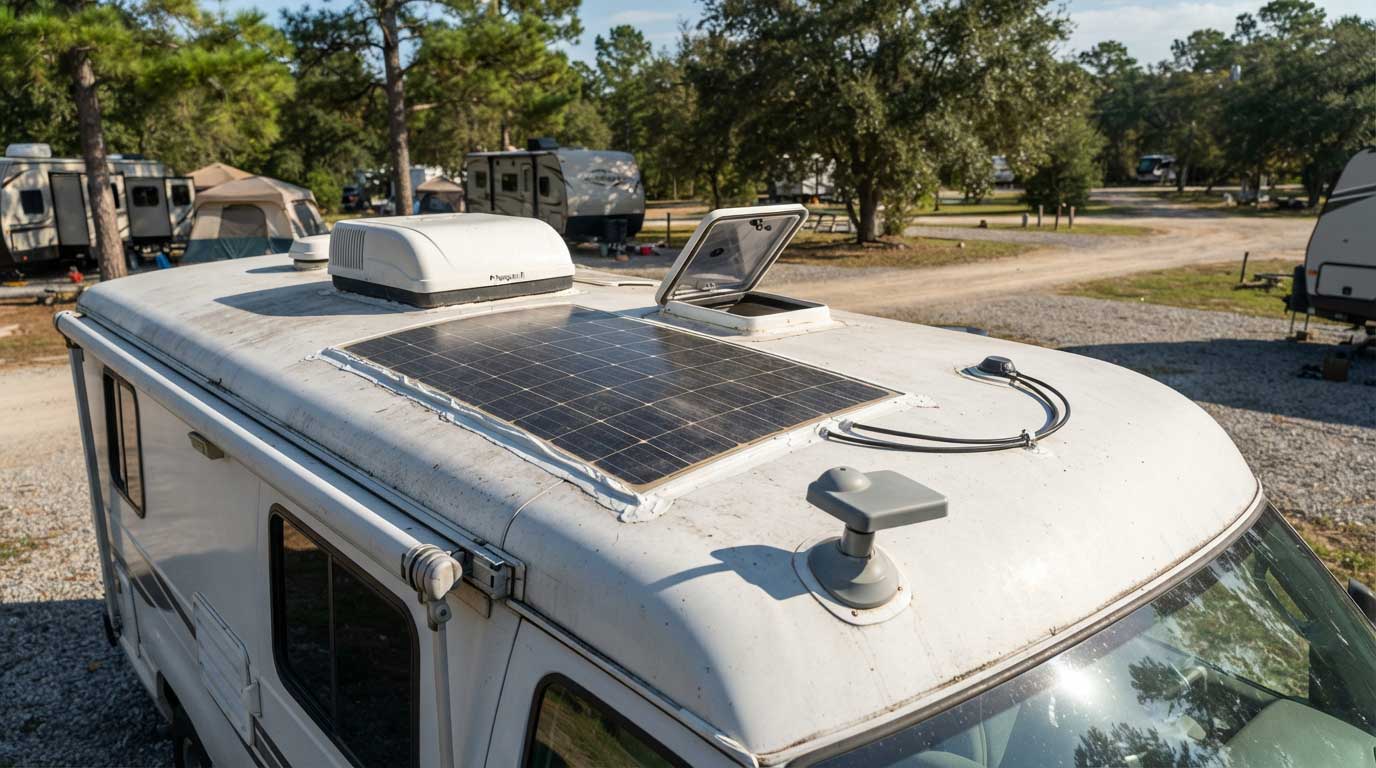
A flexible panel may allow more usable roof area.
That does not automatically mean it produces more energy.
The useful comparison is the complete system:
available roof area → module power density → array size → installation method → controller capacity → battery capacity → expected energy demand.
That is where a cheap panel either makes sense or stops making sense.
How Much Should Cheap Flexible Solar Panels Cost?
There is no single reliable retail price that applies to every flexible module.
Pricing changes with wattage, dimensions, cell technology, materials, order volume, customization, certification, shipping terms, and market.
For comparison, DOE’s U.S. PV cost benchmarks show why module pricing should not be confused with complete system pricing. Its 2025 Q1 benchmark for an 8 kW residential PV-only system was $2.78/W at the minimum sustainable price level and $2.95/W at the modeled market price level, while the benchmark explicitly covers the complete PV system rather than simply a flexible module.
NREL has also published historical residential modeling inputs showing an ex-factory first-buyer price of $0.34/W for Tier 1 monocrystalline modules in its cited dataset. That figure is not a current quote for flexible modules and should not be used as one.
The distinction is important.
A buyer should not take a conventional rigid-module benchmark and assume that it represents a fair price for a flexible custom module.
Flexible products can involve different materials, processes, dimensions, and mechanical requirements.
Cheap Flexible Solar Panels for Boats
Marine buyers should be particularly careful with low-cost offers.
A boat roof may look like an easy mounting surface, but the environment is harsh.
Saltwater, UV exposure, vibration, moisture, temperature changes, and foot traffic can all affect the installation.
A cheap flexible solar panel may be suitable for a protected cabin roof.
The same product may be a poor choice for an exposed deck.
Before buying, identify:
- Freshwater or saltwater environment
- Cabin roof or exposed deck
- Walkable or non-walkable area
- Expected UV exposure
- Cleaning requirements
- Cable protection
- Connector location
- Required environmental protection
- Expected operating temperature
For marine applications, price should come after environmental compatibility.
Cheap Does Not Mean Poor Quality
This point deserves attention because “cheap” is often used too broadly.
A competitively priced flexible solar panel can be a good product.
A manufacturer may reduce cost through:
- High production volume
- Efficient material purchasing
- Automated lamination
- Standardized dimensions
- Repeat orders
- Simplified packaging
- Direct factory supply
- Stable component sourcing
None of these automatically indicates poor quality.
The warning sign is not a low price.
The warning sign is a low price combined with missing technical information.
If a supplier cannot provide basic electrical specifications, dimensional drawings, material information, test documentation, or installation limitations, the purchasing risk is much higher.
Part 1 Practical Evaluation Table
Before requesting samples, prepare a comparison sheet.
| Specification | Supplier A | Supplier B | Supplier C |
|---|---|---|---|
| Rated power | — | — | — |
| Efficiency | — | — | — |
| Dimensions | — | — | — |
| Weight | — | — | — |
| Vmp | — | — | — |
| Voc | — | — | — |
| Imp | — | — | — |
| Isc | — | — | — |
| Bending radius | — | — | — |
| Surface material | — | — | — |
| Connector | — | — | — |
| Warranty | — | — | — |
| Certification | — | — | — |
| MOQ | — | — | — |
| Sample price | — | — | — |
| Production lead time | — | — | — |
This table looks simple.
In actual sourcing work, it prevents one of the most common purchasing mistakes: comparing three prices while comparing three completely different products.
How to Evaluate a Cheap Flexible Solar Panel Supplier
The supplier matters almost as much as the module.
For a one-off camping project, buying a single panel is relatively straightforward. For an RV manufacturer, marine equipment company, distributor, or solar integrator, the situation changes quickly. A supplier has to deliver the same electrical and physical characteristics repeatedly.
Before approving a supplier, request a technical datasheet and compare the following information against the physical sample:
- Rated power
- Vmp and Imp
- Voc and Isc
- Module efficiency
- Cell technology
- Dimensions and tolerances
- Weight
- Minimum bending radius
- Front and rear materials
- Junction-box specification
- Connector type
- Operating temperature
- Warranty conditions
- Applicable test standards
- Packaging method
- MOQ
- Production lead time
The sample should not merely look like the datasheet.
Measure it.
Weigh it.
Check the connector.
Inspect the cable exit.
Measure the actual dimensions.
For flexible products, the physical inspection is especially useful because a few millimeters can affect whether a panel fits between an RV roof vent and an air-conditioning unit.
Check Price Per Watt, but Do Not Stop There
Price per watt is useful for an initial comparison:
Price per watt = panel price ÷ rated power
For example, a $160 200 W panel costs $0.80/W, while a $210 300 W panel costs $0.70/W.
The second panel appears cheaper on a watt basis.
But the calculation becomes incomplete if the 300 W panel is physically too large for the available roof.
For mobile applications, another useful measurement is:
Rated watts ÷ usable installation area
This tells the buyer how much nominal capacity can be placed on a constrained roof.
For a B2B project, I would compare at least four numbers:
- Price per watt
- Watts per square meter
- Module weight per watt
- Installed cost per watt
The fourth number is the one purchasing spreadsheets often miss.
A module that saves $20 but adds 30 minutes of installation labor may not actually reduce project cost.
Case Study: A Small RV Production Run
Consider a realistic purchasing scenario.
A small European camper-van manufacturer needs 60 flexible modules for a production batch. The roof has limited flat space and several permanent openings.
Three suppliers provide quotations.
| Item | Supplier A | Supplier B | Supplier C |
|---|---|---|---|
| Module rating | 200 W | 200 W | 200 W |
| Unit price | $145 | $168 | $185 |
| Roof fit | Good | Excellent | Excellent |
| Cable position | Standard | Customized | Customized |
| Sample approval | Yes | Yes | Yes |
| Installation adjustment | Moderate | Low | Low |
| MOQ | 100 | 50 | 50 |
Supplier A wins the initial price comparison.
After a physical trial, however, the manufacturer finds that the standard cable exit conflicts with an existing roof feature. The installation team needs additional routing work on every vehicle.
Supplier B costs more per module but fits the production layout without modification.
For a 60-unit batch, the difference between a cheap component and a cheap installation becomes visible.
This is not an argument against low-cost products. It is an argument for evaluating the entire installation before approving the lowest quotation.
Installation Cost Can Change the Buying Decision
Flexible panels are often selected because they can be installed on surfaces where rigid modules are inconvenient.
That advantage has value.
Imagine two modules with a $35 price difference.
If the more expensive module saves 20 minutes of installation time, the labor saving may offset much of the purchase-price difference. If it also reduces rework around the cable entry, the economic case becomes stronger.
The exact calculation depends on local labor rates, production volume, and installation procedures.
For a factory, use a simple worksheet:
| Cost item | Calculation |
|---|---|
| Module | Unit price × quantity |
| Shipping | Freight + handling |
| Installation | Labor hours × labor rate |
| Roof preparation | Material + labor |
| Electrical work | Labor + components |
| Rework | Estimated failure/replacement cost |
| Warranty exposure | Expected service cost |
| Total | Sum of project costs |
That is a more useful definition of “cheap.”
Electrical Matching Is More Important Than the Sticker Price
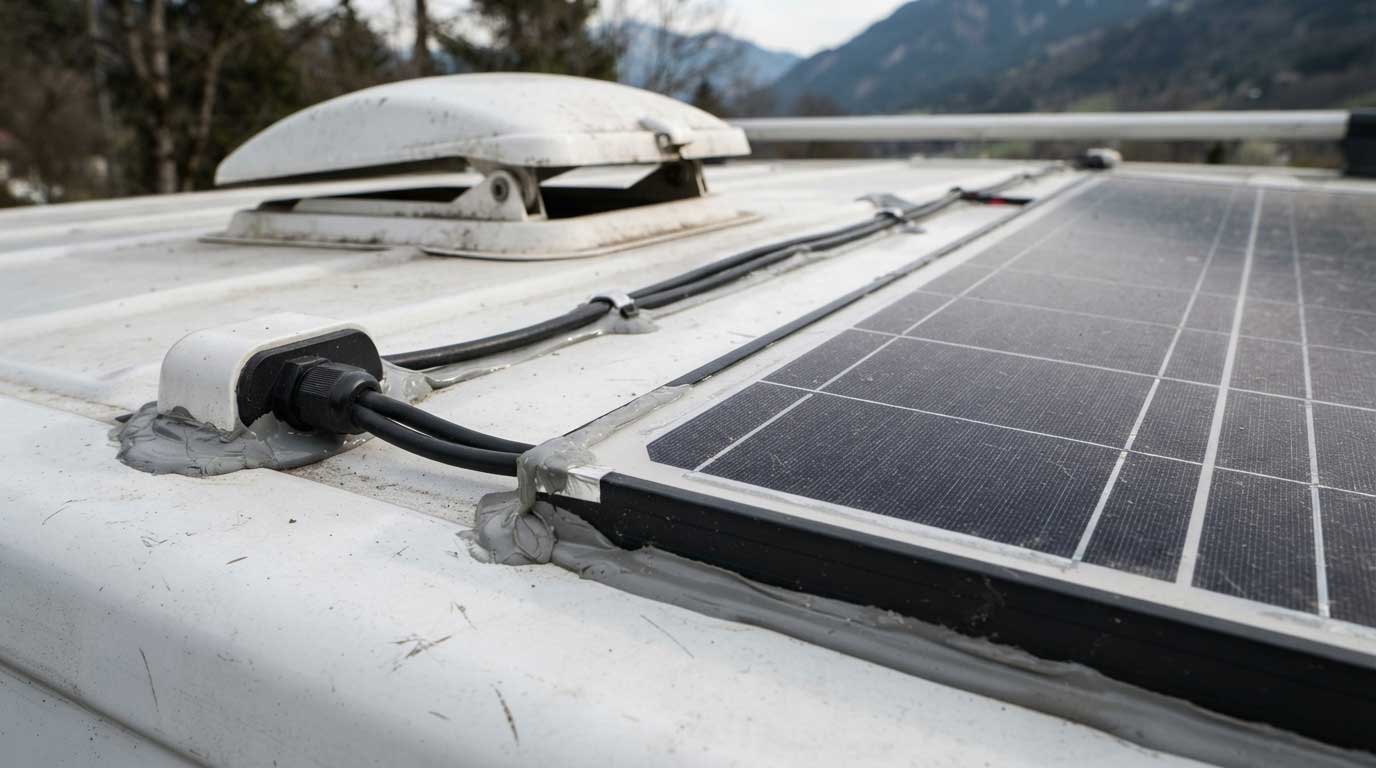
A flexible panel still behaves like a photovoltaic module electrically.
If several modules are connected in series, their voltages add.
If they are connected in parallel, their currents add.
The charge controller has to remain within its voltage and current limits.
This is particularly important in cold climates because open-circuit voltage changes with temperature. A string that looks acceptable on a warm day should not be evaluated only from its nominal operating voltage.
DOE defines standard test conditions for PV module ratings at 1,000 W/m² irradiance and a 25°C cell temperature. Actual operating conditions differ, so the rated value should be treated as a reference rather than a continuous output level.
Before connecting a low-cost flexible module to an existing system, confirm:
- Maximum controller PV voltage
- Maximum controller PV current
- Module Voc
- Module Vmp
- Module Isc
- Module Imp
- Series/parallel configuration
- Battery-system voltage
- Inverter requirements
- Cable size
- Fuse and disconnect requirements
Never assume that two panels with the same wattage can automatically be wired together.
Why the Datasheet Matters More Than the Product Photograph
A product photograph can tell you almost nothing about the parameters that determine system compatibility.
A datasheet should tell you the numbers.
For example, two nominal 100 W modules could have different:
- Voc
- Vmp
- Current
- Dimensions
- Weight
- Temperature coefficient
- Cell technology
- Bending radius
That difference becomes important when designing an array.
A useful procurement rule is simple:
Do not approve a flexible module from a photograph alone.
Request the technical documentation first, then verify the sample.
Quality Control for Cheap Flexible Solar Panels
Low-cost manufacturing does not have to mean low-quality manufacturing.
The important issue is process control.
For a production order, quality inspection can include:
Visual Inspection
Look for:
- Bubbles
- Wrinkles
- Delamination
- Uneven lamination
- Scratches
- Edge defects
- Cell cracks
- Discoloration
- Loose cables
- Connector damage
Dimensional Inspection
Measure:
- Overall length
- Overall width
- Thickness
- Cable length
- Cable exit position
- Connector dimensions
For an OEM project, record acceptable tolerances before mass production.
Electrical Inspection
Verify the supplied electrical characteristics against the approved specification.
A module’s nameplate should correspond with the technical documentation.
For larger orders, buyers may also specify sampling procedures and flash-testing requirements appropriate to the product and contract.
Packaging Inspection
Flexible modules need appropriate packaging because bending or compression during transport can create problems before the product ever reaches the installation site.
Check:
- Carton protection
- Stacking method
- Corner protection
- Cable protection
- Moisture protection
- Pallet stability
A low factory price does not compensate for excessive transit damage.
When Cheap Flexible Solar Panels Are a Good Choice
A low-cost flexible module can make sense when the application has moderate requirements and the product’s specifications are well understood.
Examples include:
- RV auxiliary charging
- Camper-van projects
- Portable outdoor systems
- Small off-grid installations
- Prototype vehicles
- OEM sampling
- Educational or demonstration systems
- Projects with large available surface area
The key is matching the product to the environment.
A low-cost module intended for a sheltered recreational application should not automatically be specified for a heavily exposed marine installation or a demanding commercial fleet.
When You Should Not Choose the Cheapest Option
There are situations where the lowest quotation deserves extra scrutiny.
Be cautious when:
- The supplier cannot provide a proper datasheet.
- The bending radius is unspecified.
- Electrical tolerances are unclear.
- Surface materials are not disclosed.
- The warranty language is vague.
- Test documentation cannot be verified.
- The cable construction is poorly documented.
- The sample differs from the quoted production model.
- The supplier cannot explain environmental limitations.
- The module is being specified for a demanding application without validation.
A cheap panel with complete documentation can be easier to trust than a more expensive panel with vague specifications.
Bright Solar: Flexible Solar Panels for B2B Applications
Bright Solar approaches flexible PV from the application side.
For an OEM or system integrator, the first step is not simply selecting the lowest-cost module. The project needs to establish the required dimensions, rated power, electrical configuration, installation surface, bending conditions, environment, and expected quantity.
Bright Solar’s flexible product range includes configurations for applications such as RVs, boats, outdoor systems, and curved surfaces.
The L Series, for example, uses PERC monocrystalline cells and DuPont ETFE material, with a product design offering up to 30% flexibility. It is also designed with saltwater resistance and a 0–3% output tolerance. These are product-specific characteristics and should be confirmed against the exact model being quoted.
For marine-oriented applications, Bright Solar’s H Series is designed for marine and yacht use, with double ETFE construction and an IP67 junction box. The H Series should likewise be evaluated according to the exact project requirements rather than treating every flexible module as identical.
For B2B purchasing, this distinction is important.
A manufacturer should be able to discuss the product as a component of the customer’s system, not just as a finished retail item.
What Makes a Good Flexible Solar Panel Supplier?
A dependable supplier should be able to answer technical questions without turning every answer into a sales pitch.
Ask for:
- A current datasheet
- Technical drawings
- Electrical test information
- Material information
- Bending specifications
- Installation instructions
- Sample availability
- Production capacity
- Quality-control procedure
- Packaging specifications
- Warranty terms
- Customization options
For OEM customers, also ask whether the same approved construction will be maintained during mass production.
That question is easy to overlook.
A sample is only useful if the production version remains consistent with it.
Three Practical Questions Before Ordering Cheap Flexible Solar Panels
Before sending a purchase order, ask these three questions internally:
Will it fit?
Confirm the physical dimensions and bending requirements.
Will it work electrically?
Confirm voltage, current, controller compatibility, and system configuration.
Will it survive the application?
Confirm the environmental exposure, surface construction, installation method, and expected operating conditions.
If all three answers are clear, price becomes much easier to evaluate.
FAQ About Cheap Flexible Solar Panels
Are cheap flexible solar panels worth buying?
Yes, provided the panel’s specifications match the application. A low purchase price can be reasonable when the supplier provides reliable electrical data, appropriate materials, acceptable bending characteristics, and consistent production quality.
What is the cheapest type of flexible solar panel?
There is no single cheapest type for every project. Price depends on wattage, dimensions, cell technology, materials, production volume, customization, certification, and shipping. Comparing price per watt is useful, but it should not be the only purchasing criterion.
Are cheap flexible solar panels good for RVs?
They can be. RV buyers should prioritize roof fit, weight, bending radius, electrical compatibility, surface construction, and installation method. A slightly more expensive panel may have a lower total installed cost if it fits the roof better.
Can cheap flexible solar panels be used on boats?
Yes, but marine exposure requires additional scrutiny. Check UV resistance, saltwater suitability, moisture protection, cable and connector construction, mounting method, and whether the module is intended for the location where it will be installed.
How do I compare cheap flexible solar panels from different suppliers?
Compare the same specifications: rated power, efficiency, dimensions, weight, Voc, Vmp, Isc, Imp, bending radius, materials, environmental ratings, warranty, MOQ, lead time, and installation requirements. Then compare total installed cost rather than only unit price.
Does a lower price mean lower solar panel quality?
No. Manufacturers can reduce costs through production volume, standardized designs, efficient manufacturing, material sourcing, and direct factory sales. The concern is not low price itself but insufficient technical documentation or inconsistent quality.
What should I ask a flexible solar panel manufacturer before ordering?
Request the current datasheet, technical drawing, electrical specifications, bending limits, material information, installation instructions, warranty terms, quality-control details, MOQ, production lead time, and sample. For OEM projects, also confirm that mass production will follow the approved sample.
Conclusion
The right way to buy cheap flexible solar panels is not to chase the smallest number on a quotation sheet.
Look at the complete product.
A low-cost flexible module can be an excellent fit for an RV, camper van, boat, off-grid system, or OEM project when its construction and specifications match the application. The same low-priced panel can become expensive if it causes installation problems, electrical incompatibility, premature replacement, or production delays.
For B2B buyers, the strongest purchasing decision usually comes from combining price per watt, watts per usable area, weight, installation labor, technical documentation, environmental suitability, and supplier consistency.
Bright Solar supports flexible solar panel projects where dimensions, power requirements, curved surfaces, marine exposure, and production quantities need to be evaluated together.
The goal is not simply to find a cheap flexible solar panels supplier. It is to find a flexible PV solution whose total cost remains reasonable after it leaves the factory and reaches the real installation site.
Related recommendations
-

Custom Shape Flexible Solar Panels: Design, Applications and Buying Guide
80Custom shape flexible solar panels are designed around project-specific installation areas, helping use irregular or limited spaces on RVs, yachts, and speci...
View details -
1000W Solar Panel: Complete Guide to Size, Power Output, Cost, and System Setup
230Explore 1000w solar panel size, cost, power output, and system setup. Learn how to choose the right 1000 watt solar solution for RV, off-grid, and backup energy needs with Bright Solar.
View details -
Solar Panel Wiring for RV, Marine, and Off-Grid Solar Systems
188Learn solar panel wiring for RVs, boats, homes, and off-grid systems. Discover series vs parallel setups, safety tips, and real installation cases.
View details -
Sungrow Inverter Helps Chilean Photovoltaic Project in the Atacama Desert
190Sungrow Inverter turnkey PV inverter solutions and solar panel cleaning robots to a 480 MW photovoltaic project in Chile’s Atacama Desert, supporting the country’s Energy Policy 2050 with high-efficiency inverters, anti-PID technology, and waterle...
View details