Black Flexible Solar Panel: Design, Performance, and Applications
A black flexible solar panel combines a dark photovoltaic surface with a lightweight module structure that can follow controlled curves. The black appearance is usually related to light absorption and cell design, not simply color choice. For RVs, boats, vans, and curved roofs, the right panel must balance appearance, efficiency, heat, bending limits, weight, and installation conditions.
Why Are Solar Panels Black?
The first thing to clarify is that “black” does not necessarily describe a cosmetic coating applied over an otherwise conventional solar panel.
A photovoltaic cell looks dark because its surface is designed to absorb as much useful incoming light as practical while minimizing reflection. The U.S. Department of Energy explains that untreated silicon can reflect more than 30% of incident light, while anti-reflection coatings and textured surfaces reduce reflection. DOE also notes that high-efficiency cells can appear dark blue or black.
That makes the visual appearance of a black flexible solar panel relevant to the underlying photovoltaic design.
A dark appearance can come from factors such as:
- Cell material
- Surface texturing
- Anti-reflection treatment
- Cell architecture
- Interconnection design
- Encapsulation
- Backing and substrate construction
So, a black panel is not automatically more efficient simply because it looks darker.
The actual electrical rating remains the more useful specification.
What Is a Black Flexible Solar Panel?
A black flexible solar panel is a flexible photovoltaic module with a predominantly black visible surface or dark cell appearance.
Unlike a conventional framed glass module, a flexible panel is designed around a lighter construction that can accommodate controlled curvature. Depending on the product, the module may use flexible substrates, encapsulation layers, protective surfaces, and lightweight electrical components rather than a conventional aluminum frame and rigid glass structure.
That makes this format attractive when the installation surface is not perfectly flat.
Typical applications include:
- RV and motorhome roofs
- Camper vans
- Boats and yachts
- Trailers
- Curved vehicle roofs
- Portable off-grid systems
- Specialty outdoor equipment
- Low-profile architectural applications
The important word is controlled.
Flexible does not mean the module can be folded, sharply creased, rolled without limitation, or bent in any direction.
IEC 61215 includes specific testing requirements for flexible PV modules, including the MQT 22 bending test. IEC 61215-2:2021 also includes test methods for flexible modules.
Does Black Color Improve Solar Panel Efficiency?
Not by itself.
Solar-cell efficiency depends on how effectively the cell converts incident sunlight into electricity. DOE identifies wavelength, temperature, reflection, and semiconductor properties among the factors influencing PV conversion efficiency.
A black appearance can be associated with lower optical reflection, but the color seen by the customer is not a reliable way to compare two modules.
For procurement, compare:
| Specification | Why it matters |
|---|---|
| Rated power | Defines nominal electrical output |
| Module efficiency | Shows power conversion relative to area |
| Vmp | Determines normal operating voltage |
| Voc | Important for system voltage limits |
| Imp | Helps size conductors and controllers |
| Isc | Relevant to protection and controller sizing |
| Temperature coefficient | Indicates how output changes with temperature |
| Weight | Important for mobile applications |
| Dimensions | Determines actual roof coverage |
| Bending radius | Defines installation curvature |
| Surface construction | Affects durability and optical behavior |
A black finish may be aesthetically desirable, but it should not replace an electrical comparison.
Black Flexible Solar Panel vs. Black Rigid Solar Panel
The visual similarity can be misleading.
A black rigid solar panel generally uses glass, a frame, and a mechanically rigid cell structure. A black flexible solar panel prioritizes lower weight and controlled bending.
For a flat commercial rooftop, the rigid product may be the more conventional solution.
For a curved camper roof, the flexible product can fit the surface without the visual and mechanical bulk of a framed module.
| Feature | Black flexible panel | Black rigid panel |
|---|---|---|
| Curved surface | Well suited to controlled curves | Limited |
| Weight | Generally lower | Generally higher |
| Frame | Usually absent or minimal | Typically framed |
| Roof profile | Low | Higher |
| Handling | Lightweight but flexible | Rigid and easier to grip |
| Installation | Adhesive or specialized mounting | Rack or mechanical mounting |
| Air circulation | Depends on installation | Often easier to provide |
| Best application | Mobile/curved surfaces | Conventional flat installations |
The choice should follow the structure, not the appearance.
Why Black Flexible Solar Panels Work Well on RVs
An RV roof is a difficult solar surface.
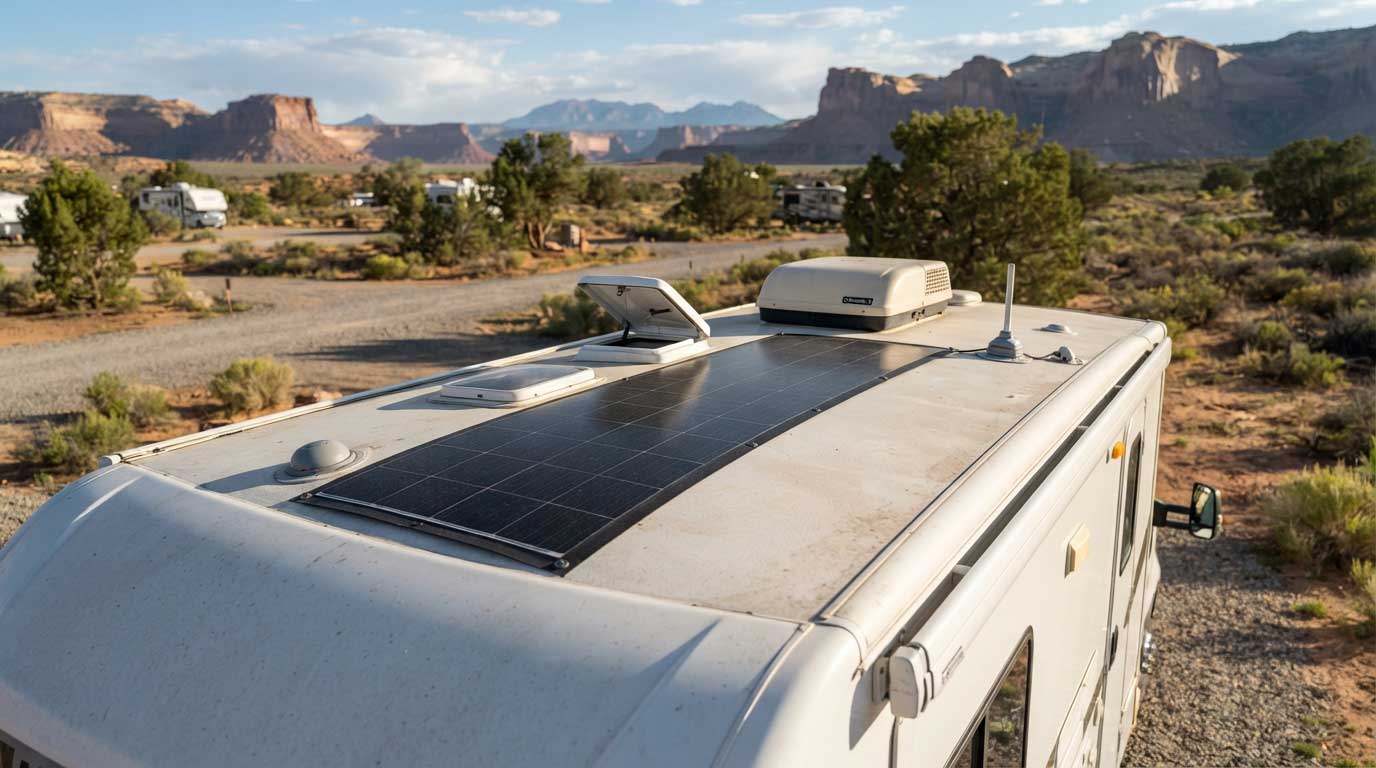
There may be an air-conditioning unit in the middle, vents near the front, antennas toward the rear, and cable entry points scattered around the available area. The roof itself may have a slight crown or curve.
A low-profile black flexible solar panel can follow that shape while maintaining a cleaner appearance than a tall framed array.
For RV manufacturers and conversion companies, appearance can also matter. A dark panel generally integrates more naturally with a dark or neutral vehicle roof than a large silver aluminum frame.
But the installation still needs to be designed around the roof.
A practical survey should record:
- Maximum usable length.
- Maximum usable width.
- Roof curvature.
- Air-conditioning and vent positions.
- Cable-entry locations.
- Areas requiring maintenance access.
- Expected shading.
- Mounting method.
- Electrical system voltage.
- Total allowable roof weight.
This measurement work is often more important than selecting a panel from a list of wattages.
Field Detail: Measure the Roof Before Ordering
For a curved RV roof, measure at several locations.
Do not assume that a roof described as “flat” by the vehicle manufacturer is optically or mechanically flat enough for every flexible panel.
A simple field approach is to place a straight reference along the intended installation area and record the curvature over a known distance. For a production project, use an actual roof drawing or 3D surface data when available.
Then compare the measured curve with the panel’s specified bending radius.
IEC 61215 treats bending as a specific qualification consideration for flexible modules, which reinforces the need to use a documented mechanical limit rather than estimating flexibility by eye.
Black Flexible Solar Panel for Boats
Marine applications place more emphasis on environmental exposure.
A yacht roof may have a dark cabin top, curved fiberglass surfaces, stainless fittings, hatches, rails, antennas, and navigation equipment. A black flexible panel can visually integrate with the cabin roof and avoid the raised appearance of a conventional framed array.
But marine suitability cannot be judged from color.
A panel intended for boat use should be evaluated for:
- UV exposure
- Saltwater exposure
- Water ingress
- Connector protection
- Cable strain relief
- Surface abrasion
- Mechanical attachment
- Thermal conditions
- Bending requirements
- Cleaning and maintenance
The International Electrotechnical Commission’s IEC 61215 series provides qualification and test frameworks for terrestrial PV modules, including flexible-module bending requirements. IEC 61215-2:2021 also includes test methods for flexible modules.
For a marine project, those standards are useful reference points, but the buyer should still review the manufacturer’s actual product construction and environmental specifications.
Black Flexible Solar Panel and Heat
A common misconception is that a black solar panel is automatically unsuitable for hot climates.
The more useful question is how the photovoltaic module behaves at its operating temperature.
DOE explains that solar cells generally perform better at lower temperatures. As temperature rises, current increases slightly while voltage decreases much more significantly. Excessive temperature can also affect module materials and operating lifetime.
That matters on a black flexible solar panel because mobile roofs can become very hot under direct summer sunlight.
Consider three different installations:
| Installation | Airflow | Thermal consideration |
|---|---|---|
| Flexible panel bonded directly to roof | Low | Roof heat can remain significant |
| Panel mounted with controlled gap | Higher | More air movement may be possible |
| Rigid elevated module | Usually higher | Greater rear airflow potential |
This does not mean an air gap automatically makes a flexible panel more efficient.
It means installation geometry affects the module’s operating environment.
For a hot-climate RV or boat, the mounting method should therefore be considered alongside the panel’s temperature coefficient and construction.
Part 1 Practical Takeaway
A black flexible solar panel is best understood as a functional photovoltaic module with a dark appearance, not simply a black-colored solar product.
The useful evaluation comes down to the actual cell technology, rated power, efficiency, dimensions, weight, bending radius, temperature behavior, construction, and installation environment.
How to Install a Black Flexible Solar Panel
Installation determines whether a flexible module remains a useful long-term power source or becomes a roof-maintenance problem.
For a curved RV, van, or boat, begin with the surface rather than the adhesive.
Clean the mounting area according to the module and adhesive manufacturer’s requirements. Remove wax, grease, loose coatings, and contamination. Then position the panel without permanently fixing it.
Check the edges.
Check the cable exit.
Check the curvature.
Then step back and look at the complete roof.
Large flexible panels are unforgiving of small positioning mistakes because moving a bonded module later can be difficult.
A practical installation sequence is:
- Measure and mark the approved mounting area.
- Confirm the panel dimensions and cable position.
- Inspect the roof for cracks, old sealant, or loose coatings.
- Test-fit the panel without adhesive.
- Verify the bending radius.
- Confirm the cable route before bonding.
- Prepare the surface according to the specified installation method.
- Install the panel without creating sharp folds or local pressure points.
- Secure and protect the cable.
- Inspect the complete installation before electrical commissioning.
IEC 61215-1:2021 added specific test methods for flexible modules, including the MQT 22 bending test. That is a useful reminder that flexibility is an engineered characteristic with defined limits, not an invitation to bend the panel wherever convenient.
Should a Black Flexible Solar Panel Be Fully Bonded?
Not necessarily.
Full-surface bonding is common in some low-profile flexible installations because it minimizes movement and maintains a clean appearance. But the correct mounting method depends on the module construction and application.
For example, a vehicle manufacturer may prefer a bonded installation because the roof has no provision for conventional racking. A marine integrator may use a different attachment strategy because of service access, vibration, water exposure, or the need to replace a module later.
Before selecting adhesive mounting, confirm:
- Substrate compatibility
- Adhesive compatibility
- Surface preparation
- Curing conditions
- Thermal expansion
- Drainage
- Edge protection
- Cable routing
- Serviceability
- Manufacturer-approved installation procedure
Do not substitute a generic construction adhesive simply because it appears to have sufficient initial grip.
A photovoltaic module remains exposed to UV radiation, heat cycling, moisture, vibration, and mechanical movement for years. The attachment system has to survive that environment too.
Black Flexible Solar Panel for Vans and Camper Conversions
Van roofs present a different problem from large motorhomes.
The available area is smaller, but the roof shape is usually more complicated than it looks from ground level.
Roof ribs, raised seams, skylights, fans, roof racks, and curved transitions can interrupt the usable surface.
A black flexible solar panel is particularly attractive for conversions where maintaining a low roof profile matters.
The dark appearance can also blend with black roof accessories, skylights, and roof-mounted equipment.
For a van conversion company producing multiple vehicles, repeatability becomes important.
Suppose a conversion workshop installs solar on 50 similar vans. A panel that fits a known roof section precisely may save more labor than a theoretically higher-efficiency panel that requires a different layout for every vehicle.
That is a useful B2B insight: installation consistency has economic value.
Black Flexible Solar Panel for Boats and Yachts
Marine installations need a more conservative approach.
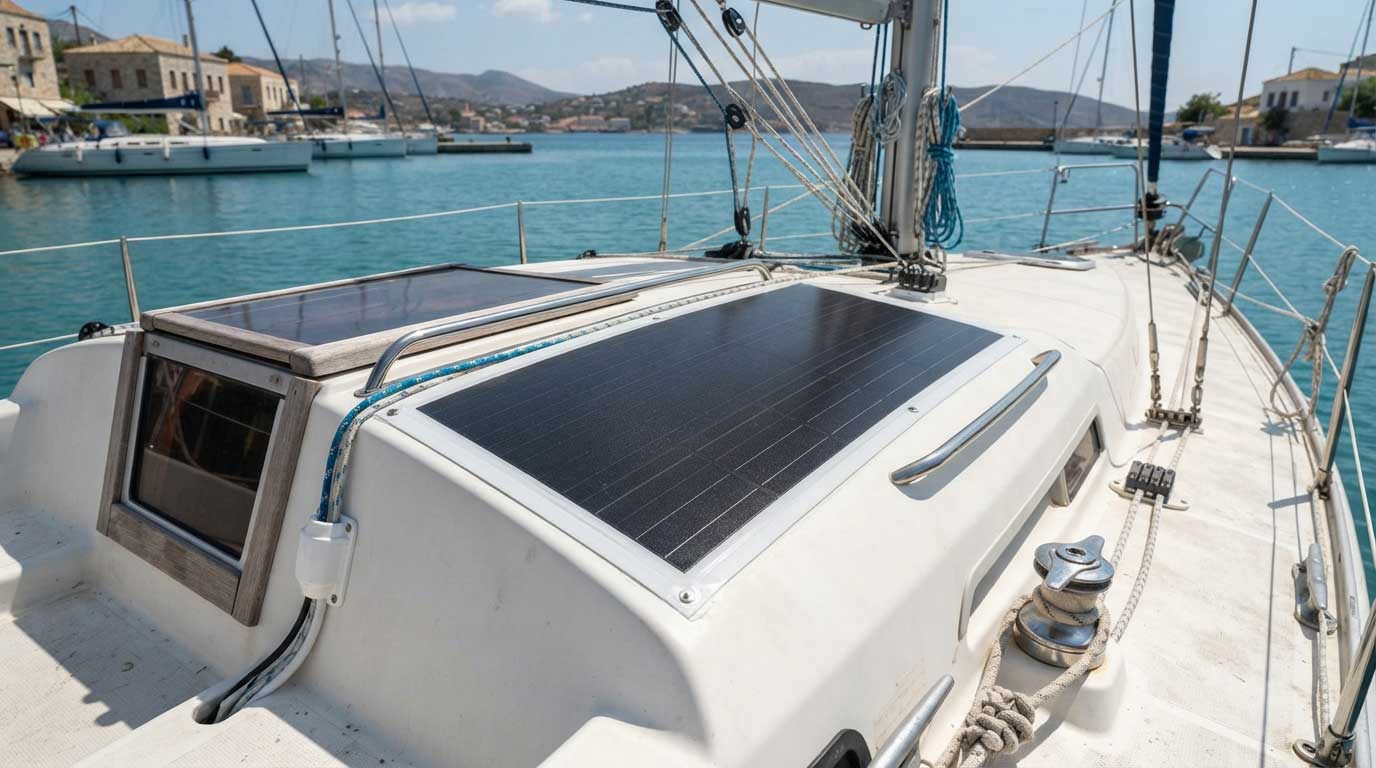
A yacht may be exposed to salt spray, intense UV, vibration, standing water, and occasional impact from equipment or crew. A dark flexible module can look excellent on a fiberglass cabin roof, but visual integration should come after mechanical and environmental requirements.
Inspect the proposed location for:
- Mast shadows
- Radar-arch shadows
- Antennas
- Hatches
- Handrails
- Foot-traffic areas
- Drainage channels
- Cable penetrations
- Areas exposed to standing water
A panel that receives full sunlight at the dock may be partially shaded after the boat changes heading.
For this reason, a marine installation should be evaluated as an operating environment, not just photographed at commissioning.
Electrical Design: Black Does Not Change the Basic PV Rules
The color of a solar module has no special electrical advantage by itself.
The array still has to be designed around voltage, current, controller limits, inverter requirements, cable sizing, and protection.
For a typical system, check:
| Electrical value | Design purpose |
|---|---|
| Voc | Maximum open-circuit voltage |
| Vmp | Normal operating voltage |
| Isc | Maximum short-circuit current |
| Imp | Normal operating current |
| Rated power | Nominal module capacity |
| Temperature coefficient | Helps estimate temperature-related changes |
| Maximum system voltage | Prevents incompatible system configurations |
PV module ratings are normally measured under standard test conditions of 1,000 W/m² irradiance and 25°C cell temperature. DOE notes that real-world sunlight is usually below this reference level and module temperatures are often above 25°C.
That difference is critical.
A 200 W black flexible solar panel does not produce 200 W continuously throughout a sunny day. The 200 W figure is a standardized rating, not a daily-energy guarantee.
How Temperature Affects a Black Flexible Solar Panel
The dark appearance of a module naturally raises a question: does black make it hotter?
The answer is more nuanced than simply comparing surface color.
The photovoltaic cells absorb sunlight and convert only part of that energy into electricity; much of the remaining energy becomes heat. DOE notes that increasing temperature causes a much larger reduction in PV voltage than the associated increase in current, which generally reduces conversion efficiency.
This makes installation especially important in hot climates.
A flexible panel mounted directly against a dark metal roof, for example, has a different thermal environment from a module installed with ventilation beneath it.
For a black flexible solar panel used in Arizona, southern California, southern Europe, Australia, or similar climates, compare the temperature coefficient in the datasheet rather than judging performance from the panel’s appearance.
Realistic Case: Black Flexible Solar Panel on a Camper Van
Consider a conversion company building 20 camper vans with the same high-roof body.
The available solar area is approximately 4.5 m² after a roof fan and skylight are excluded.
The company initially considers two conventional framed panels because they have a familiar specification and attractive price.
The problem appears during the physical mock-up.
The frames interfere with the roof layout, increase the overall height, and leave unused sections around the curved roof transitions.
A black flexible module is then tested over the same area.
The revised design has three practical advantages:
- More continuous use of the available roof surface
- Lower visual height
- Fewer compromises around the curved roof section
The decision is not based on the fact that the panel is black.
It is based on the combination of form factor, weight, installation geometry, and available area.
For a fleet of 20 identical vans, those details can be repeated. That repeatability is where a custom flexible solution can become commercially interesting.
Black Flexible Solar Panel for Off-Grid Systems
Off-grid buyers often focus heavily on rated wattage.
The better starting point is the load profile.
For example, a small off-grid system might power:
- LED lighting
- Communications equipment
- Small refrigeration
- Monitoring devices
- USB charging
- DC appliances
- A battery charging system
The solar array should then be matched to expected energy demand, battery capacity, available sunlight, and system losses.
DOE emphasizes that actual PV energy production varies with solar resource, temperature, shading, orientation, and other system factors.
A black flexible solar panel can be useful where the available mounting surface is curved or where a low-profile installation is important. But its color does not change the underlying energy calculation.
Black Flexible Solar Panel vs. Rigid Panel: Which Should You Choose?
There is no universal winner.
Use a flexible design when the installation benefits from:
- Lower module weight
- Controlled curvature
- Low-profile appearance
- Direct integration with a suitable curved surface
- Mobile or specialty installation requirements
Consider rigid modules when:
- The surface is flat
- Conventional racking is available
- Rear ventilation is important
- Maximum structural rigidity is preferred
- Installation access supports conventional framed modules
A practical comparison should look like this:
| Requirement | Flexible | Rigid |
|---|---|---|
| Curved roof | Strong advantage | Limited |
| Low profile | Strong advantage | Moderate |
| Lightweight installation | Strong advantage | Usually heavier |
| Flat commercial roof | Possible | Often practical |
| Easy one-person positioning | Product-dependent | Product-dependent |
| Conventional rack compatibility | Limited | Strong |
| Irregular mobile surfaces | Strong advantage | Limited |
For Bright Solar applications, the intended surface should be identified before the module format is selected.
How Bright Solar Approaches Black Flexible Solar Panels
Bright Solar treats black flexible solar panels as application-specific photovoltaic products rather than decorative black roof panels.
For an OEM, distributor, or system integrator, the useful technical conversation begins with the actual project:
Where will the panel go?
Then:
How much space is available?
Then:
What curvature, power, weight, voltage, environment, and installation method are required?
This approach avoids choosing a module simply because its product photograph looks attractive.
Bright Solar’s flexible panel portfolio includes configurations designed for mobile, outdoor, marine, RV, and curved-surface applications. Product-specific specifications such as cell technology, flexibility, surface material, dimensions, electrical ratings, and environmental protection should be confirmed against the selected model rather than generalized across every flexible panel.
For example, Bright Solar’s L Series uses PERC monocrystalline cells and DuPont ETFE surface material, with product-specific flexibility and saltwater-resistant characteristics. Those specifications belong to that product series and should not be assumed for unrelated panel designs.
Inspection and Maintenance
A flexible solar panel does not need complicated maintenance, but it does need inspection.
For RV installations, check the panel after roof work or equipment replacement.
For boats, inspect it after extended exposure to salt spray and severe weather.
Look for:
- Lifted edges
- Cracked surfaces
- Cable damage
- Connector corrosion
- Adhesive deterioration
- New shading
- Heavy dirt
- Salt deposits
- Water accumulation
- Changes around cable entry points
Cleaning should follow the manufacturer’s instructions. Avoid abrasive brushes, aggressive solvents, or tools that can damage the protective surface.
One simple field practice is particularly useful: take photographs immediately after installation.
Photograph the panel edges, cable exits, mounting areas, and nearby roof equipment.
Six months later, those photographs provide a reference that memory cannot.
What Should You Ask a Black Flexible Solar Panel Manufacturer?
Before placing a B2B order, request the technical information that affects installation rather than relying on marketing photographs.
Product Questions
- What cell technology is used?
- What is the rated power?
- What are Voc, Vmp, Isc, and Imp?
- What is the module efficiency?
- What is the temperature coefficient?
- What is the module weight?
- What is the exact dimension?
- What is the minimum bending radius?
Installation Questions
- Can the panel be bonded?
- Is mechanical mounting supported?
- What surface preparation is required?
- Where can the cable exit be positioned?
- Are there restrictions on curved installation?
- What clearance or ventilation is recommended?
Environmental Questions
- What operating temperature is specified?
- What surface material is used?
- What connector and junction-box protection is provided?
- What environmental testing applies?
- Is marine use supported for the intended product?
IEC 61215-2:2021 includes test methods for flexible PV modules and specifically incorporates the MQT 22 bending test. It also includes test methods required for bifacial modules.
That makes standards documentation a useful part of supplier evaluation, especially for OEM and distributor projects.
FAQ About Black Flexible Solar Panel
Are black flexible solar panels more efficient?
Not simply because they are black. A dark appearance can be associated with reduced reflection and high-efficiency cell structures, but actual performance must be judged from the module’s rated power, efficiency, cell technology, and operating conditions.
Why are some solar cells black?
Solar cells can appear black because their surfaces are designed to reduce reflection and absorb more incoming light. DOE notes that anti-reflection coatings and textured surfaces reduce reflection and that high-efficiency cells can appear dark blue or black.
Is a black flexible solar panel good for an RV?
Yes, when its dimensions, bending radius, weight, electrical characteristics, and mounting method match the RV roof. The low-profile appearance can also integrate well with many modern camper and van roofs.
Can a black flexible solar panel be used on a boat?
Yes. Marine installations require appropriate consideration of UV exposure, saltwater, moisture, vibration, mounting, cable protection, and roof curvature. The selected product should be evaluated against its actual environmental specifications.
Does a black flexible solar panel get hotter than a rigid panel?
Operating temperature depends on the module construction, surface, mounting method, airflow, ambient conditions, and solar irradiance. PV output generally decreases as cell temperature rises, so temperature coefficients and installation conditions should be reviewed rather than judging temperature from color alone.
Can a black flexible solar panel be installed directly on a curved roof?
It can be installed on suitable curved surfaces when the curvature remains within the manufacturer’s specified bending limit and the approved installation method is followed. Flexible does not mean unlimited bending.
How do I choose the right black flexible solar panel?
Start with the installation area and curvature, then compare rated power, efficiency, weight, dimensions, bending radius, voltage, current, temperature characteristics, surface construction, and environmental requirements. For B2B projects, also request technical drawings and installation documentation.
Conclusion
A black flexible solar panel is valuable because its photovoltaic performance can be combined with a low-profile, lightweight form factor suitable for curved and mobile surfaces. The black appearance may reflect the optical design of the cells, but color alone should never be used as a measure of solar performance.
For RVs, vans, boats, and specialty off-grid systems, the important specifications are more practical: power, efficiency, dimensions, weight, bending radius, temperature behavior, electrical characteristics, surface construction, and installation requirements.
The best selection is the one that fits the actual roof or deck without forcing the structure, wiring, or maintenance process to adapt around an unsuitable module.
Bright Solar can evaluate these requirements for OEM and B2B applications, including curved-surface installations and customized flexible solar panel projects.
Related recommendations
-

Off Grid Solar System Cost: Complete Price Guide for 2026
243Explore off grid solar system cost with our complete guide covering panels, batteries, installation, and pricing factors to build a reliable solar power solution with Bright Solar.
View details -
Solar Panels Series or Parallel: Which Wiring Method Works Better?
114Learn whether solar panels series or parallel wiring is better for RVs, boats, homes, and off-grid systems. Compare efficiency, shading, and performance.
View details -
450 Watt Solar Panels: Output, Sizing and Applications
221Discover how 450 watt solar panels perform, how much energy they can produce, and how to size, wire and install them for RV, home and off-grid systems.
View details -
200 Watt Flexible Solar Panels: Lightweight Power Solution for RV, Marine and Off-Grid Applications
134200 watt flexible solar panels deliver lightweight and powerful solar energy for RVs, boats, camping, and off-grid systems. Explore Bright Solar solutions today.
View details