China Flexible Solar Panel: Manufacturer Guide for Global Buyers
A china flexible solar panel is a lightweight photovoltaic module manufactured in China for applications where conventional rigid panels may be difficult to install. Buyers should evaluate cell technology, bending limits, encapsulation, electrical specifications, certifications, and supplier quality controls before choosing a manufacturer. Bright Solar supplies flexible solar panel solutions for RVs, marine applications, and off-grid projects.
What Is a China Flexible Solar Panel?
A flexible solar panel converts sunlight into electricity while allowing a degree of bending that conventional glass-fronted modules generally cannot accommodate. Its construction, weight, flexibility, and mounting requirements depend on the particular product design.
For international buyers, the term china flexible solar panel covers products with different materials, electrical ratings, and intended applications. Two panels with the same rated wattage may have substantially different bending capabilities, surface materials, weights, and installation requirements.
Flexible modules are commonly considered for:
- RV roofs and campervans.
- Boats, yachts, and selected marine installations.
- Off-grid cabins and remote power systems.
- Mobile homes and recreational vehicles.
- Portable power applications when the module is specifically designed for portable use.
- Curved or weight-sensitive surfaces that are compatible with the manufacturer’s installation instructions.
An important distinction: Flexible does not mean foldable, rollable, or suitable for unrestricted bending. A panel must remain within its specified mechanical limits. Repeatedly bending a module beyond those limits can damage its internal electrical connections even when the outer surface appears intact.
Why Global Buyers Source Flexible Solar Panels from China
China has an extensive photovoltaic manufacturing industry, making it a major sourcing destination for solar products. However, a country’s manufacturing scale does not establish the quality of an individual supplier. Buyers still need to verify the factory, product specifications, quality procedures, and suitability for the intended installation.
Manufacturing and customization requirements
For distributors, installers, and equipment manufacturers, the sourcing process often involves more than purchasing a standard module.
Typical requirements include:
- Selecting rated power and operating voltage.
- Checking module dimensions against available roof or deck space.
- Confirming connector and cable configurations.
- Reviewing the panel’s maximum permitted bending.
- Confirming the intended mounting method.
- Requesting product drawings and electrical documentation.
- Establishing packaging, labeling, and inspection requirements.
Customization should be based on an engineering review. A change in dimensions, cell layout, cable position, or laminate construction can affect electrical performance, mechanical durability, and compatibility with the installation.
What buyers should not assume
A supplier located in China is not automatically a manufacturer. Some businesses are trading companies, distributors, or assemblers working with external factories.
Likewise, claims such as high efficiency, marine grade, walkable, and IP67 should be checked against the exact product model and its supporting documentation.
For procurement teams, the practical question is not simply where a panel is manufactured. It is whether the supplier can demonstrate that the specific product meets the project’s requirements.
How to Evaluate a China Flexible Solar Panel Manufacturer
A product catalog is a starting point, not proof of manufacturing capability. Before placing an order, buyers should establish whether the supplier can provide consistent specifications, traceable production information, and appropriate documentation.
1. Verify the company’s manufacturing role
Ask the supplier to explain which production processes take place in its own facility and which are outsourced.
Useful questions include:
- Does the company manufacture the complete module or purchase finished panels?
- Which processes are performed in-house?
- Can it provide factory photographs or arrange a factory audit?
- How are incoming materials inspected?
- How are finished modules identified and traced?
- What happens when a product fails inspection?
A direct, documented answer is more useful than a general claim about factory ownership.
2. Review the technical datasheet
Request the datasheet for the exact model being quoted. Avoid relying on a general company brochure when comparing products.
| Specification | What buyers should verify |
|---|---|
| Rated power | Nominal output under the stated test conditions |
| Vmp | Voltage at maximum power |
| Imp | Current at maximum power |
| Voc | Open-circuit voltage |
| Isc | Short-circuit current |
| Solar cell type | Actual cell technology used |
| Module efficiency | Published efficiency and its measurement basis |
| Dimensions | Exact module length, width, and thickness |
| Weight | Product weight, including clarification of included components |
| Maximum bending radius | Manufacturer’s permitted mechanical limit |
| Operating temperature | Published operating range |
| Connector | Connector type and electrical compatibility |
| IP rating | Applicable rating and the component or assembly it covers |
| Warranty | Coverage, exclusions, and warranty duration |
These details matter because a panel that physically fits a roof may still be electrically unsuitable for the existing charge controller or inverter.
3. Check certifications and test documentation
Certification requirements depend on the destination market, installation type, and product configuration.
Buyers should establish:
- Which standards apply to the product and its intended use.
- Whether the certificate covers the exact model being purchased.
- Whether the issuing organization can verify the certificate.
- Whether the report applies to the complete module or only a component.
- Whether the installation requires additional electrical or structural approvals.
A certificate for one product family should not automatically be treated as evidence that every module from the supplier has the same certification.
For projects involving boats, vehicles, or buildings, also check whether the relevant installation standards impose requirements beyond the solar module itself.
Flexible Solar Panel Materials and Construction
The materials used in a flexible module influence its weight, bending capability, weather resistance, and suitability for different environments. A buyer should assess the complete laminate construction rather than treating the word flexible as a technical specification.
Solar cells and electrical performance
The photovoltaic cells generate electricity when exposed to sunlight. The U.S. Department of Energy explains that semiconductor materials absorb light and release electrical charges, allowing current to flow through the cell. Multiple cells are connected to form a module.
Cell technology is only one part of the selection process. Module output also depends on irradiance, cell temperature, shading, and system configuration.
When comparing suppliers, ask for the actual cell type used in the quoted model. Do not assume that every flexible panel uses the same cell technology.
Surface materials and protective layers
Flexible modules may use polymer-based protective surfaces rather than the conventional glass construction found in many Rigid Solar Panels.
Bright Solar’s L Series uses DuPont ETFE material, with UV-resistant and anti-slip surface characteristics specified for the product range. The manufacturer describes the L Series as offering a maximum flexibility of 30%.
These are product-specific characteristics, not universal properties of all flexible solar panels manufactured in China.
Before specifying a surface material, consider:
- Exposure to sunlight and outdoor weather.
- The intended cleaning method.
- The risk of abrasion during installation or use.
- Whether the panel will experience foot traffic.
- Whether the application involves saltwater exposure.
- The manufacturer’s permitted bending and mounting conditions.
A surface described as anti-slip should not automatically be interpreted as proof that a panel is walkable. Walkability requires explicit confirmation for the particular product and installation.Learn more about the Flexible Solar Panel Installation Guide
China Flexible Solar Panel Applications: RV, Marine, and Off-Grid
RV and campervan solar installations
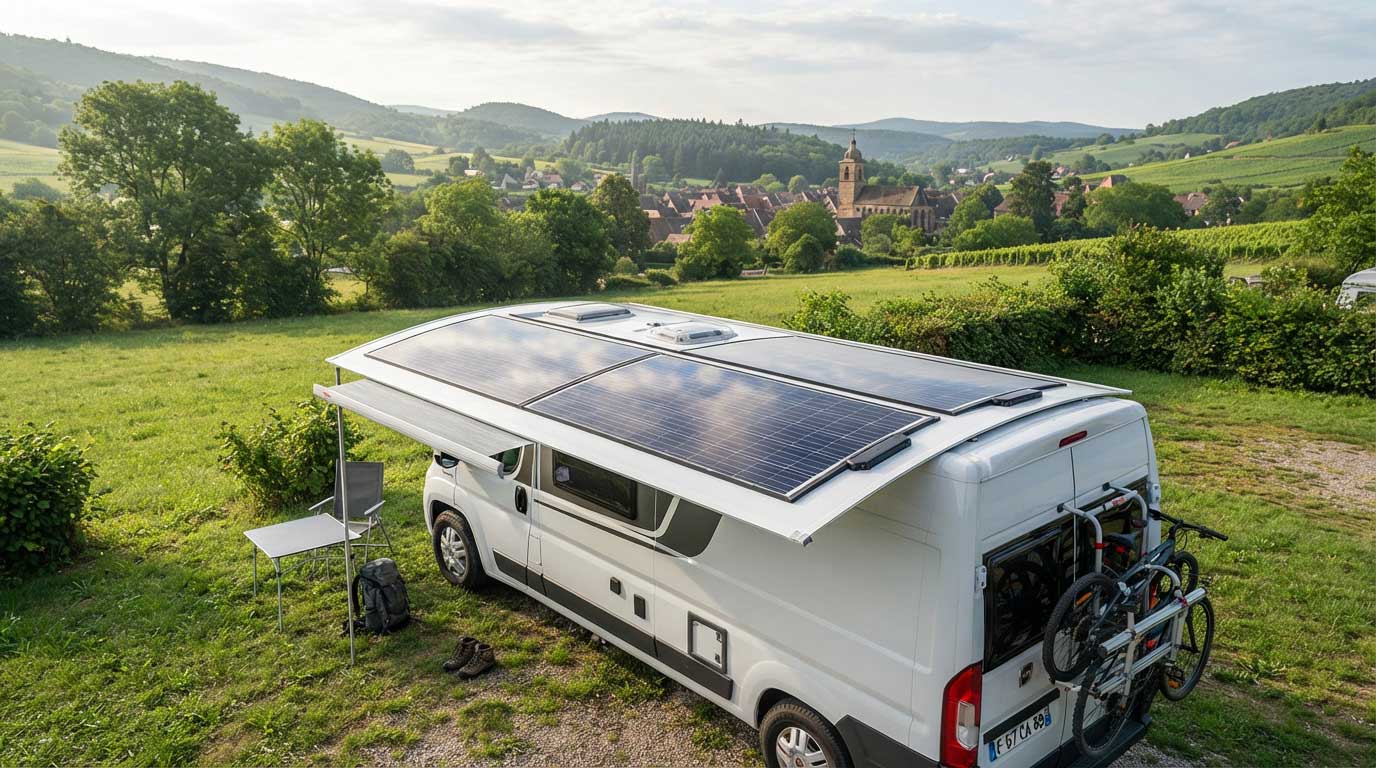
RV owners often have limited roof space and must consider vehicle weight, roof curvature, wiring routes, and the location of vents or air-conditioning equipment.
A flexible panel may be considered where its permitted bending characteristics and mounting instructions suit the roof. It should not be forced over a curve simply because the roof appears compatible.
Before installation, check:
- The usable roof area after accounting for vents, antennas, and service access.
- The roof manufacturer’s restrictions and the solar module’s mounting instructions.
- The panel’s dimensions and weight.
- The electrical requirements of the battery and charge controller.
- Cable routing, connector protection, and maintenance access.
A common planning mistake is measuring the roof’s total area rather than the space that remains usable after all obstructions and installation clearances are considered.
Marine and yacht applications
Marine installations introduce additional questions about moisture, salt exposure, movement, and maintenance.
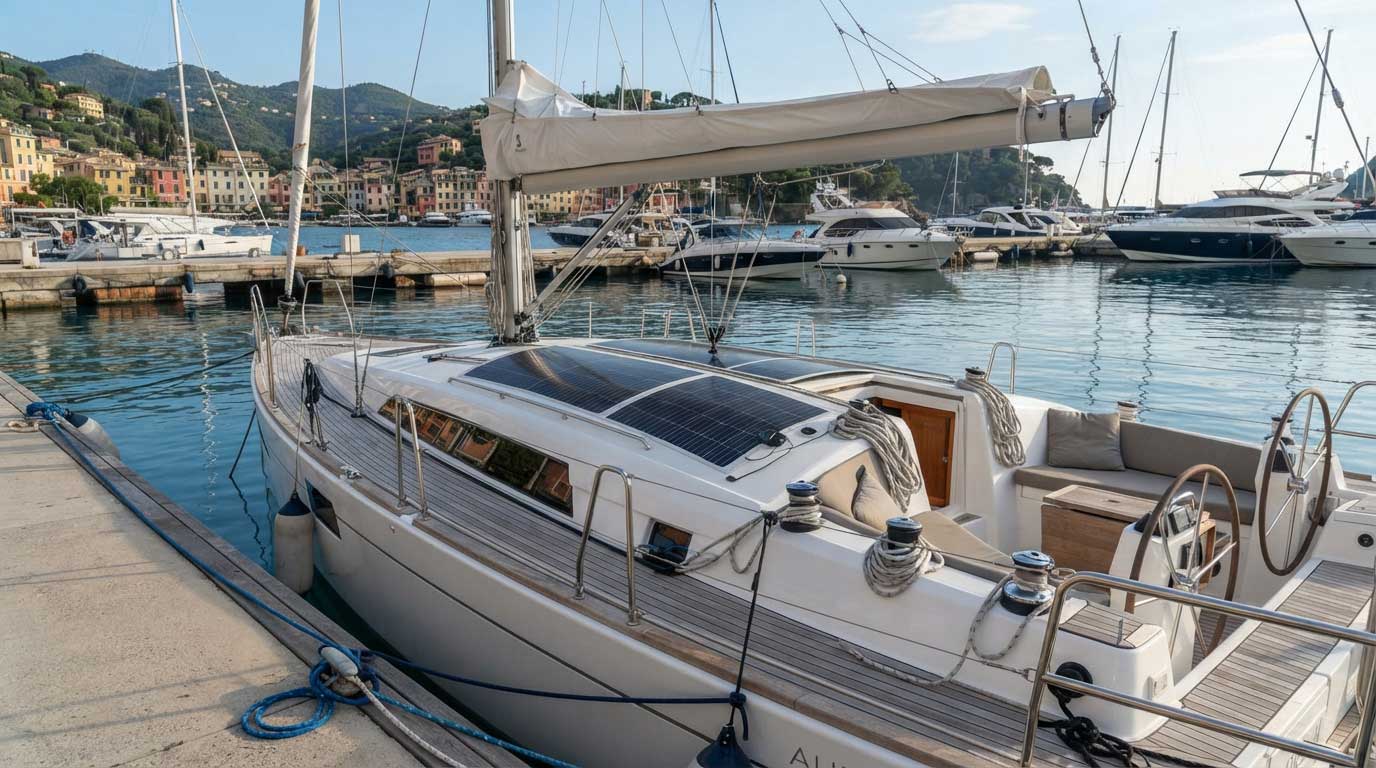
Bright Solar’s H Series is designed for marine and yacht applications. Its specified features include a double-ETFE construction, a walkable design, and an IP67-rated junction box.
These descriptions should be verified against the exact model’s documentation. In particular, the junction box rating should not be interpreted as an automatic IP67 rating for every part of the complete installation.
For a marine project, confirm:
- Whether the selected model is approved for the intended marine use.
- The manufacturer’s saltwater-resistance specifications.
- The mounting method and surface compatibility.
- The permitted walking conditions, if relevant.
- Connector and cable protection requirements.
- Maintenance and inspection recommendations.
Off-grid and remote power systems
Flexible solar panels can form part of an off-grid system, but the panel alone does not determine whether the system can meet a site’s energy needs.
The system designer must consider the expected daily energy consumption, available sunlight, battery capacity, controller limits, inverter requirements, and losses.
The U.S. Department of Energy notes that a photovoltaic system includes more than modules: mounting structures and electrical equipment are also needed to make the generated electricity useful.
For an off-grid project, start with an energy-load assessment instead of selecting a panel solely by its advertised wattage.
How Much Power Can a Flexible Solar Panel Produce?
A flexible solar panel’s rated power indicates its nominal output under specified test conditions. It does not guarantee that the panel will continuously deliver that wattage on a vehicle roof, boat, or off-grid installation.
The U.S. Department of Energy explains that solar cell performance is affected by factors including temperature and the characteristics of incoming light. Higher cell temperatures can reduce voltage and therefore affect power output.
Rated power versus real-world output
Consider a hypothetical 100W flexible solar panel.
The 100W figure is its rated power, not a promise that it will produce 100W throughout the day. Actual output varies with sunlight, module temperature, orientation, shading, and electrical-system losses.
For preliminary planning, a simple estimate is:
Daily energy (Wh) = Rated power (W) × Equivalent peak-sun hours × Performance factor
For example, assume a 100W panel receives the equivalent of 4 peak-sun hours and apply an illustrative performance factor of 0.75:
100W × 4 hours × 0.75 = 300Wh per day
This is an example calculation, not a production guarantee or a Bright Solar product test result. The 0.75 factor is an assumed planning value for this illustration; a real project needs location-specific solar-resource data and system-loss assumptions.
The National Renewable Energy Laboratory’s PVWatts tool estimates photovoltaic energy production using system characteristics and local solar conditions. Its modeling considers variables such as array orientation, mounting type, shading, and system losses.
Why installation conditions matter
A flexible module mounted close to a roof may have less airflow around it than a module installed on an open rack. That difference can affect operating temperature and performance.
Shadows from roof equipment, rigging, nearby trees, or other obstructions can also reduce the sunlight reaching the cells. Even a panel with a suitable rated power can underperform if the installation location is poorly chosen.
For this reason, compare suppliers using both the datasheet and the intended installation conditions. Avoid using rated wattage alone to estimate annual energy production.
Bright Solar Flexible Solar Panel Solutions
Bright Solar supplies flexible and semi-flexible solar panel products for applications including RVs, marine environments, outdoor power, and off-grid systems.
For buyers comparing product ranges, the following overview summarizes the product characteristics provided by Bright Solar. Confirm the exact model datasheet before using any specification in a quotation, engineering design, or product listing.
| Product range | Specified characteristics | Application context |
|---|---|---|
| L Series | Maximum flexibility of 30%; DuPont ETFE surface with UV-resistant and anti-slip characteristics; saltwater resistance; PERC monocrystalline cells; maintenance-free design; 0–3% output tolerance | RVs, campers, outdoor and selected marine or off-grid applications |
| H Series | Double-ETFE construction; walkable design; IP67-rated junction box | Marine and yacht applications |
| PSP / RS / NB | Product-family names supplied by Bright Solar | Confirm individual model specifications and intended applications |
The table is a summary of product information supplied for this article. It does not replace the technical datasheet, test report, or installation manual for a specific model.
Selecting a Bright Solar model
A practical inquiry should include the following information:
- Application: RV, yacht, mobile home, or off-grid installation.
- Required rated power: The target module wattage or total array capacity.
- Available space: Maximum length, width, and installation clearance.
- Surface geometry: Whether the mounting surface is flat or curved.
- Electrical system: Battery voltage, controller model, and array configuration.
- Environment: Expected temperature, moisture, salt exposure, and shading.
- Commercial requirements: Quantity, destination market, documentation, packaging, and delivery expectations.
Providing these details early helps the supplier determine whether an existing model is suitable or whether a customization discussion is needed.
A Practical Supplier Evaluation Example
Consider a hypothetical European RV equipment distributor sourcing flexible solar panels for a new product line.
The distributor has identified a roof area but has not yet confirmed the final module dimensions, controller compatibility, or installation method. Instead of choosing a supplier based only on price per watt, the purchasing team requests model-specific datasheets, mechanical limits, connector details, warranty terms, and evidence supporting relevant product claims.
The team then checks the proposed panel against the vehicle manufacturer’s roof restrictions and the electrical system design.
This example illustrates a procurement workflow, not a documented Bright Solar customer project. No shipment volume, measured energy yield, cost saving, or customer result is being claimed.
What should be recorded during evaluation?
| Evaluation stage | Information to record |
|---|---|
| Initial inquiry | Application, quantity, destination market, and target specifications |
| Technical review | Datasheet, dimensions, weight, electrical ratings, and bending limits |
| Compliance review | Applicable standards, certificates, and test documentation |
| Installation review | Mounting instructions, surface compatibility, wiring, and clearances |
| Sample inspection | Physical condition, labeling, dimensions, and conformity with agreed specifications |
| Order approval | Final model, approved documents, packaging, inspection criteria, and warranty terms |
The useful insight is that a sample should be evaluated against an agreed specification—not simply against a product photograph or a verbal description.
A written record also makes it easier to investigate discrepancies if the delivered product differs from the approved sample or documentation.
Common Mistakes When Buying Flexible Solar Panels from China
Comparing panels by wattage alone
Two modules with the same rated power may differ in size, weight, cell technology, surface construction, and electrical characteristics. Compare the complete specifications rather than relying on wattage or price alone.
Assuming every flexible panel can fit every curved surface
A flexible panel still has mechanical limits. Confirm the permitted bending radius or other specified bending limit, and follow the manufacturer’s installation instructions.
Treating a component rating as a complete-system rating
An IP rating for a junction box does not automatically establish the same protection level for the entire module, connectors, cable entries, or finished installation.
Overlooking electrical compatibility
Check Voc, Vmp, Isc, and Imp against the controller and system design. Also consider the number of modules connected in series or parallel and the effect of expected temperatures on operating voltage.
Accepting unsupported performance claims
Ask how efficiency, flexibility, durability, walkability, and environmental-resistance claims were established. Where relevant, request the test method, report, and model identification.
FAQ About China Flexible Solar Panels
What is a China flexible solar panel?
A China flexible solar panel is a photovoltaic module manufactured in China that is designed to bend within defined mechanical limits. Its construction and intended applications depend on the specific model. Buyers should check its datasheet, electrical ratings, materials, and installation requirements before purchasing.
Are flexible solar panels suitable for RV roofs?
They can be suitable for some RV installations when the module’s bending limits, dimensions, mounting method, and electrical characteristics match the vehicle and system requirements. Check the roof manufacturer’s restrictions and the solar panel installation instructions before fitting a module.
Can flexible solar panels be used on boats and yachts?
Yes, certain flexible solar panels are designed for marine applications. Buyers should confirm the model’s suitability for the intended environment, including moisture and salt exposure, mounting requirements, electrical protection, and any applicable marine standards. Do not assume every flexible module is marine-rated.
How do I verify a Chinese flexible solar panel manufacturer’s quality?
Request the exact model datasheet, relevant test reports and certificates, manufacturing and inspection information, warranty terms, and sample products where appropriate. Verify that documentation applies to the model being purchased and establish written acceptance criteria before production.
Do flexible solar panels produce the same power as rigid panels?
Panels with the same rated wattage have the same nominal power rating under their specified test conditions. Their real-world output can differ because of cell technology, temperature, orientation, shading, mounting, and system losses. Compare model-specific performance data and installation conditions.
What information should I provide when requesting a quotation from Bright Solar?
Provide the intended application, required wattage, available installation area, surface shape, electrical-system details, destination market, and estimated quantity. Include any requirements for connectors, documentation, packaging, or customization so the proposed model can be evaluated against the project.
Does flexible mean a solar panel can be folded or rolled?
No. Flexibility does not automatically mean a module can be folded, rolled, or repeatedly bent. Follow the manufacturer’s specified bending limits and handling instructions. Exceeding those limits can damage the module even if the outer surface does not show obvious damage.
Conclusion
Choosing a china flexible solar panel requires more than finding a supplier with a competitive price. Buyers need to verify the actual manufacturer, compare model-specific electrical and mechanical specifications, confirm relevant documentation, and assess how the module will perform in its intended installation.
For RV, marine, and off-grid projects, the details that matter most are often the ones that are easy to overlook: available mounting space, permitted bending, connector compatibility, operating temperature, and the distinction between a component rating and a complete-system rating.
Bright Solar offers flexible solar panel product ranges for different application requirements. Share your project details and technical requirements to discuss suitable models and obtain the relevant product documentation.
Related recommendations
-

highest watt flexible solar panel: Powerful Flexible Solar Solution for High Energy Demand
213Discover the highest watt flexible solar panel for RVs, marine, and off-grid applications. Learn power output, technology, installation, and benefits from Bright Solar.
View details -
Mounting Solar Panels on RV: Complete Installation Guide for Secure Solar Power
202Mounting solar panels on RV made simple. Learn installation methods, brackets, flexible panels, waterproofing tips, and expert solutions from Bright Solar.
View details -
Solar Panel in Series: How to Wire Panels for Higher Voltage
283Learn how solar panel in series connections increase voltage, size strings safely, and match MPPT controllers. Practical wiring guidance for RV and off-grid solar.
View details -
Flexible solar panels 300w: Lightweight High-Power Solar Solution for RV and Off-Grid Use
153Explore flexible solar panels 300w from Bright Solar. Learn power output, installation methods, applications, and why 300W flexible solar panels are ideal for RV, marine, and off-grid systems.
View details