Best Semi Flexible Solar Panel: How to Choose the Right One
The best semi flexible solar panel combines controlled bending, low weight, suitable power output, outdoor durability, and dimensions that match the installation surface. For RVs, boats, vans, and curved roofs, the right choice depends less on maximum wattage alone and more on bending limits, heat, mounting, electrical ratings, and long-term environmental exposure.
What Is a Semi Flexible Solar Panel?
A semi flexible solar panel is a photovoltaic module engineered to bend to a specified degree while remaining much thinner and lighter than a conventional glass solar panel.
The word semi matters.
It does not mean the module can be folded, rolled indefinitely, or bent in any direction. It means the panel has a defined mechanical range that allows it to follow a curved mounting surface.
That distinction is often lost in product listings.
A conventional rigid PV module normally relies on a rigid frame and glass construction. A semi-flexible module uses a different mechanical structure, allowing the finished panel to conform to surfaces that would be difficult to cover with a framed module.
The International Electrotechnical Commission’s IEC 61215:2021 standard specifically added test methods for flexible PV modules, including a bending test identified as MQT 22. This is useful context for buyers: flexibility is a measurable engineering characteristic, not simply a marketing description.
For a professional buyer, therefore, one question should come immediately after “Is it flexible?”
How much can it bend, and under what conditions?
Semi Flexible vs Flexible vs Rigid Solar Panels
These terms are sometimes used interchangeably in online stores, but they can describe different mechanical constructions.
| Panel Type | Mechanical Behavior | Typical Installation | Main Advantage |
|---|---|---|---|
| Rigid solar panel | Minimal bending | Framed roof or rack | Structural protection |
| Semi-flexible solar panel | Controlled bending | Curved roof or low-profile surface | Balance of flexibility and durability |
| Highly flexible panel | Greater controlled bending | Specialized curved/mobile applications | More freedom around curved surfaces |
The actual construction matters more than the label.
Two panels both advertised as “flexible” may have completely different bending specifications.
For example, one module may be designed to follow a gentle longitudinal curve, while another may tolerate a substantially tighter radius.
That difference becomes important when the installation surface is a van roof, yacht cabin, curved camper roof, or custom enclosure.
NREL has researched lightweight and flexible PV for transportation and other applications where conventional rigid modules can create integration problems. Its work highlights the importance of weight, flexibility, and the ability to conform to vehicle surfaces.
Why Choose a Semi Flexible Solar Panel?
The strongest reason is usually installation geometry.
A rigid module wants a reasonably flat mounting plane.
A semi-flexible module can follow a controlled curve.
That creates several practical advantages.
Lower Profile
A conventional panel often requires brackets, rails, or another mounting structure.
A semi-flexible module can be installed much closer to the mounting surface, depending on the product design and approved installation method.
For a camper van, this can preserve roof clearance.
For a boat, it can reduce the amount of equipment projecting above the deck or cabin.
For a specialty vehicle, it can make the solar installation visually less intrusive.
Better Use of Curved Surface Area
A curved roof may have useful solar area that is difficult to use with a rigid framed panel.
Semi-flexible construction allows the module to follow that curvature.
This is particularly useful when roof space is already occupied by:
- Roof fans
- Skylights
- Antennas
- Air-conditioning equipment
- Roof racks
- Hatches
- Navigation equipment
The result is not necessarily more solar power per square meter. The advantage is that more of the available surface can become usable solar area.
Reduced Structural Hardware
Some semi-flexible products can be installed without the same type of rails and brackets required for conventional framed modules.
That can simplify the physical design.
However, the mounting method must always follow the manufacturer’s installation instructions. “No frame” does not mean “no engineering.”
What Makes the Best Semi Flexible Solar Panel?
There are five specifications I would examine before comparing prices:
- Bending radius
- Weight
- Rated power and electrical characteristics
- Protective construction
- Installation requirements
These should be considered together.
A 200W panel with excellent electrical performance is not necessarily the better choice if it cannot fit the roof curve.
Likewise, a very flexible panel is not automatically better if the installation requires only a gentle curve and the project places greater importance on mechanical protection or thermal behavior.
Bending Radius Comes First
The bending radius describes how tightly a panel can curve without exceeding its mechanical specification.
Imagine placing a semi-flexible module over a gently rounded camper roof. The panel forms a smooth arc.
Now imagine forcing the same module over a sharply curved edge.
The second installation creates substantially more mechanical stress.
That is why a buyer should ask for an actual bending specification rather than accepting phrases such as:
- “Ultra flexible”
- “Super bendable”
- “Can fit any surface”
- “Foldable solar panel”
Those phrases do not define an engineering limit.
IEC 61215:2021 specifically includes bending testing for flexible PV modules, reinforcing the importance of evaluating flexibility as a defined module characteristic.
How Much Can a Semi Flexible Solar Panel Bend?
There is no universal bending radius for every semi-flexible solar panel.
It depends on the module construction.
Some products are designed for relatively gentle curves. Others are engineered for more pronounced bending.
The manufacturer’s technical specification should therefore take priority over general industry assumptions.
A safe purchasing process is:
- Measure the mounting surface.
- Determine the approximate curvature.
- Ask the supplier for the minimum bending radius.
- Compare the two.
- Confirm whether the bending direction matters.
- Check whether the panel is intended for permanent curved installation.
- Confirm whether repeated flexing is allowed.
That last point is particularly important.
A panel permanently mounted on a curved roof is not necessarily designed to be repeatedly bent back and forth.
Permanent curvature and repeated flexing are different mechanical requirements.
This distinction is valuable for distributors and system integrators because a product selected for a fixed curved roof may not be appropriate for a portable application where the module is frequently handled.
Power Rating: Don’t Buy by Wattage Alone
A semi-flexible solar panel’s rated power tells you its nominal electrical capacity under specified test conditions. It does not tell you how much energy the module will produce every day.
The U.S. Department of Energy explains that photovoltaic efficiency depends on multiple factors, including the characteristics of incoming light and cell behavior. Temperature is also important: as temperature rises, PV voltage generally decreases significantly.
For a simple planning example:
200W × 4 peak-sun hours = 800Wh
That is a theoretical 0.8kWh before system losses and real-world operating conditions.
Actual daily energy can differ because of:
- Cloud cover
- Shading
- Panel temperature
- Orientation
- Dirt
- Wiring losses
- Charge-controller behavior
- Battery charging conditions
This distinction is particularly important in sales materials.
A manufacturer should avoid presenting rated wattage as guaranteed daily production.
The more credible approach is to explain the conditions behind the number.
Cell Technology and Semi Flexible Solar Panels
Semi-flexible panels can use different photovoltaic technologies and construction approaches.
Crystalline silicon remains the dominant PV technology globally, and the U.S. Department of Energy describes silicon as the most common semiconductor material used in solar cells.
Flexible construction does not automatically mean thin-film construction.
That is another common misunderstanding.
A semi-flexible crystalline-silicon module can be engineered using a flexible or semi-flexible module structure while still using crystalline cells.
Thin-film technologies can also be manufactured on flexible substrates. NREL has documented flexible CIGS module development for transportation and other applications requiring lightweight construction.
For buyers, the better question is not simply:
“Which cell technology is best?”
It is:
“Which cell and module construction best matches the required power density, flexibility, weight, and installation environment?”
Weight Matters on Mobile Solar Systems
Weight becomes much more important when the panel is going onto an RV, van, boat, or specialty vehicle.
A vehicle may already carry batteries, water, tools, furniture, appliances, and passengers. The solar system becomes another part of the payload calculation.
For example, consider two hypothetical 400W systems:
| Parameter | System A | System B |
|---|---|---|
| Total rated power | 400W | 400W |
| Panel count | 2 | 4 |
| Roof footprint | Similar | Similar |
| Module weight | Higher | Lower |
| Installation | Raised mounting | Low-profile mounting |
The nominal 400W rating does not tell the whole story.
The lighter system may simplify roof integration, but the buyer still needs to verify mechanical strength, environmental protection, connectors, temperature range, and warranty.
This is where a manufacturer specification sheet becomes much more useful than a marketplace product title.
Heat and Semi Flexible Solar Panel Performance
A semi-flexible panel mounted directly against a roof can experience a different thermal environment from a rigid panel installed above the roof with an air gap.
This matters because PV cells do not operate at their best simply because the sun is bright.
The Department of Energy notes that solar cells generally perform better at lower temperatures and that higher temperatures can cause a much larger reduction in voltage than the corresponding current increase.
For a semi-flexible installation, check:
- Operating temperature range
- Mounting method
- Roof material
- Expected ambient temperature
- Solar exposure
- Ventilation conditions
- Installation instructions
A dark RV roof sitting in direct summer sun is a very different operating environment from a shaded experimental installation.
For professional projects, this is one of the specifications worth discussing with the manufacturer before final selection.
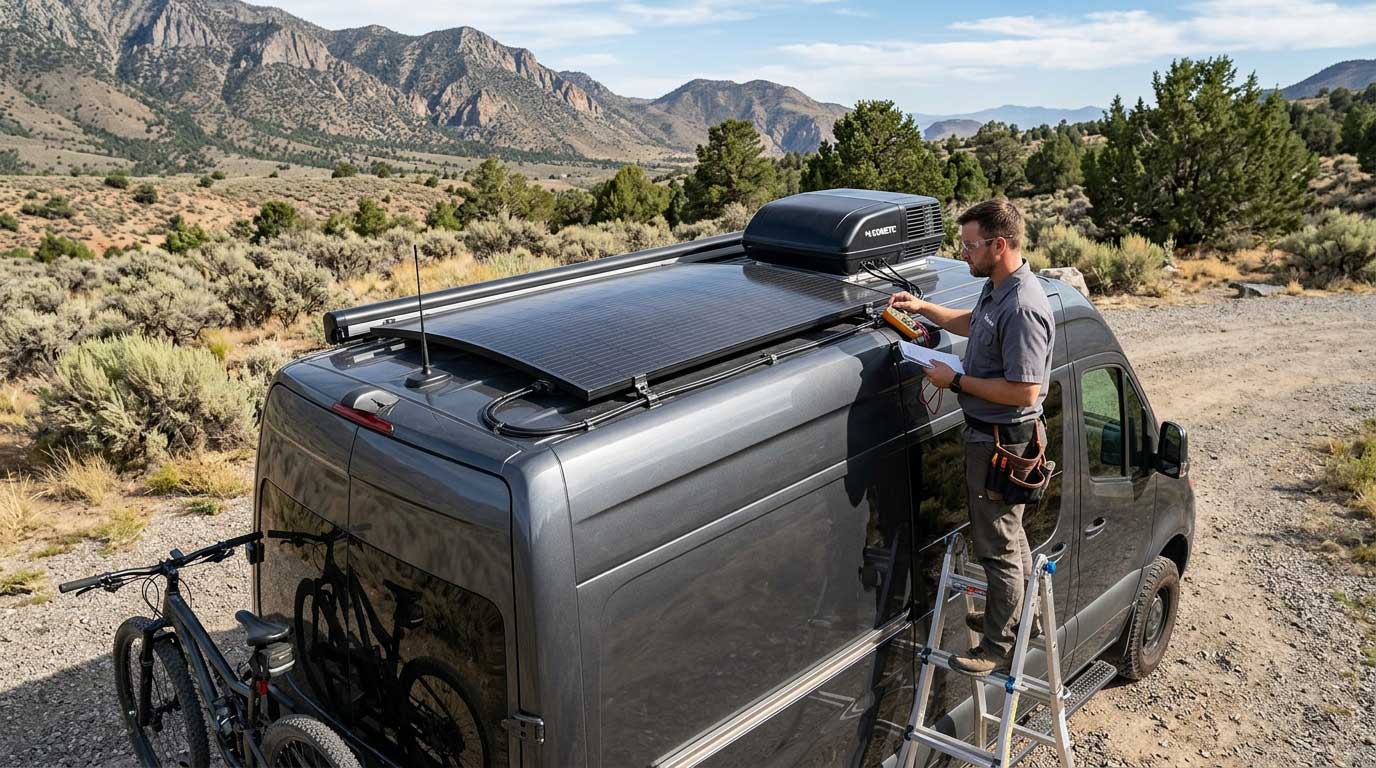
Realistic Application Case: Semi Flexible Solar Panels on a Camper
Consider a medium-sized camper used for weekend and extended off-grid travel.
The roof has a curved central section and already contains a ventilation fan.
The owner wants approximately 400W of solar capacity.
A rigid-panel layout initially looks attractive because standard framed modules are easy to source. Once the roof is measured, however, the fan and roof curvature leave two narrow areas where a conventional framed panel would either require additional mounting structure or waste usable surface.
A semi-flexible design provides another option.
Two appropriately sized modules can follow the roof curve while leaving the fan accessible.
The important observation is not that semi-flexible technology magically produces more electricity.
It doesn’t.
The advantage is that the technology makes a difficult roof layout practical.
That is a recurring distinction in professional solar design: the value of flexibility often comes from installation efficiency rather than electrical efficiency alone.
How to Compare Semi Flexible Solar Panels Before Buying
A professional comparison should go beyond wattage and price.
Use a specification checklist like this:
| Specification | What to Check |
|---|---|
| Rated Power | Required system capacity |
| Vmp | Operating voltage |
| Imp | Operating current |
| Voc | Maximum open-circuit voltage |
| Isc | Short-circuit current |
| Cell Type | Mono, thin-film, or other technology |
| Efficiency | Power conversion performance |
| Dimensions | Fit on the available surface |
| Weight | Structural and vehicle considerations |
| Bending Radius | Compatibility with surface curvature |
| Operating Temperature | Suitability for outdoor conditions |
| Connector | Compatibility with system wiring |
| IP Rating | Protection against environmental exposure |
| Warranty | Long-term product support |
| Certifications | Market and application requirements |
For modules intended for long-term outdoor use, certification and qualification deserve particular attention.
IEC 61215 covers design qualification and type approval for terrestrial PV modules intended for long-term operation in open-air climates. The 2021 edition specifically added test methods for flexible modules, including bending tests.
A certification reference does not replace application-specific engineering, but it gives buyers a more meaningful basis for comparing products.
Bright Solar Approach to Semi Flexible Solar Panels
For Bright Solar, semi-flexible solar should be treated as an application-driven product rather than simply a thinner version of a rigid module.
The useful questions begin with the installation:
- What surface will the module follow?
- What is the required bending radius?
- How much power is needed?
- What weight can the structure accept?
- Is the application mobile or stationary?
- Will the panel face salt water, UV exposure, dust, or extreme heat?
- What connector and electrical configuration are required?
- Does the customer need a standard size or a customized shape?
This approach is especially relevant to B2B customers such as RV manufacturers, marine equipment companies, solar distributors, system integrators, and specialty vehicle builders.
A well-selected semi-flexible module should fit the application before the purchase order is finalized—not after the installation team discovers that the roof curvature and panel specification do not match.
How to Install a Semi Flexible Solar Panel
A good semi-flexible panel can still perform poorly if the installation is rushed.
The first step is not applying adhesive. It is checking the surface.
For an RV roof, boat cabin, van roof, or curved outdoor structure, inspect the proposed area for old sealant, dirt, oxidation, damaged coatings, standing-water areas, vents, hatches, and cable-entry points.
A practical installation sequence is:
- Measure the usable surface.
- Confirm the panel dimensions and bending radius.
- Place the panel temporarily on the surface.
- Check clearances around roof equipment.
- Mark the cable route.
- Prepare the surface according to the selected mounting method.
- Position the panel without exceeding its bending limit.
- Secure the module according to the manufacturer’s instructions.
- Protect and route the electrical cables.
- Test the system before final commissioning.
The temporary positioning stage is easy to skip and expensive to regret.
Once adhesive has been applied, moving a panel several centimeters may mean removing and replacing the mounting material.
Do Not Force the Panel Around a Roof Edge
A semi-flexible module should follow a controlled curve.
It should not be sharply creased around a corner simply because the available roof space is tight.
This distinction is important enough to appear in a professional installation guide:
A panel’s flexibility is a specification, not permission to bend it arbitrarily.
IEC 61215 includes specific testing requirements for flexible PV modules, including the MQT 22 bending test. The standard treats flexible-module behavior as an engineering characteristic that can be tested rather than as an undefined marketing term.
For B2B projects, ask the manufacturer for the permitted bending radius and installation orientation before finalizing the mounting design.
Adhesive Mounting vs. Mechanical Mounting
Semi-flexible panels are commonly selected when a low-profile installation is desirable.
Depending on the product, this can involve adhesive mounting, mechanical fixing, or a combination of methods.
The correct choice depends on the module construction and installation environment.
Adhesive Installation
Adhesive mounting can create a clean appearance and avoid some of the brackets associated with rigid framed panels.
Before using adhesive, however, check:
- Surface material
- Surface cleanliness
- Coating compatibility
- Temperature range
- UV exposure
- Moisture exposure
- Manufacturer’s installation instructions
A strong adhesive is not automatically the right adhesive.
For example, a mounting surface may expand and contract differently from the panel as temperatures change. The bonding system needs to accommodate the intended environment.
Mechanical Installation
Mechanical fixing may be appropriate for some applications, particularly where additional securing is required.
On a boat or vehicle roof, however, drilling a hole introduces another issue: waterproofing.
That means the mounting decision should consider the complete installation, not just how securely the panel is attached.
RV Applications: Where Semi Flexible Panels Make Sense
RV roofs are a natural application for semi-flexible solar technology because available space is rarely a clean rectangle.
A typical roof may already contain:
- Air conditioner
- Vent fan
- Skylight
- TV antenna
- Satellite equipment
- Roof rack
- Plumbing vents
The remaining area can be narrow and irregular.
A rigid panel may fit, but only after adding brackets or redesigning the roof layout.
A semi-flexible module can sometimes occupy that curved section directly.
This does not guarantee higher electrical output. It can simply make previously awkward space usable.
That distinction is important.
Example: A 400W RV Roof
Consider a medium-size RV with enough roof space for a nominal 400W system.
Two design options are being evaluated:
| Consideration | Conventional Rigid Layout | Semi Flexible Layout |
|---|---|---|
| Roof curvature | Requires mounting structure | Can follow controlled curve |
| Roof height | Higher | Lower profile |
| Hardware | Rails/brackets may be needed | Depends on mounting design |
| Air gap | Typically available | May be limited |
| Roof penetrations | Installation-dependent | Potentially reduced |
| Irregular roof space | Less convenient | Often easier to use |
The final choice depends on the actual roof and product specifications.
For an RV owner who prioritizes a low-profile appearance and has a curved roof, the semi-flexible approach may be the cleaner solution.
For a flat roof where ventilation beneath the module and rigid mechanical protection are more important, a conventional framed panel may remain preferable.
Marine Applications Require More Than Flexibility
Boats create a different operating environment.
Saltwater, spray, humidity, UV exposure, vibration, and limited maintenance access all affect component selection.
A semi-flexible marine panel should therefore be evaluated for more than its bending capability.
Look at:
- Protective surface material
- Junction-box protection
- Connector quality
- Cable jacket
- Corrosion resistance of related hardware
- Temperature range
- UV resistance
- Warranty
- Installation method
A panel advertised as flexible is not automatically a marine panel.
That distinction matters for yacht builders, marine distributors, and boat owners.
The module and the installation hardware should be specified for the environment as a complete system.
Heat: The Overlooked Variable in Semi Flexible Solar Panel Design
One of the less visible differences between a rigid and semi-flexible installation is the thermal environment.
A conventional framed module is commonly raised above its mounting surface.
A semi-flexible module may sit much closer to the roof.
That difference can influence operating temperature.
The U.S. Department of Energy explains that PV cells generally perform better at lower temperatures and that increasing temperature causes a much larger decrease in voltage than the corresponding increase in current. Proper thermal management can therefore improve efficiency and lifetime.
For a semi-flexible module on a dark RV or boat roof, this becomes a practical consideration.
The panel may be exposed to:
- Strong midday sunlight
- High ambient temperature
- Heated roof material
- Limited backside airflow
A manufacturer should therefore provide a meaningful operating temperature specification.
Buyers should read it.
This is one of those details that rarely appears in a short product advertisement but can matter after the panel has been installed for several summers.
Energy Output: Rated Power Is Not Daily Production
A semi-flexible panel rated at 200W is a 200W-rated PV module under its specified test conditions. It does not mean the panel produces 200W continuously throughout the day.
The U.S. Department of Energy distinguishes between laboratory efficiency and actual energy yield. Real-world energy yield is influenced by conditions such as heat, dirt, and shade.
For example:
200W × 4 hours = 800Wh
This is a simple theoretical calculation.
It does not account for:
- Temperature
- Cloud cover
- Shading
- Orientation
- Soiling
- Wiring
- Controller losses
- Battery charging losses
DOE also notes that PV performance ratings are measured under standard test conditions of 1,000 W/m² irradiance and 25°C cell temperature, while real installations commonly experience different sunlight and temperature conditions.
This is why professional solar proposals should distinguish clearly between rated power and expected energy yield.
The difference is small in wording but significant in customer expectations.
How to Choose the Right Semi Flexible Panel for an Off-Grid System
For an off-grid application, begin with the load rather than the panel.
A simple example:
| Load | Example Daily Consumption |
|---|---|
| Refrigerator | 500Wh |
| LED lighting | 40Wh |
| Laptop | 100Wh |
| Phones/tablets | 60Wh |
| Router | 120Wh |
| Water pump | 80Wh |
| Miscellaneous | 100Wh |
| Total | 1,000Wh/day |
If the proposed array is 400W and the planning assumption is four equivalent peak-sun hours:
400W × 4h = 1,600Wh theoretical energy
That may appear sufficient for a 1,000Wh daily load.
But a professional design should not stop there.
What happens on a cloudy day?
What happens when the vehicle is parked under trees?
What happens when the roof is dirty?
What happens when the panel temperature is high?
DOE’s PV system research specifically considers heat, dirt, shade, and other losses when evaluating actual energy yield.
That is why some off-grid systems are intentionally designed with additional generation capacity and battery storage rather than being sized to the average daily load alone.
Series or Parallel: What Changes for Semi Flexible Panels?
The panel technology does not eliminate the need for proper electrical design.
In a series connection, voltage increases while current remains approximately at the string level.
In a parallel connection, current increases while voltage remains approximately at the array level.
The choice affects:
- Charge-controller selection
- Cable current
- Voltage drop
- Shading behavior
- System voltage
- Cold-weather Voc margin
The maximum PV input voltage of the controller must not be exceeded.
This becomes particularly important in cold weather because a module’s open-circuit voltage can rise as temperature falls.
For a professional installation, calculate the worst-case voltage rather than simply adding the nominal panel voltage printed on the label.
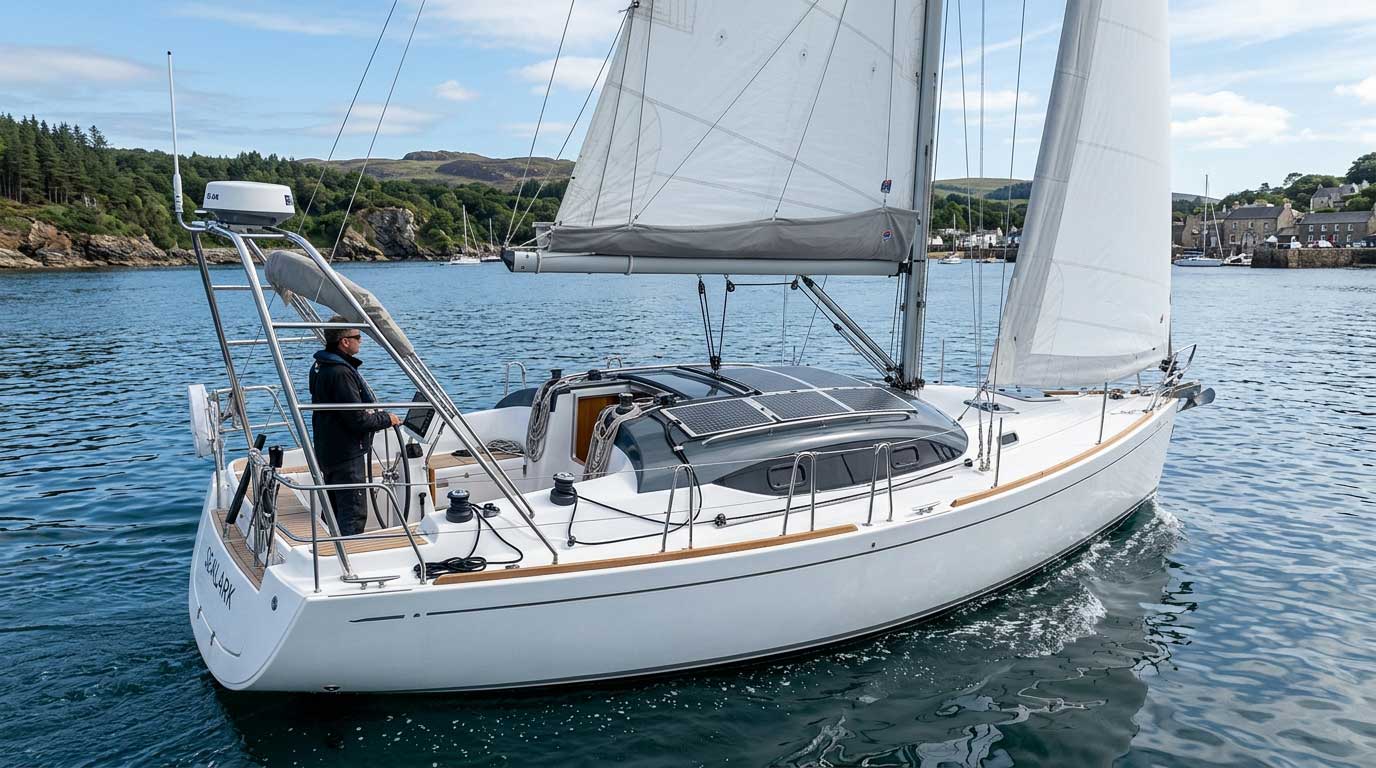
Case Study: Choosing a Semi Flexible Solar Panel for a Yacht
Consider a 32-foot cruising yacht used for coastal trips.
The cabin roof is slightly curved, and the owner wants additional solar capacity without building a tall aluminum rack.
The initial proposal is a conventional rigid panel.
The problem appears during the layout.
The rigid module would extend beyond the preferred mounting zone and create a raised structure close to a walkway.
A semi-flexible solution is considered instead.
The design team measures the cabin roof, identifies the usable curve, checks the required panel dimensions, and confirms that the proposed module’s bending capability is compatible with the surface.
The electrical system is then checked separately.
This is an important workflow.
Mechanical compatibility comes first. Electrical compatibility comes immediately after it.
The final module is selected only after both conditions are satisfied.
This type of project demonstrates where semi-flexible technology has a real advantage: not because the panel generates more electricity than every rigid alternative, but because it can integrate into a surface where conventional construction creates compromises.
Bright Solar Semi Flexible Solar Panel Selection
Bright Solar approaches semi-flexible solar panels from the application outward.
For B2B customers, the important parameters can include:
- Rated power
- Vmp
- Imp
- Voc
- Isc
- Cell technology
- Module efficiency
- Dimensions
- Weight
- Maximum bending radius
- Operating temperature
- Connector
- IP protection
- Warranty
- Required customization
For example, Bright Solar’s L Series is designed around controlled flexibility, with up to 30% flexibility, salt-water resistance, DuPont ETFE surface protection, UV resistance, and PERC monocrystalline cells. The exact suitability of the product should still be checked against the project’s mechanical and electrical requirements.
This is particularly relevant for applications where a standard rigid module creates a poor fit.
A B2B buyer may need a specific module length.
A van manufacturer may need a particular width.
A marine customer may prioritize saltwater resistance.
A distributor may need consistent dimensions across several product configurations.
Those are different requirements even though all of them can be described as “flexible solar.”
What Should a Manufacturer Provide Before Bulk Purchase?
For distributors, installers, and OEM customers, request the technical information before placing a production order.
At minimum, ask for:
- Product datasheet
- Electrical specifications
- Mechanical dimensions
- Weight
- Bending specification
- Operating temperature
- Connector specification
- Junction-box information
- Warranty terms
- Applicable certifications
- Installation instructions
- Packaging dimensions
- Sample availability
A physical sample is especially useful for customized projects.
It lets the engineering team test:
- Roof fit
- Curvature
- Cable location
- Edge clearance
- Surface compatibility
- Installation sequence
A drawing can tell you the panel is 1,000 mm wide.
A physical sample tells you whether 1,000 mm actually works on the roof.
That difference becomes important when hundreds of modules will eventually be installed.
Maintenance and Long-Term Inspection
Semi-flexible does not mean maintenance-free in every application.
The maintenance requirement depends on the product, environment, and installation.
A vehicle traveling through dusty regions can accumulate significant surface contamination. A boat can experience salt deposits. An RV parked under trees may collect pollen and organic debris.
During periodic inspection, check:
- Surface cleanliness
- Panel edges
- Cable routing
- Connectors
- Junction box
- Sealant
- Mounting points
- Visible damage
- Signs of water ingress
The inspection should also include the roof around the panel.
A panel can be electrically healthy while a poorly sealed cable entry is allowing water into the structure.
For mobile systems, inspect after long road trips or extended periods of vibration.
Small movement at a cable connection can become a much larger problem over time.\
FAQ About best semi flexible solar panel
What is the best semi flexible solar panel?
The best semi flexible solar panel is the one whose power, dimensions, weight, bending radius, electrical characteristics, environmental protection, and mounting method match the installation. There is no single model that is best for every application.
Are semi flexible solar panels better than rigid panels?
They can be better for curved, lightweight, or low-profile installations. Rigid panels can remain preferable where mechanical protection, ventilation beneath the module, or conventional mounting structures are priorities.
How much can a semi flexible solar panel bend?
The allowable bending amount depends on the module design. Buyers should use the manufacturer’s specified bending radius rather than assuming that all semi-flexible panels have the same flexibility.
Can I install a semi flexible solar panel directly on an RV roof?
Some products are designed for direct installation, but the mounting method must follow the manufacturer’s instructions. Roof preparation, adhesive compatibility, cable routing, temperature, and drainage should all be considered.
Are semi flexible solar panels suitable for boats?
Yes, when the product is appropriate for the marine environment. Saltwater exposure, UV, humidity, connectors, protective materials, and installation hardware should be evaluated together with the panel’s flexibility.
Do semi flexible solar panels get hotter than rigid panels?
A flush-mounted semi-flexible panel can have a different thermal environment from a raised rigid panel because backside airflow may be limited. Temperature affects PV voltage and efficiency, so the product’s operating conditions and installation method matter.
What specifications should I request from a semi flexible solar panel manufacturer?
Request rated power, Vmp, Imp, Voc, Isc, cell type, efficiency, dimensions, weight, bending radius, operating temperature, connector, IP rating, warranty, certifications, and installation instructions.
Conclusion
The best semi flexible solar panel is not simply the thinnest or most bendable module on the market.
It is the module that fits the physical surface, electrical system, environmental conditions, and long-term installation requirements.
For RVs and vans, that may mean prioritizing low weight, controlled curvature, compact dimensions, and a low-profile installation. For boats, saltwater exposure and component protection become more important. For custom off-grid systems, electrical characteristics and energy yield deserve equal attention.
The most reliable selection process starts with the actual installation surface.
Measure it.
Map the obstacles.
Determine the required curvature.
Calculate the electrical demand.
Then compare products against the resulting specification.
For Bright Solar’s B2B customers, this application-first method also creates a clearer path toward customized dimensions and configurations. When the mechanical and electrical requirements are defined before production, the resulting semi-flexible solar solution is easier to install and easier to integrate into the final system.
In other words, choosing the best semi flexible solar panel is an engineering decision first and a product comparison second.
Related recommendations
-

200w solar panel flexible (Real Field Performance Guide from Bright Solar)
134200w solar panel flexible explained with real RV field data, installation insights, off-grid performance results, and practical energy system design guidance.
View details -
100 Watt Solar Panel for RV: Complete Sizing Guide
222Learn how a 100 watt solar panel for rv use works, what it can power, battery sizing, daily output, wiring, and when to add more panels for off-grid travel.
View details -
Sungrow Inverter Helps Chilean Photovoltaic Project in the Atacama Desert
190Sungrow Inverter turnkey PV inverter solutions and solar panel cleaning robots to a 480 MW photovoltaic project in Chile’s Atacama Desert, supporting the country’s Energy Policy 2050 with high-efficiency inverters, anti-PID technology, and waterle...
View details -
200W Flexible Solar Panels: Lightweight Off-Grid Power for RVs, Boats, and Van Life
166Explore how 200W flexible solar panels provide lightweight, reliable off-grid energy for RVs, boats, vans, and portable solar systems.
View details