will hail damage solar panels?
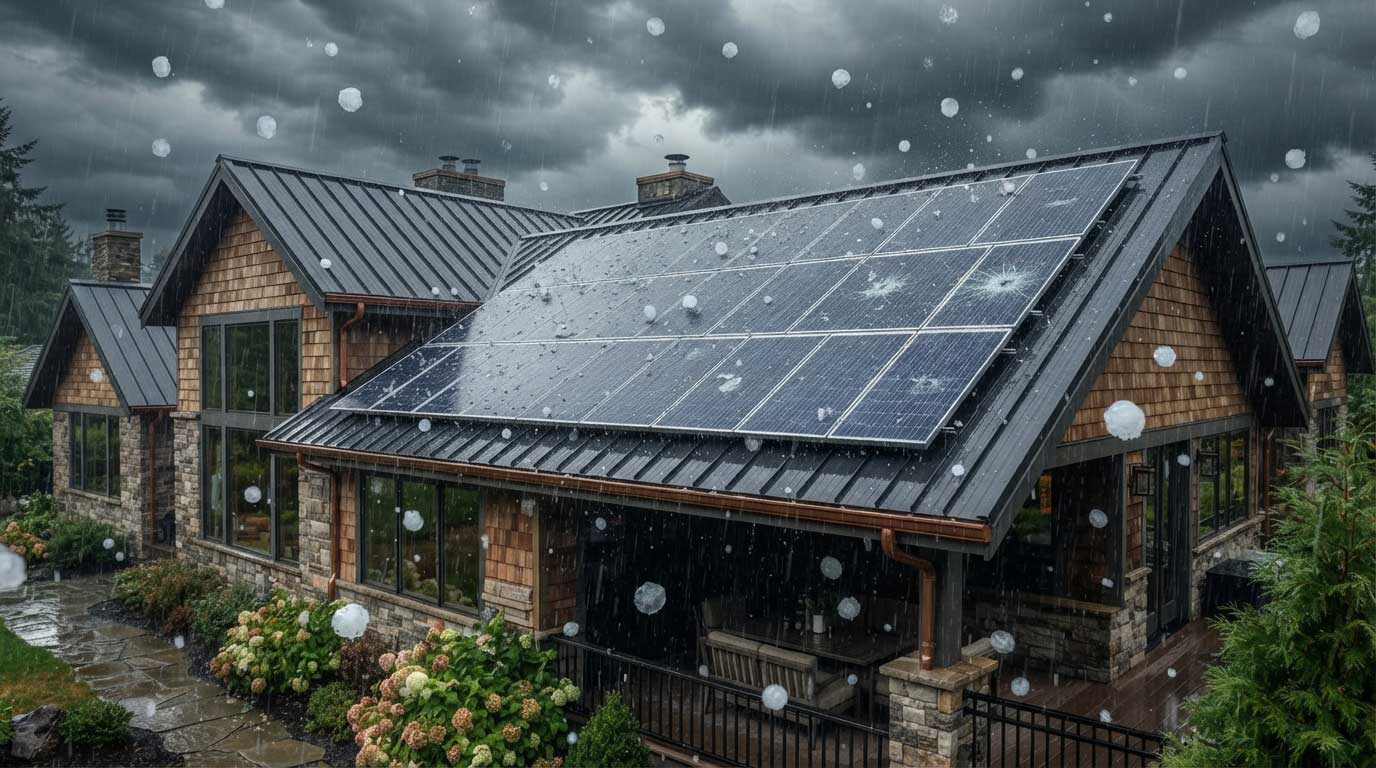
will hail damage solar panels? Yes, severe hail can damage photovoltaic modules, but modern panels are designed to withstand normal hail exposure. The real risk rises with unusually large hail, repeated impacts, vulnerable module construction, and direct high-energy strikes.
Can Hail Really Damage Solar Panels?
Yes—but not every hailstorm is a threat to a properly manufactured PV module.
Most conventional solar panels use tempered front glass designed to withstand outdoor mechanical stress. Standard PV qualification testing includes hail impact testing, but the standard test should not be confused with protection against every possible storm.
The International Electrotechnical Commission’s IEC 61215 qualification test requires crystalline-silicon modules to withstand 11 impacts from 25 mm ice balls at 23 m/s, approximately 83 km/h or 51 mph.
That gives homeowners a useful reference point.
It does not mean a panel is guaranteed against baseball-sized hail.
The U.S. Department of Energy specifically warns that PV systems have historically survived most hail events, while very large hail—particularly hail greater than 44 mm (1¾ inches)—has caused significant module damage.
What Happens to Solar Panels During a Hailstorm?
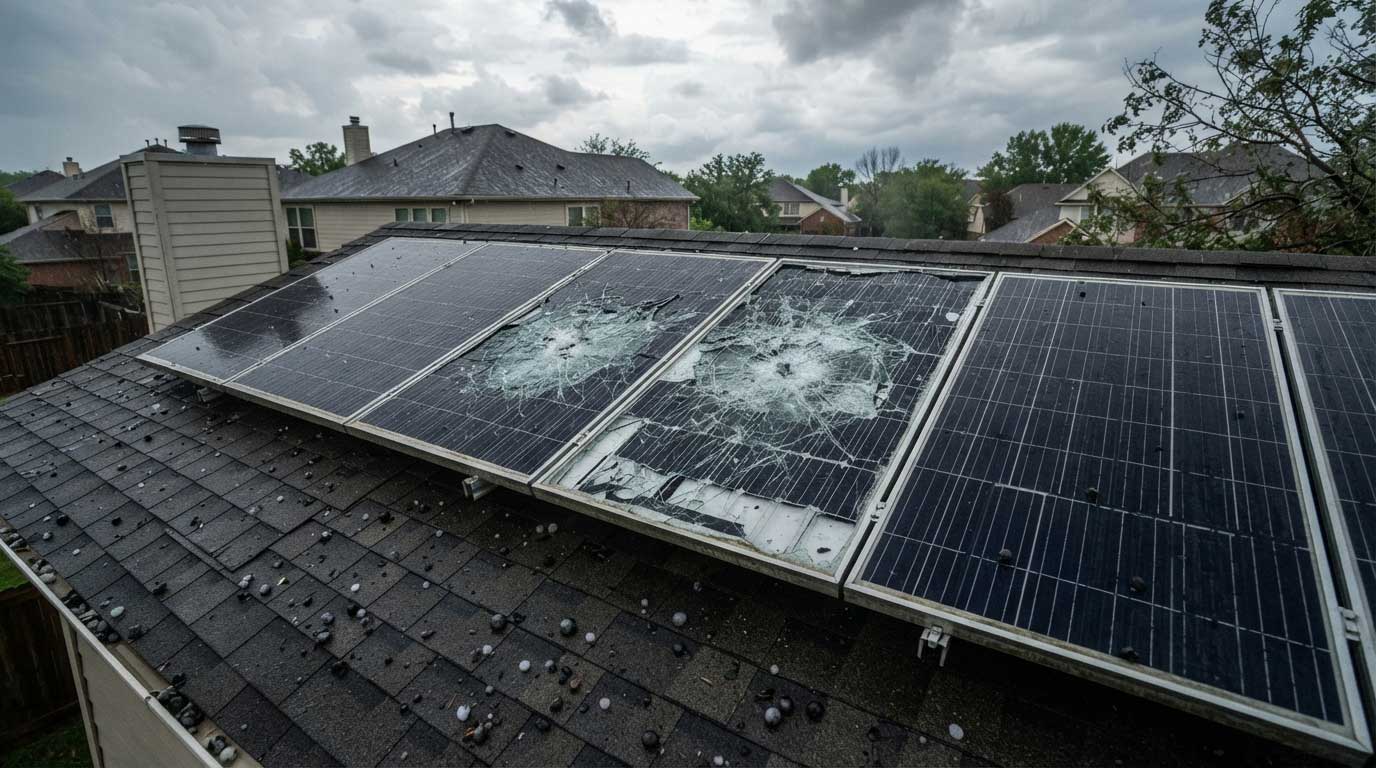
Hail damage isn’t always a dramatic shattered panel.
There are several possible outcomes:
- No visible damage
- Small glass impact marks
- Cracked front glass
- Broken solar cells
- Microcracks
- Damaged cell interconnections
- Reduced electrical output
- Hot spots
- Frame or structural damage
- Complete module failure
The tricky one is microcracking.
A panel can look normal from the ground while individual cells underneath the glass have suffered cracks. Those cracks may interrupt current paths or develop into larger problems over time.
NREL’s research has found higher performance losses after hail events involving hail 25 mm or larger, while also concluding that newer, more stringent hail testing is needed.
That is why I would not judge a storm-damaged array only by looking for broken glass.
What Size Hail Can Damage Solar Panels?
There isn’t a single hail diameter at which damage suddenly begins.
Impact energy depends on more than diameter. Hailstone mass, velocity, impact angle, glass thickness, cell construction, frame support, and the exact point of impact all matter.
| Hail condition | Potential effect |
|---|---|
| Small hail | Usually little or no module damage |
| 25 mm / 1 in | Within the basic IEC hail qualification test |
| 35 mm / 1.4 in | Greater impact energy; damage risk increases |
| 45 mm / 1.8 in | More serious concern for vulnerable modules |
| 55 mm / 2.2 in+ | Significant damage becomes increasingly possible |
| 75 mm / 3 in+ | Severe hail risk; module damage can be substantial |
DOE’s hail mitigation guidance lists optional IEC impact levels ranging from 25 mm at 23 m/s up to 76 mm at 39.5 m/s. The larger tests involve substantially greater ice-ball mass and impact energy.
The important distinction: passing the basic hail certification does not make a module hail-proof.
Are Some Solar Panels More Hail Resistant?
Yes.
Module construction can make a meaningful difference.
DOE recommends considering modules with stronger construction in hail-prone locations, including:
- At least 3.2 mm front glass
- 4.0 mm glass where appropriate
- Stronger frames
- Rear support bars
- Smaller-format modules where practical
- Higher-than-minimum hail-test performance
- Independent durability test results
DOE specifically notes that 4.0 mm front glass is preferred for hail resilience, although it is less common, and recommends asking manufacturers for evidence of hail testing beyond the minimum IEC requirement in severe or very severe hail regions.
For Bright Solar, this is where the module datasheet deserves more attention than the headline wattage.
A 550W module may look attractive on a quotation, but if the project is in a high-hail region, I would also want to know the glass construction, frame design, certification, mechanical-load rating, and enhanced hail-test results.
Does Solar Panel Angle Affect Hail Damage?
Yes.
Panel tilt can influence how directly hail strikes the module surface.
DOE’s hail mitigation guidance notes that hail impacts perpendicular to the panel surface can be more damaging. In one tracker-system study cited by DOE, increasing tilt from flat to 60° increased estimated survival likelihood from 82% to 99%. However, DOE also emphasizes that a 60° angle is generally impractical for fixed systems and that higher tilt can increase wind loading.
So I would not recommend dramatically changing a residential array’s tilt just because of hail.
The better approach is to balance:
solar production + hail exposure + wind loading + roof structure + installation cost.
For fixed rooftop systems, the panel angle is normally determined primarily by solar-resource and structural considerations.
Can Hail Damage Solar Panels Without Breaking the Glass?
Yes.
This is one of the most important points homeowners miss.
A hailstone can damage the silicon cell underneath the protective glass without producing an obvious shattered surface.
NREL research on extreme-weather impacts has identified cracked cells as a mechanism associated with performance losses after hail.
After a serious storm, production data can therefore be more informative than a quick visual inspection.
Watch for:
- Sudden production reduction
- One string producing less than comparable strings
- Unexpected inverter alerts
- Abnormal module temperatures
- Visible glass damage
- New hot spots
- Electrical insulation problems
If the storm was severe enough to raise concerns, professional testing can include infrared imaging or electroluminescence testing. DOE recommends post-hail inspection and notes that EL imaging can reveal cell cracks that are difficult to identify visually.
What Should You Do After Hail Damages Solar Panels?
Do not immediately climb onto the roof to inspect the modules yourself.
Broken glass can create both physical and electrical hazards.
Instead:
- Check the system monitoring platform for unusual production.
- Look for visible damage from ground level.
- Do not touch cracked or damaged modules.
- Follow the system’s emergency shutdown procedure if appropriate.
- Contact a qualified solar professional.
- Document the damage with photographs.
- Check your solar and homeowners insurance coverage.
- Request electrical testing before returning damaged equipment to normal operation.
DOE recommends shutting down a visibly damaged system until visual and electrical inspections can be completed. It also recommends considering IR, UV, or EL inspection after significant hail events because some damage is not immediately visible.
Don’t Judge Damage by Glass Alone
A common field mistake is:
“The glass isn’t broken, so the panel is fine.”
That conclusion is too quick.
A panel can have internal cell cracking while still looking acceptable from several feet away. If the system contains many modules, comparing production across strings can also help identify an abnormal section.
This is where proper commissioning records become useful. A baseline image or performance record taken before severe weather gives technicians something concrete to compare afterward. DOE recommends baseline imaging and post-event diagnostic testing as part of hail-resilience practices.
How Can You Protect Solar Panels From Hail?
The best protection starts before installation.
DOE states that designing for hail resilience during procurement and system design is more effective than trying to retrofit protection afterward.
For a hail-prone location, consider:
- Higher-rated hail-resistant modules
- Thicker front glass
- Strong module frames
- Reinforced rear support
- Appropriate mounting hardware
- Correct structural attachment
- Suitable panel tilt
- Tracker hail-stow capability where applicable
- Storm monitoring
- Documented inspection procedures
For tracker systems, DOE recommends considering a dedicated hail-stow mode, which moves modules toward a more vertical position to reduce direct hail impacts.
Residential fixed-roof systems obviously don’t have that option. Module selection becomes much more important.
How Much Damage Can a Major Hailstorm Cause?
A severe event can damage a significant portion of an array.
IEA PVPS documented a Colorado hail event in which approximately 25%–50% of on-site PV modules were impacted by a record hailstorm. Its recent analysis also documents severe hail cases involving shattered glass, cell breakage, microcracks, and structural deformation.
NREL’s broader extreme-weather research found that hail events exceeding current IEC 61215 test conditions were associated with higher post-storm performance-loss rates, reinforcing the need for more demanding hail testing.
That changes how I think about “hail resistance.”
It isn’t simply:
pass or fail.
A better question is:
How does this particular module behave when the storm exceeds the minimum certification test?
FAQ About will hail damage solar panels?
Will hail damage solar panels?
Yes, severe hail can damage solar panels, especially when hail is substantially larger or faster than the basic certification test conditions. Most ordinary hail events do not necessarily destroy properly manufactured modules.
What size hail can break solar panels?
There is no universal threshold. Hail around 25 mm is used in the basic IEC test, while significantly larger hail can cause serious damage. DOE identifies hail above approximately 44 mm as a particular concern for PV systems.
Are solar panels hail resistant?
Modern modules are designed and tested for hail resistance, but “hail resistant” does not mean “hail proof.” Ask the manufacturer for the specific certification and any enhanced hail-testing data.
Can hail damage solar panels without cracking the glass?
Yes. Internal cell cracks and other electrical damage can occur without obvious external glass breakage. Professional electrical or imaging tests may be needed to identify hidden damage.
Are thicker solar panels better against hail?
Thicker front glass can improve impact resistance, but glass thickness is not the only factor. Frame strength, cell design, module size, support structure, and test performance also matter.
Should I cover solar panels before a hailstorm?
Do not attempt to climb onto a roof or manually cover an installed PV array during an approaching storm. For systems specifically designed with automated hail protection, follow the manufacturer’s operating procedure.
Should I replace solar panels after a hailstorm?
Not automatically. A qualified technician should assess the modules and electrical system first. Panels with only cosmetic marks may not require replacement, while cracked glass, cell damage, insulation faults, or significant performance loss may require repair or replacement.
Conclusion
will hail damage solar panels? It can, but the risk depends heavily on hail size, impact energy, module construction, installation design, and local storm conditions.
The basic IEC hail test uses 25 mm ice balls traveling at 23 m/s, while real-world severe storms can produce much larger hail.
For Bright Solar projects, hail resistance should therefore be evaluated before the panels reach the roof. In high-risk regions, stronger glass, robust frames, enhanced hail testing, sound mounting, and a post-storm inspection plan are more valuable than simply assuming a certified panel is indestructible.
The prev: what is a solar panel made of?The next: do solar panels cause cancer?
Related recommendations
-

How to Mount a Flexible Solar Panel?
246Learn how to mount a flexible solar panel correctly using adhesive, airflow spacing, and waterproof wiring. Real installer tips for RVs, vans, boats, and off-grid use.
View details -
how to connect two portable solar panels together?
115Connect two portable solar panels in series or parallel based on the receiving device’s voltage and current limits. Always verify Voc, Vmp, Isc, Imp, wattage...
View details -
How to Wire Solar Panels?
107Learn how to wire solar panels correctly with series and parallel connections. Explore professional wiring methods, safety tips, and expert insights from Bright Solar.
View details -
what are solar panels made of?
112Discover what are solar panels made of, from silicon cells to glass and aluminum layers. Learn real manufacturing details and Bright solar insights.
View details