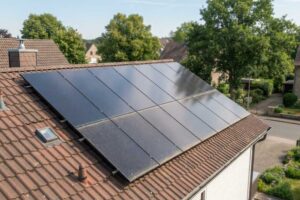
what is a solar panel made of?
what is a solar panel made of can be answered simply: modern crystalline-silicon panels mainly contain silicon solar cells, tempered glass, polymer encapsulants, an aluminum frame, a protective backsheet, copper wiring, and a junction box. Each layer has a specific electrical, mechanical, or weather-protection role.
What Materials Are Used in a Solar Panel?
A solar panel is not one material.
It is a laminated structure built around photovoltaic cells.
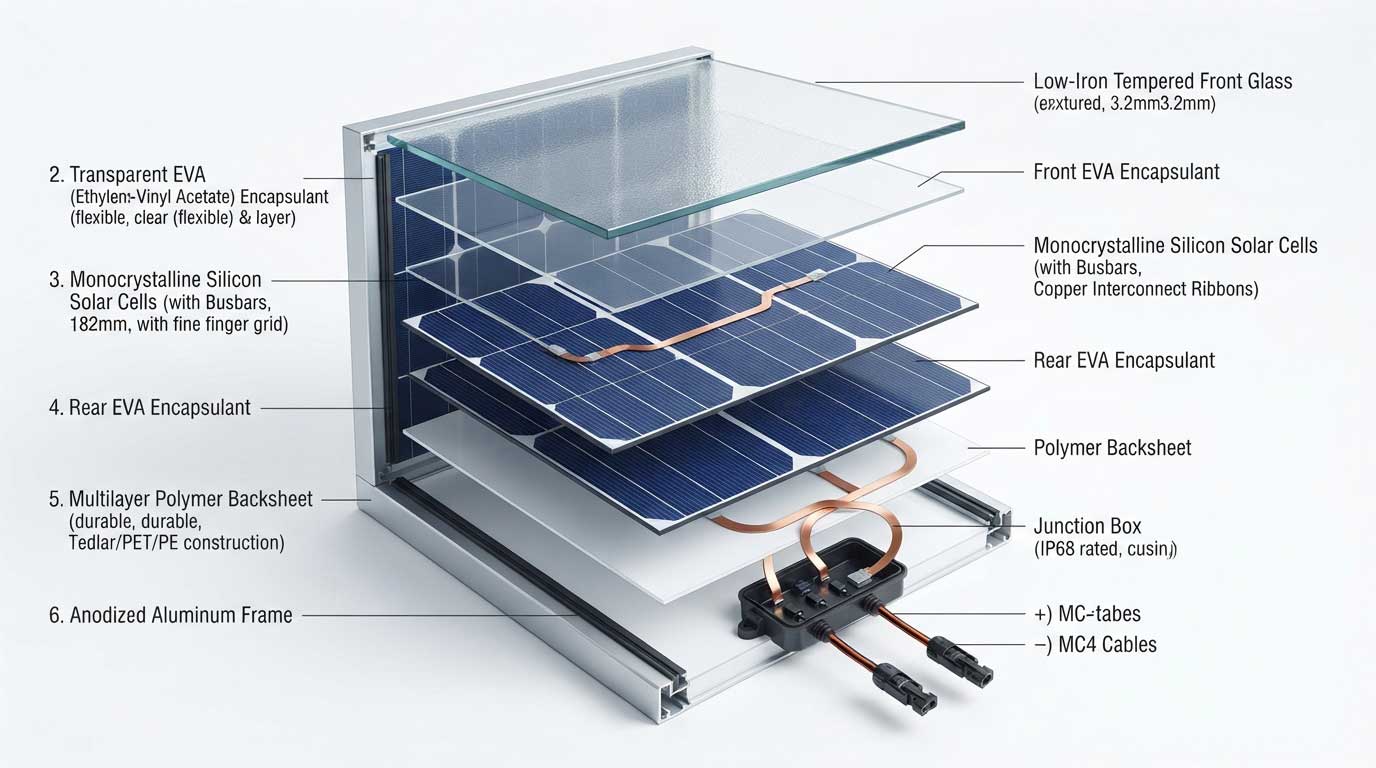
For the crystalline-silicon modules used in most residential and commercial installations, the basic construction is:
Glass → encapsulant → silicon cells → encapsulant → backsheet → aluminum frame
The junction box and electrical conductors complete the module.
The U.S. Department of Energy lists wafers, cells, encapsulants, glass, backsheets, junction boxes, connectors, and frames among the major components used in PV module manufacturing.
There is a reason manufacturers put so much effort into the layers around the cell. The silicon itself generates electricity, but it is surprisingly vulnerable when exposed directly to rain, humidity, mechanical stress, and temperature changes.
The packaging has to protect it for years without blocking too much sunlight.
What Are Solar Cells Made Of?
The photovoltaic cell is the electrical heart of the panel.
Most modern solar cells use crystalline silicon as the semiconductor. DOE states that silicon is by far the most common semiconductor material used in solar cells because it offers a useful combination of efficiency, cost, and long service life.
A silicon cell starts with a very thin wafer made from high-purity silicon.
During manufacturing, the wafer is processed to create the electrical properties needed for photovoltaic conversion. Metal contacts are then added so the current generated inside the cell can be collected.
DOE reports that monocrystalline silicon represented 96% of global solar shipments in 2022, demonstrating how dominant this material has become in the PV market.
Monocrystalline vs. Other Solar Cell Materials
Not every solar panel uses silicon.
| Solar technology | Main semiconductor | Typical construction |
|---|---|---|
| Monocrystalline | Crystalline silicon | Silicon wafer |
| Polycrystalline | Crystalline silicon | Multiple crystal grains |
| CdTe thin film | Cadmium telluride | Semiconductor deposited on glass |
| CIGS | Copper, indium, gallium, selenium | Thin semiconductor layers |
| Perovskite | Perovskite compounds | Emerging thin-film technology |
DOE notes that thin-film PV can use materials such as cadmium telluride and copper indium gallium diselenide, while emerging PV research also includes perovskites and other semiconductor structures.
For mainstream residential modules, however, crystalline silicon remains the material to know.
What Is the Glass on a Solar Panel Made Of?
The front glass is more than a transparent cover.
It protects the cells from hail, wind, moisture, dirt, and mechanical impact while allowing sunlight to reach the semiconductor.
Modern crystalline-silicon modules commonly use glass as the front protective layer. DOE explains that PV cells are sandwiched between protective materials such as glass and plastic to withstand outdoor exposure.
Glass also influences optical performance.
Untreated silicon can reflect more than 30% of incident light, according to DOE. Anti-reflective treatments and textured surfaces help reduce these optical losses.
This is something I pay attention to when comparing modules: the glass is part of the optical system, not merely a piece of protective hardware.
What Is the Encapsulant in a Solar Panel?
The encapsulant surrounds the solar cells and holds the internal structure together.
EVA, or ethylene-vinyl acetate, has traditionally been one of the most widely used encapsulant materials. Newer module designs may also use polyolefin-based encapsulants.
The encapsulant has several jobs:
- Protect cells from moisture
- Reduce mechanical movement
- Electrically isolate components
- Maintain optical transmission
- Help bond the internal layers
- Absorb some mechanical stress
NREL‘s module construction research identifies EVA as a key material used to laminate crystalline-silicon cells between the protective layers.
This layer is thin and mostly invisible once the module is finished, but its long-term stability matters. UV exposure, heat, humidity, and thermal cycling all put pressure on the encapsulation system.
What Is the Back of a Solar Panel Made Of?
Traditional framed solar panels often use a polymer backsheet on the rear.
The backsheet provides electrical insulation and environmental protection. Some newer modules instead use glass-glass construction, replacing the polymer backsheet with another glass layer.
That changes the module’s mechanical characteristics, weight, moisture resistance, and sometimes installation requirements.
NREL field studies have documented crystalline-silicon modules using glass superstrates with polymeric backsheets, while modern module construction increasingly includes different glass and encapsulant configurations.
For flexible solar panels, the construction can be different again. Flexible modules may replace conventional rigid glass with polymer-based outer materials to reduce weight and allow controlled bending.Visit product page:Flexible Solar Panels
Why Are Solar Panel Frames Made of Aluminum?
Most conventional framed modules use aluminum around the perimeter.
Aluminum provides structural rigidity without adding the weight associated with heavier structural metals. It also gives installers a defined mounting interface for roof and ground-rack systems.
NREL’s analysis of modern crystalline-silicon PV modules found an approximate material composition of 77% glass, 10% aluminum, 3% silicon, and 9% polymers by weight, with copper, silver, and tin accounting for less than 1% combined.
Those numbers are particularly useful because they correct a common misconception: silicon is not the majority of a finished solar panel by weight.
The glass is.
What Metals Are Inside a Solar Panel?
Small quantities of metals are essential for collecting and transporting electricity.
Common examples include:
- Copper
- Aluminum
- Silver
- Tin
- Other conductive materials depending on cell technology
Silver is used in electrical contacts in many crystalline-silicon cells because of its excellent conductivity. Copper and other metals are used throughout module interconnections and wiring.
The quantities are relatively small compared with glass and aluminum. NREL’s material assessment places copper, silver, and tin at less than 1% combined by weight for crystalline-silicon PV modules.
That detail becomes important when discussing recycling. Most of the physical mass of a conventional module comes from materials such as glass and aluminum rather than the semiconductor itself.
Are Solar Panels Made With Toxic Materials?
Modern PV modules should not be described simply as “toxic” or “non-toxic.”
The chemistry depends on the technology.
NREL reports that in 2022, approximately 97% of the PV market was crystalline silicon and 3% was cadmium telluride (CdTe). For crystalline-silicon modules, NREL estimates lead at less than 0.1% by weight. CdTe modules contain very small quantities of cadmium and tellurium.
The important point is that material composition should be evaluated by technology and concentration rather than by assuming every solar panel contains the same substances.
How Long Do These Materials Last?
A solar panel is exposed to much harsher conditions than it appears to be from the ground.
The module sees:
- UV radiation
- Rain and humidity
- Temperature cycling
- Wind
- Hail
- Snow
- Thermal expansion
- Mechanical loading
DOE says crystalline-silicon modules are expected to last 25 years or more and can still produce more than 80% of their original power after that period.
That durability comes from the complete construction—not simply from the silicon cell.
For Bright Solar, this is an important manufacturing perspective: a high-efficiency cell is valuable, but its performance only matters if the surrounding materials keep that cell electrically and mechanically stable outdoors.
Can Solar Panels Be Recycled?
Yes.
The materials themselves are an important reason why PV recycling is technically possible.
DOE states that more than 85% of a PV module is composed of commonly recycled materials such as aluminum and glass, although widespread PV recycling remains challenging because collection and processing can be costly.
The large glass content is particularly significant.
As the solar industry expands, module design increasingly has to consider what happens after decades of operation—not just how efficiently the panel performs on day one.
FAQ About what is a solar panel made of?
What is a solar panel mainly made of?
A conventional crystalline-silicon solar panel mainly consists of glass, silicon solar cells, polymer encapsulants, an aluminum frame, a backsheet or rear glass, and electrical components.
Are solar panels made from sand?
Indirectly, yes. Silicon is derived from silica-rich materials, and DOE notes that silicon is abundant and found in materials such as sand. However, solar-grade silicon requires extensive purification and processing before it becomes a photovoltaic wafer.
What metal is used in solar panels?
Solar panels can contain aluminum, copper, silver, tin, and other metals. Aluminum is commonly used for the frame, while conductive metals are used for cell contacts and electrical interconnections.
Are solar panels made of pure silicon?
No. Silicon is the semiconductor used in the solar cells, but a finished module contains many other materials that protect the cells and conduct electricity.
Are solar panels mostly silicon?
No. Silicon is the key electrical material, but it represents only about 3% by weight of a typical crystalline-silicon module in NREL’s material analysis. Glass accounts for the largest share.
What is the plastic in solar panels?
Several polymers may be used, including encapsulants such as EVA and protective backsheets. Their exact chemistry varies by module design and manufacturer.
7. Are flexible solar panels made differently?
Yes. Flexible modules generally replace conventional rigid glass and aluminum-frame construction with lighter, bendable materials. The exact layer structure depends on the flexible panel technology.
Conclusion
what is a solar panel made of is best answered by looking at the entire module: silicon creates the photovoltaic effect, glass protects the front surface, encapsulants hold and isolate the cells, the backsheet or rear glass protects the back, aluminum provides structural support, and conductive metals move the electricity out.
The interesting part is that the silicon cell is only a small fraction of the finished module. In NREL’s analysis, glass alone represented about 77% of the mass of a crystalline-silicon module.
For Bright Solar, understanding these layers is more useful than simply knowing the cell wattage. The materials surrounding the cell determine how well that electrical performance survives real weather, handling, installation, and decades outdoors.
The prev: what direction do solar panels face?The next: will hail damage solar panels?
Related recommendations
-

How Much To Install Solar Panels On House?
254How much to install solar panels on house? Learn residential solar installation costs, pricing factors, equipment details, and savings insights from Bright Solar.
View details -
How Many Watts Are Solar Panels?
225How many watts are solar panels? Learn common solar panel wattages, output differences, and how to choose the right solar power size with Bright Solar.
View details -
do solar panels work at night?
185Find out do solar panels work at night with real energy storage explanations, battery system insights, and Bright solar field experience from real installations.
View details -
how often do solar panels need to be cleaned?
199Most solar panels need cleaning once or twice a year, but dusty, agricultural, coastal, or polluted sites may require monthly monitoring or more frequent cle...
View details