Tiny Homes Solar Power: How to Size a Solar System
Tiny Homes Solar Power: The Short Answer
Tiny homes solar power systems can reliably supply a small home when the array, battery, inverter, and daily loads are sized together. For many efficient tiny homes, a practical starting point is roughly 1.5–4 kW of solar, but actual sizing depends on appliances, climate, roof space, and whether the home is grid-connected or off-grid.
The important word is together.
A 2,000W solar array is not automatically a 2,000W home-energy solution. A tiny house with an induction cooktop, electric water heater, refrigerator, mini-split, laptop, and well pump can have a very different electrical profile from a tiny home using propane for cooking and heating.
That distinction is where most solar sizing mistakes begin.
At Bright Solar, our approach to small-home PV design starts with the load profile rather than the available roof area. The U.S. Department of Energy makes the same broader point in its homeowner solar guidance: solar system performance depends on electricity consumption, roof orientation, shading, and available sunlight rather than a universal system size.
Why Tiny Homes Are a Good Match for Solar Power
A tiny home has one obvious advantage: there is less conditioned space to power.
But smaller floor area does not necessarily mean proportionally smaller electricity demand.
A 250-square-foot tiny home can still contain:
- Refrigerator
- Microwave
- Induction cooktop
- Mini-split heat pump
- Water heater
- Water pump
- Lighting
- Wi-Fi router
- Television
- Computers
- Washing machine
- Ventilation fans
The floor area may be tiny.
The electrical loads are not.
This is why I would never size a tiny-home solar system from square footage alone.
DOE’s solar guidance specifically recommends looking at actual household electricity consumption when evaluating a PV system.
For a new tiny home, there is no utility bill yet, so the process changes slightly. You estimate each load, its operating hours, and whether it is used during daylight or after sunset.
That last point matters more than many first-time buyers expect.
How Much Solar Power Does a Tiny Home Need?
A useful starting point is to estimate daily electricity consumption in kilowatt-hours (kWh).
Here is a realistic example for an efficient tiny home occupied by one or two people:
| Load | Approx. Daily Energy |
|---|---|
| Refrigerator | 1.0–1.5 kWh |
| LED lighting | 0.3–0.6 kWh |
| Wi-Fi, laptop, electronics | 0.8–1.5 kWh |
| Microwave/cooking | 0.5–1.2 kWh |
| Water pump | 0.2–0.5 kWh |
| Mini-split | 2–6 kWh |
| Water heating | 2–4 kWh |
| Miscellaneous | 0.5–1 kWh |
| Estimated total | 7.3–16.3 kWh/day |
These are planning values, not measured consumption figures for every tiny home. Heating and water heating can move the result dramatically.
A propane water heater can change the calculation.
So can a heat-pump water heater.
So can a wood stove.
That is why a tiny home designed around electric appliances may require considerably more solar capacity than a similar-sized home using propane for high-energy thermal loads.
A Better Calculation
Start with:
Daily energy use × system losses ÷ usable solar production
For example, suppose the home requires:
8 kWh/day
If the design uses an assumed 4 peak-sun-hour equivalent and a planning derate of 80%:
8 ÷ (4 × 0.80) = 2.5 kW
A roughly 2.5 kW PV array becomes a reasonable preliminary design target.
This is not a guarantee of 8 kWh every day. Weather, season, orientation, temperature, shading, snow, soiling, and system losses all affect actual production.
NREL’s PVWatts model explicitly incorporates system losses and other design variables when estimating PV production. Its published documentation lists a default total system loss assumption of 14% for the referenced PVWatts version.
For an actual project, use NREL’s PVWatts Calculator for location-specific production estimates rather than relying on a generic “watts per day” number. DOE also recommends PVWatts as a starting point for estimating how much electricity a proposed PV system can generate.
Solar Panels for Tiny Homes: How Many Panels?
The number of panels depends on panel wattage.
For example:
| Solar Array | 200W Panels | 400W Panels |
|---|---|---|
| 1.6 kW | 8 | 4 |
| 2.0 kW | 10 | 5 |
| 2.4 kW | 12 | 6 |
| 3.0 kW | 15 | 8 |
| 4.0 kW | 20 | 10 |
The table looks straightforward until you put the panels on a tiny-house roof.
Roof geometry can become the limiting factor.
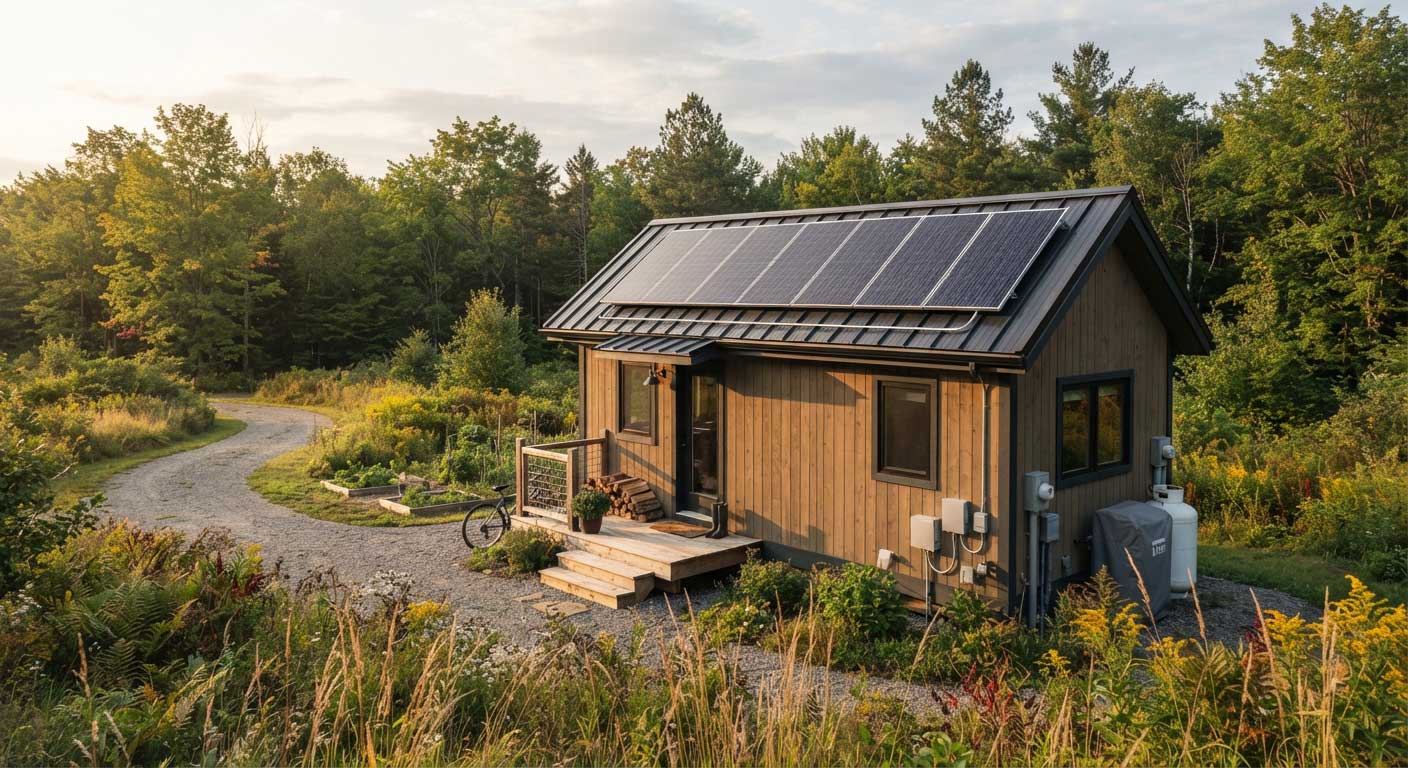
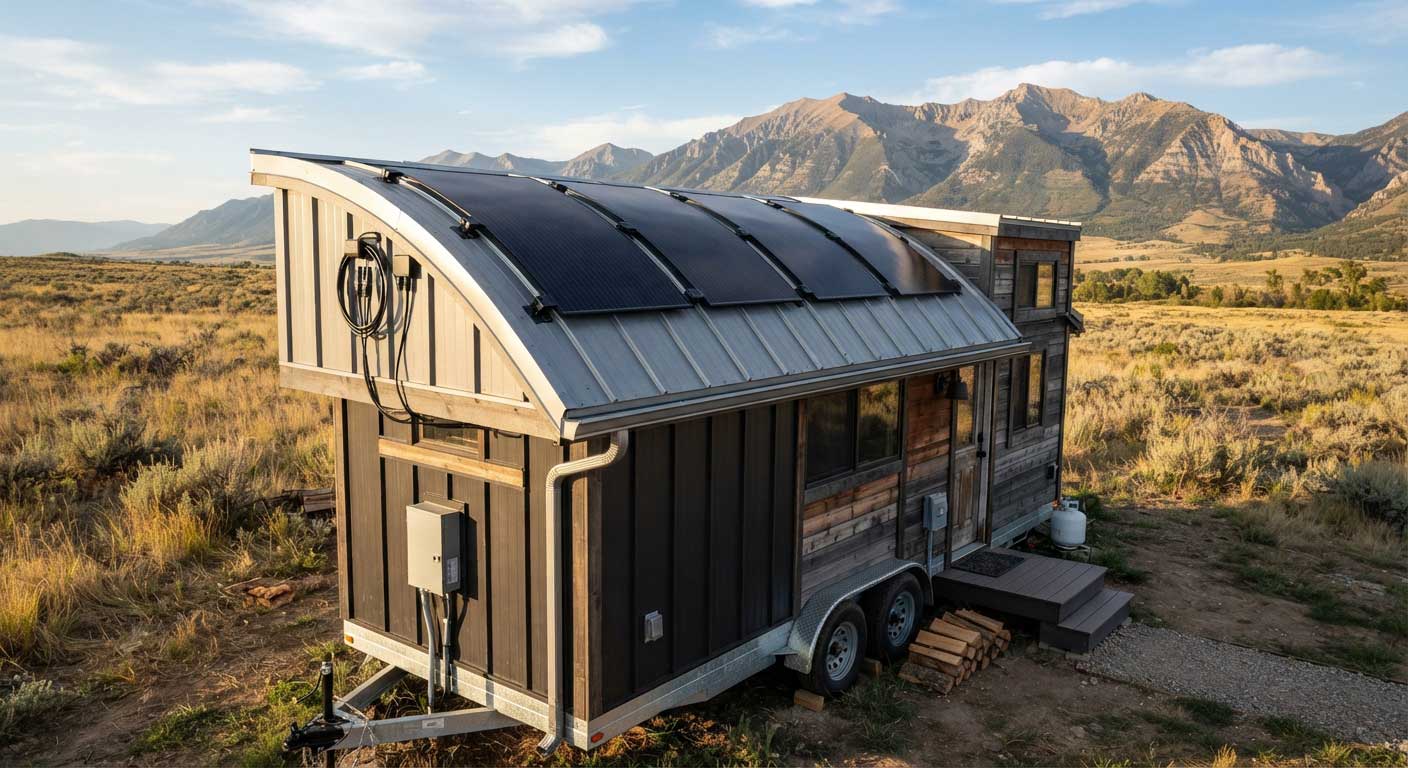
A tiny home may have a steep roof, dormer, skylight, chimney, vent pipe, roof deck, or shaded side. Flexible panels can sometimes provide additional placement options where conventional framed modules are difficult to install, but the electrical design still follows the same PV principles.Visit product page:Flexible Solar Panel
DOE’s PV system design guidance emphasizes that the mounting structure, roof orientation, tilt, wind exposure, weather, and durability all have to be considered as part of the system.
Off Grid Tiny House Solar: Battery Storage Matters
A grid-connected tiny home and an off-grid tiny home should not be designed the same way.
For an off-grid house, solar panels only solve part of the problem.
You also need energy storage.
During the day, the panels produce electricity. After sunset, the battery becomes the energy source for most loads.
That changes the sizing equation.
Suppose your tiny home uses 8 kWh per day and you want approximately one day of usable battery storage.
A lithium battery bank might be specified around:
8–10 kWh usable capacity
But usable capacity is not necessarily the same as the battery’s nameplate capacity.
If a battery system is designed around an 80% usable depth of discharge, for example:
8 kWh ÷ 0.80 = 10 kWh nominal battery capacity
Actual battery specifications, temperature limits, manufacturer recommendations, reserve requirements, and inverter efficiency must be checked before final sizing.
Solar Array and Battery Are Not Interchangeable
This distinction is worth emphasizing.
A larger battery does not create energy.
A larger solar array does not automatically provide nighttime power.
The array generates energy.
The battery shifts energy through time.
The inverter converts DC electricity into usable AC electricity.
The load determines how much energy the home actually consumes.
A well-designed tiny-home system has all four considered together.
Tiny Home Solar System: Inverter Sizing
The inverter is often overlooked because people focus on solar-panel wattage.
That can create an awkward situation.
Imagine a tiny home with only 8 kWh of daily energy consumption.
That sounds small.
But at 8 p.m., someone could simultaneously turn on:
- 1,200W induction cooktop
- 1,500W microwave
- 800W kettle
- 1,000W hair dryer
The instantaneous demand can exceed 4 kW, even though total daily energy consumption remains modest.
This is why energy consumption and peak power are different measurements.
For an off-grid tiny home, I would record both:
Daily energy: kWh/day
Peak demand: kW
A 3 kW inverter may be adequate for one lifestyle and frustrating for another.
If the home relies heavily on electric cooking, electric water heating, and electric space heating, inverter sizing needs considerably more attention.
Designing a Tiny Home Around Solar From the Beginning
The best tiny-home solar projects are not simply houses with panels added afterward.
The electrical architecture is considered while the house is being designed.
Step 1: List Every Electrical Load
Do not stop at major appliances.
Include:
- Standby loads
- USB chargers
- Router
- Water pump
- Fans
- Refrigerator
- Lighting
- Heating and cooling
- Cooking
- Water heating
- Laundry
- Tools
- Outdoor lighting
Small loads accumulate.
Step 2: Separate Daytime and Nighttime Loads
This is one of the most useful design habits.
A washing machine can operate during sunny hours.
A refrigerator runs continuously.
Lighting is mainly a nighttime load.
An electric water heater can potentially be scheduled around solar production.
Moving flexible loads into daylight can reduce the battery capacity required.
Step 3: Identify the Roof’s Real Usable Area
Measure around:
- Roof vents
- Skylights
- Chimneys
- HVAC equipment
- Roof edges
- Walkways
- Shaded areas
Do not assume the entire roof is usable.
DOE’s PV guidance notes that roof size, slope, orientation, and shading influence solar suitability and production.
Step 4: Calculate Solar Production by Location
A 3 kW array in Arizona will not produce the same annual energy profile as a 3 kW array in the Pacific Northwest.
This is exactly why location-specific modeling is useful.
PVWatts allows the system size, orientation, tilt, and other parameters to be evaluated for a specific location.
Step 5: Size the Battery Around the Actual Lifestyle
If the occupants routinely consume 6 kWh after sunset, designing a battery around 2 kWh simply because the solar array is small does not solve the problem.
The battery follows the load profile.
A Practical Tiny Home Solar Case Study
Consider a hypothetical 360-square-foot tiny home in the western United States.
The occupants use:
- Propane cooking
- Propane water heating
- Efficient refrigerator
- LED lighting
- Laptop and internet equipment
- Small washing machine
- Mini-split heating and cooling
Measured or estimated average consumption is approximately 7.5 kWh/day.
Instead of immediately installing a huge array, the designer models the location using PVWatts and targets roughly 2.5–3.0 kW of PV capacity, subject to the actual solar resource and seasonal requirements.
A possible architecture could be:
2.8 kW solar array → MPPT charge controller → 10–15 kWh battery → 3–5 kW inverter → AC loads
That is an example, not a universal specification.
The interesting part is the load strategy.
The home does not need to generate huge amounts of electricity for electric cooking and resistance water heating because those loads have been shifted to propane.
This is a design decision, not a solar-panel efficiency trick.
For tiny homes, reducing the biggest loads can sometimes be more valuable than adding another few hundred watts of PV.
DOE’s Efficient New Homes program similarly emphasizes whole-building efficiency, with the goal that a sufficiently efficient home can have renewable energy offset most or all of its annual energy use.
Tiny Homes Solar Power and Energy Efficiency
Solar should not be used to compensate for poor building efficiency.
That is especially true in a tiny house because the roof has limited space.
If insulation is poor and the mini-split runs continuously, adding more panels may eventually hit the physical roof limit.
The better sequence is often:
Reduce demand → improve envelope efficiency → optimize appliances → size battery → size solar array.
DOE’s manufactured-home efficiency work illustrates the scale of the opportunity: DOE estimated that updated efficiency standards could save residents hundreds of dollars per year on average, depending on home type.
Tiny homes are not identical to manufactured homes, so those figures should not be transferred directly to tiny houses. The broader lesson is what matters: efficiency changes the energy requirement before solar equipment is even selected.
Series or Parallel Solar Panels for Tiny Homes?
Once the array size is established, the next question is wiring.
For example, six 400W panels provide:
6 × 400W = 2,400W
They could potentially be arranged as:
- All series
- All parallel
- Series-parallel
The correct configuration depends on the MPPT controller’s voltage range and current limit.
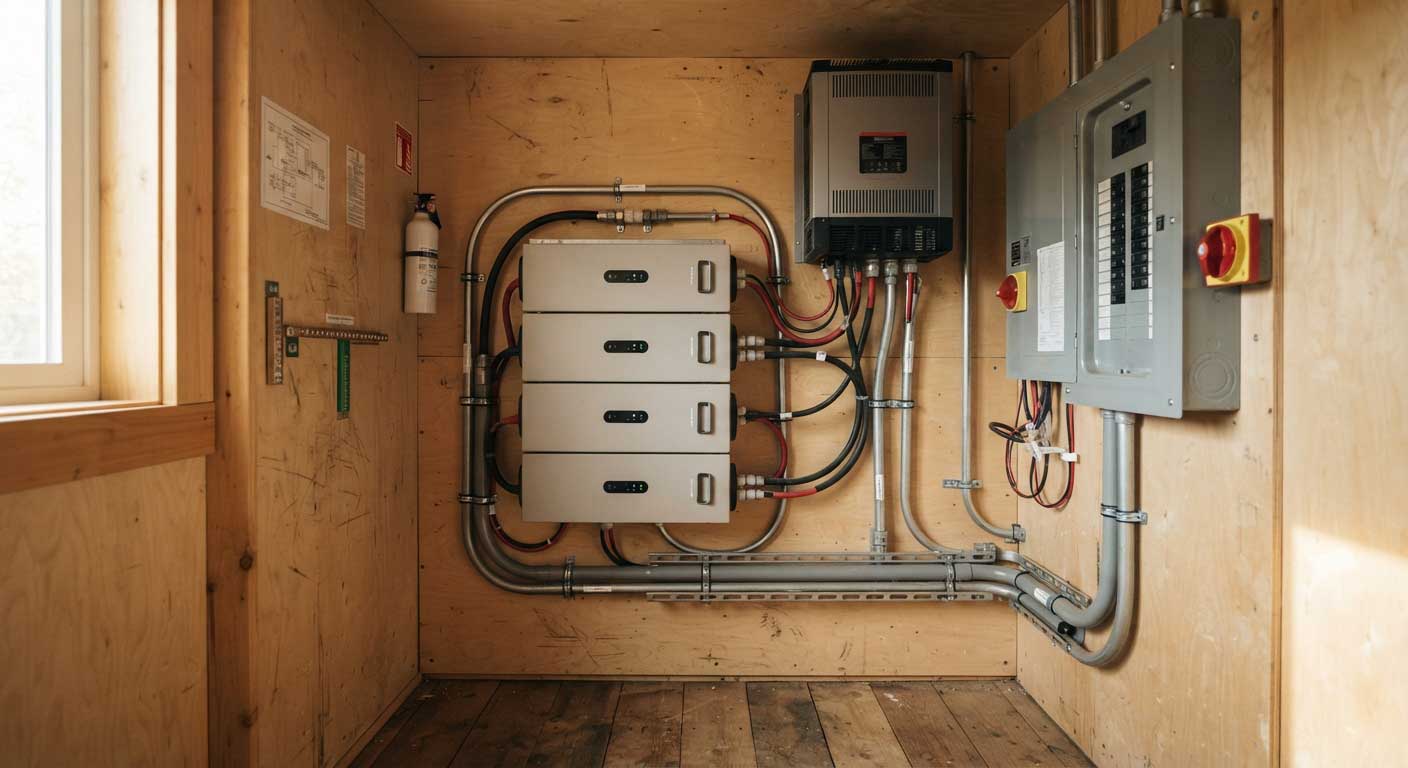
For a tiny-home roof with a relatively long cable route from the roof to the electrical room, a higher-voltage series configuration can reduce PV current and therefore reduce resistive cable losses for a given conductor resistance.
But the array’s cold-weather Voc must remain below the controller’s maximum PV input voltage.
This is not a place for guesswork.
A tiny-home installation may be physically small, but DC PV voltage can still be hazardous and must be installed according to applicable electrical requirements.
DOE states that qualified installers should install solar systems to applicable local building, fire, and electrical codes.
Common Tiny Home Solar Mistakes
Using Roof Size to Determine System Size
A roof can physically hold 3 kW of panels without the house actually needing 3 kW.
Load comes first.
Ignoring Winter Production
An annual average can hide difficult winter months.
If the home is occupied year-round, seasonal production needs to be modeled.
Oversizing the Battery and Undersizing the Array
A large battery can carry nighttime loads, but if the solar array cannot refill it after several cloudy days, the system will eventually require a generator or grid connection.
Forgetting Peak Loads
Daily energy and instantaneous power are separate design parameters.
A 7 kWh/day home can still require a 4 kW inverter.
Installing Panels Before Planning Cable Routing
On tiny homes, the electrical room may be on the opposite end of the building from the best roof location.
Cable routing should be considered before final panel placement.
FAQ: Tiny Homes Solar Power
How many solar panels does a tiny home need?
There is no fixed number. A highly efficient tiny home may work with around 1.5–3 kW of PV, while an all-electric home can require 3–5 kW or more. Actual sizing depends on daily kWh consumption, location, seasonal solar production, roof area, and system losses.
Can a tiny home run completely on solar power?
Yes. A properly designed off-grid tiny home can operate from solar, batteries, and backup generation when necessary. The system must be sized for both average energy consumption and peak electrical demand, with enough storage for periods of poor solar production.
What size battery does a tiny home need?
Battery capacity depends primarily on nighttime consumption and the number of autonomy days required. An efficient tiny home using 6–8 kWh per day might begin evaluating batteries in the 8–15 kWh range, but the correct capacity requires a load profile and site-specific design.
Are flexible solar panels good for tiny homes?
They can be useful when roof weight, shape, or mounting limitations make rigid panels difficult to install. Their electrical specifications still need to be evaluated like conventional PV modules, including voltage, current, temperature coefficients, wiring, and controller compatibility.
Can solar panels power an air conditioner in a tiny home?
Yes, but air conditioning can become one of the largest loads. A high-efficiency mini-split heat pump is generally easier to integrate into a solar-powered tiny home than a conventional high-consumption cooling system, but the actual load should be measured or estimated for the local climate.
Is 2,000 watts of solar enough for a tiny home?
It can be enough for an efficient tiny home with moderate electricity consumption and favorable solar conditions. It may not be enough for a home using electric resistance heating, electric water heating, frequent cooking loads, or heavy air-conditioning demand.
Can I use solar without batteries in a tiny home?
Yes, if the home remains connected to a suitable utility grid and the system is designed for grid-connected operation. For a truly off-grid tiny home, batteries or another energy-storage or backup strategy are required for electricity when solar production is unavailable.
Final Takeaway: Tiny Homes Solar Power
Tiny homes solar power works best when the house is designed around the energy system rather than simply adding panels to the roof. Start with actual daily consumption, identify peak loads, evaluate the usable roof, model local solar production, then select the PV array, battery, inverter, and wiring configuration as one system.
For Bright Solar applications, flexible panels can be particularly interesting when a tiny home’s roof has limited usable area or an unusual shape. But panel flexibility should never replace electrical analysis.
A 2.4 kW array can be excellent for one tiny home and inadequate for another.
The difference is usually not the panel.
It is the lifestyle inside the house.
Related recommendations
-

400 W Solar Panel: Real-World Power Output, Applications, and Buying Guide
280Discover how a 400 w solar panel performs in real-world conditions. Learn daily power production, battery charging capacity, installation methods, and expert buying advice from Bright Solar.
View details -
Portable Solar Panels with Battery Storage: Complete Guide
171Portable solar panels with battery storage generate electricity during daylight and store it for later use in RVs, camping, boats, work sites, and emergency ...
View details -
12V Folding Solar Panels: Output, Battery Charging and Uses
1712V folding solar panels provide portable solar power for camping, RVs, and compatible off-grid battery systems. Their actual energy output depends on panel ...
View details -
Flat Flexible Solar Panels: Uses, Benefits and Installation Guide
102Flat flexible solar panels offer lightweight, low-profile power for selected RV, boat, campervan, and off-grid installations where rigid modules may be diffi...
View details