Solar Series vs Parallel: Which Wiring Setup Is Better?
Solar Series vs Parallel: The Short Answer
Solar series vs parallel comes down to what you need to increase: series wiring raises voltage while keeping current roughly the same; parallel wiring raises current while keeping voltage roughly the same. The better choice depends on your MPPT limits, cable distance, battery voltage, shading conditions, and panel specifications.
That distinction sounds simple. The design decision is not.
When I review a solar wiring layout, I do not start by asking whether series or parallel is “better.” I start with the controller’s maximum PV voltage, the panel’s Voc and Vmp, expected cold-weather voltage, operating current, cable length, and whether the panels will actually receive similar sunlight.
That approach prevents one of the most common mistakes: choosing a wiring configuration first and checking the electrical limits afterward.
The U.S. Department of Energy explains the basic relationship clearly: modules connected in series add voltage, while modules connected in parallel add current. NREL likewise describes PV modules as being wired in series to reach the required voltage, with strings then connected in parallel to achieve the desired array capacity.
Solar Panels in Series vs Parallel: What Actually Changes?
A solar panel has several electrical ratings, but four matter immediately when designing an array:
- Voc: Open-circuit voltage
- Vmp: Voltage at maximum power
- Isc: Short-circuit current
- Imp: Current at maximum power
Power is calculated from voltage and current:
P = V × I
So if a 200W panel operates around 20V and 10A:
20V × 10A = 200W
The interesting part begins when another panel is connected.
Panels Connected in Series
For identical panels connected in series:
- Voltage adds
- Current stays approximately the same
- Power increases with the number of panels
Example:
| Configuration | Voltage | Current | Approx. Power |
|---|---|---|---|
| 1 × 200W panel | 20V | 10A | 200W |
| 2 × 200W in series | 40V | 10A | 400W |
| 3 × 200W in series | 60V | 10A | 600W |
This is why series wiring is commonly used when a system needs a higher PV operating voltage.
NREL’s technical material describes the same architecture at system level: PV modules form series strings to reach the desired voltage, while strings can then be connected in parallel.
Panels Connected in Parallel
For identical panels connected in parallel:
- Voltage stays approximately the same
- Current adds
- Total power increases
Using the same 200W panel:
| Configuration | Voltage | Current | Approx. Power |
| 1 × 200W panel | 20V | 10A | 200W |
| 2 × 200W parallel | 20V | 20A | 400W |
| 3 × 200W parallel | 20V | 30A | 600W |
The total rated power can therefore be the same in either configuration.
The electrical path is different, though—and that difference matters once the array is connected to an MPPT controller, inverter, battery system, or long cable run.
When Series Wiring Makes More Sense
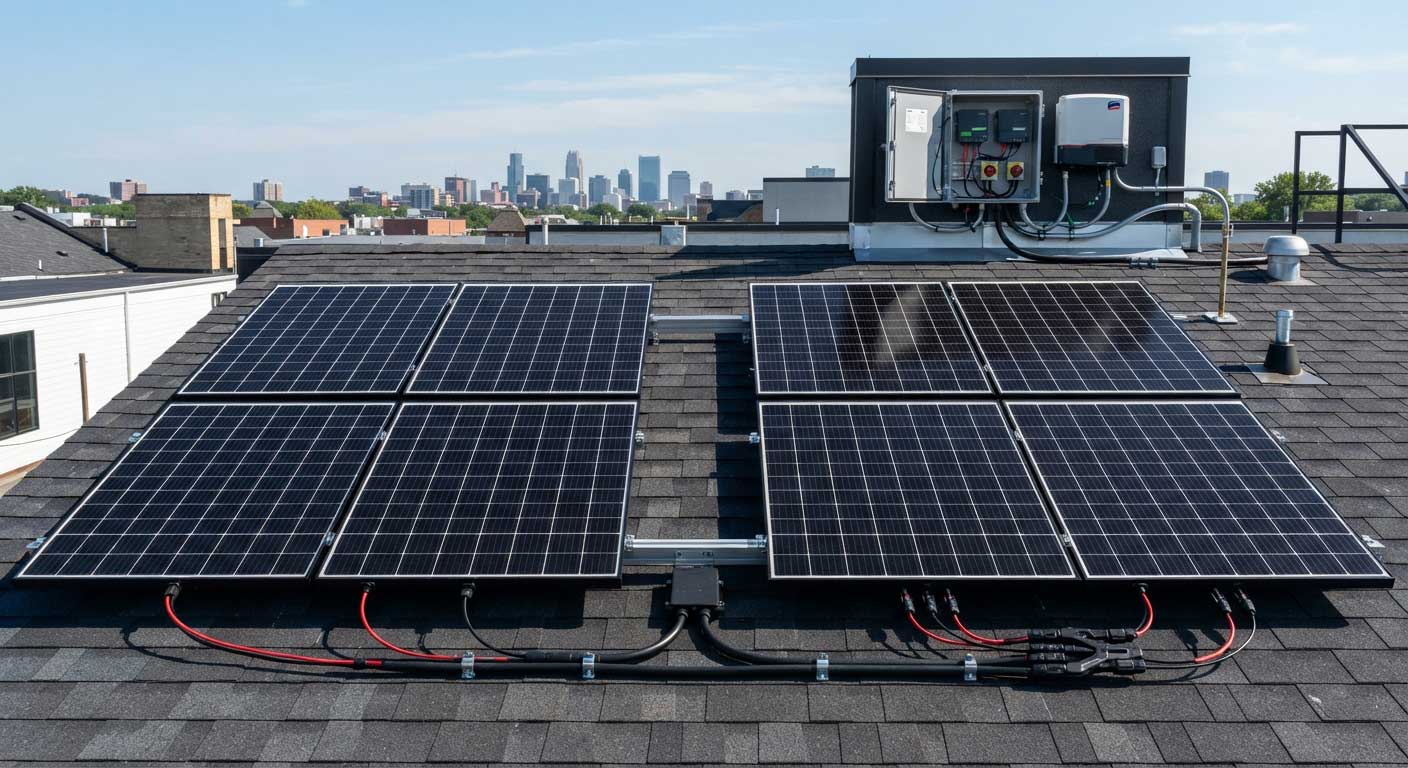
Series wiring becomes attractive when the charge controller or inverter needs a higher PV input voltage and the system can safely operate inside its voltage window.
This is particularly useful on larger arrays.
Suppose four identical 200W modules have:
- Voc = 24V
- Vmp = 20V
- Imp = 10A
Four panels in series produce approximately:
Vmp = 20 × 4 = 80V
Current = 10A
Power = 80 × 10 = 800W
That higher voltage can be useful when the array is physically distant from the controller.
Why?
For the same power, higher voltage means lower current. Lower current generally reduces resistive cable loss for a given conductor size and distance.
That does not mean “higher voltage is always more efficient.” The controller’s operating range and the actual wiring design still determine whether the configuration is appropriate.
Series Wiring and Long Cable Runs
This is one place where the difference becomes practical rather than theoretical.
Imagine two 400W arrays producing the same 800W:
- Array A: 40V at 20A
- Array B: 80V at 10A
Both represent approximately 800W.
For a given cable resistance, copper losses are proportional to I²R. So reducing current can significantly reduce voltage drop and resistive loss.
This is one reason higher-voltage PV strings are common in larger systems.
The U.S. Department of Energy’s PV guidance similarly describes modules being wired in series to provide the voltage required by the inverter.
But there is a catch.
Voc is not a number you can ignore.
The PV array’s open-circuit voltage must remain below the maximum allowable input voltage of the controller or inverter. Victron’s technical documentation specifically warns that array Voc must not exceed the MPPT’s maximum voltage rating.
Cold weather can make this more important because PV module voltage rises as temperature falls. DOE notes that solar cells generally operate more effectively at lower temperatures and that temperature changes have a significant effect on PV voltage.
When Parallel Wiring Makes More Sense
Parallel wiring is often considered when maintaining a lower PV voltage is important or when the system architecture benefits from higher current.
For example, two 200W panels rated at approximately 20V and 10A can be connected in parallel:
Voltage = 20V
Current = 10A + 10A = 20A
Power ≈ 400W
This can be useful for certain low-voltage battery applications, provided the charge controller is designed for the resulting current.
There is another practical reason people choose parallel connections: shading behavior.
Partial Shading: Where the Debate Gets More Interesting
Imagine three panels installed on an RV roof.
One panel is shaded by a roof vent for part of the afternoon.
With a conventional series string, the modules share the same current path. A poorly matched or heavily shaded module can therefore influence the string’s operating point.
DOE has noted that conventional PV arrays can be affected by the weakest module in a string, which is one reason module-level power electronics and alternative architectures have been developed.
Parallel wiring can reduce the degree to which one module dictates the current of the entire array, but it does not magically eliminate shading losses.
Bypass diodes, MPPT behavior, module characteristics, optimizer architecture, and the physical shading pattern all matter.
This is where simplistic advice such as “parallel is better for shade” falls apart.
It can be better in some layouts.
It can also be a poor choice if the increased current forces oversized conductors or exceeds the controller’s input-current rating.
Solar Series vs Parallel for MPPT Controllers
The MPPT controller is often the deciding component.
Before connecting panels, check at least:
- Maximum PV open-circuit voltage
- MPPT operating voltage range
- Maximum PV short-circuit or input current
- Maximum recommended PV power
- Battery voltage
- Panel Voc, Vmp, Isc and Imp
- Expected minimum operating temperature
Do not size the array using nominal panel voltage alone.
A panel marketed as a “12V solar panel” does not necessarily have a Voc of 12V. Victron gives an example in which a nominal 12V PV module can have a Voc around 22V.
That difference becomes critical when several modules are placed in series.
For example, three modules with approximately 22V Voc could produce:
22V × 3 = 66V Voc
That may be acceptable for a 75V controller under certain conditions, but the cold-temperature correction still needs to be checked.
The correct question is not:
“Can three 12V panels be connected to this controller?”
The better question is:
“Will the corrected maximum array Voc remain below the controller’s maximum PV input voltage under the coldest expected conditions?”
That is the engineering question.
Solar Panel Series vs Parallel Wiring: A Practical Comparison
| Factor | Series | Parallel |
| Voltage | Increases | Stays similar |
| Current | Stays similar | Increases |
| Total power | Adds | Adds |
| Long cable runs | Often advantageous | Higher current can require larger conductors |
| MPPT voltage | Higher | Lower |
| MPPT current | Lower | Higher |
| Shading sensitivity | Can be more noticeable | Can be less concentrated |
| Voltage limit concern | High priority | Lower |
| Current limit concern | Lower | High priority |
| Common larger-system use | Very common | Often used for combining strings |
The U.S. Department of Energy provides the fundamental electrical relationship: two 12V, 3A modules in series produce 24V at 3A, while the same modules in parallel produce 12V at 6A.
That simple example is worth remembering because it remains true whether you’re dealing with a small RV system or a much larger PV array.
Series-Parallel Solar Panels: The Configuration Many Real Systems Use
Large solar arrays rarely have to choose between “all series” and “all parallel.”
A series-parallel configuration combines both.
For example, four 200W panels can be arranged as:
2 panels in series + 2 strings in parallel
Each series string:
40V × 10A = 400W
Two strings in parallel:
40V × 20A = 800W
The array therefore remains around 40V while the current rises to approximately 20A.
This approach gives designers more freedom to match the PV array to the inverter or MPPT controller.
NREL specifically describes this architecture: PV modules are connected in series into strings, and those strings are then connected in parallel to build the array.
Why This Matters for Bright Solar Flexible Panels
Flexible solar panels are frequently installed where roof shape, weight, portability, or mounting limitations make conventional rigid modules less convenient.
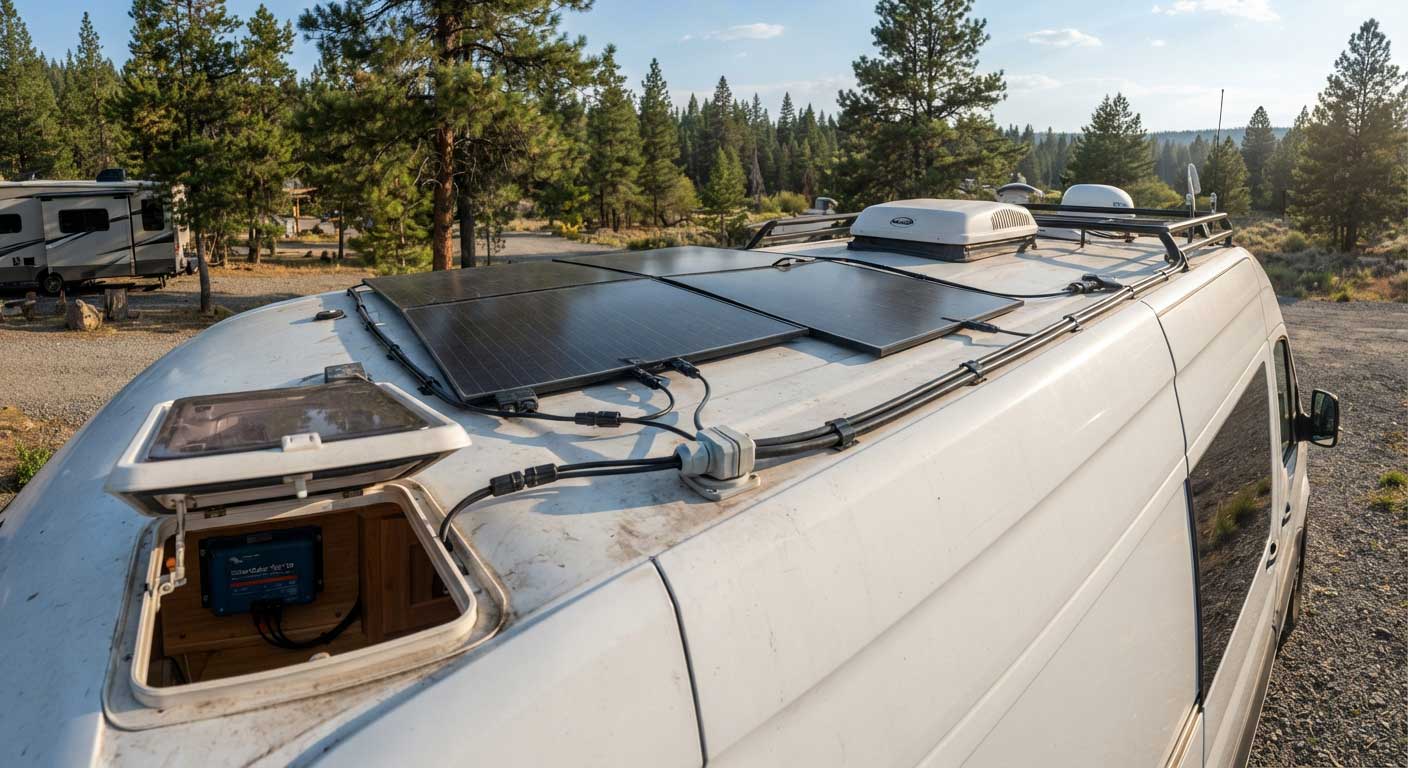
On an RV, marine deck, curved roof, or lightweight mobile structure, the electrical layout still has to respect the same rules.Visit product page:Flexible Solar Panel
The panel being flexible does not make its Voc, current, cable sizing, or controller limits less important.
In fact, compact installations often make cable routing more difficult because the controller may be installed inside a cabinet while the panels are spread across a roof.
A carefully planned series string can reduce the current traveling through that longer cable path.
But if the controller has a tight voltage ceiling, parallel wiring—or a different series/parallel ratio—may be the safer electrical choice.
A Realistic Design Example: 4 × 200W Panels
Consider a 800W flexible solar array for an off-grid or RV application.
Assume each panel has approximately:
- Rated power: 200W
- Vmp: 20V
- Imp: 10A
- Voc: 24V
- Isc: 10.5A
Option A: Four Panels in Series
Approximate operating values:
- Vmp = 80V
- Imp = 10A
- Power = 800W
- Voc = 96V
This configuration could be attractive for a controller with a sufficiently high PV voltage limit.
However, the 96V figure is only the nominal sum based on the example specifications. A real design must account for temperature-related voltage rise.
Option B: Four Panels in Parallel
Approximate values:
- Vmp = 20V
- Imp = 40A
- Power = 800W
- Voc = 24V
Now the voltage is easy to keep low, but the current is substantial.
That 40A operating current affects:
- Cable size
- Fuse or breaker selection
- Connector ratings
- Combiner requirements
- Charge controller input limits
- Voltage drop
The U.S. Department of Energy notes that PV conductors and overcurrent protection must be appropriately sized, and its guidance specifically highlights the increase in current when PV source circuits are combined in parallel.
Option C: Two Series Strings in Parallel
Two panels in series form one string:
40V × 10A = 400W
Two strings in parallel:
40V × 20A = 800W
For many system designs, this middle configuration is more useful than either extreme.
It gives the controller a higher PV voltage without pushing the array current as high as an all-parallel configuration.
What Happens If Solar Panels Are Mismatched?
This question comes up frequently when someone already owns one panel and wants to add another.
The safest approach is to use modules with closely matched electrical characteristics.
Mixing different wattages does not automatically make a system impossible, but the electrical consequences depend heavily on how the modules are connected.
In series, the lower-current module can constrain the string.
In parallel, the lower-voltage module can affect the array’s usable operating voltage.
Victron’s technical discussion of differently sized PV modules makes the same point: different modules can sometimes be combined, but the electrical characteristics and controller limits must be carefully considered, and using matched modules is the more robust approach.
For a new Bright Solar system, I would generally specify modules with the same model, wattage, electrical characteristics, and orientation whenever practical.
That removes a surprising number of variables.
Common Solar Series vs Parallel Mistakes
Checking Vmp but Ignoring Voc
This is probably the most serious mistake.
The controller sees the array’s open-circuit voltage under certain conditions, not just the nominal operating voltage printed in a marketing description.
Always verify maximum Voc against the controller specification.
Assuming More Voltage Is Always Better
Higher PV voltage can reduce current and help with long cable runs.
It can also exceed the controller’s maximum input voltage.
More voltage is useful only when it remains inside the equipment’s operating envelope.
Ignoring Current in Parallel Arrays
Four 10A panels in parallel do not remain a 10A circuit.
They can produce approximately 40A at the array operating point.
That affects conductor sizing and protection.
Treating Shading as a Simple Series-vs-Parallel Problem
Real shading patterns are messy.
A vent may shade one corner for 30 minutes, a nearby tree may move across several modules, and bypass diodes may change the string’s behavior.
The correct solution depends on the actual site rather than a universal “series is bad” or “parallel is best” rule.
Forgetting That Solar Voltage Changes With Temperature
PV voltage is not fixed.
DOE specifically notes that temperature has a strong effect on solar-cell voltage, with higher temperatures generally reducing voltage.
For series arrays, that makes cold-weather Voc verification especially important.
How to Choose Series or Parallel Solar Panels
Use this practical decision process before making the connection.
Choose More Series When:
- The MPPT or inverter accepts a higher PV voltage.
- The array has a relatively long cable run.
- You want lower PV operating current.
- The panels receive reasonably consistent sunlight.
- The resulting cold-weather Voc remains safely below the controller limit.
Choose More Parallel When:
- The system is designed around lower PV voltage.
- The controller can accept the resulting current.
- Shading conditions make independent string behavior desirable.
- Cable runs are short enough that higher current is manageable.
- The battery and controller architecture favor the configuration.
Choose Series-Parallel When:
- You need a compromise between voltage and current.
- The array is larger than a few modules.
- The controller has both voltage and current limits that must be respected.
- You want multiple strings that can be monitored or protected separately.
There is no universal winner.
The correct configuration is the one that lands inside the electrical limits of every component in the chain.
FAQ: Solar Series vs Parallel
Is it better to wire solar panels in series or parallel?
Neither is universally better. Series wiring increases voltage and can reduce current in the PV cables, while parallel wiring increases current and maintains a lower array voltage. The correct choice depends on the MPPT or inverter limits, cable distance, shading, battery voltage, and panel specifications.
Do solar panels produce more power in series or parallel?
With identical panels and comparable operating conditions, the rated total power is approximately the same in series or parallel. Two 200W panels remain a nominal 400W array whether they are wired in series or parallel. The voltage and current distribution changes.
Does series wiring increase solar panel voltage?
Yes. When identical PV modules are connected in series, their voltages add while current remains approximately the same. This is why series strings are commonly used to reach the PV voltage required by an MPPT controller or inverter.
Does parallel wiring increase solar panel current?
Yes. Parallel-connected panels maintain approximately the same voltage while their currents add. Two 12V, 3A modules, for example, produce approximately 12V at 6A when connected in parallel.
Is series or parallel better for shaded solar panels?
Parallel or independently controlled strings can reduce the impact of one shaded module on other modules, but the answer depends on the shading pattern, bypass diodes, MPPT behavior, and system architecture. Shading should be evaluated at the site rather than solved with a blanket wiring rule.
Can different solar panels be connected in series or parallel?
They sometimes can, but mismatched modules require careful electrical analysis. In series, current characteristics become especially important; in parallel, voltage characteristics matter more. Matched modules are generally the more predictable choice.
How many solar panels can I connect in series?
There is no universal number. Calculate the total corrected Voc of the string and compare it with the maximum PV input voltage of the MPPT controller or inverter. The minimum operating voltage and maximum current also need to be checked.
Final Takeaway: Solar Series vs Parallel
Solar series vs parallel is not really a competition between two wiring methods. It is a voltage-and-current design decision. Series increases voltage, parallel increases current, and series-parallel combines both to fit the electrical limits of a real PV system.
For Bright Solar flexible panels, the practical starting point is simple: identify the panel’s Voc, Vmp, Isc and Imp; check the controller’s voltage and current limits; account for temperature; then select the string arrangement.
Do that before touching the MC4 connectors.
A wiring diagram that looks perfect on paper can still be wrong if the controller’s maximum PV voltage is exceeded on a cold morning.
For system sizing, Bright Solar recommends evaluating the complete electrical chain—panel → string → combiner or connectors → MPPT/inverter → battery or load—rather than choosing a configuration from panel wattage alone.
Solar series vs parallel ultimately works best when the wiring configuration is designed around the equipment, environment, cable run, and actual installation conditions—not around a generic rule that says one method is always better.
Related recommendations
-

Best RV Solar Kit for Off-Grid Travel
197Find the best rv solar kit for off-grid travel. Learn how to size solar panels, batteries, charge controllers and wiring for reliable RV power.
View details -
Series vs Parallel Solar Panels: Which Wiring Method Performs Better?
146Compare series vs parallel solar panels for RVs, homes, and off-grid systems. Bright Solar explains voltage, current, shading, and wiring efficiency.
View details -
Foldable Portable Solar Panels: A Practical Guide to Mobile Power
66Foldable portable solar panels provide mobile electricity and can be repositioned toward better sunlight without permanent installation.
View details -
Folding Solar Panels for Camping: A Practical Guide to Portable Power
90Folding solar panels provide portable camping power and can be repositioned to capture better sunlight when campsites become shaded.
View details