Flat Flexible Solar Panels: Uses, Benefits and Installation Guide
Flat flexible solar panels provide a lightweight way to generate electricity on surfaces where conventional rigid modules may be difficult to install. They are used on RVs, campervans, boats, and selected off-grid structures. Their suitability depends on roof geometry, mounting conditions, ventilation, electrical requirements, and the manufacturer’s installation specifications.
For buyers comparing solar technologies, the important question is not simply whether a panel bends. It is whether the module’s construction, electrical output, and installation method match the actual surface and operating environment.
This guide explains how flat flexible solar panels work, where they are useful, what to check before purchasing, and how to approach installation. It also covers practical considerations for B2B buyers evaluating products for OEM projects, distribution, and customized solar applications.
What Are Flat Flexible Solar Panels?
Flat flexible solar panels are photovoltaic modules designed with a thin, lightweight construction that allows them to conform to certain surfaces. Unlike conventional rigid panels, which typically use a framed structure and a rigid protective front, flexible modules can be manufactured with different encapsulation materials and backing structures.
Their defining feature is installation flexibility, not unlimited bendability. A flexible panel must still remain within its specified bending limits. Excessive bending, twisting, or pressure can damage the solar cells and electrical connections.
How Do Flat Flexible Solar Panels Generate Electricity?
The underlying photovoltaic process is similar to that of rigid solar panels.
According to the U.S. Department of Energy, photovoltaic cells use semiconductor materials to convert sunlight into electricity. When light is absorbed, it transfers energy to electrons, allowing electrical current to flow through the material. Multiple cells are connected to form a module with a usable electrical output.
A flexible module generally includes several functional layers:
- Solar cells: Convert incoming sunlight into electrical energy.
- Encapsulation: Protects the cells and helps hold the module structure together.
- Front surface: Provides protection against environmental exposure while allowing sunlight to reach the cells.
- Backsheet or supporting layer: Contributes to the module’s mechanical structure.
- Electrical connections: Carry the generated DC electricity to the rest of the solar system.
The exact construction depends on the product. Buyers should review the manufacturer’s datasheet rather than assume that every flexible panel uses the same cell technology, protective film, or electrical configuration.
Flat Flexible Solar Panels vs. Rigid Solar Panels
| Feature | Flat flexible solar panels | Conventional rigid solar panels |
|---|---|---|
| Construction | Thin, lightweight construction; may support limited bending | Rigid module construction |
| Surface compatibility | Can suit selected curved or irregular surfaces | Generally requires a suitable flat or supported mounting surface |
| Weight | Often selected where reducing installed weight matters | Weight varies by module and frame |
| Mounting | May use manufacturer-approved adhesive or mechanical mounting methods | Commonly uses rails, brackets, or other mounting hardware |
| Airflow | Some installations place the panel close to the roof, making thermal management important | Elevated mounting can allow airflow beneath the module |
| Maintenance | Surface cleaning and mounting inspection remain necessary | Surface cleaning and mounting inspection remain necessary |
| Best-fit applications | Selected RVs, boats, campervans, and weight-sensitive projects | Residential rooftops, ground-mounted arrays, and other suitable installations |
These are general design distinctions, not universal specifications. Actual weight, flexibility, durability, mounting requirements, and electrical performance depend on the individual product.
A rigid panel may be appropriate when a project can accommodate its mounting structure. A flexible module may be considered when surface geometry or weight constraints make a conventional installation difficult.
Main Benefits of Flat Flexible Solar Panels
1. Lightweight Construction for Mobile Applications
Weight can become a practical constraint on an RV, campervan, or boat. A solar installation adds more than the panels themselves: mounting hardware, wiring, protective components, and other equipment also contribute to the final load.
A lightweight module can help reduce the panel portion of that load. However, buyers should compare the complete installed system rather than judging weight from the panel datasheet alone.
For vehicle and marine projects, confirm:
- Panel weight and dimensions.
- Total planned panel area.
- Mounting hardware and adhesive requirements.
- Cable routing and connector placement.
- The surface’s condition and suitability for the installation.
2. Compatibility With Selected Curved Surfaces
Some RV roofs, campervan bodies, and boat surfaces are not perfectly flat. A flexible panel designed for limited curvature may fit these applications more readily than a rigid module.
That does not mean every curved surface is suitable.
The panel’s maximum permitted bend, the direction of bending, the surface profile, and any restrictions on repeated flexing must be checked before installation. A module that can conform to a gentle curve should not automatically be treated as suitable for a sharply curved or compound-curved surface.
3. Useful for Space-Constrained Solar Projects
On a mobile installation, roof space is rarely an empty rectangle. Roof vents, air-conditioning units, antennas, hatches, and other equipment can interrupt the available area.
A flexible panel may provide another option for using a suitable section of roof, provided the panel can be installed without obstructing equipment or violating its mounting requirements.
Original project insight: Measure the usable surface after accounting for access, cable routing, shadows, and maintenance—not before. A roof that appears large enough in a photograph may have substantially less practical solar area once these details are considered.
4. Adaptable Product Configurations for B2B Projects
For distributors, vehicle converters, marine equipment suppliers, and solar system integrators, product selection may involve more than choosing a standard wattage.
Relevant purchasing considerations include:
- Required dimensions and available installation area.
- Cell technology and electrical configuration.
- Surface curvature and permitted bending.
- Connector and cable requirements.
- Environmental exposure and mounting conditions.
- Documentation, quality requirements, and order quantities.
Bright Solar provides flexible solar panel solutions for B2B applications. Buyers considering OEM or ODM projects should confirm the available customization options, technical limits, and production specifications directly with the manufacturer.
Where Are Flat Flexible Solar Panels Used?
Flexible Solar Panels for RVs and Campervans
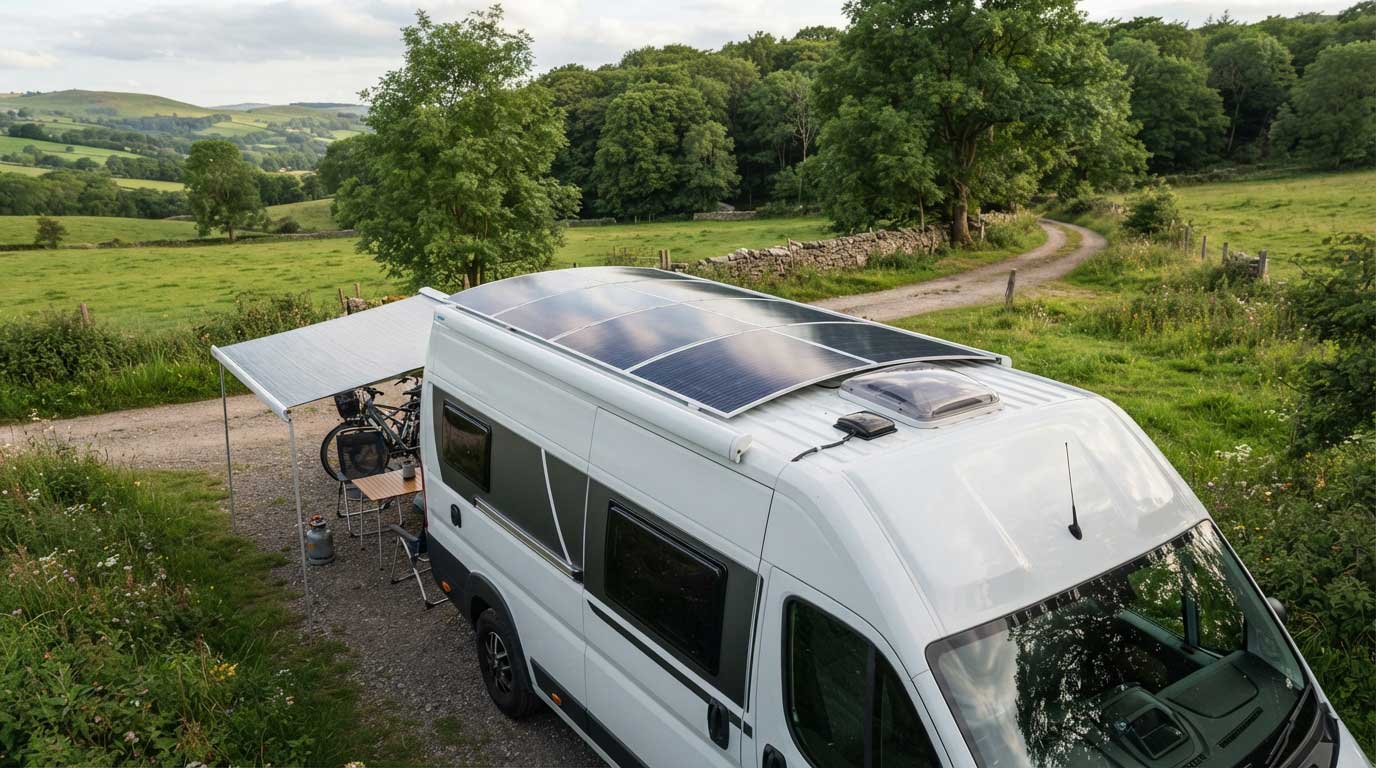
Recreational vehicle and campervan owners may consider flexible panels when roof weight, limited space, or surface geometry affects their solar installation.
Common uses for an appropriately sized RV solar system include supporting:
- Interior lighting.
- Device charging.
- Ventilation fans.
- Selected DC appliances.
- Battery charging when the system is correctly designed.
The panel’s rated power alone does not determine whether it can support a particular appliance. Daily energy demand, sunlight availability, battery capacity, charge-controller compatibility, and conversion losses all matter.
For example, a system intended to support lighting and device charging has a different energy profile from one expected to operate an air conditioner. The latter requires a careful assessment of power demand, operating duration, battery storage, and inverter capacity.
Flexible Marine Solar Panels for Boats
Boat installations introduce additional requirements.
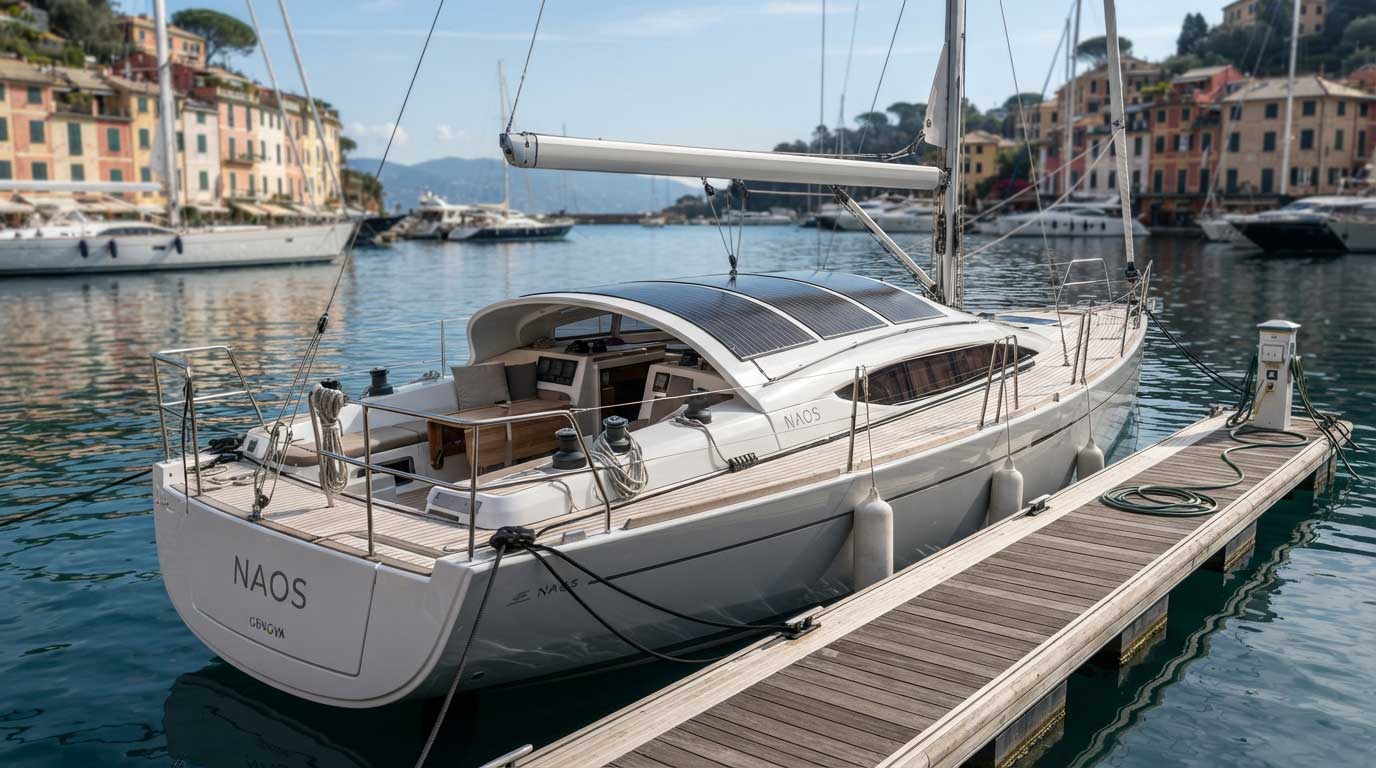
A marine environment can expose solar modules to salt spray, moisture, vibration, changing temperatures, and movement. A panel’s suitability therefore depends on its actual construction and the manufacturer’s stated environmental and installation limits.
Before choosing a panel for a boat, examine:
- Whether the product is specified for the intended marine environment.
- Whether the mounting surface is suitable for the module.
- How cables and connectors will be protected.
- Whether the installation will experience foot traffic or mechanical impact.
- How the panel can be inspected and maintained.
Do not assume that a flexible panel is walkable or waterproof simply because it is thin. Those characteristics require explicit product specifications.
Flexible Solar Panels for Off-Grid Systems
Flexible modules can also be considered for selected off-grid installations where portability, weight, or surface compatibility is important.
Potential applications include camper-based power systems, mobile workspaces, and certain remote equipment installations.
System designers should consider whether the panel’s voltage and current are compatible with the charge controller and battery system. The array must also be sized around the energy requirement rather than an arbitrary panel count.
When a Flexible Panel May Not Be Suitable
A flexible design is not automatically the right choice for every solar project.
Consider another module type or installation approach when:
- The surface curvature exceeds the panel’s permitted bending limits.
- The mounting surface cannot provide the support required by the manufacturer.
- The installation would trap excessive heat or conflict with thermal requirements.
- The panel would be exposed to unapproved foot traffic or impact.
- The project requires certifications or environmental ratings the product does not have.
- A rigid, ventilated mounting arrangement better matches the available space and operating conditions.
The decision should be based on the complete application, not on flexibility alone.
How to Choose Flat Flexible Solar Panels
Selecting a module begins with the installation site. Wattage is important, but it is only one part of the specification.
1. Measure the Available Surface
Measure the usable roof or mounting area, including its length, width, and curvature.
Allow space for:
- Roof vents and other obstructions.
- Cable exits and connector access.
- Required gaps between modules, if specified.
- Mounting and inspection access.
- Any areas that must remain clear for safety or maintenance.
For a curved roof, record the surface profile as well as its overall dimensions. A panel that fits the length and width may still be unsuitable if the curve exceeds its permitted bending limit.
2. Check Rated Power and Electrical Specifications
The product datasheet should provide the electrical information needed for system design.
| Specification | Why it matters |
|---|---|
| Rated power (Pmax) | Identifies the module’s nominal power rating under specified test conditions |
| Voltage at maximum power (Vmp) | Helps determine compatibility with the charge controller and array configuration |
| Current at maximum power (Imp) | Supports current calculations and component selection |
| Open-circuit voltage (Voc) | Important when checking the controller’s maximum input voltage |
| Short-circuit current (Isc) | Relevant to current ratings and system protection |
| Dimensions | Determines whether the module fits the available installation area |
| Weight | Helps assess the load added by the panel |
| Maximum permitted bending | Establishes the panel’s mechanical installation limits |
| Operating temperature | Identifies the manufacturer’s specified temperature range |
| Connector and cable details | Helps ensure electrical compatibility and safe connections |
| Environmental protection ratings | Indicates the protection level claimed for the specified components |
For series-connected modules, voltage increases while the current remains limited by the string configuration. For parallel-connected modules, current increases while voltage remains broadly aligned with the connected modules’ operating voltage.
The actual design must account for the controller’s input limits, environmental conditions, and the electrical characteristics of the selected modules.
3. Evaluate the Installation Environment
A panel mounted on an exposed RV roof faces different conditions from one installed on a stationary structure.
Consider:
- Ambient temperature and expected module heating.
- Water exposure and drainage.
- Salt spray for marine installations.
- Vibration and movement.
- Dust, dirt, and other surface contamination.
- Shading from vents, antennas, nearby structures, or equipment.
- The mounting surface’s material, condition, and temperature tolerance.
The U.S. Department of Energy explains that temperature affects photovoltaic performance: higher cell temperatures generally reduce voltage and can lower output. It also identifies sunlight, reflection, and cell characteristics as factors affecting conversion efficiency.
For a flexible panel installed close to a roof, thermal management deserves particular attention. A low-profile installation should not be assumed to perform identically to an elevated, ventilated array.
4. Compare the Complete System Cost
The purchase price of the panel is only one component of the project.
Include:
- Charge controller and any required power electronics.
- Battery storage, if the system is designed to store energy.
- Wiring, connectors, and protective devices.
- Mounting materials and installation labor.
- Monitoring equipment, if required.
- Inspection and maintenance considerations.
A lower-priced module may not reduce the total project cost if it requires additional installation work or does not match the intended operating environment.
For B2B procurement, compare equivalent specifications and confirm what is included in the quoted product configuration.
How to Install Flat Flexible Solar Panels
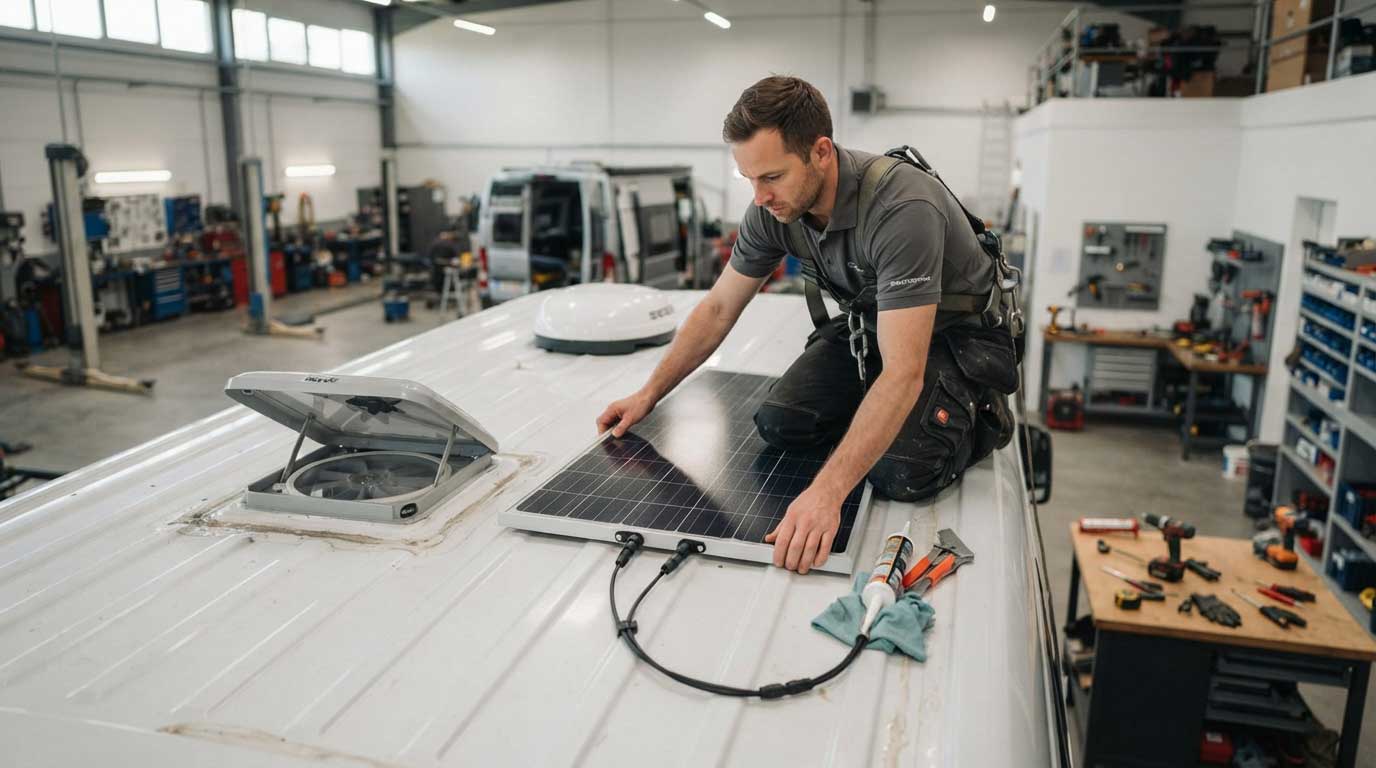
Installation requirements vary by product. Always follow the module manufacturer’s instructions and use qualified electrical or installation professionals where required.
Step 1 — Inspect the Mounting Surface
Clean and inspect the intended area before positioning the panel.
Look for loose coatings, damaged roof material, standing water, sharp edges, or other conditions that could interfere with mounting. Confirm that the surface material is compatible with the proposed adhesive or mechanical fixing method.
Do not install over a surface simply because it appears smooth. The condition of the underlying material matters.
Step 2 — Confirm Panel Orientation and Fit
Position the module according to the installation plan.
Check that:
- The panel fits within the available area.
- The bend remains within the manufacturer’s permitted limits.
- Roof equipment is accessible.
- Cable exits can be routed without sharp bends or pinch points.
- The installation does not create an unintended water-trapping area.
If the panel does not sit naturally on the intended surface, stop and reassess the fit rather than forcing it into position.
Step 3 — Apply the Approved Mounting Method
Use only mounting methods permitted by the panel manufacturer.
Depending on the product, this may involve an approved adhesive system, mechanical fasteners, or another specified arrangement.
Incorrect adhesive selection can affect the roof material or fail to provide the required attachment. Mechanical mounting can also create problems if fasteners penetrate a surface that must remain watertight.
Avoid drilling or bonding until the installation method has been confirmed for both the module and the mounting surface.
Step 4 — Route and Connect the Wiring
Plan the cable route before making electrical connections.
Keep wiring protected from abrasion, excessive heat, water ingress, and moving components. Use compatible connectors and appropriate electrical protection.
Before connecting the array, verify the polarity and electrical ratings. Confirm that the array’s expected voltage and current remain within the charge controller’s permitted limits, including relevant temperature-related voltage changes.
Never assume that two panels can be connected together safely simply because they have the same nominal wattage.
Step 5 — Test the Installation
After installation, check the mounting, wiring, and system operation.
A practical inspection should include:
- Visual examination of the panel surface and edges.
- Confirmation that mounting materials have been applied correctly.
- Inspection of cable routing and connector security.
- Verification of polarity and relevant electrical measurements.
- Confirmation that the charge controller recognizes the array.
- Monitoring of system operation under suitable sunlight conditions.
Record the installed configuration and any baseline measurements. This provides a useful reference for later maintenance.
Understanding Solar Output: Why Rated Wattage Is Not Daily Energy
A panel’s rated power is not the same as the amount of electricity it will produce over a day.
Rated power is measured under specified test conditions. Actual generation depends on the available sunlight, module temperature, orientation, shading, system configuration, and other losses.
The U.S. Department of Energy identifies location, time of day, season, local weather, and landscape as factors that affect the solar radiation reaching a particular site.
The National Renewable Energy Laboratory’s PVWatts calculator also accounts for system losses such as soiling, shading, wiring, connections, and module mismatch. Its default loss assumptions are modeling inputs, not a guarantee that every installation will experience the same losses.
A Simple Illustrative Energy Calculation
Consider a hypothetical 100W solar panel.
If it receives the equivalent of five hours of full rated-power output in a day, the simple energy calculation is:
100W × 5 hours = 500Wh, or 0.5kWh.
This is an illustrative calculation, not a production forecast. It assumes five equivalent full-power hours and does not account for real-world losses.
Actual energy production could be lower because of:
- Cloud cover or changing sunlight.
- Partial shading from roof equipment.
- High module temperatures.
- Non-optimal orientation.
- Dirt or other surface contamination.
- Wiring, controller, and battery-charging losses.
For project planning, use location-specific solar data and the actual module and system specifications. PVWatts can provide a preliminary estimate for suitable grid-connected PV configurations, while more detailed system models may be needed for specialized mobile or off-grid installations.
Practical Case Study: Planning a Flexible Solar Installation for a Campervan
The following is an illustrative planning scenario, not a verified Bright Solar customer installation or a measured field-performance claim.
A campervan conversion company is assessing whether flexible solar modules could fit a roof with a limited usable area. The roof includes a ventilation opening and other equipment, so the full roof dimensions cannot be treated as available panel space.
The project team begins by measuring the unobstructed surface and checking its curvature. It then compares candidate modules using their dimensions, rated power, weight, electrical specifications, and permitted bending limits.
Rather than selecting a panel solely because its wattage appears attractive, the team also checks the planned charge controller, wiring route, mounting method, and expected operating environment.
The energy assessment starts with the vehicle’s daily electricity requirements. Lighting, device charging, refrigeration, and other loads are listed separately, with estimated operating hours. The resulting demand is compared with a location-appropriate solar estimate and the intended battery capacity.
During the design review, the team identifies three questions that must be resolved before procurement:
- Does the proposed module fit the roof without exceeding its mechanical limits?
- Can the complete array operate within the controller’s voltage and current ratings?
- Does the estimated energy generation match the intended use, with realistic allowance for variable sunlight and system losses?
The project proceeds to product validation only after these questions have been addressed.
The practical lesson: A successful flexible solar project begins with surface measurements and electrical design. Choosing a nominal wattage first and trying to make the rest of the system fit afterward can create avoidable problems.
Common Mistakes to Avoid
Even a suitable module can perform poorly or become damaged if the installation is not properly planned.
Assuming Every Flexible Panel Can Bend the Same Amount
Different products have different mechanical limits. Check the permitted bending direction, radius or other specified bending measurement, and any restrictions on repeated flexing.
A panel described as flexible should never be treated as foldable unless the manufacturer explicitly states that it is designed for folding.
Ignoring Heat and Ventilation
A low-profile installation may restrict airflow compared with an elevated array.
Since photovoltaic performance is affected by cell temperature, mounting conditions should be evaluated against the manufacturer’s instructions and the project’s operating environment.
Choosing a Panel Based on Wattage Alone
Two modules with the same rated power may have different dimensions, voltages, currents, weights, and installation requirements.
Compare the complete datasheets before making a purchasing decision.
Overlooking Shading
A roof vent, antenna, or other obstruction can cast shadows across a module. The effect depends on the obstruction, its position, the module’s electrical design, and the system configuration.
Inspect the roof throughout the day where practical, and account for shading when estimating generation. NREL’s PVWatts guidance treats shading as a distinct system-loss consideration.
Treating the Panel as a Complete Solar System
A solar panel generates electricity, but a usable installation may also require a charge controller, battery, inverter, wiring, protective devices, and appropriate monitoring.
The exact components depend on the application and the equipment being powered.
FAQ About Flat Flexible Solar Panels
Are flat flexible solar panels suitable for RV roofs?
Yes, flat flexible solar panels can be suitable for selected RV roofs when their dimensions, bending limits, mounting requirements, and electrical specifications match the installation. Check roof condition, obstructions, ventilation, and the manufacturer’s instructions before fitting a module.
Can flat flexible solar panels be installed on curved surfaces?
Yes, some flexible modules are designed to conform to gently curved surfaces. However, the permitted curvature varies by product. Never force a panel to fit a surface that exceeds its specified bending limits.
Are flexible solar panels waterproof?
Water resistance depends on the module’s construction, connectors, junction components, and stated protection ratings. Do not assume that every flexible panel is waterproof or suitable for continuous marine exposure. Review the product documentation for the intended application.
Do flexible solar panels produce electricity on cloudy days?
Yes. Photovoltaic modules can generate electricity under diffuse sunlight, but output generally changes with the amount and intensity of sunlight reaching the cells. Actual production depends on local weather, module characteristics, shading, and system conditions.
How much electricity can a 100W flexible solar panel produce per day?
There is no single daily energy figure that applies to every installation. As an illustration, 100W operating at its rated power for five equivalent full-power hours would produce 500Wh before system losses. Actual output depends on sunlight, temperature, orientation, shading, and other operating conditions.
Can flexible solar panels be connected in series or parallel?
They can be connected in series or parallel when the modules, charge controller, wiring, and protective components are compatible with the resulting electrical configuration. Series connections increase voltage; parallel connections increase current. Check the manufacturer’s specifications and the controller’s limits before connecting modules.
What should B2B buyers check before ordering flexible solar panels?
B2B buyers should confirm rated power, electrical characteristics, dimensions, weight, cell technology, bending limits, environmental ratings, connectors, mounting requirements, and relevant documentation. For OEM or ODM projects, also confirm customization availability, production specifications, order quantities, and quality requirements with the manufacturer.
Explore Flat Flexible Solar Panel Solutions From Bright Solar
Choosing a flexible solar module is a matter of matching its design to the intended application. RV roofs, campervans, boats, and off-grid projects each introduce different requirements for surface geometry, weight, electrical compatibility, environmental exposure, and installation.
Bright Solar supports B2B buyers exploring flexible solar panel solutions for different project requirements. When evaluating a product, provide the intended application, available installation area, required rated power, electrical system details, and operating environment. These details help establish which product specifications need to be reviewed before a purchasing decision.
For distributors, OEM/ODM customers, and system integrators, confirm product availability, technical parameters, customization options, and installation requirements directly with Bright Solar.
Flat flexible solar panels can offer a useful alternative where a lightweight, low-profile module is needed, provided the installation respects the product’s mechanical and electrical limits. The right selection starts with the real conditions of the project—not just the shape of the panel.
Related recommendations
-

300 w solar panels: Output, Sizing and Installation Guide
278300W solar panels provide 300W of rated DC power under STC, while actual daily energy depends on sunlight, temperature, shading, orientation, system losses, ...
View details -
How Many Solar Panels Can Be Connected in Series?
276Learn how many solar panels can be connected in series with voltage calculations, Voc limits, inverter requirements, and wiring tips for safe solar system design.
View details -
400W Flexible Solar Panels for RV, Marine & Off-Grid Systems
208400W flexible solar panels deliver lightweight, high-efficiency off-grid power for RVs, boats, cabins, and mobile solar systems. Explore expert insights from Bright Solar.
View details -
flexible solar panels for van roof: Lightweight Solar Solution for Camper Conversions
141Explore flexible solar panels for van roof with lightweight design, easy installation, and reliable off-grid power solutions for camper conversions and travel vehicles.
View details