Solar Power for RV Air Conditioner: Complete Guide
Direct Answer :
Solar power for RV air conditioner systems is practical when the solar array, battery bank, inverter, and air conditioner are sized together. A typical 13,500 BTU rooftop RV air conditioner can draw around 12.5 amps at 115V, so continuous cooling requires substantial battery storage and solar generation.
Can Solar Power Run an RV Air Conditioner?
Yes, but running an RV air conditioner from solar is a much larger electrical project than powering a refrigerator, lights, or small electronics.
The key issue is not simply the air conditioner’s BTU rating.
It is the electrical energy required over time.
For example, Dometic’s specifications for a 13,500 BTU rooftop RV air conditioner list a cooling full-load amperage of 12.5A at 115V. That works out to roughly 1,438W while operating at that stated current. The same specification lists a locked-rotor current of 63A, illustrating why starting the compressor can create a much more demanding electrical event.
That changes the design completely.
A 400W solar array may be enough for an RV refrigerator and lighting.
It is not equivalent to a 1,400W-class air-conditioning load.
At Bright Solar, our experience with mobile solar applications has taught us to start these projects from the air conditioner’s measured electrical consumption and expected runtime rather than from the available RV roof area.
That distinction saves people from buying a large battery bank and discovering later that the solar array cannot recharge it.
How Much Power Does an RV Air Conditioner Use?
The first number to obtain is the air conditioner’s electrical specification.
A common 13,500 BTU rooftop unit may operate around the 1.4kW range under the conditions represented by its rated current.
A 15,000 BTU unit can require even more.
Dometic’s published specifications for one 15,000 BTU rooftop model list 13.0A cooling current at 115V, which is approximately 1,495W at that rated operating point. Its locked-rotor current is listed at 63A.
That does not mean the air conditioner necessarily consumes 1,495Wh every hour in real use.
The compressor cycles.
Thermostat settings change runtime.
Outdoor temperature changes the cooling load.
Insulation matters.
Direct sunlight on the RV roof matters.
Door openings matter.
So there are two different numbers to consider:
Running power — how much electricity the unit draws while operating.
Energy consumption — how many watt-hours it uses over a period of time.
That second number is what determines the required battery capacity.
RV Air Conditioner Solar Power Calculation
A simple starting calculation is:
Energy Consumption = Running Power × Operating Hours
Suppose an RV air conditioner averages approximately 1,400W while the compressor is operating.
If it actually runs for four hours:
1,400W × 4h = 5,600Wh
That is:
5.6kWh of energy
And this is before accounting for inverter losses and other RV electrical loads.
If your battery and inverter operate at 90% combined efficiency, the battery-side requirement will be higher.
This is why “I have 1,000W of solar” does not tell us whether the RV AC will run comfortably.
The next question is:
How many hours can the solar system realistically replace the energy consumed by the air conditioner?
How Many Solar Panels Do You Need to Run an RV Air Conditioner?
There is no single number that works for every RV.
A rough example makes the scale easier to understand.
Assume:
- RV air conditioner: 1,400W operating power
- Actual compressor runtime: 4 hours
- Daily AC energy: 5.6kWh
- Solar system losses and other electrical loads: additional energy required
A 400W solar array would need approximately:
5.6kWh ÷ 0.4kW = 14 equivalent full-output hours
That is far beyond what a typical day can provide.
A 1,000W array would require approximately:
5.6kWh ÷ 1kW = 5.6 equivalent full-output hours
Now the system becomes much more realistic, although actual production depends heavily on location, weather, orientation, temperature, shading, and system losses.
This is why a larger rooftop array is generally necessary if the goal is to operate an RV air conditioner for extended periods using solar energy.
Solar Panel Capacity for Different RV Air Conditioner Loads
The following table is useful for initial planning:
| Solar Array | Approximate Application |
|---|---|
| 400–600W | Battery charging and small RV loads |
| 800–1,000W | Moderate AC support with battery storage |
| 1,200–1,600W | More practical for daytime AC operation |
| 1,600W+ | Higher AC runtime and larger energy demand |
These are design ranges, not guaranteed AC operating capacities.
A 1,200W array does not continuously produce 1,200W.
Solar output changes throughout the day.
At 9 a.m., the array may be producing much less than its rated capacity.
At noon under clear conditions, it may approach a much higher output.
Late afternoon brings another decline.
That daily curve matters.
Battery Size for Solar-Powered RV Air Conditioning
Solar panels produce energy during daylight.
The battery handles the gap.
That gap becomes very important when running air conditioning.
Suppose the RV uses:
5.6kWh for AC
and another:
1.5kWh for refrigerator, lights, fans, electronics, water pump, and other loads.
The daily energy requirement becomes approximately:
7.1kWh
A battery needs to provide enough usable energy for the intended operating period.
For example:
| Battery Bank | Nominal Energy at 12.8V |
|---|---|
| 200Ah | 2.56kWh |
| 300Ah | 3.84kWh |
| 400Ah | 5.12kWh |
| 600Ah | 7.68kWh |
| 800Ah | 10.24kWh |
These are nominal values.
They should not be interpreted as completely usable energy.
Battery chemistry, allowable depth of discharge, temperature, inverter losses, and manufacturer specifications all affect actual usable capacity.
This is why large RV AC systems frequently move toward higher-voltage battery architectures.
At higher voltage, the same power requires less current.
For example, a 1,400W load at 12V would theoretically require about:
117A
At 48V:
29A
Actual current will be higher after accounting for conversion losses, but the difference illustrates why system voltage matters when power levels become large.
Why a 48V RV Solar System Can Make Sense for High AC Loads
A traditional RV electrical system may be based around 12V.
That works well for:
- Lighting
- Water pumps
- Fans
- Refrigerators
- USB charging
Air conditioning changes the equation.
A 1,400W AC load requires substantial DC current when supplied through an inverter.
Higher-voltage battery systems can reduce current in the main battery circuit and potentially allow more manageable cable sizes and lower resistive losses.
However, conversion to 24V or 48V introduces additional design requirements because many RV appliances still operate at 12V.
A DC-DC converter may therefore be required for the 12V distribution system.
This is an area where professional system design becomes important.
What Inverter Size Is Needed for an RV Air Conditioner?
The inverter must handle both:
- Continuous operating power
- Compressor startup demand
The second point is often underestimated.
Dometic states that RV air conditioners can have some of the highest startup current demands among common RV electrical devices, although that startup surge may last only a fraction of a second. Inverter-equipped air conditioners can provide a softer startup.
One Dometic 13,500 BTU specification lists:
- Cooling full-load current: 12.5A
- Locked-rotor current: 63A
- Supply: 115V
That is a substantial startup event.
For a conventional compressor-based RV AC, a 2,000W inverter may be marginal depending on the specific unit and startup characteristics, while a 3,000W-class inverter is often considered during system planning.
But do not use this as a universal specification.
The correct inverter must be selected according to the exact air conditioner, startup behavior, other simultaneous loads, and manufacturer’s requirements.
Inverter Air Conditioners Change the Solar Calculation
Modern inverter-driven RV air conditioners are different from traditional fixed-speed compressor units.
Instead of simply switching the compressor fully on and off, an inverter compressor can vary its operating speed.
Dometic describes its FreshJet FJX7 series as using variable compressor speed for quieter operation and energy-efficient cooling.
This can be useful for solar applications.
If the RV is already close to the desired temperature, the compressor may not need to operate at its maximum rate continuously.
That changes the energy profile.
It does not eliminate the need for adequate solar and battery capacity, but it can make the system easier to manage.
For a new RV solar project, I would seriously consider the air conditioner technology before deciding how much battery capacity to buy.
Solar Power for RV Air Conditioner: A Realistic Use Case
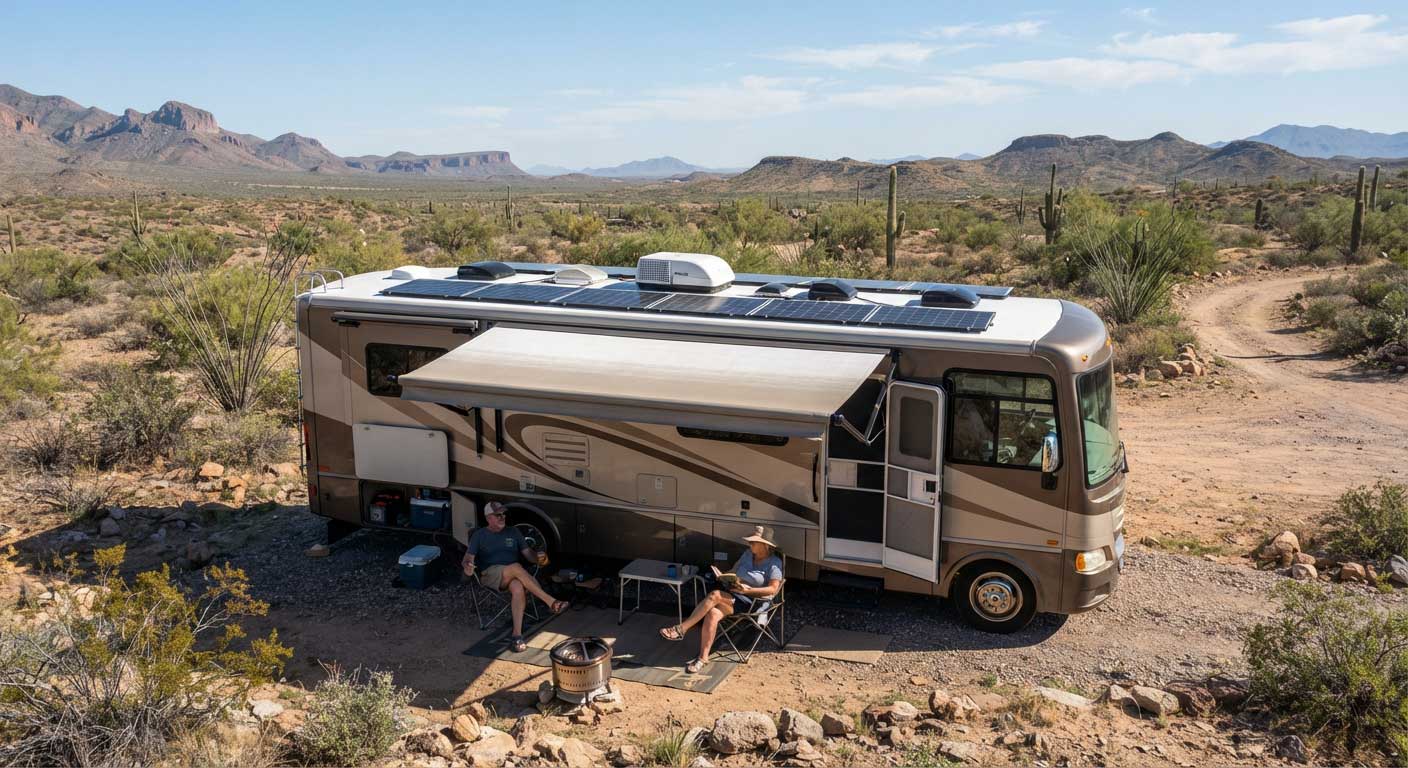
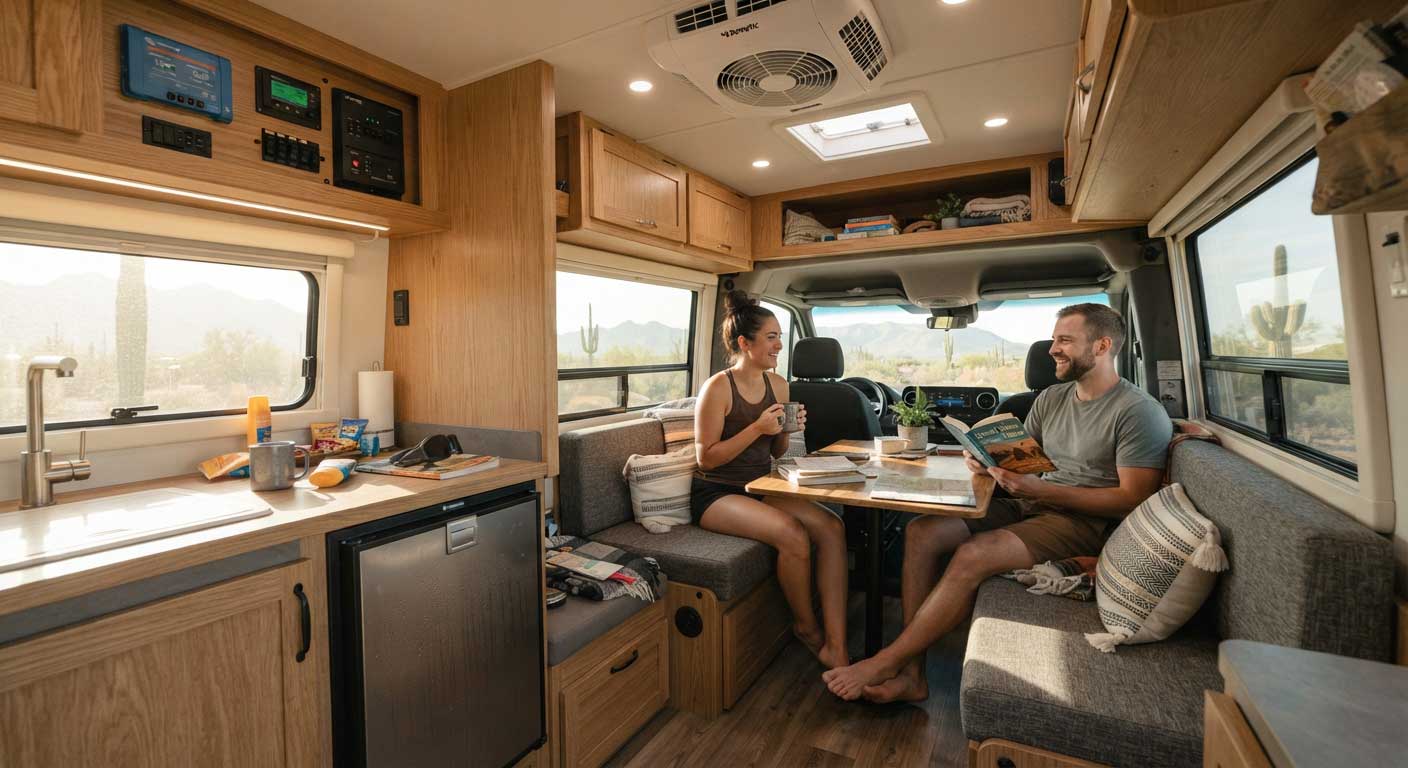
Consider a 30-foot RV traveling through Arizona during summer.
The owner wants to operate a 13,500 BTU rooftop air conditioner during the hottest part of the afternoon.
The RV has:
- 1,200W solar array
- 48V lithium battery bank
- 3,000W pure sine wave inverter
- Refrigerator
- LED lighting
- Wi-Fi router
- Water pump
The air conditioner operates around the 1.4kW level when the compressor is running.
At first glance, the solar array appears too small.
But the compressor does not necessarily run at full load every minute.
The RV is also generating solar power while the air conditioner is consuming energy.
During strong midday sunlight, the solar array can offset part of the AC demand while excess generation charges the battery.
Later in the afternoon, the battery can supply the difference.
That is a much more realistic way to think about solar-powered RV air conditioning.
The system is not simply:
Solar → AC
It is:
Solar → AC + Battery Charging
and later:
Battery → Inverter → AC
How to Improve RV Air Conditioner Solar Efficiency
The cheapest watt is often the watt you do not need to produce.
Before adding more solar panels, reduce the cooling load.
Improve RV Insulation
Insulation affects how quickly cooled air escapes.
Focus on:
- Roof insulation
- Window coverings
- Door seals
- Roof vents
- Wall insulation
Dometic specifically recommends closing windows, doors, skylights, and hatches and using curtains or awnings to reduce heat load when operating its RV air conditioners.
That is not a minor detail.
Reducing heat entering the RV means the compressor may run less.
Park in the Shade When Practical
A shaded campsite can significantly reduce direct solar heat entering the RV.
There is a catch, of course.
Shade is also bad for rooftop solar production.
This creates a genuine RV solar trade-off:
Shade helps the air conditioner but hurts the solar panels.
In practice, a partial-shade parking position may be worse for a solar-powered AC system than a sunny position with reflective window covers.
Use the Air Conditioner Strategically
Instead of demanding maximum cooling all day:
- Cool the RV before peak afternoon heat
- Close blinds and curtains
- Minimize door opening
- Use ceiling fans
- Increase the thermostat slightly when comfortable
The goal is to reduce compressor runtime without sacrificing comfort.
Can Solar Power Run an RV Air Conditioner at Night?
Yes, but solar panels themselves cannot provide nighttime generation.
The battery must supply the energy.
Suppose the air conditioner requires an average of 1,000W while running.
Four hours of operation requires approximately:
1,000W × 4h = 4kWh
That 4kWh has to come from stored energy if there is no grid or generator support.
This is why overnight RV air conditioning is much more demanding than daytime AC operation.
For people who need cooling throughout the night, battery capacity becomes one of the largest parts of the system.
A solar array large enough to recharge that battery the following day is equally important.
Can Flexible Solar Panels Power an RV Air Conditioner?
Yes, provided the total solar array is large enough.
The fact that panels are flexible does not change the fundamental energy calculation.
The main advantages are related to installation:
- Lower weight
- Low-profile construction
- Greater installation flexibility
- Better adaptation to certain roof surfaces
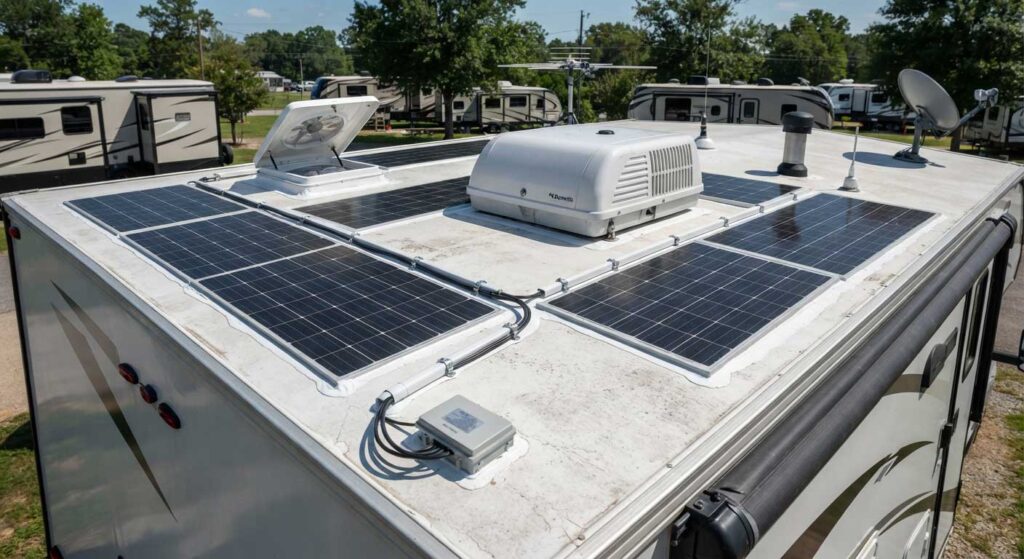
For RVs, available roof area is usually limited.
A flexible solar panel can sometimes use roof areas that would be difficult to accommodate with conventional framed modules.Visit product page:Flexible Solar Panel
At Bright Solar, we focus on flexible panel solutions for mobile applications where weight and available installation space are important considerations.
The important point is to evaluate the complete system rather than comparing panel types by wattage alone.
Common Mistakes When Designing Solar Power for RV Air Conditioner
Using Panel Wattage as the Only Calculation
A 1,000W array does not guarantee 1,000W of continuous production.
Solar output changes throughout the day.
Ignoring Compressor Startup
The inverter must handle the air conditioner’s startup characteristics, not just its average running load.
Using Too Small a Battery
A large solar array cannot solve a battery-storage shortage at night.
Ignoring Other RV Loads
The air conditioner is not the only electrical device running.
Add:
- Refrigerator
- Lights
- Fans
- Water pump
- Internet equipment
- TVs
- Laptops
- Cooking appliances
Installing Panels Without Considering Roof Equipment
Air conditioners, vents, antennas, and roof racks compete for the same limited space.
FAQ About Solar Power for RV Air Conditioner
How many solar panels do I need to run an RV air conditioner?
There is no universal number. A 13,500 BTU unit can draw around 12.5A at 115V according to one Dometic specification, or approximately 1.44kW at that rated current. The actual panel requirement depends on runtime, solar conditions, battery storage, and system losses.
Can a 400W solar panel run an RV air conditioner?
A 400W array is generally insufficient for sustained operation of a conventional 13,500 BTU RV air conditioner. It may contribute energy to the system, but extended AC operation usually requires substantially more solar generation and battery storage.
How much battery do I need for RV air conditioning?
The required battery depends on AC runtime and actual power consumption. If an air conditioner averages 1,000W for four hours, it needs about 4kWh before inverter losses and other RV loads. Longer runtime requires proportionally more usable battery capacity.
Can I run my RV AC on solar without a generator?
Yes, if the solar array, battery bank, inverter, and air conditioner are properly matched. Daytime operation is considerably easier because solar production can directly offset part of the AC load. Extended nighttime operation requires substantial battery storage.
What size inverter do I need for an RV air conditioner?
The exact size depends on the air conditioner and startup characteristics. Conventional compressor units can have high startup current; one Dometic 13,500 BTU model lists a 63A locked-rotor current. A qualified designer should verify the inverter’s continuous and surge ratings against the specific AC unit.
Are inverter RV air conditioners better for solar systems?
They can be. Variable-speed compressor technology can adjust operating speed rather than continuously switching between full output and off. Dometic’s FreshJet FJX7 series, for example, uses variable compressor speed and is designed for lower-noise, energy-efficient operation.
Can flexible solar panels be used for RV air conditioning?
Yes. Flexible panels can be used as part of an RV AC solar system when enough total capacity is installed. Their main advantages are installation flexibility, lower profile, and potentially lower weight rather than inherently producing more electricity per watt.
Bright Solar Flexible Solar Panels for RV Air Conditioning
Bright Solar develops flexible solar panels for mobile applications where roof space, weight, and installation conditions matter.
RV air conditioning is a demanding application, so the solar panel should be treated as one part of a complete energy system.
The design should consider:
- Total solar capacity
- Battery voltage
- Battery storage
- Inverter output
- AC startup behavior
- Roof space
- Shading
- Climate
- Daily cooling requirements
For a small RV, a compact flexible array may be enough for basic electrical loads.
For serious off-grid air conditioning, the system usually needs a much larger solar array and battery bank.
That is where careful system design becomes more valuable than simply adding another panel.
Conclusion: Solar Power for RV Air Conditioner
Solar power for RV air conditioner systems is achievable, but air conditioning requires far more energy than typical RV appliances.
The most important figures are:
- 13,500 BTU rooftop AC: one Dometic model specifies 12.5A at 115V, approximately 1.44kW at rated current.
- 15,000 BTU rooftop AC: one Dometic model specifies 13.0A at 115V, approximately 1.50kW.
- Compressor startup can be substantially higher than normal running current.
- Battery capacity determines how long AC can operate when solar production is insufficient.
- Solar array size determines how quickly that battery can be replenished.
For practical off-grid operation, the strongest approach is to combine high-capacity solar generation, adequate battery storage, an appropriately sized inverter, efficient air conditioning, and reduced RV heat gain.
Bright Solar flexible solar panels can provide the solar-generation component where RV roof space, weight, and installation flexibility are important.
Related recommendations
-

400W Flexible Solar Panel: High-Output Solar Power Without the Weight
181400w flexible solar panel solutions for RVs, boats, and off-grid systems. Discover lightweight ETFE solar panels with high efficiency and real-world durability.
View details -
USB Solar Panel Flexible: Portable Solar Charging Solution for Outdoor Power Needs
186USB solar panel flexible provides lightweight portable charging for camping, hiking, and emergency power. Explore Bright Solar technology, performance, and real outdoor applications.
View details -
solar panel wiring guide (Field Installation Manual from Bright Solar)
217solar panel wiring guide explained with real installation steps, safety standards, wiring diagrams, and field-tested methods for off-grid and RV solar systems.
View details -
Flexible 100 Watt Solar Panel for RV, Marine and Off-Grid Applications
124Discover flexible 100 watt solar panel solutions from Bright Solar. Learn efficiency, applications, installation tips, and why lightweight solar fits RV, marine, and off-grid energy needs.
View details