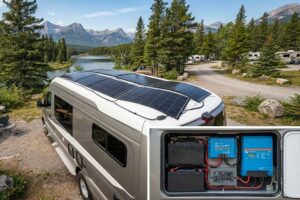
1000 Watt Flexible Solar Panel: Output, Sizing and Installation Guide
A 1000 watt flexible solar panel system can provide about 1 kWh of rated DC power under standard test conditions, but actual daily energy depends on sunlight, temperature, shading, orientation, and installation. It is best suited to large RVs, vans, boats, cabins, mobile systems, and other applications where roof shape and weight matter.
A 1,000W array sounds straightforward until you actually try to put one on a curved roof.
The number on the label is easy. Finding enough usable roof area, deciding how many panels to connect, routing the cables without creating a weak point, and keeping the modules cool enough to perform well are where most installation decisions happen.
For Bright Solar, I would not evaluate a 1000 watt flexible solar panel system by wattage alone. The better question is whether the complete array, charge controller, battery, wiring, mounting surface, and daily energy demand are properly matched.
That distinction matters because PV module ratings are measured under controlled laboratory conditions. The U.S. Department of Energy states that standard test conditions use 1,000 W/m² of sunlight and a 25°C cell temperature, while real installations normally experience lower irradiance and higher cell temperatures.
What Is a 1000 Watt Flexible Solar Panel?
A 1000 watt flexible solar panel system is an array of flexible photovoltaic modules whose combined rated power is 1,000 watts.
It does not necessarily mean one enormous 1,000W sheet.
In practical installations, 1,000 watts is normally built from multiple modules. For example:
| Configuration | Total Rated Power |
|---|---|
| 5 × 200W panels | 1,000W |
| 4 × 250W panels | 1,000W |
| 10 × 100W panels | 1,000W |
| 2 × 500W panels | 1,000W |
The right combination depends on panel dimensions, electrical characteristics, roof shape, charge-controller limits, and the available installation area.
That is one reason flexible solar panels are interesting for mobile applications. A roof does not have to be perfectly flat to become useful solar real estate.
Flexible Does Not Mean Unlimited Bending
One common mistake is treating “flexible” as permission to bend the module however you want.
It is not.
The permitted bend radius depends on the module construction. The manufacturer’s mechanical specifications should always take priority.
IEC 61215-1:2021 and IEC 61215-2:2021 include specific test methods for flexible PV modules, including the MQT 22 bending test. IEC also makes clear that qualification testing is not a quantitative prediction of a module’s lifetime.
That is important when installing a large array across an RV roof or curved marine surface. A smooth, controlled curve is very different from forcing a panel over a sharp edge.
How Much Power Does a 1000 Watt Flexible Solar Panel System Produce?
A 1000 watt flexible solar panel system has a rated output of 1,000W under standard test conditions, but its actual energy production varies throughout the day.
A simple planning calculation is:
Daily energy = Array power × equivalent peak sun hours
For a 1,000W array:
| Equivalent Peak Sun Hours | Simple Energy Estimate |
|---|---|
| 2 hours | 2,000Wh/day |
| 3 hours | 3,000Wh/day |
| 4 hours | 4,000Wh/day |
| 5 hours | 5,000Wh/day |
| 6 hours | 6,000Wh/day |
These numbers are planning examples, not guaranteed production figures.
A real system can produce less because of clouds, shading, high module temperature, orientation, wiring losses, controller efficiency, dirt, and other system conditions.
DOE specifically notes that solar resource, angle of incidence, temperature, clouds, and module age all affect actual PV production.
Why a 1000W Array Does Not Produce 1000W All Day
A 1,000W nameplate rating is a maximum reference point, not an hourly promise.
Imagine a clear summer day.
At 8:00 a.m., the array may be producing substantially less than its rated output. Around solar noon, irradiance can become much stronger. Later in the afternoon, production falls again.
Temperature complicates the picture.
NREL’s PVWatts model calculates operating cell temperature using irradiance, wind speed, and ambient temperature. Its model also accounts for mounting configuration because roof-mounted modules can experience different thermal conditions from open-rack installations.
This is particularly relevant for flexible solar panels that are installed close to a roof surface.
A More Useful Way to Think About 1,000 Watts
Instead of asking:
“How many watts will I get?”
I usually start with:
“How many watt-hours do I need each day?”
For example, a mobile installation might have:
| Load | Example Daily Consumption |
|---|---|
| LED lighting | 150Wh |
| Phones/tablets | 80Wh |
| Router/communications | 200Wh |
| Ventilation fan | 300Wh |
| Small electronics | 250Wh |
| Refrigerator | 600Wh |
| Total | 1,580Wh |
A 1,000W solar array has substantially more rated capacity than this simplified load profile requires.
But that does not automatically mean the system is oversized. Weather, battery charging, seasonal production, and future loads still matter.
Where Is a 1000 Watt Flexible Solar Panel System Useful?
A 1,000W flexible array makes the most sense where available roof area is valuable and conventional rigid modules are difficult to install.
Typical applications include:
- Large RVs and motorhomes
- Camper vans with broad roof areas
- Boats and yachts
- Off-grid cabins
- Mobile workstations
- Remote monitoring systems
- Portable or semi-permanent power systems
- Agricultural or outdoor equipment
- Custom curved-roof applications
For a small weekend camper, 1,000W may be unnecessary.
For a larger RV running refrigeration, communications equipment, lighting, ventilation, and other DC loads, it becomes much more practical.
The roof itself usually decides the design.
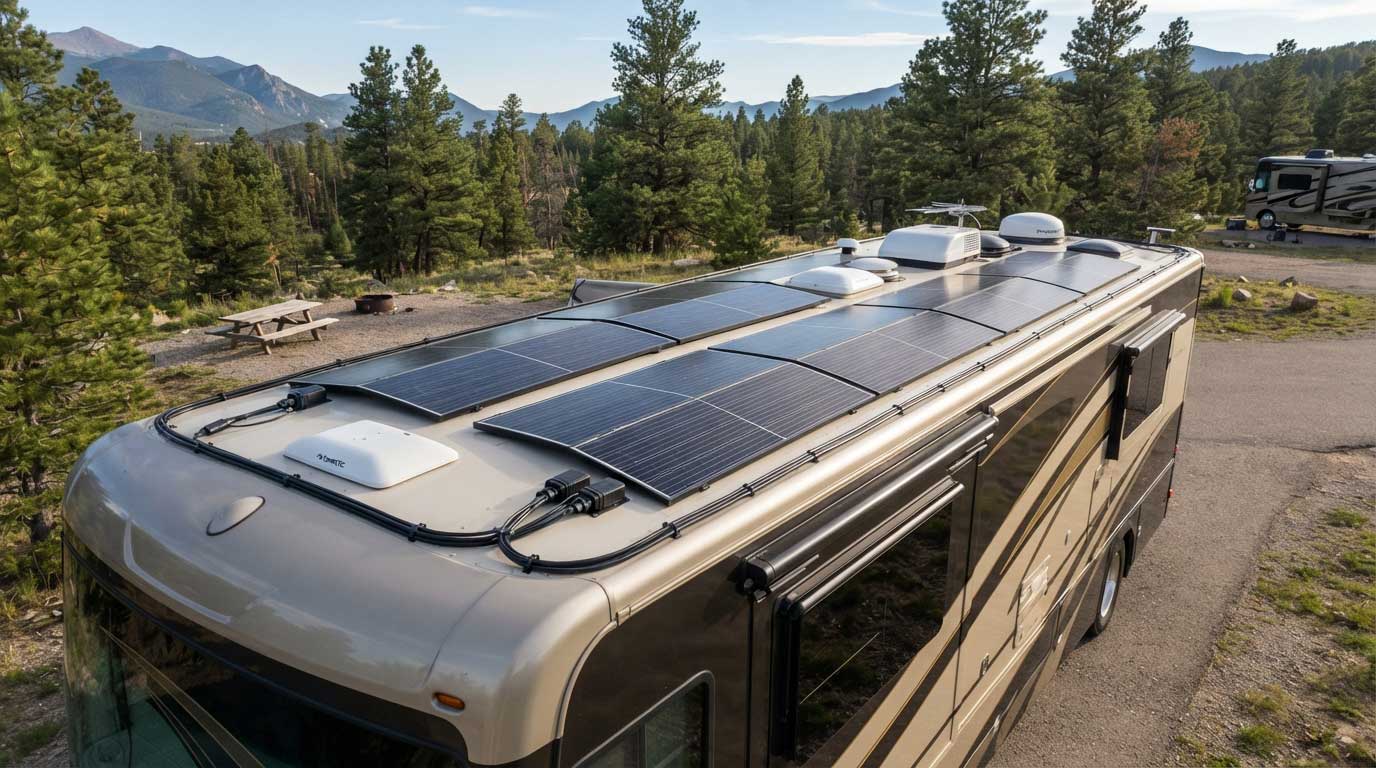
1000 Watt Flexible Solar Panel for RV Applications
An RV is one of the strongest use cases for a large flexible solar array.
Rigid panels often require mounting hardware, rails, brackets, and sufficient clearance around roof equipment. Flexible modules can reduce some of those physical constraints because their low-profile construction can follow suitable roof contours.
But installation still requires planning.
Before putting adhesive or fasteners on the roof, I would physically lay out every panel.
Not approximately.
Actually lay them out.
Mark the air conditioner. Mark vents. Mark skylights. Mark roof-access areas. Then look at where the cable connectors will end up.
This five-minute layout exercise can prevent hours of rework.
RV Roof Checks Before Installation
Check these areas first:
- Available uninterrupted roof area
- Roof curvature and panel bend limitations
- Existing roof vents and air conditioners
- Potential afternoon shadows
- Cable entry location
- Charge-controller location
- Battery-bank location
- Maintenance access
- Roof material compatibility
- Manufacturer-approved mounting method
A technically efficient panel layout can still be a poor installation if it blocks service access.
That is an overlooked point.
A roof technician needs to reach the air conditioner later. A cable gland may need inspection. A vent may need replacement. Solar should not turn routine maintenance into panel removal.
How to Build a 1000W Flexible Solar Panel System
The electrical design starts with the individual module specifications.
Do not select a connection method simply because the total wattage looks correct.
You need to compare:
- Maximum power voltage (Vmp)
- Open-circuit voltage (Voc)
- Maximum power current (Imp)
- Short-circuit current (Isc)
- Maximum system voltage
- Charge-controller operating range
- Battery voltage
- Maximum controller input current
- Cable size
- Connector compatibility
Series Connection
In a series connection, panel voltages add while current remains approximately at the level of one panel.
For example, four hypothetical 200W modules might have:
- 20V Vmp
- 10A Imp
Four in series would produce approximately:
20V × 4 = 80V
Current would remain approximately:
10A
Total rated power:
80V × 10A = 800W
This is only an example. Actual module values must be taken from the panel datasheet.
Parallel Connection
In parallel, voltage remains approximately the same while current increases.
Using the same hypothetical 200W module:
Two modules in parallel would approximately produce:
20V × 20A = 400W
As the number of panels increases, conductor sizing and controller input-current limits become increasingly important.
Series-Parallel Configuration
Large 1,000W arrays often require more deliberate electrical planning.
For example, several modules can be connected into series strings and then those strings connected in parallel.
The objective is not simply “higher voltage” or “higher current.”
The objective is matching the array to the charge controller and battery architecture while keeping voltage and current within equipment limits.
Battery Size for a 1000 Watt Flexible Solar Panel
The solar array and battery bank should be sized together, but they are not the same thing.
A 1,000W array does not automatically require a 1,000Ah battery.
Battery capacity depends on how much energy needs to be stored and how long the system must operate without sufficient solar production.
For example, a simplified 2,000Wh daily load could be approached with a battery bank sized around the required usable energy, after considering the battery chemistry, allowable depth of discharge, inverter losses, temperature, and reserve requirements.
A useful planning relationship is:
Battery energy (Wh) = Voltage (V) × Capacity (Ah)
So a nominal 12V, 200Ah battery represents:
12V × 200Ah = 2,400Wh nominal energy
That does not mean 2,400Wh is necessarily available for useful loads.
The usable amount depends on battery technology and the manufacturer’s operating limits.
This is where I would resist the temptation to buy the biggest battery simply because the solar array is large.
The better approach is to build the load profile first.
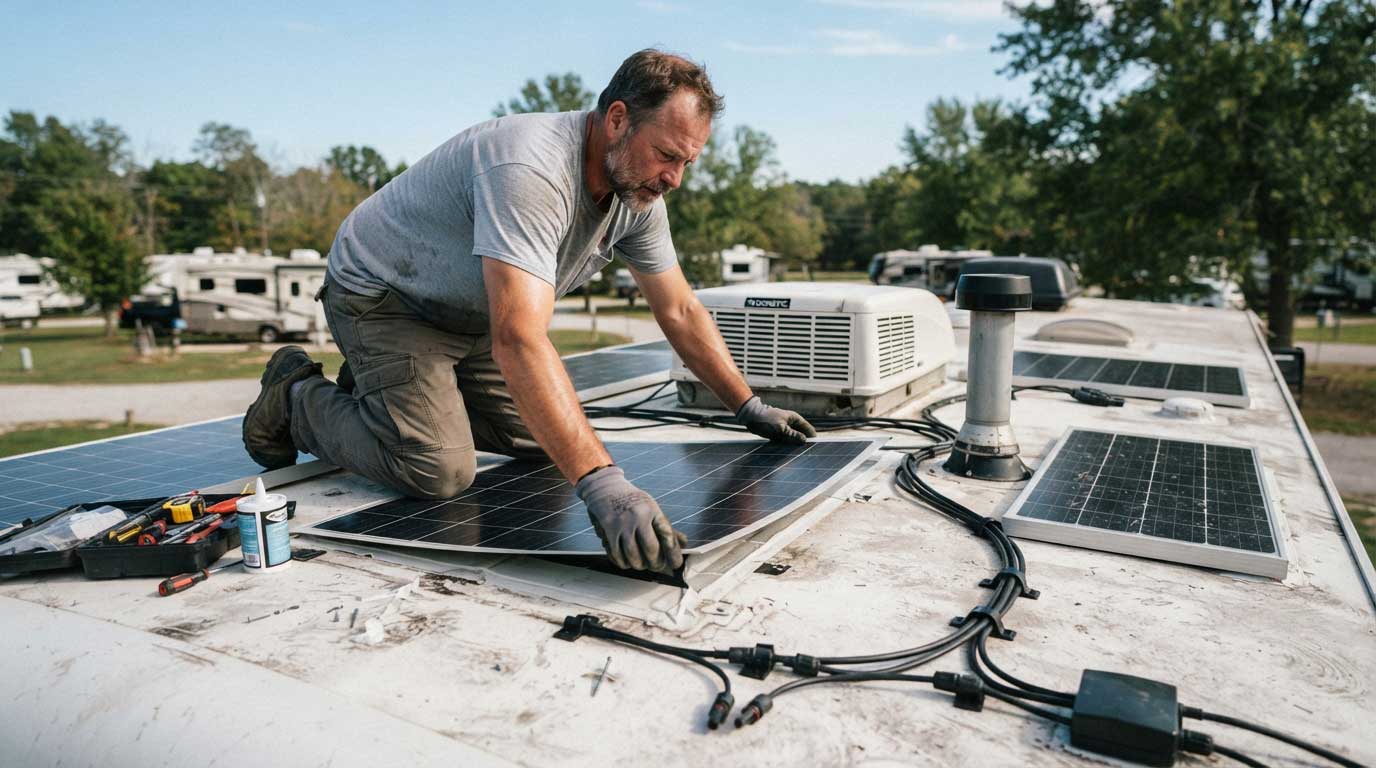
How to Install a 1000 Watt Flexible Solar Panel
The installation sequence matters more than people expect.
Step 1 — Dry-Fit the Entire Array
Place all modules on the roof without permanent attachment.
Check spacing and cable paths.
Take photographs before moving anything.
Step 2 — Confirm Polarity and Electrical Layout
Verify positive and negative leads with the actual module documentation.
If multiple panels are being connected in series or parallel, confirm the final voltage and current before connecting to the controller.
Never rely on memory from a previous installation.
Step 3 — Prepare the Mounting Surface
The surface must be clean and compatible with the selected mounting method.
Dust, wax, oxidation, loose coatings, or contamination can compromise adhesion.
The mounting method should follow the module manufacturer’s instructions and the roof-material manufacturer’s requirements.
Step 4 — Route Cables Before Final Attachment
This is where a dry-fit pays off.
A connector that looked convenient on the ground may become awkward once the panel is positioned on a curved roof.
Keep cable runs:
- Short where practical
- Mechanically protected
- Away from sharp edges
- Clear of moving equipment
- Properly supported
- Protected from unnecessary UV exposure
Step 5 — Attach the Modules
Apply the approved mounting method carefully.
Do not force a panel into a curve that exceeds its specified mechanical limits.
Flexible construction is an installation advantage only when the mechanical design is respected.
Step 6 — Connect the Charge Controller and Battery
Follow the controller manufacturer’s connection sequence.
Verify polarity.
Check open-circuit voltage before final connection.
Confirm that the controller’s maximum PV voltage and current are not exceeded.
Step 7 — Monitor the First Few Days
Do not consider the installation finished the moment the controller turns on.
Watch:
- Morning production
- Midday production
- Afternoon production
- Battery charging behavior
- Unexpected voltage drops
- Individual string behavior
- Shading patterns
The first week often reveals things that were invisible during installation.
Flexible vs Rigid Solar Panels for a 1000W System
The decision between flexible and rigid modules should be based on the installation environment.
| Factor | Flexible Solar Panels | Rigid Solar Panels |
|---|---|---|
| Weight | Usually lower | Usually higher |
| Roof profile | Low-profile | Raised mounting |
| Curved surfaces | Strong advantage | Limited |
| Mounting hardware | Potentially simpler | Usually more hardware |
| Ventilation under module | Can be limited | Usually better |
| Installation flexibility | High | Moderate |
| Large flat roof | Good | Often very practical |
| RV/mobile applications | Excellent fit | Also widely used |
There is no universal winner.
On a flat commercial roof with plenty of mounting space, rigid modules can be very attractive.
On a curved RV roof where height, weight, and appearance matter, flexible modules can solve problems that rigid modules cannot solve as neatly.
That is the real reason to choose flexible.
Not because “flexible” sounds better.
Temperature, Shading and Real-World Output
Temperature deserves more attention in flexible-panel installations.
PV modules do not operate at their nameplate conditions all day.
DOE identifies 1,000 W/m² irradiance and 25°C cell temperature as the standard test reference, while real systems frequently operate at higher cell temperatures.
NREL’s PVWatts documentation similarly models cell temperature based on irradiance, wind speed, ambient temperature, and mounting configuration.
This is why two identical 1,000W systems can produce noticeably different energy over a year.
One may have better airflow.
Another may sit on a hotter roof.
One may have a chimney, roof vent, satellite dish, or air-conditioning unit creating partial shade during important hours.
Partial Shading Is Not a Small Detail
When planning a large flexible array, look at the roof from morning through afternoon.
A small shadow from an air-conditioning unit can move considerably during the day.
Do not judge the roof only at noon.
For mobile systems, the situation changes again because the vehicle orientation changes.
That is one reason production monitoring is useful after installation.
How Long Does a 1000 Watt Flexible Solar Panel System Last?
There is no honest single number that applies to every flexible module.
Module lifetime depends on construction, materials, environment, installation quality, operating conditions, and maintenance.
IEC 61215 explicitly states that qualification testing does not provide a quantitative prediction of module lifetime.
DOE notes that PV module efficiency degrades at about 0.5% per year as a general performance consideration.
For buyers, the more useful approach is to examine the actual manufacturer’s documentation:
- Product warranty
- Power warranty
- Material construction
- Encapsulation
- Surface material
- Bending specifications
- Temperature range
- Water and environmental protection
- Electrical certifications
- Installation instructions
Do not evaluate a flexible panel solely by its advertised wattage.
Bright Solar 1000 Watt Flexible Solar Panel System
Bright Solar approaches flexible solar systems around the practical requirements of the installation rather than treating wattage as the only specification.
For a 1,000W design, the important questions are:
- How much roof area is available?
- How many modules fit without obstructing equipment?
- What are the module Vmp and Voc?
- What battery voltage will the system use?
- Which charge controller is being used?
- What is the expected daily energy demand?
- Where will the cables enter the vehicle or building?
- How will the modules be serviced later?
For curved roofs, the mechanical side deserves equal attention to the electrical side.
A perfect electrical configuration is still a poor system if the modules are installed under excessive mechanical stress.
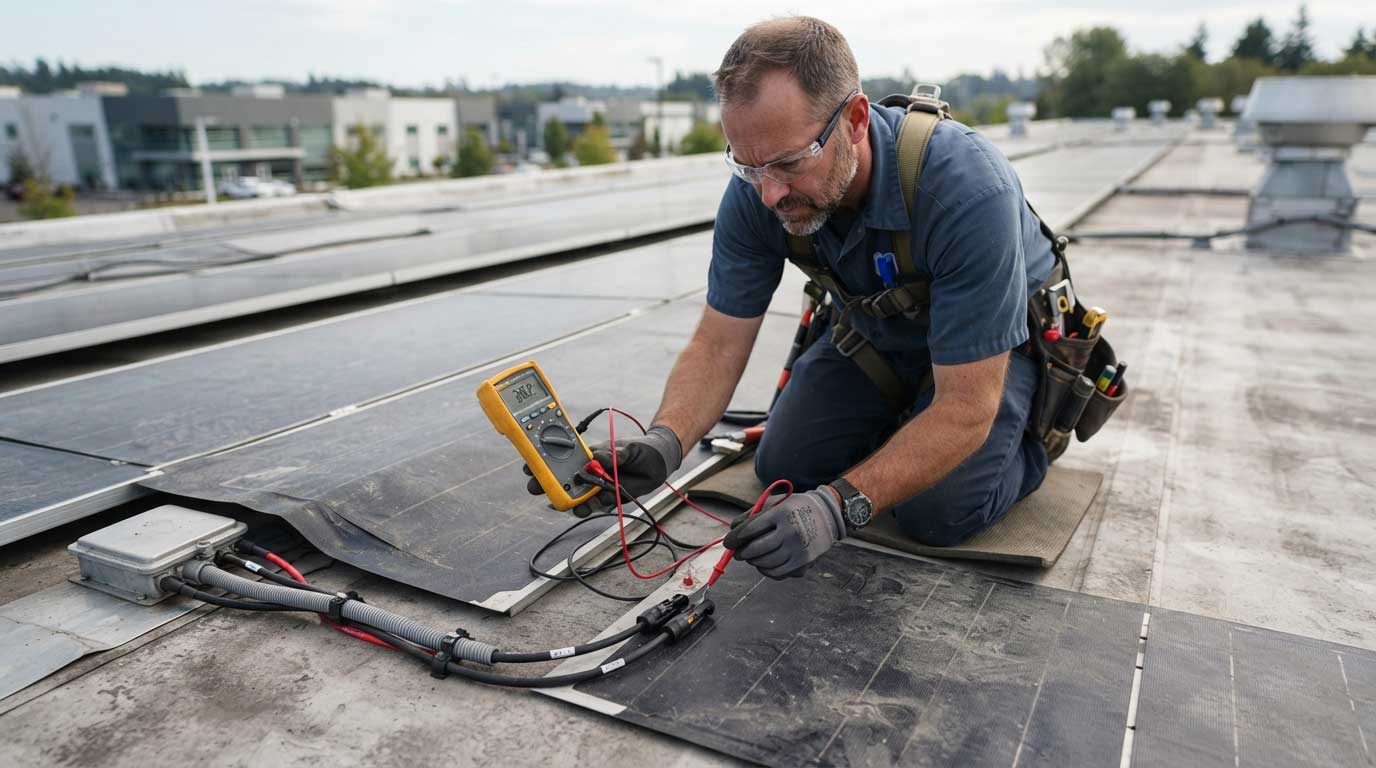
Common Mistakes When Installing a 1000W Flexible Solar Array
The most expensive mistakes are often not caused by the solar cells.
They happen during system design.
Mistake 1 — Designing Around Wattage Only
Two 1,000W arrays can have very different voltage and current characteristics.
Always design from the electrical datasheet.
Mistake 2 — Ignoring Roof Equipment
An air conditioner, vent, antenna, or cargo accessory can create shading and installation conflicts.
Mistake 3 — Over-Bending the Module
Never assume a flexible module can make any curve.
Check the manufacturer’s bend specification.
Mistake 4 — Undersizing the Wiring
Higher-current configurations can require larger conductors.
Cable selection should account for current, distance, allowable voltage drop, insulation rating, temperature, and installation environment.
Mistake 5 — Forgetting Future Maintenance
Leave access to critical roof equipment.
Solar should make the vehicle or building more energy independent, not harder to repair.
1000 Watt Flexible Solar Panel FAQ
How much power does a 1000 watt flexible solar panel produce?
A 1,000W flexible solar array is rated to produce 1,000W under standard test conditions. Actual output varies with irradiance, temperature, shading, orientation, wiring, and other operating conditions. Daily energy is better estimated using site-specific solar conditions than by treating 1,000W as continuous output.
Is a 1000 watt flexible solar panel system good for an RV?
Yes. A 1,000W flexible array can be suitable for larger RVs and motorhomes with sufficient roof space and meaningful daily electrical loads. It is particularly attractive when low-profile installation and curved roof compatibility are more important than conventional rigid-panel mounting.
How many panels do I need for 1000 watts?
The number depends on individual module wattage. Five 200W modules equal 1,000W, while ten 100W modules also equal 1,000W. The best configuration depends on panel dimensions, roof layout, electrical specifications, and charge-controller limits.
Can I install 1000W of flexible solar panels on a curved roof?
Yes, provided the modules are designed for the intended curvature and installed within the manufacturer’s mechanical limits. Flexible does not mean unlimited bending. IEC 61215 includes bending-test methods for flexible PV modules.
What battery size is needed for a 1000W solar system?
There is no single correct battery size. Battery capacity should be based on daily energy consumption, required autonomy, battery chemistry, allowable depth of discharge, system voltage, and charging conditions. The solar array and battery should be designed as one system.
Is flexible solar better than rigid solar?
Neither technology is universally better. Flexible solar is particularly useful where weight, roof height, appearance, or curved surfaces matter. Rigid panels can be advantageous where maximum ventilation, conventional mounting, and large flat installation areas are available.
Does a 1000W solar system produce 1000W continuously?
No. The 1,000W figure is the rated DC power under standard test conditions. Real production changes throughout the day and is affected by sunlight intensity, cell temperature, shading, orientation, and other factors. DOE confirms that real-world conditions normally differ from STC.
Final Takeaway
A 1000 watt flexible solar panel system is a practical way to add substantial solar capacity where conventional rigid panels are difficult to fit, particularly on RVs, vans, boats, cabins, and other curved or weight-sensitive installations.
The important number is not just 1,000 watts.
Look at the complete system: usable roof area, module specifications, wiring configuration, charge controller, battery capacity, shading, temperature, mounting method, and future maintenance access.
That is how I would evaluate a serious 1,000W installation for Bright Solar—not from the label on the panel, but from how the entire system is going to behave after it leaves the showroom and starts living outdoors.
Technical References:
- U.S. Department of Energy — Optimizing Solar Photovoltaic Performance for Longevity.
- U.S. Department of Energy — Understanding Solar Photovoltaic System Performance: An Assessment of 75 Federal Photovoltaic Systems.
- NREL — PVWatts Version 5 Manual.
- IEC — IEC 61215-1:2021, Terrestrial photovoltaic modules: Design qualification and type approval.
- IEC — IEC 61215-2:2021, Terrestrial photovoltaic modules: Test procedures.
Related recommendations
-

Best Flexible Solar Panels for Van: How to Choose the Right One
302The best flexible solar panels for vans are lightweight, low-profile modules matched to roof curvature, space, power needs, and electrical requirements.
View details -
300 w flexible solar panel (High-Power Mobile Energy System Guide from Bright Solar)
258300 w flexible solar panel explained with real RV field performance data, installation insights, energy output behavior, and off-grid system design notes.
View details -
400W Solar Module Performance, Applications and Buying Guide
166400W solar module solutions for RVs, marine systems and off-grid applications. Learn output, efficiency, installation methods and real-world performance from Bright Solar.
View details -
1000W Solar Panel: Complete Guide to Size, Power Output, Cost, and System Setup
309Explore 1000w solar panel size, cost, power output, and system setup. Learn how to choose the right 1000 watt solar solution for RV, off-grid, and backup energy needs with Bright Solar.
View details