Solar Panels Wired in Series: Wiring, Voltage, and Safety Guide
Solar panels wired in series increase system voltage while keeping the current close to that of one panel. Connect the positive terminal of one panel to the negative of the next, then verify total Voc against the controller and system voltage limits before energizing the string.
That sounds simple. On an installation, the difficult part usually comes afterward.
The panel connectors are easy to snap together. Choosing the right number of modules, however, requires looking at Voc, temperature coefficient, MPPT voltage range, cable routing, current limits, and the actual operating environment rather than simply adding panel wattages.
At Bright Solar, this is one of the first things I check when reviewing a proposed flexible or rigid PV layout: what will the string voltage become on the coldest morning, not the warmest afternoon? That distinction matters because photovoltaic voltage changes with temperature. The U.S. Department of Energy notes that higher temperatures cause a much larger decrease in PV voltage than the corresponding increase in current.
NREL‘s photovoltaic modeling work also treats series and parallel configuration as fundamental electrical characteristics of a PV array, with array voltage and current determined by the configuration of the individual modules.
What Happens When Solar Panels Are Wired in Series?
When solar panels are connected in series, the voltages add while the current remains approximately the same as the current of the individual modules.
For example, assume three identical panels have these electrical specifications:
| Parameter | One Panel | 3 Panels in Series |
|---|---|---|
| Rated power | 200 W | 600 W |
| Vmp | 20 V | 60 V |
| Imp | 10 A | 10 A |
| Voc | 24 V | 72 V |
| Isc | 10.5 A | About 10.5 A |
The basic calculation is:
Series Vmp = Panel Vmp × Number of Panels
Series Voc = Panel Voc × Number of Panels
So, three 200 W modules with a 20 V Vmp theoretically produce approximately 60 V at maximum power.
The important word is theoretically.
Actual PV voltage moves with irradiance and temperature. The nameplate values are normally based on standardized test conditions, while a roof, RV, boat, or off-grid installation rarely operates under those exact conditions all day.
The National Renewable Energy Laboratory explicitly identifies array Vmp, Imp, Voc, and Isc as important parameters when documenting PV array configuration.
Why Wire Solar Panels in Series?
The main reason is straightforward: higher voltage can make a PV string easier to match with an MPPT controller or inverter and can reduce current for a given power level.
Suppose a 600 W array operates around 60 V:
600 W ÷ 60 V = 10 A
The same 600 W at 30 V would require approximately:
600 W ÷ 30 V = 20 A
That difference becomes useful when selecting conductors and planning longer cable runs.
It does not mean that series wiring automatically produces more energy. The array’s power rating still comes from the combined modules. Victron’s technical guidance similarly notes that total solar-array power is the sum of the individual module power regardless of whether modules are connected in series or parallel.
What changes is how the voltage and current are presented to the rest of the system.
How to Wire Solar Panels in Series
1. Check the panel specifications first
Before touching an MC4 connector, record:
- Maximum power, Pmax
- Voltage at maximum power, Vmp
- Current at maximum power, Imp
- Open-circuit voltage, Voc
- Short-circuit current, Isc
- Voc temperature coefficient
- Maximum system voltage
- Module operating temperature range
Do not design the string from wattage alone.
Two 200 W panels can have very different voltage characteristics. A panel’s 200 W rating does not tell you whether two, three, or four modules are appropriate for a particular MPPT controller.
2. Confirm that the modules are suitable for series connection
Ideally, use modules with matching electrical characteristics, especially Vmp and Imp.
Mixing different panels is sometimes electrically possible, but it can introduce mismatch losses and complicate system design. If the modules have substantially different current characteristics, the lower-current module can constrain the series string.
For a clean commercial or off-grid installation, matched modules are the better starting point.
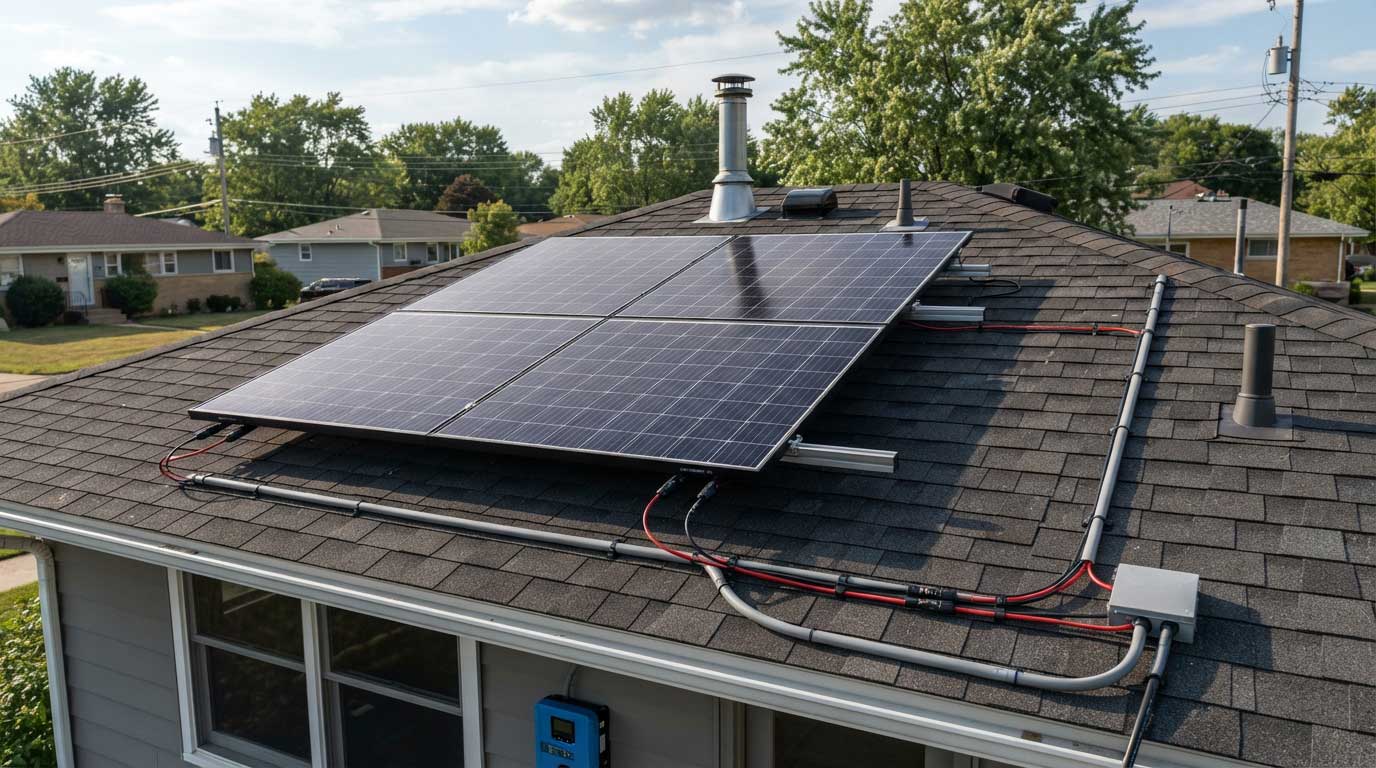
3. Connect the panels end-to-end
A typical series string looks like this:
Panel 1 (+) → Panel 2 (-)
Panel 2 (+) → Panel 3 (-)
Panel 3 (+) → Panel 4 (-)
The unused negative terminal at the beginning of the string and unused positive terminal at the end become the two PV output conductors.
Visually:
PV (-) → [Panel 1] → [Panel 2] → [Panel 3] → [Panel 4] → PV (+)
The polarity sequence is important. Do not assume connector shape alone proves correct polarity.
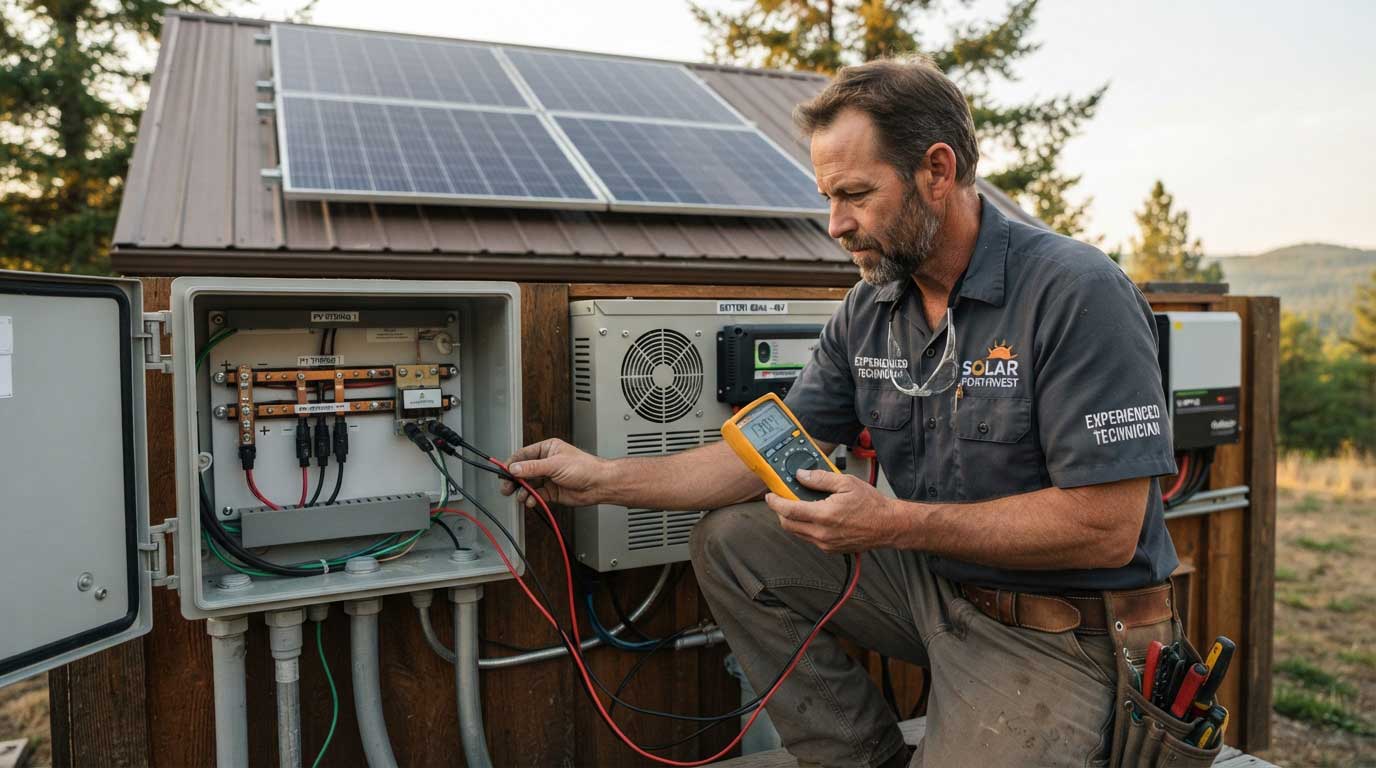
Use a properly rated meter to verify the completed string before connecting it to the controller.
Series Solar Panel Voltage: The Number That Matters Most
One of the most common mistakes I see in preliminary PV designs is checking the controller’s nominal voltage but ignoring maximum PV input voltage.
Imagine a panel with:
- Voc = 24 V
- Vmp = 20 V
- Voc temperature coefficient = -0.30%/°C
Four panels give:
String Voc at STC = 24 × 4 = 96 V
Someone may look at a 100 V MPPT controller and think the design is safe.
It may not be.
If the installation experiences a cold morning, the panel Voc can rise. That 96 V STC figure is not necessarily the maximum voltage the controller will ever see.
Victron specifically warns that when calculating the number of panels that can be connected in series, designers must account for Voc and its temperature coefficient.
This is why a string that appears acceptable on a warm spreadsheet can become a problem during cold-weather startup.
Cold-weather Voc calculation
A simplified engineering check is:
Adjusted Voc = Voc × [1 + temperature increase in Voc caused by cold conditions]
The exact calculation should use the module manufacturer’s stated temperature coefficient and the lowest expected cell temperature for the installation.
Do not substitute the average outdoor temperature.
For rooftop installations, module temperature and ambient temperature are not the same thing. The correct design temperature depends on the engineering method and local conditions.
Series Connection and MPPT Charge Controllers
An MPPT controller is designed to operate within a defined PV voltage window.
That creates two separate checks:
1. Maximum voltage:
The cold-weather string Voc must remain below the controller’s maximum PV voltage.
2. Operating voltage:
The string’s working voltage must be high enough for the controller to track the PV array and charge the battery under expected conditions.
For example, a 24 V battery system might benefit from a higher-voltage PV string because the controller can convert the higher PV voltage down to the battery charging voltage.
Victron’s published installation documentation provides specific examples of series configurations and emphasizes checking both the controller voltage limit and the panel Voc/temperature characteristics.
DOE also describes power electronics as responsible for managing PV voltage and current to maximize power output and convert PV DC power appropriately for the system.
Solar Panels in Series vs Parallel
The distinction is easiest to understand from the electrical behavior.
| Configuration | Voltage | Current | Typical Advantage |
|---|---|---|---|
| Series | Adds | Approximately unchanged | Higher PV voltage |
| Parallel | Approximately unchanged | Adds | Higher PV current |
| Series-parallel | Adds by string and then combines | Adds between strings | Larger arrays with controlled voltage/current |
Consider four 200 W panels with approximately 20 V Vmp and 10 A Imp.
4 in series:
80 V × 10 A ≈ 800 W
4 in parallel:
20 V × 40 A ≈ 800 W
The theoretical power is essentially the same.
The electrical architecture is not.
For a longer cable run from an array to a controller, the higher-voltage series configuration can be attractive because the current is lower for the same power. But the controller must be rated for the resulting PV voltage.
A Practical Example: Four 200 W Panels on an Off-Grid System
Consider a realistic design scenario:
A small off-grid cabin uses four 200 W modules.
Each module:
- Pmax: 200 W
- Vmp: 20 V
- Imp: 10 A
- Voc: 24 V
- Isc: 10.5 A
The installer wants to use all four panels in series.
The basic electrical result is:
Array power: 800 W
Vmp: approximately 80 V
Imp: approximately 10 A
Voc at STC: approximately 96 V
At first glance, the configuration looks efficient.
But the final decision depends on the MPPT controller’s actual maximum PV input voltage and the temperature-adjusted Voc.
This is where a real installation review becomes different from simply multiplying numbers.
If the controller has a 100 V maximum PV input rating, a 96 V STC Voc string leaves very little voltage margin. A colder site could push the array beyond the controller’s limit.
I would not approve that configuration without running the manufacturer’s temperature calculation.
What Happens If One Panel Is Shaded?
This is one reason series wiring deserves more thought than simply calculating voltage.
In a series string, the current path passes through each module. A shaded module can therefore influence the operating behavior of the string.
Modern modules use bypass diodes to help manage partial shading, but bypass diodes do not magically make shading irrelevant.
The physical layout matters.
A tree shadow crossing one module at 9:00 a.m. is different from a chimney shading half of several modules throughout the day.
This is also where system monitoring becomes useful. DOE notes that PV monitoring systems can track voltage and current at the level of the entire PV system, inverter, individual series string, or individual module.
That level of visibility can turn a vague “solar production seems low” complaint into something measurable.
Series Wiring Mistakes to Avoid
Using STC Voc as the absolute maximum
This is probably the most important mistake.
STC values are reference conditions. They are not a guarantee of the highest voltage your array can experience.
Choosing panels based only on wattage
A 400 W module is not defined electrically by “400 W” alone.
You still need Vmp, Imp, Voc, Isc, and temperature coefficients.
Exceeding the MPPT voltage rating
The controller’s maximum PV voltage is a hard design constraint. Victron’s documentation, for example, explicitly requires the PV open-circuit voltage to remain within the controller’s rating.
Assuming more series panels always means better performance
More voltage is useful only when the rest of the system can accept it.
A higher string voltage that exceeds the controller’s input range is not an optimization. It is a design error.
Connecting mismatched modules without checking current characteristics
Different modules may have different Vmp, Imp, Voc, and temperature behavior. Series strings are best designed around compatible modules.
Ignoring connectors and cable routing
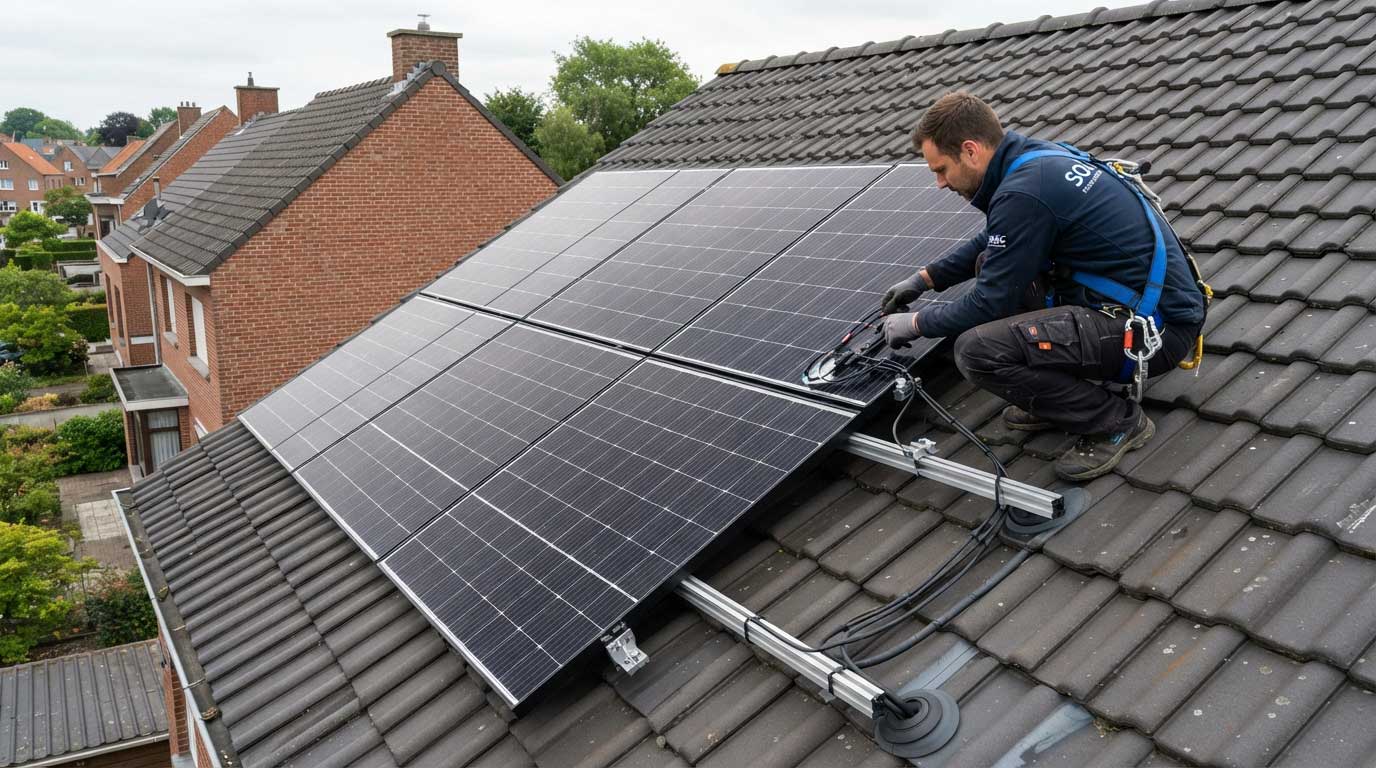
A technically correct electrical calculation can still produce a poor installation if cables are left under tension, connectors sit in standing water, or cables rub against sharp roof edges.
The physical installation deserves the same attention as the spreadsheet.
How Many Solar Panels Can Be Wired in Series?
There is no universal number.
The correct number is determined by the electrical specifications of the module, the MPPT controller or inverter, and the site’s temperature range.
A simplified design process is:
- Find the module Voc.
- Find the module Voc temperature coefficient.
- Determine the lowest expected design temperature.
- Calculate the cold-adjusted string Voc.
- Multiply by the number of modules in series.
- Compare the result with the controller’s maximum PV input voltage.
- Check the MPPT operating-voltage range.
- Confirm current, connector, cable, fuse, disconnect, and system-voltage requirements.
NREL’s PV modeling framework treats the number of series-connected cells/modules and parallel strings as core inputs to PV-array electrical behavior.
For an actual installation, the module datasheet and controller manual should override generic examples.
Can Flexible Solar Panels Be Wired in Series?
Yes. Flexible solar panels can be connected in series when their electrical specifications and installation requirements permit it.
The flexible construction does not change the basic electrical principle: connecting modules in series raises voltage while the current remains approximately that of the string’s limiting module.
For RVs, boats, vans, and other mobile systems, however, there is another consideration: mechanical installation.
Flexible panels may experience different surface temperatures, movement, curvature, and ventilation conditions compared with framed rooftop modules.
That makes proper mounting and thermal management especially important.
DOE notes that PV performance changes with temperature and that high temperatures can reduce voltage and potentially shorten material lifetime.
Bright Solar Field Insight: Check the String at the Controller
One practical habit is worth emphasizing.
Do not stop testing at the roof.
After the modules are connected, verify the string voltage at the point where the PV conductors actually reach the controller or inverter. Long cable runs, connectors, junctions, and routing conditions can introduce problems that are invisible from the panel layout.
For larger installations, documenting the individual string voltage and current also creates a useful baseline for future troubleshooting.
If one string later produces significantly different readings from its neighboring strings under comparable conditions, the fault-finding process becomes much faster.
This is why PV commissioning is not just about getting the panels connected. It is about establishing known electrical conditions that can be checked again later.
Safety When Wiring Solar Panels in Series
PV modules generate electricity whenever sufficient light reaches them. Covering or switching off a downstream device does not automatically make an exposed PV string harmless.
Before working on a string:
- Follow the module manufacturer’s installation instructions.
- Follow the controller/inverter manufacturer’s maximum voltage requirements.
- Use appropriately rated PV cable and connectors.
- Provide the required disconnecting means.
- Verify polarity before connection.
- Avoid working on energized DC connectors.
- Use appropriate electrical protective equipment.
- Follow local electrical codes and inspection requirements.
For grid-connected systems, requirements can extend beyond the equipment itself. The U.S. Department of Energy notes that solar systems connected to a home’s electrical panel are subject to requirements involving equipment, labeling, breakers, utility interconnection, and local authority requirements.
For permanent installations, a qualified solar/electrical professional should verify the final design and local code compliance.
FAQ: Solar Panels Wired in Series
Does wiring solar panels in series increase voltage?
Yes. The voltage of each compatible panel adds in a series string, while the current remains approximately equal to the current of the string. For example, three panels with a 20 V Vmp can produce approximately 60 V Vmp when connected in series.
Is it better to wire solar panels in series or parallel?
Neither configuration is universally better. Series wiring is useful when higher PV voltage is desirable, while parallel wiring increases current. The best configuration depends on the MPPT or inverter voltage range, cable distance, module specifications, battery voltage, shading, and site conditions.
Can I connect four solar panels in series?
Yes, if the resulting cold-weather Voc remains below the controller or inverter’s maximum PV input voltage and the operating voltage remains within its permitted MPPT range. The number of panels should never be chosen from wattage alone.
Does shading affect solar panels wired in series?
Yes. Shading can affect the operating current of a series string. Bypass diodes can reduce the impact of certain partial-shading conditions, but they do not eliminate shading losses. Panel placement and string design remain important.
Can different solar panels be connected in series?
They can sometimes be connected, but mixing substantially different modules can create electrical mismatch. Check Vmp, Imp, Voc, Isc, temperature coefficients, and manufacturer compatibility before combining modules.
What should I check before connecting a solar series string to an MPPT?
Check the total cold-adjusted Voc, MPPT operating-voltage range, maximum PV input voltage, PV current limits, connector ratings, cable sizing, polarity, and disconnect requirements. The controller manufacturer’s specifications should be treated as the final constraint.
Do solar panels in series produce more watts?
Connecting panels in series does not inherently create extra power. The total rated power is still approximately the sum of the module ratings. Series wiring changes the voltage/current relationship of the array so that the system can operate within the desired electrical range.
Technical References
The electrical principles and safety considerations in this guide are supported by established PV engineering references, including:
- U.S. Department of Energy — Solar Photovoltaic Performance and Efficiency Basics: explains the relationship between PV voltage, current, power, and temperature.
- National Renewable Energy Laboratory (NREL) — A Detailed Performance Model: documents PV array behavior using series and parallel configurations and electrical parameters.
- NREL — Procedures for Determining the Performance of Stand-Alone Photovoltaic Systems: identifies array configuration, Vmp, Imp, Voc, and Isc as key PV-system parameters.
- Victron Energy — DC Wiring: provides practical series/parallel PV-array examples and explains the importance of keeping array Voc within MPPT limits.
- Victron Energy — SmartSolar Installation Documentation: emphasizes considering Voc and temperature coefficient when determining the number of modules in series.
Author perspective: Bright Solar technical content is written from a practical PV-system perspective, with emphasis on module electrical specifications, flexible-panel applications, string configuration, controller matching, and installation-level troubleshooting. For publication, the author/reviewer line should be matched to the actual Bright Solar engineer or technical specialist responsible for final review rather than assigning an unverified certification or job title.
Final Takeaway
solar panels wired in series are primarily about managing PV voltage, not magically increasing solar power. The connection is electrically simple; the engineering is not. Before adding another module to a string, check the panel’s Voc, temperature coefficient, MPPT voltage range, maximum input voltage, current limits, and actual site temperature.
That final cold-weather voltage check is often the difference between a clean PV design and a controller operating outside its specification.
Related recommendations
-

DIY Flexible Solar Panels: A Practical Guide to Building a Solar Setup
187DIY flexible solar panels can be used in self-built solar systems, but finished, tested modules are generally more practical than fabricating panels from ind...
View details -
Sungrow Inverter Helps Chilean Photovoltaic Project in the Atacama Desert
215Sungrow Inverter turnkey PV inverter solutions and solar panel cleaning robots to a 480 MW photovoltaic project in Chile’s Atacama Desert, supporting the country’s Energy Policy 2050 with high-efficiency inverters, anti-PID technology, and waterle...
View details -
Black on Black Solar Panels: Do They Really Combine Beauty and Performance?
140Discover how black on black solar panels combine modern aesthetics with high-efficiency energy production. Learn performance data, installation insights, and real-world applications from Bright Solar.
View details -
flexible 400w solar panel: Lightweight High-Power Solar Solution for RV, Marine and Off-Grid Use
275Explore flexible 400w solar panel solutions from Bright Solar with lightweight design, high efficiency, and reliable power for RV, marine, and off-grid applications.
View details