350 watt solar panels: Output, Size and Installation Guide
350 watt solar panels are rated to produce 350 watts of DC power under Standard Test Conditions. In real installations, daily energy depends on sunlight, temperature, shading, orientation, wiring and system losses, making 350W panels especially useful for RVs, cabins and medium-size off-grid systems.
The number 350W is easy to understand and surprisingly easy to misuse.
A customer sees 350 watts on the datasheet and naturally asks how much electricity the panel will actually deliver. The practical answer is not “350 watts every hour.” A PV module’s nameplate rating is a controlled test result, while a roof in Arizona, a camper in Oregon, and a cabin in Maine all experience very different operating conditions.
When I review a solar layout, I start with the installation rather than the number printed on the module. Where the panel sits, what shades it, how hot the surface becomes, how the cables are routed, and what the charge controller can accept often matter more than a small difference between 330W, 350W and 370W.
NREL‘s PVWatts model uses hourly simulation and accounts for solar irradiance, cell temperature, module characteristics and system losses when estimating PV production.
That is the right mindset for evaluating 350 watt solar panels.
What Are 350 Watt Solar Panels?
A 350W solar panel is a photovoltaic module with a maximum rated power of 350 watts under defined test conditions.
The wattage represents electrical power at a particular operating point. It does not represent the panel’s daily energy production.
This distinction becomes important when comparing panels.
A 350W module may produce:
- Around 350W during favorable operating conditions
- Much less during weak morning or evening sunlight
- Reduced power when the module becomes hot
- Very little during heavy cloud cover
- Zero production at night
The U.S. Department of Energy explains that PV performance changes with operating conditions, including cell temperature. Higher temperatures generally reduce PV voltage and therefore affect power output.
For system planning, I normally separate three numbers:
| Measurement | What it tells you |
|---|---|
| Watts (W) | Instantaneous electrical power |
| Watt-hours (Wh) | Energy produced or consumed over time |
| Kilowatt-hours (kWh) | Larger energy quantity, equal to 1,000Wh |
So if a 350W panel effectively produces its rated output for one hour, that represents roughly 350Wh of energy.
If it receives an equivalent five peak-sun-hours:
350W × 5 hours = 1,750Wh
That is 1.75kWh of theoretical daily energy before accounting for system losses.
It is a useful calculation.
It is not a production guarantee.
How Much Power Does a 350 Watt Solar Panel Produce?
A 350W panel can produce 350 watts at its rated maximum-power point under STC, but real output changes continuously throughout the day.
For quick planning, this is what the simple peak-sun-hour calculation looks like:
| Equivalent peak sun hours | Theoretical daily output |
|---|---|
| 3 hours | 1.05kWh |
| 4 hours | 1.40kWh |
| 5 hours | 1.75kWh |
| 6 hours | 2.10kWh |
| 7 hours | 2.45kWh |
These figures are mathematical estimates based on 350W × peak-sun hours.
They do not include:
- Temperature losses
- Shading
- Soiling
- Wiring losses
- Connector losses
- Controller losses
- Inverter losses
- Battery charging losses
- Module mismatch
- System availability
NREL’s PVWatts methodology explicitly incorporates system losses and environmental effects into its production modeling.
A better way to estimate production
For a real installation, enter the actual location into PVWatts rather than assuming five hours of sunlight every day.
NREL notes that PVWatts calculates hourly performance using weather data and adjusts production for losses and DC-to-AC conversion.
That difference is important.
A five-hour assumption might be reasonable for a rough conversation with a customer. It is not enough for deciding whether an RV refrigerator will remain powered through winter.
350 Watt Solar Panel Output in Real Conditions
One of the most useful lessons from field installations is that the panel temperature can become a bigger issue than people expect.
The roof surface can become extremely hot under strong sunlight. The solar cells respond to that temperature increase, and electrical output changes.
This is why two identical 350W modules installed in different locations can deliver different results.
Imagine two installations:
Installation A
- Open roof
- Minimal shading
- Good orientation
- Short cable run
- Adequate ventilation
- Correctly configured MPPT controller
Installation B
- Partial afternoon shade
- Hot roof
- Long cable run
- Poor cable sizing
- Nearby obstruction
- Controller operating near its limits
Both modules are labeled 350W.
They are not equivalent systems.
This is also why I prefer looking at production over time rather than taking one instantaneous power reading. A brief 330W reading tells you something about that moment. Monthly energy data tells you much more about whether the system is actually doing its job.
350 Watt Solar Panel Size and Weight
There is no universal physical dimension for a 350W panel.
Two manufacturers can produce 350W modules with different dimensions, cell layouts, frame thicknesses and weights.
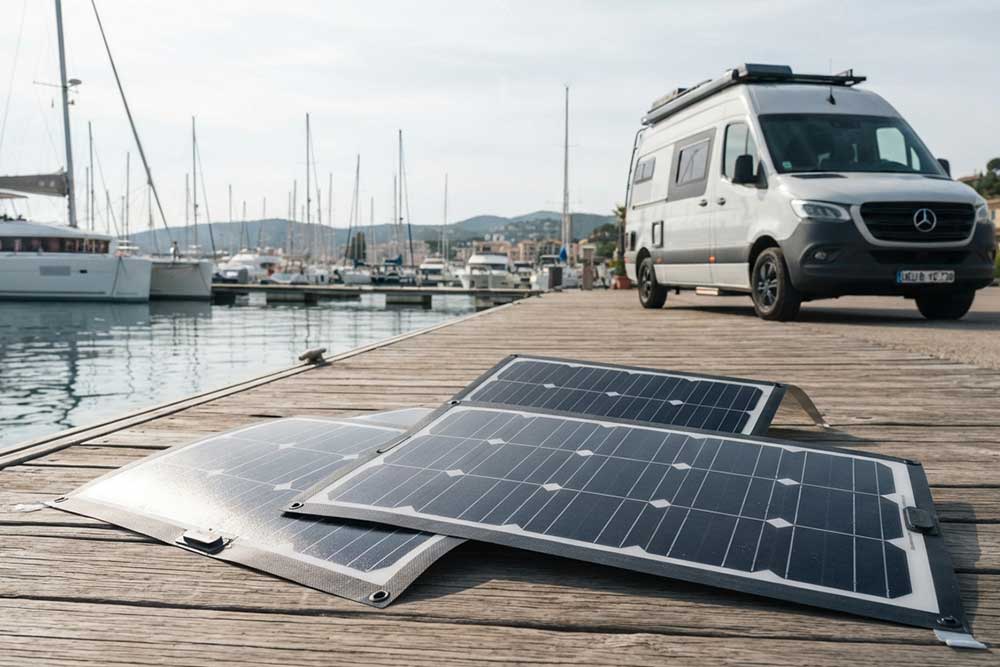
Typical rigid 350W panels are substantially larger than many older residential modules, while flexible versions can use a very different construction.
Before buying, check the manufacturer’s actual:
- Length
- Width
- Thickness
- Weight
- Cell configuration
- Junction-box position
- Cable length
- Mounting-hole pattern
- Bending limitation, if flexible
- Maximum operating voltage
- Open-circuit voltage
- Maximum-power current
- Maximum-power voltage
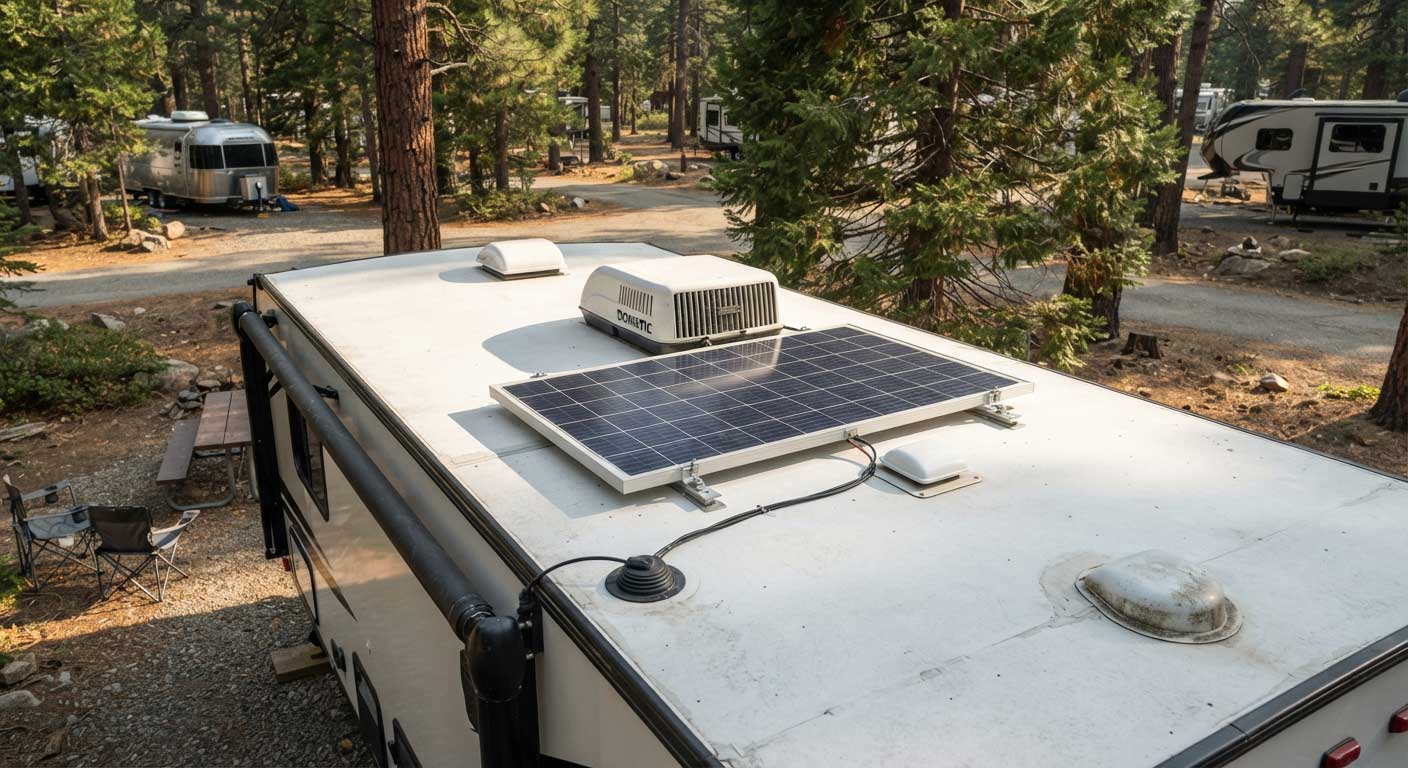
For an RV, dimensions are not a minor specification.
A panel can technically fit on the roof but still block an air conditioner, vent, skylight or service hatch.
I have found that a cardboard or foam-board template is one of the simplest tools for avoiding this problem. Cut the template to the panel’s actual dimensions, place it on the roof, and walk around the vehicle.
You see problems immediately.
350 Watt Solar Panel for RV Applications
A 350 watt solar panel for RV applications can be a useful middle ground.
It is more substantial than a small 100W or 200W setup, but it does not require the roof area of a large multi-panel array.
For an RV, typical electrical loads might include:
- Compressor refrigerator
- LED lights
- Ventilation fan
- Water pump
- Phone charging
- Laptop
- Internet equipment
- Small DC appliances
- Occasional inverter loads
The refrigerator deserves particular attention.
A refrigerator’s rated wattage is not the same as its daily energy consumption. Compressors cycle on and off. Weather changes cabinet temperature. Opening the door frequently changes demand.
The same applies to a fan.
A 40W fan running for 2 hours consumes approximately:
40W × 2h = 80Wh
A 40W fan running for 10 hours consumes:
40W × 10h = 400Wh
The appliance wattage did not change.
The operating time did.
That is why I recommend calculating the RV’s daily Wh consumption before selecting the panel count.
How Many 350 Watt Solar Panels Do You Need?
The basic calculation is:
Required solar capacity = Daily energy demand ÷ peak sun hours ÷ estimated system efficiency
Suppose an RV consumes approximately 1,200Wh per day.
Assume five equivalent peak-sun-hours and an illustrative 80% overall system factor:
1,200Wh ÷ 5 ÷ 0.80 = 300W
A single 350W panel would be above that simplified requirement.
But I would not stop there.
Winter conditions, cloudy days, roof shading and battery charging requirements can push the actual requirement higher.
For that reason, a practical design might use:
| Daily energy use | Approximate PV starting point* |
|---|---|
| 500Wh/day | 200–350W |
| 1,000Wh/day | 300–500W |
| 1,500Wh/day | 500–700W |
| 2,000Wh/day | 700–1,000W |
| 3,000Wh/day | 1,000W+ |
*Planning ranges only. Actual sizing depends on location, season, shading, battery strategy and system losses.
There is no magic ratio between panel watts and daily energy consumption.
350W Solar Panel and Battery Sizing
The battery and solar array perform different jobs.
The solar panels generate energy.
The battery stores energy.
A 350W array might theoretically produce 1.75kWh under five equivalent peak-sun-hours. That does not mean you need a 1.75kWh battery, nor does it mean a 1.75kWh battery will necessarily be fully charged every day.
For example, consider a 12V 200Ah battery:
12V × 200Ah = 2,400Wh nominal energy
That is a nominal figure, not necessarily the amount of energy you should routinely use.
Battery chemistry, allowable depth of discharge, temperature, inverter efficiency and manufacturer recommendations all matter.
For an off-grid installation, I prefer to size the battery around the load profile and desired autonomy, then size the PV array around the amount of energy required to replenish the battery.
This avoids a common mistake: installing a large battery with insufficient solar capacity and then wondering why it rarely reaches a full state of charge.
350 Watt Solar Panel Wiring: Series or Parallel?
When multiple 350W panels are used, the wiring arrangement becomes important.
Series connection
Connecting panels in series increases voltage while the current remains approximately that of the string.
For two nominally identical 350W modules:
350W + 350W = 700W
The string voltage increases, which can be useful for reducing current on the PV side and improving compatibility with some MPPT controllers.
But the controller’s maximum PV voltage must be checked carefully.
Parallel connection
Parallel wiring keeps voltage approximately similar while increasing current.
Again, two 350W panels provide a nominal:
700W array
But the PV current is higher.
This affects:
- Cable sizing
- Fuse selection
- Combiner requirements
- Controller current rating
- Connector selection
Series-parallel
For larger systems, a combination can make sense.
For example, four 350W panels produce:
4 × 350W = 1,400W
A 2S2P configuration gives two panels in series per string, with two strings connected in parallel.
The actual electrical design must be based on the module datasheet and controller specifications—not simply the total wattage.
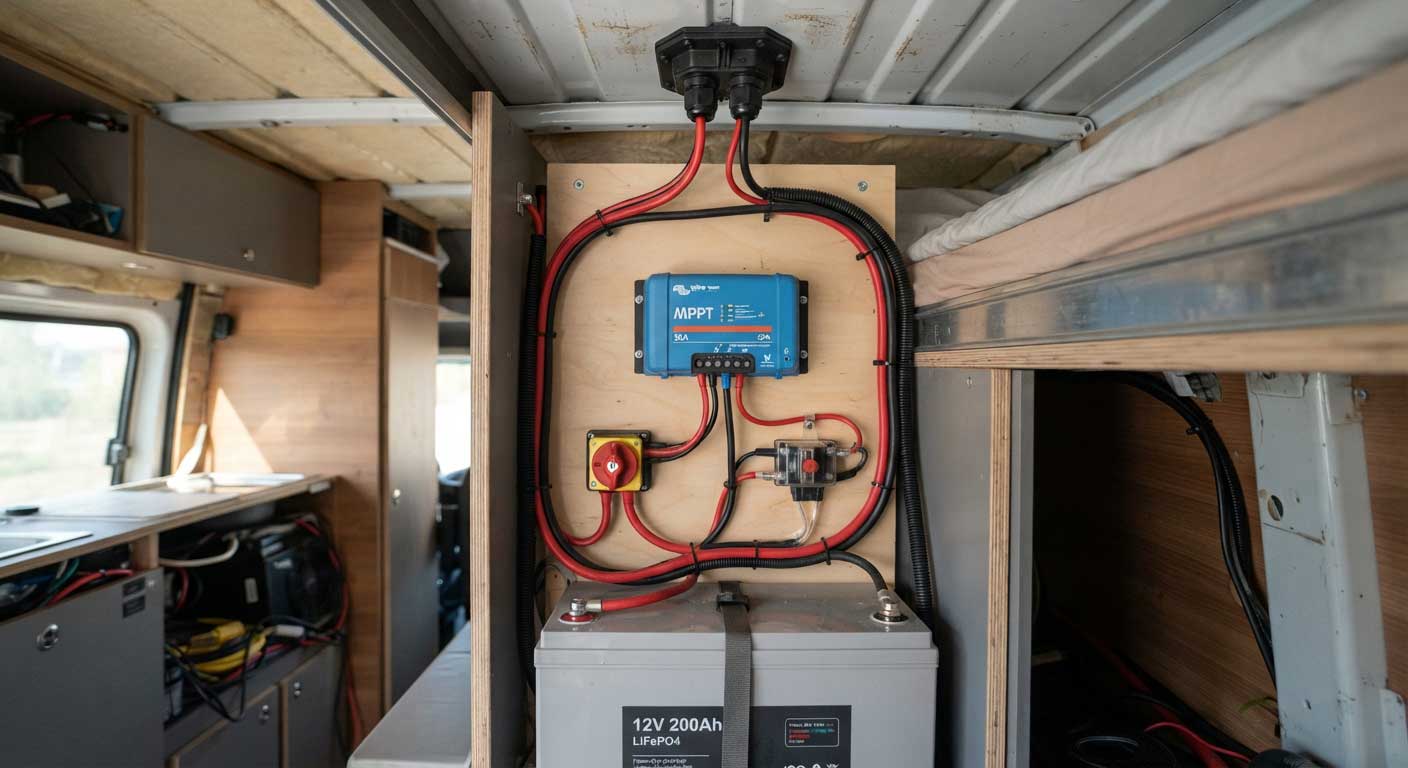
Choosing an MPPT Charge Controller for 350W Panels
An MPPT controller is often the more flexible choice when PV voltage is substantially higher than battery voltage.
A simple current estimate for a 350W array on a 12V battery might look like:
350W ÷ 12V ≈ 29.2A
That does not mean “buy a 30A controller” without further checking.
The controller also needs sufficient PV input voltage capacity and appropriate current headroom. Actual charging voltage is higher than nominal 12V battery voltage, and controller conversion efficiency matters.
For multiple panels, calculate the expected maximum PV voltage and current.
Cold-weather open-circuit voltage deserves special attention because PV voltage rises as cell temperature falls. A string that appears acceptable on a hot summer day can have a substantially higher Voc on a cold morning.
How to Install 350 Watt Solar Panels
The installation should be planned before the first hole is drilled.
1. Measure the roof
Record the usable area rather than the total roof area.
Leave room for:
- Roof vents
- HVAC equipment
- Skylights
- Antennas
- Service access
- Roof drainage
- Maintenance clearance
2. Make a physical template
Use cardboard to reproduce the actual panel footprint.
Place it where the module will go.
Check the position from ground level as well as from the roof.
3. Observe shade
Do not inspect the roof only at noon.
Morning and afternoon shadows can cross the module at very different angles.
A chimney, tree branch or roof-mounted accessory can become a recurring source of production loss.
4. Plan cable entry
Keep cable runs short and protected.
Avoid areas where cables can rub against sharp metal edges or remain exposed to mechanical movement.
5. Verify electrical specifications
Before connecting anything, check:
- Voc
- Vmp
- Isc
- Imp
- Maximum system voltage
- Controller PV voltage limit
- Controller current limit
- Battery voltage
- Fuse/disconnect requirements
6. Install the panel
Rigid modules typically use mechanical mounting hardware.
Flexible modules require greater attention to the mounting surface, bonding method, thermal conditions and manufacturer’s installation limitations.
7. Commission the system
Check polarity before connecting the PV circuit.
Measure voltage.
Verify the controller configuration.
Then monitor production under real conditions.
That first week of data can reveal more than a product brochure.
350W Rigid vs Flexible Solar Panels
For a 350W module, the rigid-versus-flexible decision should be based on the installation, not fashion.
| Factor | Rigid 350W panel | Flexible 350W panel |
|---|---|---|
| Weight | Usually higher | Usually lower |
| Profile | Higher | Low-profile |
| Curved roof | Limited | Better suited |
| Mechanical mounting | Common | Installation-specific |
| Ventilation beneath module | Easier | Can be more limited |
| RV applications | Very common | Useful for weight-sensitive installations |
| Maintenance | Generally straightforward | Installation quality is critical |
Flexible PV modules also need to be evaluated against appropriate product standards and manufacturer specifications.
IEC 61215-1:2021 covers design qualification and type approval for terrestrial PV modules and includes test methods for flexible modules, including a bending test.
That does not mean an IEC qualification predicts a specific service life. IEC explicitly states that qualification results should not be interpreted as a quantitative prediction of module lifetime.
That distinction is worth keeping on a product page.
A Realistic 350W Solar Panel Case Example
Consider a small travel trailer used by two people for weekend and occasional week-long trips.
Their estimated daily consumption is:
| Load | Daily energy |
|---|---|
| Refrigerator | 650Wh |
| LED lighting | 100Wh |
| Ventilation | 120Wh |
| Phones/tablets | 80Wh |
| Laptop | 120Wh |
| Water pump | 50Wh |
| Total | 1,120Wh/day |
The roof has enough space for one 350W panel.
Using a simplified five-hour solar-resource assumption:
350W × 5h = 1,750Wh/day theoretical PV energy
At first glance, that appears comfortably above the 1,120Wh daily load.
But then reality enters.
The trailer is parked under partial afternoon tree shade. The refrigerator consumes more energy during hot weather. The roof becomes hot. Some energy is lost during conversion and battery charging.
The owner can still have a workable system, but the margin is much smaller than the raw 1.75kWh calculation suggests.
If the trailer is regularly used in winter or cloudy regions, increasing the PV capacity may be more useful than simply installing a larger battery.
This is the part of solar sizing that generic “watts per day” calculators often miss.

How to Improve 350 Watt Solar Panel Performance
If the output looks lower than expected, don’t immediately assume the panel is defective.
Check the installation in this order:
- Look for shading
- Check the panel surface for heavy soiling
- Check connectors
- Measure PV voltage
- Check cable routing and resistance
- Review controller settings
- Check battery state of charge
- Compare production against weather conditions
- Compare measured results with a location-specific model
NREL’s modeling approach is useful here because PVWatts can evaluate different array configurations, orientations and system-loss assumptions rather than treating every 350W module as operating identically.
One practical detail I pay attention to is the difference between panel output and energy reaching the battery.
A controller may report 280W from the PV array while the battery system receives a different instantaneous power level because the operating voltages differ.
Likewise, an inverter can turn DC energy into AC energy with additional conversion losses.
Those numbers should not be mixed together.
Is 350W a Good Solar Panel Size?
For many small and medium off-grid applications, yes.
A 350W module offers enough capacity to be useful on an RV or cabin without immediately requiring a large array. It can also be combined with additional panels when the electrical system is designed for expansion.
The important question is not whether 350W is universally “better.”
It is whether 350W fits the physical and electrical constraints of the project.
For an RV, roof space and weight may dominate.
For a cabin, annual energy demand and winter production may dominate.
For a marine installation, saltwater exposure, mounting and surface conditions can become more important.
For a backup system, battery capacity and inverter demand may matter more than daily solar yield.
A module’s wattage is the starting point.
The installation determines what that wattage is actually worth.
FAQ About 350 Watt Solar Panels
How much power does a 350 watt solar panel produce?
A 350W solar panel is rated to produce up to 350W of DC power under Standard Test Conditions. Actual output varies with irradiance, temperature, shading, orientation and system losses.
How much energy does a 350W solar panel produce per day?
At five equivalent peak-sun-hours, a 350W panel produces a theoretical 1.75kWh per day before losses. Actual daily production depends on the installation location and operating conditions.
Is a 350 watt solar panel good for an RV?
Yes. A 350 watt solar panel can be suitable for an RV running moderate loads such as refrigeration, lighting, fans, electronics and battery charging, provided the daily energy demand is properly calculated.
Can I connect two 350W solar panels together?
Yes. Two 350W panels provide a nominal 700W array. They can be wired in series or parallel, but the resulting voltage and current must remain within the charge controller and system limits.
What size battery do I need for a 350W solar panel?
There is no single required battery size. Battery capacity should be based on daily energy consumption, desired backup duration, battery chemistry, allowable depth of discharge and system efficiency.
What charge controller do I need for a 350W solar panel?
The controller must be compatible with the panel’s maximum PV voltage and current as well as the battery voltage. An MPPT controller is often useful for systems where the PV operating voltage is substantially higher than battery voltage.
Are flexible 350W solar panels reliable?
Flexible panels can be appropriate for applications where weight, profile or curved mounting surfaces matter. The module construction, installation method, thermal conditions and applicable qualification requirements should all be checked. IEC 61215-1:2021 includes specific testing methods for flexible PV modules.
Bright Solar’s Approach to 350 Watt Solar Panels
At Bright Solar, we don’t treat 350 watt solar panels as a standalone specification.
The better question is what the panel needs to do after it leaves the factory.
An RV panel needs to survive movement, weather and roof constraints. A cabin installation has a different problem: energy production over changing seasons. A flexible module may solve a weight or curvature problem but create different thermal and mounting considerations.
That is why our evaluation starts with the application.
For a new project, collect these numbers first:
- Daily energy consumption in Wh
- Battery voltage
- Battery capacity
- Available roof area
- Expected installation location
- Shading conditions
- Required autonomy
- Charge-controller PV limits
- Desired future expansion
Then evaluate the module.
This order prevents one of the most common mistakes in solar design: choosing a panel first and trying to force the rest of the system around it.
NREL recommends location-specific modeling because PV production depends on solar resource, system configuration and losses rather than nameplate capacity alone.
For customers comparing rigid and flexible solutions, Bright Solar can also evaluate the mechanical constraints alongside the electrical requirements.
A 350W panel should not merely look good on a datasheet.
It should make sense on the roof, inside the wiring diagram, next to the battery, and six months after installation.
Related recommendations
-

China Flexible Solar Panel: Manufacturer Guide for Global Buyers
144A China flexible solar panel is a lightweight photovoltaic module designed for applications where rigid panels may be difficult to install. Buyers should ver...
View details -
How to Connect Solar Panels to Charge Controller: Complete Wiring Guide
288Learn how to connect solar panels to charge controller with step-by-step wiring instructions, safety tips, MPPT and PWM setup guidance for efficient solar systems.
View details -
solar panel wiring guide (Field Installation Manual from Bright Solar)
217solar panel wiring guide explained with real installation steps, safety standards, wiring diagrams, and field-tested methods for off-grid and RV solar systems.
View details -
Flexible CIGS Solar Panel: Efficiency, Uses and Buying Guide
82A flexible CIGS solar panel uses thin-film copper indium gallium diselenide technology to create lightweight, bendable modules for curved and space-constrain...
View details