Most Powerful Solar Panel: How to Choose the Highest Output Solar Solution
The most powerful solar panel is not simply the one with the highest watt rating. It is the panel that delivers the best combination of power output, efficiency, durability, and real-world performance for your specific application.
When customers ask us which solar panel is “the most powerful,” they usually expect one simple number. After years working with flexible solar solutions, RV systems, marine applications, and off-grid projects at Bright Solar, I found the answer is more complicated.
A 700W panel may produce less usable energy than a smaller, higher-efficiency module if installation conditions are poor. Roof space, temperature, shading, weight limitations, and battery systems all influence actual performance.
This guide explains how to evaluate the most powerful solar panel technology, what specifications actually matter, and how to select the right high-output solar panel for real projects.
What Makes a Solar Panel the Most Powerful?
The power of a solar panel is usually measured by wattage (W), but wattage alone does not tell the complete story.
A powerful solar panel depends on several technical factors:
- Rated power output
- Solar conversion efficiency
- Cell technology
- Temperature performance
- Size-to-power ratio
- Durability in harsh environments
- Energy production over time
For example:
A traditional 550W rigid solar panel may have a large surface area, while a premium flexible solar panel with lower wattage may provide better installation flexibility where space and weight are limited.Visit product page:Flexible Solar Panels
In practical installations, the “most powerful” panel is the one that produces the highest usable energy from the available space.
Solar Panel Wattage vs Efficiency: Which One Matters More?
Understanding Solar Panel Watt Ratings
Solar panel wattage represents the maximum electrical output under standard test conditions.
Common residential and commercial panel ratings include:
| Solar Panel Type | Typical Power Output |
|---|---|
| Portable solar panel | 50W–200W |
| RV solar panel | 100W–400W |
| Residential panel | 350W–450W |
| Commercial panel | 500W–700W |
| Utility-scale modules | 600W+ |
Higher wattage means more electricity generation potential, but only if the panel size and installation conditions support it.
Why Efficiency Defines True Solar Power
Solar efficiency measures how much sunlight is converted into usable electricity.
For example:
- Panel A:
- 400W output
- Smaller size
- 23% efficiency
- Panel B:
- 450W output
- Larger size
- 20% efficiency
If the installation area is limited, Panel A may actually be the better choice.
According to the National Renewable Energy Laboratory (NREL), solar cell technology continues improving through advanced designs such as tandem and multi-junction cells. NREL research has demonstrated laboratory solar cells exceeding 40% efficiency under specialized conditions, showing the future potential of high-efficiency photovoltaic technology.
Source: https://www.nrel.gov/pv/
For commercial products available today, crystalline silicon modules generally operate at much lower efficiency levels, but improvements in TOPCon, HJT, and tandem technologies continue pushing practical limits.
The Most Powerful Solar Panel Technologies Available Today
Monocrystalline Solar Panels
Monocrystalline panels are currently among the most widely used high-performance solar technologies.
Advantages:
- High efficiency
- Long lifespan
- Strong outdoor performance
- Better power output per square meter
Most premium high-wattage panels use advanced monocrystalline cells.
Bright Solar uses high-quality mono solar cells in flexible solar products because they provide a balance between energy output and lightweight design.
TOPCon Solar Panels
TOPCon (Tunnel Oxide Passivated Contact) technology improves electron movement inside solar cells.
Benefits:
- Higher conversion efficiency
- Better low-light performance
- Reduced energy losses
Modern high-power modules increasingly use TOPCon technology because manufacturers can achieve higher output without dramatically increasing panel size.
Heterojunction (HJT) Solar Panels
HJT combines crystalline silicon with thin-film layers.
Key advantages:
- Excellent temperature coefficient
- High efficiency potential
- Strong performance in hot climates
For locations with extreme heat, temperature performance can significantly affect annual energy production.
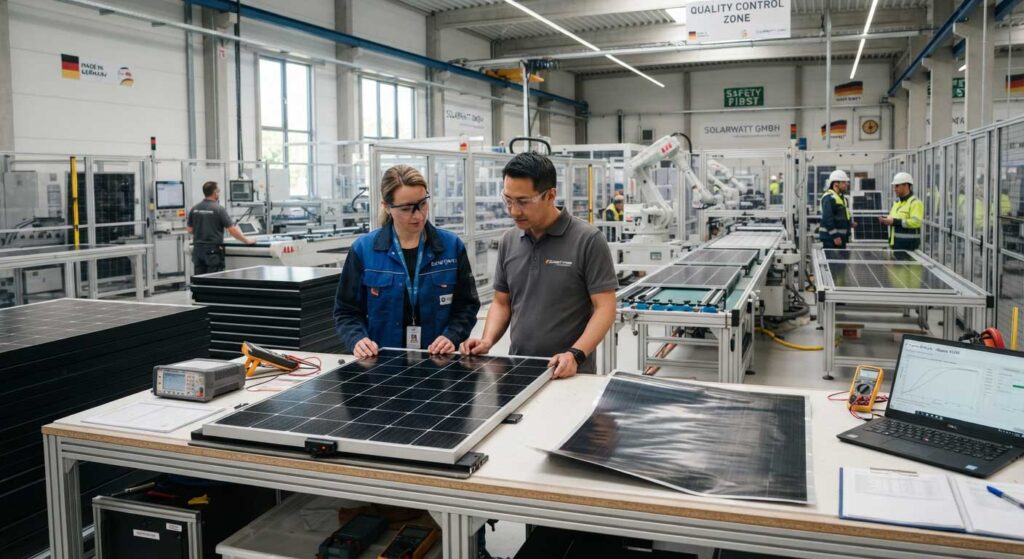
How to Identify the Most Powerful Solar Panel for Your Application
The best solar panel depends on where it will be installed.
A utility project has completely different requirements from an RV or marine system.
Most Powerful Solar Panels for Off-Grid Systems
Off-grid applications require reliable energy production.
Important factors:
- Maximum daily energy generation
- Battery compatibility
- Weather resistance
- Long-term reliability
A high-power off-grid system usually combines:
- High-efficiency solar panels
- MPPT charge controller
- Lithium battery storage
- Proper system sizing
A common mistake we see is choosing the biggest panel without calculating energy demand first.
A customer may install a large solar array but still experience power shortages because the battery capacity and inverter are not matched.
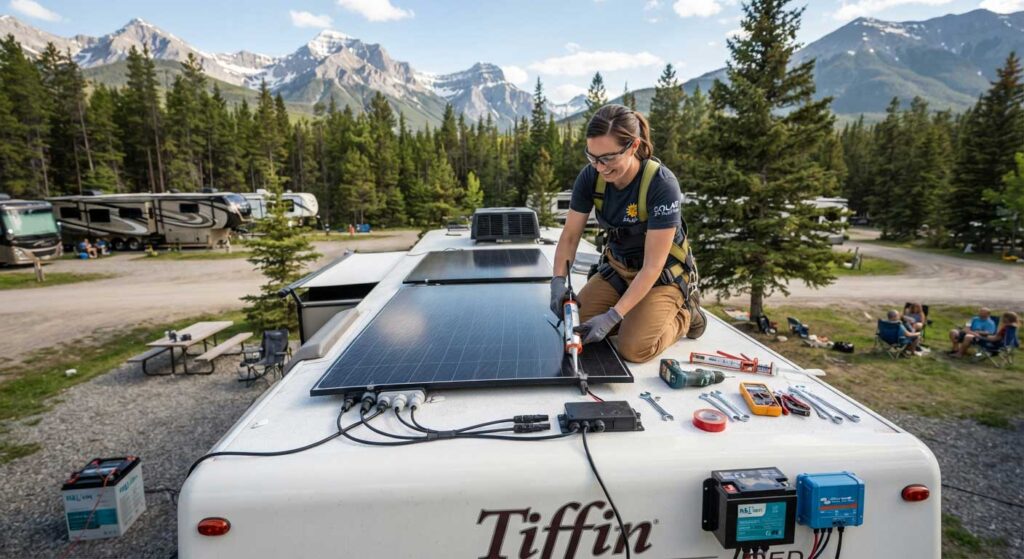
Most Powerful Solar Panels for RV Applications
RV owners often have limited roof space.
For recreational vehicles, important features include:
- Lightweight construction
- Flexible installation
- Vibration resistance
- High power density
A 400W flexible solar panel can sometimes outperform multiple smaller panels because it simplifies installation and reduces wiring complexity.
Bright Solar flexible panels are designed for applications where traditional rigid panels are difficult to install, including:
- RV roofs
- Camper vans
- Boats
- Portable energy systems
Most Powerful Solar Panels for Marine Use
Marine environments create additional challenges:
- Saltwater exposure
- Strong UV radiation
- Limited installation space
- Constant vibration
Marine solar panels require:
- Waterproof construction
- Corrosion resistance
- Lightweight design
For boats, the strongest solution is not always the highest watt panel.
A durable 200W–400W marine solar panel that survives years of exposure can provide more lifetime energy than a higher-output panel that fails early.
Real Project Example: Choosing a High Power Solar System
During one Bright Solar flexible panel application review, a customer was upgrading a small off-grid camper used throughout the western United States.
The original setup:
- Two 100W portable panels
- Limited charging speed
- Frequent generator use
The owner wanted:
- More energy
- Less equipment
- Better roof utilization
The upgraded system:
| Component | Specification |
|---|---|
| Solar panels | 400W flexible solar panels |
| Battery | 200Ah LiFePO4 |
| Controller | MPPT |
| Application | Off-grid camping |
After testing:
- Charging time improved significantly during sunny conditions
- Generator dependency decreased
- Installation weight was reduced
The biggest improvement was not simply adding more watts.
It was improving the energy collected from limited space.
How to Compare the Most Powerful Solar Panel Specifications
Choosing a high-output solar panel requires looking beyond the marketing number printed on the label.
When reviewing solar panels for commercial, RV, marine, or off-grid projects, I usually compare five specifications first:
- Maximum power output (W)
- Solar efficiency (%)
- Temperature coefficient
- Weight and installation limitations
- Expected lifetime performance
A panel that performs well in a factory test but loses significant output in real outdoor conditions may not be the best choice.
Maximum Power Output (Watts)
Wattage remains one of the fastest ways to compare solar panels.
For example:
| Panel Rating | Typical Application |
|---|---|
| 100W–200W | Portable systems, small RVs |
| 300W–400W | RV, marine, cabins |
| 450W–550W | Residential systems |
| 600W+ | Commercial and utility applications |
However, higher wattage usually means a physically larger panel.
For rooftop applications, available installation space often determines the best option.
A customer with a small camper roof may gain more value from a compact 400W flexible solar panel than a large 600W rigid module that cannot physically fit.
Temperature Performance Matters in Real Conditions
Solar panels rarely operate under perfect laboratory conditions.
Real installations experience:
- Summer heat
- Dust
- Wind
- Partial shade
- Changing sunlight angles
Solar panel output decreases as temperature increases.
The temperature coefficient indicates how much performance drops when the panel gets hotter.
For example:
A panel installed on a dark RV roof in Arizona may experience much higher temperatures than a ground-mounted system in a cooler climate.
This is why advanced solar designs focus not only on peak wattage but also on maintaining output during challenging conditions.
Most Powerful Solar Panel Installation Tips for Maximum Energy Output
Even the highest-rated solar panel cannot perform well with poor installation.
From reviewing solar installations, several mistakes appear repeatedly.
Install Panels Where Sun Exposure Is Maximized
Solar production depends heavily on sunlight availability.
Before installation:
- Check roof shadows
- Observe nearby trees
- Consider antennas and vents
- Track sunlight throughout the day
A small shaded area can reduce total system output, especially when panels are connected incorrectly.
Use Proper Wiring and Components
A powerful solar panel system requires matching components.
Important parts include:
- Correct wire size
- Suitable connectors
- Proper charge controller
- Compatible battery voltage
Example:
A 400W solar system connected with undersized cables may lose energy before it reaches the battery.
The solar panel is only one part of the complete energy system.
Keep Panels Clean and Maintained
Dust, bird droppings, salt deposits, and debris reduce sunlight reaching the solar cells.
According to the U.S. Department of Energy, photovoltaic system performance depends on factors including solar resource availability, system design, and operation conditions.
Source:
https://www.energy.gov/eere/solar/solar-photovoltaic-technology-basics
For marine and desert environments, maintenance becomes even more important.
A quick inspection every few months can help identify:
- Loose connections
- Surface contamination
- Cable damage
- Seal problems
Most Powerful Solar Panel vs Most Efficient Solar Panel
These two terms are often confused.
They are related but different.
| Feature | Most Powerful Panel | Most Efficient Panel |
|---|---|---|
| Focus | Highest watt output | Highest energy conversion |
| Main Measurement | Watts | Efficiency percentage |
| Best For | Large available space | Limited installation area |
| Example | Large commercial panels | Compact premium modules |
A commercial solar farm may prioritize the highest watt panel.
An RV owner may prioritize efficiency and lightweight design.
The correct choice depends on the project.
FAQ About the Most Powerful Solar Panel
What is the most powerful solar panel available today?
The most powerful commercial solar panels currently exceed 700W, mainly designed for utility-scale installations. For residential and mobile applications, 400W–550W panels are commonly used because of size and installation limitations.
Does a higher watt solar panel always produce more electricity?
Not always. Actual energy production depends on sunlight conditions, panel efficiency, temperature, installation angle, and system design.
What is the most efficient solar panel technology?
Modern high-efficiency technologies include TOPCon, HJT, and tandem solar cells. Commercial efficiency continues improving as manufacturers develop new photovoltaic designs.
Are flexible solar panels less powerful than rigid panels?
Flexible solar panels usually have lower maximum watt ratings because of their lightweight design, but they provide advantages in applications where weight, shape, and installation flexibility matter.
What size solar panel is best for off-grid living?
The ideal size depends on electricity usage. Many off-grid systems use several hundred watts to several kilowatts of solar capacity combined with battery storage.
How long does a powerful solar panel last?
Quality solar panels are designed for long-term outdoor operation. Many manufacturers provide performance warranties around 20–25 years depending on technology and product design.
Authority & Reference Sources
National Renewable Energy Laboratory (NREL)
NREL conducts photovoltaic research covering solar cell efficiency, reliability, performance testing, and future solar technologies.
U.S. Department of Energy Solar Energy Technologies Office
https://www.energy.gov/eere/solar
The U.S. Department of Energy provides technical information about photovoltaic technology, solar performance factors, and renewable energy development.
International Energy Agency (IEA) Solar PV Analysis
https://www.iea.org/energy-system/renewables/solar-pv
The IEA publishes global solar photovoltaic market analysis, technology development trends, and renewable energy data.
Conclusion: Choosing the Most Powerful Solar Panel Means Choosing the Right Performance
The most powerful solar panel is not simply the panel with the largest watt number.
A truly powerful solar solution combines:
- High energy output
- Strong efficiency
- Reliable construction
- Suitable installation design
- Long-term outdoor performance
For RV owners, marine users, and off-grid applications, the best solar panel is the one that delivers dependable electricity where traditional power sources are unavailable.
At Bright Solar, we develop flexible solar solutions designed for real-world environments where weight, space, and durability matter.
A powerful solar system is not measured only by watts.
It is measured by how much reliable energy it delivers every day.
Related recommendations
-

Solar Panels for Mobile Homes: A Practical Guide Based on Real Installations
176Discover how solar panels for mobile homes reduce electricity costs, improve energy independence, and deliver long-term savings. Learn sizing, costs, installation tips, and real project insights.
View details -
Clear Flexible Solar Panels: Benefits, Uses and Buying Guide
102Clear flexible solar panels combine photovoltaic electricity generation with light transmission for selected architectural, vehicle, canopy, and specialized ...
View details -
Solar Powered Battery Charger for Boat: Complete Marine Guide
177A solar powered battery charger for boat use combines solar panels, a matched charge controller, battery storage, marine-grade wiring, and protection to rech...
View details -
Motorhome Solar Kit: Reliable Off-Grid Power for Modern RV Travel
104Compare series vs parallel solar panels for RVs, homes, and off-grid systems. Bright Solar explains voltage, current, shading, and wiring efficiency.
View details