Solar Panels for Van Life: Complete Solar Power Guide
Direct Answer :
Solar panels for van life provide electricity for lights, refrigerators, fans, laptops, phones, and other off-grid essentials by charging a battery bank during daylight. A practical system combines properly sized solar panels, a charge controller, batteries, and an inverter, with capacity determined by your daily energy use and travel conditions.
Why Solar Panels for Van Life Make Sense
Van life changes the way electricity is used.
In a house, you plug into the wall without thinking about where the electricity comes from. Inside a camper van, every watt-hour matters. A refrigerator running overnight, a laptop charging in the afternoon, a roof fan running while you sleep, and a water pump switching on several times a day can quietly add up.
That is where solar becomes useful.
The U.S. Department of Energy explains that photovoltaic cells convert sunlight into electricity, while the amount of solar energy available varies with location, season, time of day, weather, and landscape.
That last part is especially important for van travelers.
A 400W solar array parked under trees in Oregon is not the same system, in practical terms, as a 400W array sitting in full sun in Arizona.
I have worked with flexible solar applications at Bright Solar, and one pattern appears repeatedly: customers tend to begin by asking how many watts they can fit on the roof. I usually reverse the conversation.
First, what do you actually run?
Then, how long do you run it?
Only after that do we decide how much solar belongs on the roof.
How a Van Life Solar System Works
The basic energy path is straightforward:
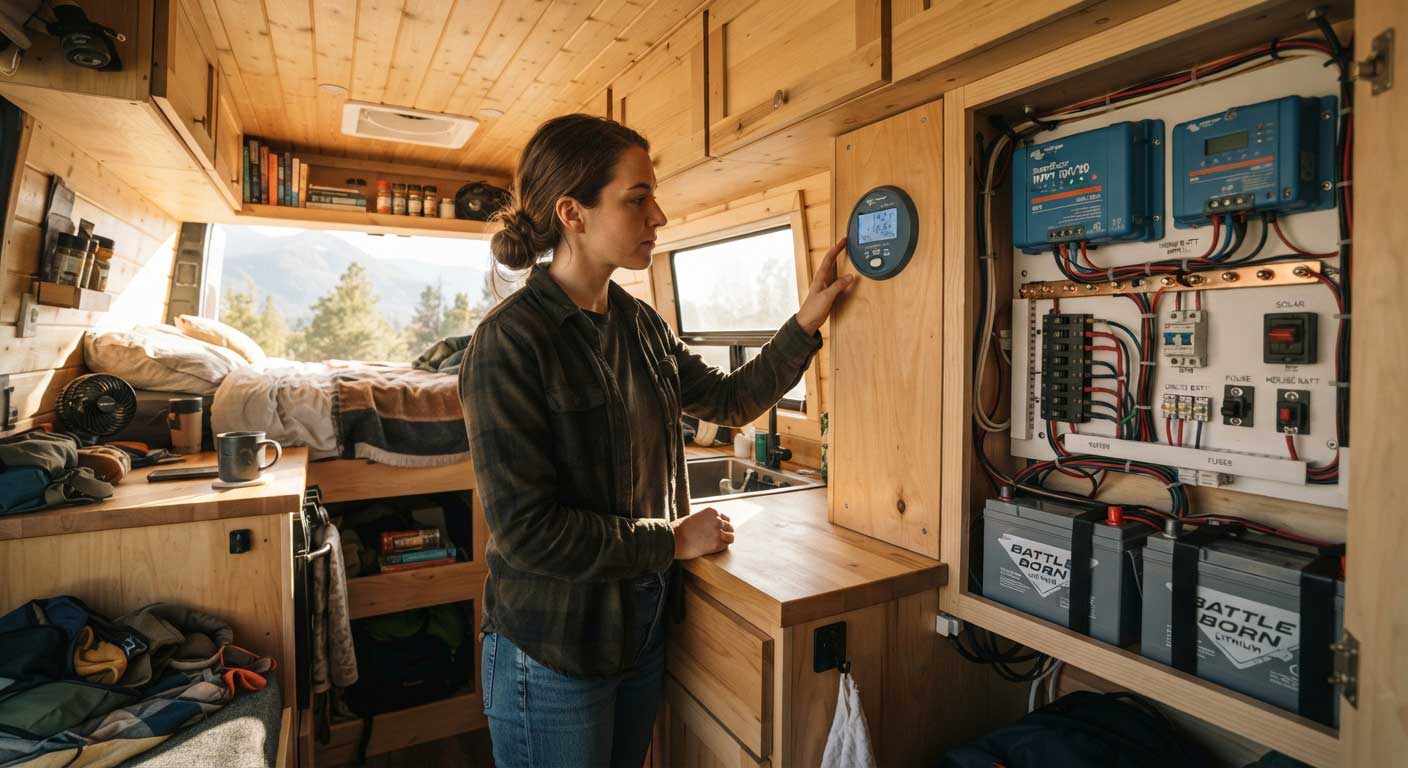
Sunlight → Solar Panels → Charge Controller → Battery → Appliances
The solar panel produces DC electricity.
The charge controller regulates the electricity going into the battery.
The battery stores energy for periods when solar production is low or unavailable.
An inverter is used when you need AC electricity for equipment that cannot operate directly from your van’s DC system.
The U.S. Department of Energy describes batteries as an important part of solar systems because stored energy can be used when sunlight is unavailable.
A typical van solar system therefore includes:
| Component | Main Function |
|---|---|
| Solar panels | Generate electricity |
| MPPT charge controller | Optimize solar charging |
| Battery | Store energy |
| Inverter | Convert DC to AC |
| Fuse/breaker | Electrical protection |
| Wiring | Connect system components |
| Monitoring device | Track voltage and energy |
There is no reason to make the system complicated if your electrical needs are modest.
A van with a 12V refrigerator, LED lights, phones, and a roof fan does not need the same electrical architecture as a van with an induction cooktop, workstation, air conditioner, and high-powered appliances.
How Much Solar Power Do You Need for Van Life?
Start with your appliances, not the panels.
A simple calculation is:
Daily Energy Consumption = Power × Hours of Use
For example:
| Device | Approx. Power | Daily Use | Daily Energy |
|---|---|---|---|
| 12V refrigerator | 45W average* | 10 hours | 450Wh |
| Roof fan | 30W | 5 hours | 150Wh |
| LED lights | 15W | 4 hours | 60Wh |
| Laptop | 60W | 3 hours | 180Wh |
| Phone charging | 10W | 3 hours | 30Wh |
Estimated total: 870Wh/day
*Actual refrigerator consumption varies because compressors cycle rather than running continuously.
That example gives you a much better starting point than simply saying, “I want 400W of solar.”
For many van conversions, a rough planning range looks like this:
| Solar Capacity | Typical Van-Life Application |
|---|---|
| 100–200W | Basic electronics, lights, small loads |
| 300–400W | Refrigerator, fan, laptop, lighting |
| 500–600W | Full-time van life with moderate electrical demand |
| 700W+ | Higher consumption and larger battery systems |
These are planning ranges, not universal specifications.
A van parked for several days without driving needs more solar and storage than a vehicle that drives every morning and can supplement its battery through the alternator.
Why Roof Space Matters More Than People Expect
Van roofs look large from the ground.
They are not.
Once you account for:
- Roof vents
- Skylights
- Air conditioners
- Antennas
- Roof racks
- Fans
- Awning hardware
- Satellite equipment
the usable solar area can shrink quickly.
I have seen layouts where the customer originally expected to install four large modules, only to discover that the roof hardware left room for two full-size panels and one narrow section.
This is one reason flexible solar panels can be useful in van conversions.
They can be produced in different dimensions and can be integrated into spaces where a conventional rigid module may be difficult to mount.
NREL also identifies lightweight, flexible thin-film PV as useful where portability or ruggedness is important.
Flexible Solar Panels for Vans vs Rigid Panels
Both technologies can work.
The better choice depends on the vehicle.
Rigid Solar Panels
Rigid panels have several advantages:
- High power density
- Strong mechanical structure
- Established installation methods
- Wide product availability
They are particularly useful when a van has a flat, strong roof and enough clearance for mounting hardware.
But there is a trade-off.
Rigid panels generally require brackets or rails, which increase installation height.
For some van owners, that is perfectly acceptable.
For others, it is not.
Flexible Solar Panels
Flexible panels are attractive for van applications where weight, profile, and roof geometry matter.
Potential advantages include:
- Lightweight construction
- Low-profile installation
- Easier integration with curved surfaces
- Reduced mounting hardware
- More freedom in panel placement
At Bright Solar, our flexible solar panel development is focused heavily on mobile and space-constrained applications.
A van roof is not a miniature residential roof.
It moves.
It vibrates.
It gets hot.
It gets dirty.
And it spends a surprising amount of time parked underneath something.
The panel needs to be selected with those conditions in mind.

How Many Batteries Do You Need for Van Life?
Solar generation and battery storage solve different problems.
The panels produce energy during daylight.
The battery carries that energy into the evening and overnight.
The U.S. Department of Energy specifically notes that solar generation does not always coincide with when electricity is needed, which is why storage can extend the usefulness of solar power beyond daylight hours.
For a 12V van system, common battery capacities include:
| Battery Capacity | Approx. Nominal Energy |
|---|---|
| 100Ah | 1.28kWh at 12.8V |
| 200Ah | 2.56kWh at 12.8V |
| 300Ah | 3.84kWh at 12.8V |
| 400Ah | 5.12kWh at 12.8V |
These figures represent nominal stored energy, not necessarily the amount you should plan to consume.
Battery chemistry, usable depth of discharge, temperature, system losses, and manufacturer specifications all matter.
For a van using approximately 1kWh per day, a 200Ah LiFePO₄ battery provides considerably more flexibility than a 100Ah battery, particularly when several cloudy days are possible.
But there is another side to this.
Installing a huge battery bank without enough solar generation means you have created expensive storage with insufficient daily recharge.
MPPT Charge Controllers for Van Solar Systems
The charge controller sits between the solar array and battery.
For van systems, MPPT controllers are commonly selected because they can operate the solar array at an appropriate voltage and convert that energy efficiently for battery charging.
When choosing one, check:
- Maximum PV input voltage
- Maximum charging current
- Battery voltage
- Solar array wattage
- Manufacturer installation requirements
Do not choose a controller simply because it says “30A” or “40A.”
The PV voltage and current must fit the controller’s operating range.
This is one of those details that looks minor on a product sheet and becomes very important during installation.
Real-World Van Life Solar Example
Consider a converted Sprinter-style van used by a couple traveling through the western United States.
Their daily electrical loads might include:
- 12V refrigerator
- Two phones
- Two laptops
- LED lighting
- Roof fan
- Water pump
- Internet router
Their estimated daily consumption is around 1.5–2kWh.
They initially considered installing a 300W solar system because it physically fit the roof.
That looked reasonable on paper.
The problem appeared when they planned to stay at dispersed campsites for three or four days.
On a clear day, 300W could provide useful charging.
Under partial shade or during poor weather, however, the available solar energy could fall sharply. The DOE notes that solar radiation changes with weather, location, season, landscape, and time of day; thick clouds can substantially reduce direct solar radiation.
The better design was to use more roof area for solar generation and maintain sufficient battery storage.
The important lesson wasn’t “buy more panels.”
It was design for the worst realistic day rather than the best-looking day on a specification sheet.
What Appliances Can Solar Panels Power in a Van?
Solar panels can support a wide range of van-life equipment when the system is sized appropriately.
Lower-energy loads
- LED lights
- Phones
- Cameras
- Tablets
- Wi-Fi routers
- Small fans
Medium-energy loads
- 12V refrigerator
- Laptop
- Water pump
- Television
- Small DC appliances
High-energy loads
- Induction cooktop
- Microwave
- Hair dryer
- Electric heater
- Air conditioner
High-power appliances change the system dramatically.
For example, running a 1,500W appliance for one hour consumes approximately 1.5kWh before accounting for inverter and system losses.
That single appliance can consume more energy than an entire day’s worth of basic van-life electronics.
This is why I always recommend separating essential loads from comfort loads when designing a van solar system.
Van Solar Installation: What to Check Before Mounting Panels
Before installing solar panels, inspect the roof carefully.
Step 1: Map the Roof
Measure the usable area and mark:
- Roof vents
- Fans
- Air conditioners
- Roof racks
- Existing cable entries
Do not measure only the empty space you can see from ground level.
Get on the roof.
Measure it.
Make a layout.
Step 2: Identify Shading
Shading is particularly annoying on vans because the vehicle moves between different environments.
Check the expected parking locations:
- Forest campsites
- Urban streets
- Mountain valleys
- Buildings
- RV parks
A panel that looks perfect in a driveway may perform very differently under trees.
Step 3: Plan Cable Routing
Cable entry points should be:
- Waterproof
- Mechanically secure
- Protected from abrasion
- Away from sharp edges
A solar panel can last for years while a poorly protected cable can become the weak point much sooner.
Step 4: Match the Solar Array With the Battery
The solar array, charge controller, and battery should be designed together.
Avoid building the system one component at a time without checking electrical compatibility.

Solar Production Changes With Location and Season
This is where many online van-life solar calculations become misleading.
A panel’s rated wattage is not the same thing as its daily energy production.
A 400W panel does not simply produce 400W × 24 hours.
Solar generation depends on the available solar resource.
The DOE explains that solar radiation varies according to geographic location, season, time of day, local landscape, and weather.
Data source:https://www.energy.gov/cmei/systems/solar-radiation-basics
For van travelers crossing the United States, this can create large seasonal differences.
A system designed for summer travel in the Southwest may need a different energy strategy when the same van spends winter in the Pacific Northwest.
This is why experienced van owners often combine:
Solar + Battery + Alternator Charging + Energy Efficiency
The solar array handles daytime generation.
The battery handles storage.
The vehicle alternator can provide another charging source while driving.
The result is a more resilient mobile energy system.
Why Bright Solar Flexible Panels Fit Mobile Energy Applications
Bright Solar develops flexible solar panels for applications where conventional rigid modules can be difficult to integrate.
For van life, the relevant considerations are practical:
- Available roof dimensions
- Panel weight
- Surface characteristics
- Installation profile
- Outdoor exposure
- Required electrical output
The goal is not to cover every square inch of a van roof with solar cells.
Sometimes a smaller, carefully positioned panel array leaves enough room for ventilation and roof equipment while still producing the energy the owner actually needs.
That balance is where mobile solar design becomes interesting.
And it is also where a product datasheet stops being enough.
How Much Do Solar Panels for Van Life Cost?
The cost of a van solar system depends less on the panel itself than on the complete electrical architecture.
A useful system normally includes:
- Solar panels
- MPPT charge controller
- Battery
- Inverter
- Fuses and disconnects
- Wiring
- Mounting or bonding materials
- Monitoring equipment
For a small weekend van, the electrical system can remain relatively simple. A full-time conversion with a refrigerator, workstation, induction cooking, and climate-control equipment becomes a different project entirely.
A practical planning range looks like this:
| Van Solar System | Typical Configuration | Best Fit |
|---|---|---|
| 200–300W | Small battery + MPPT | Weekend travel |
| 400–600W | 200Ah-class lithium battery | Regular off-grid use |
| 600–800W | Larger battery + inverter | Full-time van life |
| 800W+ | Large battery bank + multiple charging sources | High-energy conversions |
These are planning ranges rather than fixed prices or universal system specifications.
The cost should be evaluated against actual electricity consumption. Spending more on panels while leaving the battery undersized does not solve the nighttime energy problem.
Van Life Solar Installation: A Practical Sequence
1. Measure the Roof Before Ordering Panels
Start with the roof, but do not start by buying panels.
Mark every obstruction:
- Roof fan
- Skylight
- Air conditioner
- Roof rack
- Antenna
- Satellite equipment
- Existing cable entry
Leave sufficient working space around equipment that may require future maintenance.
A drawing on paper is enough.
It is much cheaper than discovering that the final panel blocks the roof vent.
2. Decide Whether the Roof Should Use Flexible or Rigid Panels
A flat van roof with plenty of structural support may work well with rigid modules.
A curved roof or weight-sensitive conversion may benefit from flexible solar technology.
NREL specifically identifies transportation as an application where photovoltaic systems can provide auxiliary power, while lightweight and flexible PV can be valuable where weight, portability, and conformity to curved surfaces matter.
There is a trade-off, though.
Flexible panels should not be selected simply because they are thinner. The substrate, encapsulation, thermal behavior, mounting method, and long-term outdoor durability all deserve attention.
NREL research on flexible modules also highlights an important engineering issue: removing glass can reduce weight and enable new applications, but it changes how the module must be protected from environmental exposure.
That is a useful distinction when comparing products.
3. Plan the Electrical Architecture
A typical 12V van system may look like:
Solar Array → MPPT Controller → Battery → DC Loads / Inverter → AC Loads
Install appropriate overcurrent protection and disconnects according to the equipment manufacturer’s instructions and applicable electrical requirements.
Keep cable runs as short and direct as practical.
Long cable runs can increase voltage drop, especially on high-current battery circuits.
The battery-to-inverter wiring deserves particular attention because inverter loads can be substantially higher than ordinary lighting or USB circuits.
Solar Panels for Van Life: Why MPPT Matters
An MPPT charge controller is often a strong choice for a permanent van solar installation.
Instead of treating the panel voltage and battery voltage as identical, the controller continuously manages the operating point of the solar array and converts available power into an appropriate battery-charging output.
When selecting an MPPT controller, check:
- Maximum PV voltage
- Maximum PV current
- Maximum solar wattage
- Battery voltage
- Supported battery chemistry
- Temperature limits
- Manufacturer installation requirements
Do not size the controller from the battery amperage alone.
The solar array determines the controller’s PV-side requirements.
For example, a 600W solar array can produce substantially more charging current than a 200W array, so the controller needs sufficient capacity for the actual system.
Battery Sizing for an Off-Grid Van Solar System
The battery should be sized around the amount of energy you want available after sunset and during poor solar conditions.
For example, suppose a van consumes approximately:
1,500Wh per day
If the owner wants two days of energy autonomy, the storage requirement begins at:
1,500Wh × 2 = 3,000Wh
The usable battery capacity must then account for the battery chemistry and manufacturer’s recommended depth of discharge.
This is why a nominal battery rating should not be treated as completely usable energy.
A 12.8V 200Ah battery has approximately:
12.8V × 200Ah = 2,560Wh nominal
The usable energy will be lower depending on the battery specification and operating conditions.
For full-time van life, lithium iron phosphate (LiFePO₄) batteries are commonly considered because of their energy density, cycle characteristics, and usable capacity.
The exact battery choice should follow the manufacturer’s specifications and the complete system design.
Solar Alone Is Not Always Enough for Van Life
This is one of the more useful lessons from real mobile solar projects.
A van does not live under ideal sunlight.
You may park beneath trees.
You may spend three days in a rainy coastal town.
You may arrive at a campsite after sunset.
You may simply need more electricity than the roof can produce.
For that reason, many serious van conversions use several charging sources:
| Charging Source | Main Advantage |
| Solar | Free daytime energy |
| Alternator | Fast charging while driving |
| Shore power | Reliable charging at campsites |
| Generator | Backup during prolonged low-solar periods |
Solar does not have to carry the entire electrical system.
It can be the primary source while the other sources provide resilience.
NREL provides solar resource data and tools specifically because PV production varies by location and solar conditions; estimating production from real geographic data is more useful than assuming a panel’s rated wattage will be available continuously.
How to Maintain Solar Panels on a Van
Van solar maintenance is simple, but ignoring it for months is not.
Keep the Panel Surface Clean
Dust, pollen, road grime, and bird residue can accumulate on the surface.
Use:
- Clean water
- Soft cloth
- Non-abrasive sponge
- Mild cleaning solution when appropriate
Avoid aggressive scrubbing or harsh chemicals that may damage the surface.
Inspect the Electrical Connections
Every few months, inspect:
- Cable insulation
- Connectors
- Waterproof entry points
- Mounting areas
- Fuse holders
- Battery terminals
The van is constantly moving.
That vibration is easy to forget when the system is working normally.
Watch for Roof Water Intrusion
Cable entry points deserve particular attention.
A small seal failure can become a much larger problem inside a van roof or ceiling.
After heavy rain, check the interior around cable penetrations for:
- Moisture
- Discoloration
- Soft materials
- Water marks
Fixing a seal early is considerably easier than repairing interior water damage later.
Common Solar Mistakes in Van Conversions
Using the Maximum Available Roof Area
More panels are not automatically better.
Roof space may also be needed for ventilation and cooling.
Oversizing the Inverter
A huge inverter can add cost and standby consumption without providing useful value.
Choose the inverter around actual AC loads.
Ignoring Alternator Charging
For travelers who drive regularly, alternator charging can complement rooftop solar very effectively.
Designing Around Summer Conditions Only
A system that performs beautifully in July may behave very differently in November.
Forgetting Future Loads
Adding a laptop, refrigerator, Starlink-type internet equipment, induction cooking, or another high-load device can change the daily energy balance quickly.
Leave reasonable room for expansion when practical.
FAQ About Solar Panels for Van Life
How many watts of solar do I need for van life?
A small van may operate with 200–300W, while full-time off-grid conversions often need 400–800W or more. The correct capacity depends on daily watt-hours, battery storage, climate, roof space, and how frequently the van moves.
Are flexible solar panels good for van life?
Yes, particularly when low weight, low-profile installation, or curved roof surfaces are important.
NREL identifies lightweight and flexible PV as useful for transportation and other applications where conventional rigid modules can be difficult to integrate.
Can solar panels run a refrigerator in a van?
Yes. A properly sized solar and battery system can support a 12V refrigerator.
Because compressor refrigerators cycle on and off, actual energy consumption should be measured or taken from the manufacturer’s specifications rather than calculated from compressor wattage alone.
Can solar panels run an air conditioner in a camper van?
They can, but air conditioning substantially increases the required solar and battery capacity.
A van running AC for several hours may need a large solar array, significant battery storage, and a properly sized inverter. For many conversions, AC is one of the loads that determines the entire system size.
Is 400W of solar enough for van life?
It can be enough for moderate electrical use.
A 400W system may support a refrigerator, lighting, fans, electronics, and other modest loads when sunlight and battery capacity are adequate.
It may not be sufficient for heavy daily AC loads.
Can solar panels charge a van battery while driving?
Yes. Solar can continue charging while the vehicle is moving if the panels receive sunlight.
Many van owners also use alternator-based charging because it provides another source of energy during travel.
How long do flexible solar panels last on a van?
Service life depends on the specific module construction, encapsulation, UV exposure, temperature, installation, and maintenance.
Flexible PV should be evaluated using the manufacturer’s published warranty, testing, environmental ratings, and installation requirements rather than assuming a single lifespan for every product.
Bright Solar Flexible Solar Panels for Van Life
Bright Solar develops flexible solar panels for mobile and space-constrained applications where conventional rigid modules are not always convenient.
For van projects, the important specifications are not limited to efficiency.
We look at:
- Panel dimensions
- Weight
- Flexibility
- Surface protection
- Electrical output
- Installation conditions
- Environmental exposure
NREL’s photovoltaic research recognizes transportation and mobile applications as areas where lightweight PV can provide value beyond conventional rooftop solar.
That matches what we see in practice.
A van roof has limited real estate. Every component competes for space. The best system is the one that gives the owner useful energy without compromising ventilation, roof access, payload, or the way the vehicle is actually used.
Conclusion: Solar Panels for Van Life
Solar panels for van life are most effective when the entire electrical system is designed around real daily consumption.
For a basic conversion, 200–300W may cover essential electronics and lighting. A full-time off-grid van may require 400–800W or more, combined with substantial battery storage and additional charging sources.
The practical priorities are clear:
- Calculate daily energy consumption first.
- Measure usable roof space before choosing panels.
- Match solar capacity with battery storage.
- Consider flexible panels when weight or roof geometry matters.
- Use MPPT charging where appropriate.
- Keep alternator or shore charging available when the lifestyle requires it.
- Design for cloudy days, not just perfect sunshine.
The most successful van solar installations I have seen are rarely the ones with the biggest number printed on the panel.
They are the systems that quietly produce enough energy for the way the owner actually lives.
For mobile applications where roof space, weight, and installation flexibility matter, solar panels for van life from Bright Solar provide a practical foundation for building a more independent off-grid electrical system.
Related recommendations
-

10W Flexible Solar Panel: Compact Power for Portable and Off-Grid Use
153A 10W flexible solar panel is a compact power source for low-energy, portable, marine, RV, and small off-grid applications.
View details -
300 Watt Solar Panels for RV, Marine and Off-Grid Power Systems
262Discover how 300 watt solar panels power RVs, boats, cabins, and off-grid systems. Learn real performance, battery charging, and installation tips from Bright Solar.
View details -
800w flexible solar panel (Ultra High Power Off-Grid Energy System Guide from Bright Solar)
176800w flexible solar panel explained with real off grid field data, RV and marine case studies, installation insights, and system design performance analysis.
View details -
Solar Panels for Semi Trucks: Complete Guide to Truck Solar Power Systems
188Solar panels for semi trucks provide reliable power for long-haul vehicles. Learn system sizing, installation, benefits, and real truck applications with Bright Solar flexible solar solutions.
View details