
Solar Panels Series vs Parallel: Which Configuration Delivers Better Performance?
When comparing solar panels series vs parallel, neither configuration is universally better. Series wiring increases voltage and improves efficiency over long cable runs, while parallel wiring increases current and performs better when partial shading occurs. The best choice depends on your system design, charge controller, climate, and installation conditions.
I have worked on solar systems mounted on RVs crossing Arizona deserts, sailboats moving through the Florida Keys, remote telecommunications stations in rural Canada, and agricultural monitoring systems scattered across large ranches. One lesson appears again and again: many solar problems blamed on panels are actually wiring configuration mistakes.
The debate around solar panels series vs parallel often sounds simple online. In practice, it rarely is.
A customer once called me after spending nearly $3,000 upgrading his RV solar system. He had purchased premium panels, a quality lithium battery bank, and an expensive MPPT controller. Yet the system consistently underperformed.
The problem was not the equipment.
The problem was how the panels were connected.
Why Understanding Solar Panels Series vs Parallel Matters
Solar panels generate electricity through photovoltaic cells, but how multiple panels connect together dramatically affects overall system behavior.
Changing the wiring configuration alters:
- System voltage
- System current
- Wire size requirements
- Energy losses
- Shading performance
- Controller compatibility
- Safety considerations
Many buyers focus exclusively on panel wattage.
Experienced installers focus on system architecture.
Because two 400W solar systems can perform very differently depending on how the panels are connected.Learn more:400 Watt Solar Panel Guide
What Happens When Solar Panels Are Wired in Series?
Series wiring works much like batteries inside a flashlight.
Voltage increases.
Current remains constant.
For example:
Panel A:
- 40V
- 10A
Panel B:
- 40V
- 10A
Series connection:
- 80V
- 10A
Total power:
800W
The power remains identical, but the electrical characteristics change significantly.
Advantages of Series Wiring
Over the years, I have found series configurations particularly useful for:
- Long cable runs
- High-voltage MPPT systems
- Large residential installations
- Commercial rooftop systems
Higher voltage means lower current.
Lower current reduces cable losses.
According to the U.S. Department of Energy, electrical resistance losses increase as current rises. Reducing current often improves overall system efficiency.
This becomes important when cable distances exceed 30-50 feet.
Real Example from a Farm Installation
Several years ago, I worked on a livestock monitoring project covering roughly 12 acres.
The battery bank was positioned approximately 120 feet from the solar array.
Originally, the owner planned a low-voltage parallel system.
The wiring calculations showed significant voltage drop.
We redesigned the system using a higher-voltage series configuration.
The result:
- Smaller wire size
- Lower installation cost
- Improved charging consistency
Interestingly, the savings on copper wire nearly covered the cost difference of the upgraded MPPT controller.
What Happens When Solar Panels Are Wired in Parallel?
Parallel wiring behaves differently.
Current increases.
Voltage remains constant.
Using the same example:
Panel A:
- 40V
- 10A
Panel B:
- 40V
- 10A
Parallel connection:
- 40V
- 20A
Total power remains:
800W
The system still produces the same theoretical energy.
The difference lies in how that energy moves through the system.
Why Parallel Wiring Often Wins in Partial Shade
This is where many online articles oversimplify the discussion.
In real installations, perfect sunlight rarely exists.
There are:
- Roof vents
- Air conditioners
- Antennas
- Trees
- Boat rigging
- Utility poles
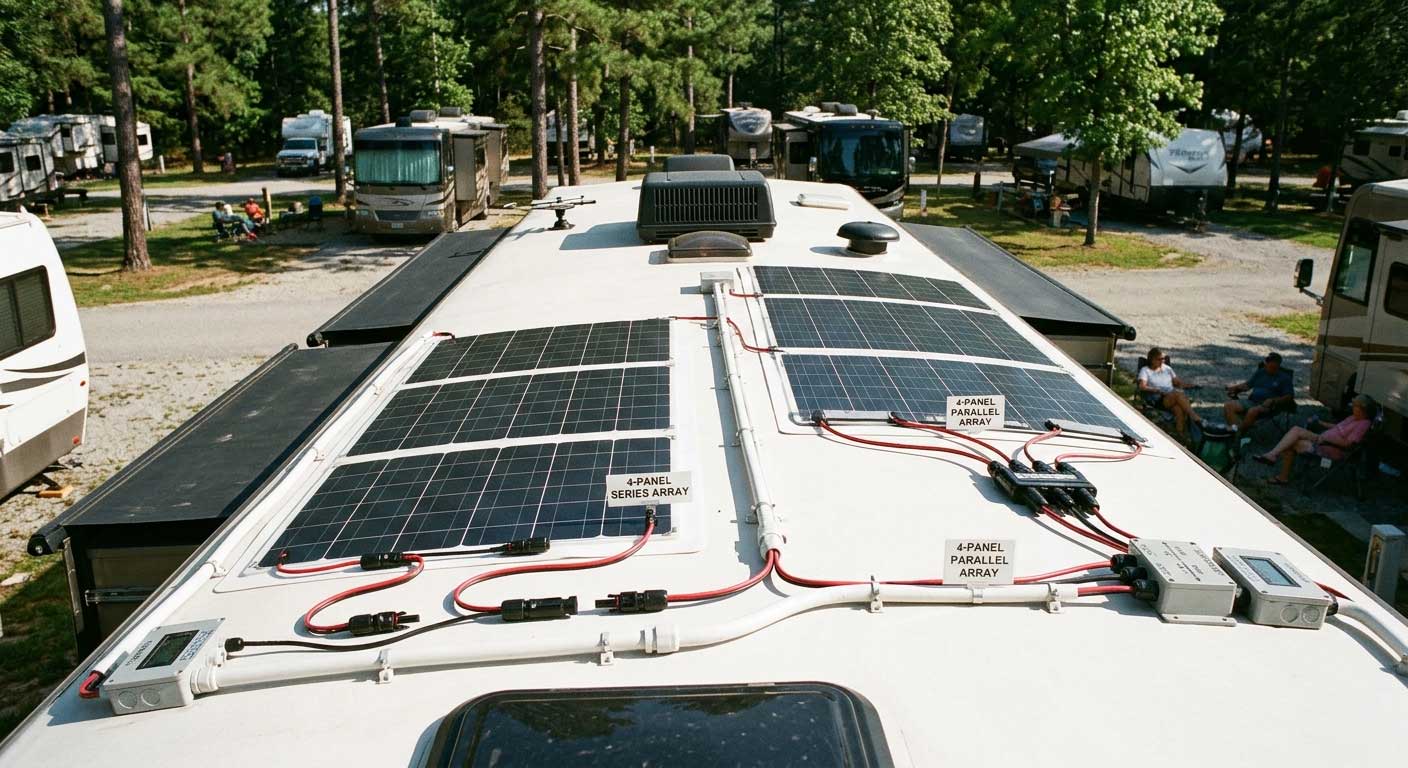
I once tested two identical RV Solar Panels systems parked side by side at a campground in Oregon.
System A:
- Series wiring
System B:
- Parallel wiring
Around 3 PM, a pine tree shadow crossed one panel.
Production data showed:
| Configuration | Output Reduction |
|---|---|
| Series | Approximately 38% |
| Parallel | Approximately 15% |
The exact numbers vary by panel design and bypass diode configuration, but the trend is consistent.
Parallel wiring generally tolerates partial shading better.
When one panel experiences reduced production, the others continue contributing more effectively.
Solar Panels Series vs Parallel in MPPT Systems
The rise of MPPT controllers changed the conversation.
Twenty years ago, many small solar systems operated at relatively low voltages.
Modern MPPT controllers can efficiently convert high-voltage solar input into usable battery charging current.
For example:
Solar Array:
- 80V input
Battery:
- 12V lithium
MPPT controllers step voltage down while increasing charging current.
This flexibility often makes series wiring more attractive than it was in older systems.
In RV projects completed over the past five years, I have increasingly recommended higher-voltage series configurations when shading is minimal.
The efficiency gains are noticeable.
Voltage Drop: The Hidden Performance Killer
Most owners never measure voltage drop.
They simply notice slower charging.
Consider two identical 600W solar systems.
System A:
- 24V array
- Long cable run
System B:
- 80V array
- Same cable length
System B will usually experience significantly lower transmission losses.
According to engineering guidance from the National Renewable Energy Laboratory (NREL), minimizing voltage drop remains an important factor in maximizing system performance.
In practical terms:
Higher voltage often means:
- Smaller cables
- Lower installation costs
- Better energy delivery
When Series Wiring Creates Problems
Series wiring is not perfect.
One challenge is mismatch sensitivity.
Suppose three panels are connected in series.
Panel outputs:
- 400W
- 400W
- 250W
The weaker panel can limit the overall string.
This issue becomes more noticeable as arrays age.
Several years ago, I inspected a marine installation where one aging panel had degraded substantially faster than the others.
Because all panels were wired in series, overall production suffered.
Replacing a single panel restored much of the system’s performance.
The owner initially assumed all three panels needed replacement.
Comparing Solar Panels Series vs Parallel Performance
The following table summarizes typical differences.
| Factor | Series | Parallel |
|---|---|---|
| Voltage | Higher | Lower |
| Current | Lower | Higher |
| Cable Losses | Lower | Higher |
| Long-Distance Runs | Excellent | Moderate |
| Shade Tolerance | Lower | Better |
| Wire Size Required | Smaller | Larger |
| MPPT Compatibility | Excellent | Good |
| Expansion Flexibility | Moderate | Excellent |
Notice that neither column wins every category.
That is why experienced installers rarely answer the question with a simple “always use series” or “always use parallel.”
The correct answer depends on site conditions.
The Most Common Mistake I See
Surprisingly, it is not choosing series.
It is not choosing parallel.
It is mixing different panels without understanding electrical compatibility.
I frequently encounter systems where owners connect:
- Different wattages
- Different voltages
- Different cell counts
- Different ages
into the same string.
The result is rarely optimal.
Even premium equipment cannot overcome poor system design.
The best-performing systems are often the simplest ones:
- Matching panels
- Consistent wiring
- Proper controller sizing
- Minimal shading
That foundation matters far more than chasing theoretical efficiency gains.
Real-World Case Studies: When Series Won and When Parallel Won
The internet is full of theoretical diagrams. Real installations rarely look like those diagrams.
Over the last several years, I have reviewed solar layouts on RVs, boats, mobile homes, and off-grid cabins. What surprised me wasn’t how often people wired panels incorrectly—it was how often they copied a wiring method from somebody else’s project without considering their own conditions.
A wiring strategy that works perfectly on a desert RV can perform poorly on a forest cabin.
Let’s look at a few examples.
Case Study 1 — Travel Trailer in Arizona
System:
- 4 × 200W flexible solar panels
- Total array: 800W
- MPPT controller
- Lithium battery bank
- No roof obstructions
Location:
- Southern Arizona
- Annual solar irradiance among the highest in North America
Observation:
The roof received nearly uninterrupted sunlight from sunrise until late afternoon.
In this situation, series wiring produced the best results.
Why?
Because:
- Higher voltage reduced cable losses
- MPPT controller operated efficiently
- No shading penalty existed
- Wire size could remain relatively small
Daily production consistently exceeded expectations.
The owner recorded average summer yields near the expected theoretical values.
Parallel wiring offered no meaningful advantage.
This is exactly the type of installation where series wiring shines.
Case Study 2 — Forest Cabin in Oregon
System:
- 3 × 180W solar panels
- Cabin surrounded by tall fir trees
- MPPT controller
- Seasonal use
At first, the owner wired everything in series.
Performance looked excellent during midday.
Morning and afternoon were another story.
One panel frequently fell under tree shadow.
Output dropped dramatically.
After rewiring into parallel strings, the system behaved differently.
Individual shaded modules no longer dragged down the entire array.
The cabin owner reported noticeably longer charging periods during partially shaded hours.
Peak production remained slightly lower than the series arrangement, but total daily harvest increased.
For this location, parallel wiring proved more practical.
Case Study 3 — Sailboat in Coastal Florida
Marine environments create a unique challenge.
Solar panels rarely remain flat relative to the sun.
Booms, radar arches, antennas, rigging, and sails introduce intermittent shading.
System:
- 2 × 175W Marine Flexible Solar Panels
- Mounted on a bimini
- MPPT controller
Initially wired in series.
During sailing, shadows from rigging moved continuously across the panels.
Production fluctuated heavily.
After reconfiguration to parallel wiring:
- Voltage remained stable
- Partial shading became less damaging
- Charging performance improved during sailing hours
At anchor under full sun, the series setup produced slightly higher peak numbers.
Over an entire month, however, parallel wiring delivered more usable energy.
Marine environments often reward resilience more than theoretical efficiency.
Why Modern MPPT Controllers Changed the Series vs Parallel Debate
Ten years ago, the answer was simpler.
Many installers automatically recommended parallel wiring because PWM charge controllers dominated the market.
Today, that recommendation is outdated.
Modern MPPT controllers changed the conversation entirely.
According to the U.S. Department of Energy and numerous controller manufacturers, MPPT technology can improve energy harvest by approximately 20%–30% compared with PWM systems under favorable conditions.
Source:
MPPT controllers excel when panel voltage significantly exceeds battery voltage.
That naturally favors series wiring.
For example:
| Configuration | Array Voltage |
|---|---|
| Two 12V Panels Parallel | ~18V |
| Two 12V Panels Series | ~36V |
The MPPT controller converts excess voltage into charging current.
Higher voltage gives the controller more room to optimize.
That is one reason large residential systems almost always rely on higher-voltage strings.
The technology itself encourages series configurations whenever shading remains minimal.
Common Mistakes I See With Solar Panels Series vs Parallel Installations
Most failures are not caused by the wiring method itself.
They’re caused by poor planning.
Mixing Different Panel Sizes
Example:
- 100W panel
- 200W panel
Wiring them in series forces current matching.
The larger panel cannot deliver its full potential.
Result:
Lower-than-expected production.
Ignoring Voltage Limits
Every charge controller has a maximum input voltage.
Cold weather can increase panel voltage.
A system that appears safe during summer can exceed limits during winter mornings.
Always check:
- Voc rating
- Temperature coefficient
- Controller voltage limit
Undersized Wiring
Many DIY installers focus on panel wattage while ignoring cable losses.
The National Renewable Energy Laboratory (NREL) repeatedly emphasizes minimizing resistive losses in solar systems.
Source:
Long cable runs strongly favor higher-voltage series strings.
Assuming More Voltage Always Means More Power
This is one of the biggest misconceptions.
Power equals:
Voltage × Current
Increasing voltage alone does not automatically increase energy production.
Environmental conditions ultimately determine performance.
Bright Solar Recommendation Matrix
After evaluating hundreds of project scenarios, this simplified framework works surprisingly well.
| Situation | Recommended Wiring |
|---|---|
| Open roof with full sun | Series |
| RV in desert regions | Series |
| Long cable distance | Series |
| Large MPPT controller | Series |
| Frequent shading | Parallel |
| Boats and yachts | Parallel |
| Forest cabins | Parallel |
| Mixed panel orientation | Parallel |
When conditions fall somewhere in the middle, hybrid configurations often deliver the best outcome.
FAQ About Solar Panels Series vs Parallel
Do solar panels charge faster in series or parallel?
Neither method inherently charges faster. Series wiring improves voltage, while parallel wiring improves shade tolerance. Actual charging speed depends on sunlight conditions, controller type, battery state, and system design.
Is series wiring better for MPPT controllers?
In most cases, yes. MPPT controllers operate most efficiently with higher array voltages, making series wiring attractive for many RV, residential, and mobile home systems.
Can I mix series and parallel solar panels?
Yes. Many larger systems use series-parallel configurations to balance voltage, current, efficiency, and shading performance.
What happens if one solar panel is shaded in series?
Current through the entire string may decrease significantly, reducing overall output despite bypass diodes.
What happens if one solar panel is shaded in parallel?
The shaded panel primarily affects itself while other panels continue producing near-normal power.
Final Thoughts on Solar Panels Series vs Parallel
After years of evaluating real installations, I no longer view the solar panels series vs parallel debate as a contest with a single winner.
Series wiring is usually the most efficient solution when sunlight is consistent and shading is minimal.
Parallel wiring often becomes the smarter choice when environmental conditions are unpredictable.
The best-performing systems are rarely designed around theory alone. They are designed around the actual roof, the actual weather, the actual wiring distance, and the actual daily usage pattern.
That is why every Bright Solar project begins with site conditions rather than wiring diagrams.
For some installations, series is clearly superior.
For others, parallel is the reason the system works reliably at all.
Understanding that difference is what separates a functioning solar installation from an exceptional one.
Related recommendations
-

Installing Solar Panels on RV: Complete Step-by-Step Guide for Reliable Off-Grid Power
307Learn installing solar panels on rv with expert steps, wiring tips, battery setup, and real RV solar experience from Bright Solar for reliable off-grid power.
View details -
1000 Watt Solar Panel Kit: Complete Sizing and Setup Guide
378A 1000 watt solar panel kit provides about 1,000W of rated PV capacity, but actual energy production depends on sunlight, battery capacity, MPPT sizing, wiri...
View details -
flexible solar panels for rv roof: Lightweight Solar Power Solution for RV Travel
187Discover flexible solar panels for rv roof with lightweight design, easy installation, and reliable power output. Bright Solar provides durable solar solutions for modern RV travel.
View details -
Flexible solar panel 550 watt: High Power Solar Solution for RV, Marine and Off-Grid Use
140Explore flexible solar panel 550 watt solutions from Bright Solar. Learn power output, installation methods, applications, and why high-power flexible solar panels are ideal for RV, marine, and off-grid systems.
View details