120 Watt Foldable Solar Panel: Output, Uses, and Buying Guide
A 120 watt foldable solar panel offers portable solar charging for camping, RV travel, outdoor electronics, and compatible battery systems. Its daily energy output depends on sunlight, panel angle, shading, and conversion losses, so check the charging equipment and your actual power needs before choosing a kit.
The appeal of a 120W panel is its balance between portability and useful output. It offers more rated power than a 100W panel, without necessarily requiring the storage space of a much larger portable array. But the extra 20 watts does not mean the panel will always generate 20% more energy in the field. That depends on how the panel is built, where it is positioned, and how much sunlight reaches it.
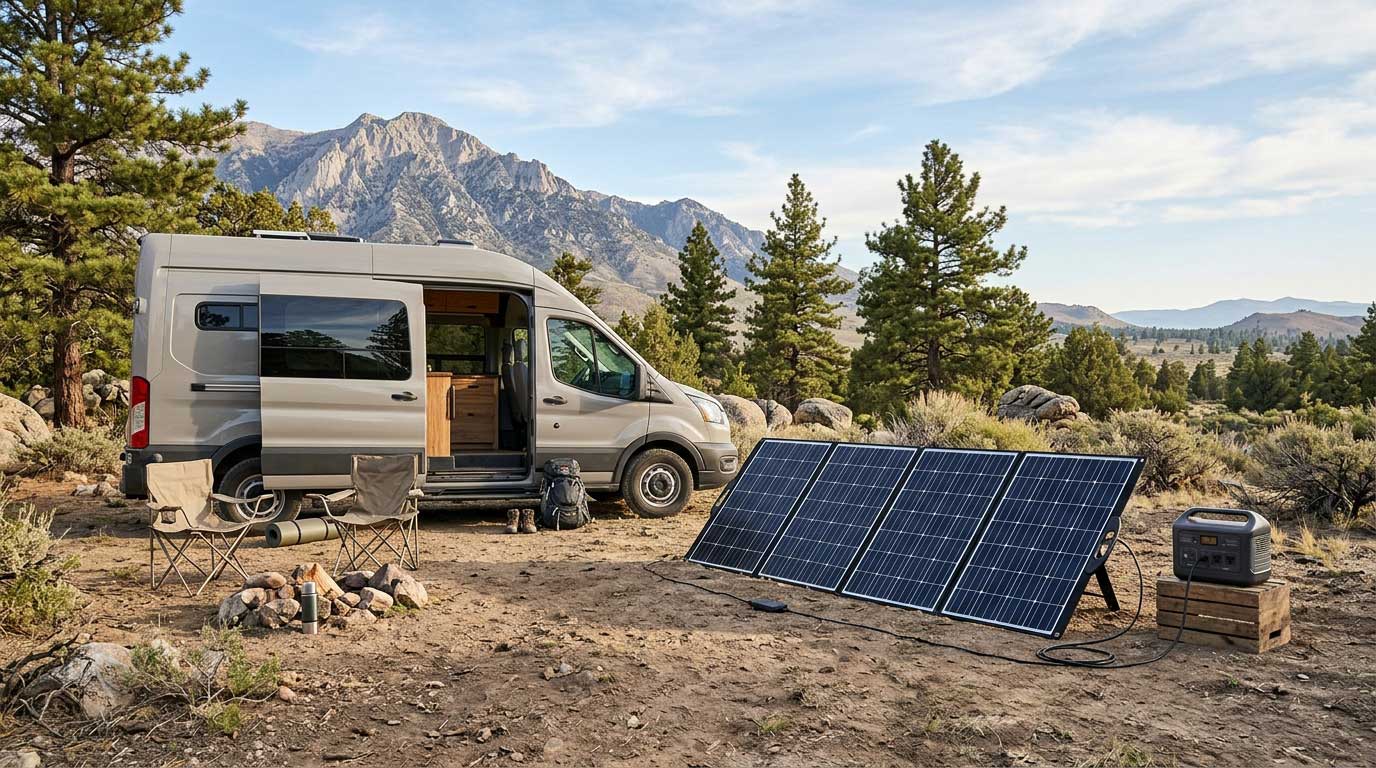
For a camper setting up at a shaded RV site, the practical advantage may be the ability to move the panel into an open area while leaving the vehicle parked. For a power-station owner, the more important question is whether the panel’s voltage, current, and connector match the station’s solar input.
What Is a 120 Watt Foldable Solar Panel?
A 120 watt foldable solar panel is a portable photovoltaic panel with a rated maximum output of 120 watts under specified test conditions. It typically consists of multiple panel sections joined by hinges or flexible connecting sections, allowing it to fold for storage and open for use.
Depending on the product, the package may include:
- Foldable solar modules
- Integrated support legs or a separate stand
- A protective carrying case
- Output cables and adapters
- A charge controller or battery connection accessories
Not all packages contain the same components. Some products connect to a portable power station with integrated solar charging electronics; others require a separate charge controller for battery charging.
What Does the 120W Rating Actually Mean?
The wattage describes power, not the amount of energy produced over a whole day. A panel rated at 120W can produce 120 watts when operating at its rated maximum-power point under the specified test conditions. Outdoor output varies as sunlight and temperature change.
The U.S. Department of Energy explains that photovoltaic cells convert sunlight into electricity and that individual cells are assembled into modules. The rated output is therefore a useful comparison point, but it should not be treated as a guarantee of continuous production. See the Solar Photovoltaic Technology Basics resource.
A 120W panel is not automatically a 12V panel, either. “120W” identifies its power rating, while its operating voltage and current are separate specifications. Check the data sheet before connecting it to a battery or power station.
How Much Energy Can a 120W Foldable Solar Panel Produce?
A practical estimate starts with the panel rating, the equivalent peak sun hours available, and an allowance for system losses.
Daily energy (Wh) = rated power (W) × peak sun hours × system efficiency
Peak sun hours represent equivalent hours at a reference solar irradiance of 1,000 watts per square metre. They do not simply mean the number of hours between sunrise and sunset.
For a 120W panel receiving four peak sun hours, theoretical daily production is:
120W × 4 hours = 480Wh
If an illustrative system-efficiency factor of 75–85% is applied, the estimated energy becomes 360–408Wh per day, before any additional battery-storage or device-conversion losses.
| Peak sun hours | Theoretical energy at 120W | Estimated energy at 75–85% efficiency |
|---|---|---|
| 2 hours | 240Wh | 180–204Wh |
| 3 hours | 360Wh | 270–306Wh |
| 4 hours | 480Wh | 360–408Wh |
| 5 hours | 600Wh | 450–510Wh |
| 6 hours | 720Wh | 540–612Wh |
These are illustrative planning figures, not guaranteed output. Shade, clouds, poor orientation, panel temperature, and equipment limits can reduce actual production. The 75–85% efficiency factor is an assumption for the example, not a specification for every panel.
For a location-based estimate, the National Renewable Energy Laboratory’s PVWatts Calculator can help model solar generation using location and system inputs. Its results are estimates and may not precisely represent the behaviour of a Portable Solar Panel moved around a campsite.
What Can a 120 Watt Foldable Solar Panel Power?
A 120W panel can support modest energy needs, particularly when paired with a compatible battery or portable power station. Whether it can cover a full day’s use depends on how much energy the connected devices consume.
| Application | Example energy use | Practical role of a 120W panel |
|---|---|---|
| Phone charging | Around 10–20Wh per charge as an illustrative allowance | Can support multiple charges when sufficient solar energy is available |
| LED camping lights | 10W × 3 hours = 30Wh | A manageable load for a small solar setup |
| Small electronics | Varies by device | Suitable when daily consumption is measured and planned |
| Laptop charging | Depends on model and workload | May contribute to charging through a compatible power station |
| Portable refrigerator | Highly variable | May help recharge its battery, but daily production may not cover total use |
| RV auxiliary battery | Depends on battery capacity and current state of charge | Provides supplemental charging during daylight |
The figures above are examples for planning, not guaranteed consumption values for every device. Actual phone charging energy, for example, depends on battery size and charging losses.
A common mistake is to compare a panel’s watts directly with a battery’s capacity. Watts measure the rate of power delivery; watt-hours measure energy. A 120W panel does not automatically refill a 500Wh battery in just over four hours because the panel will rarely remain at rated output continuously, and the charging system introduces additional constraints.
Is 120W Enough for Camping?
For a weekend trip focused on phones, lighting, and small electronics, it may be a useful size. A larger load—such as a refrigerator running day and night—needs a more careful calculation.
Start by adding the daily energy use of each device. Then compare that total with a realistic production estimate for the location and season. If the panel will be used in a forested campground, plan for less direct sunlight than at an open desert campsite.
How to Choose a 120W Foldable Solar Panel for Camping and RVs
Rated wattage is only one part of the decision. A panel can have sufficient theoretical output and still be unsuitable if its electrical specifications do not match the equipment you own.
1. Check Voltage, Current, and Connector Compatibility
Before buying, compare the panel’s electrical data with the input limits of your portable power station or charge controller.
Look for:
- Vmp: Voltage at maximum power
- Imp: Current at maximum power
- Voc: Open-circuit voltage
- Isc: Short-circuit current
- Connector type and polarity: The physical plug and electrical connection must be compatible
- Maximum PV input: The receiving device’s voltage and current limits must not be exceeded
Pay particular attention to Voc. Solar-panel open-circuit voltage can rise in cold conditions, so a panel that appears compatible under typical weather may exceed an input limit in colder conditions. If you connect multiple panels, their combined electrical values must also remain within the controller’s ratings.
Do not connect a panel directly to a battery unless the equipment manufacturer explicitly permits that arrangement. Most battery-charging setups require an appropriate charge controller.
2. Compare Folded Size, Weight, and Setup Time
A foldable panel needs to fit in the vehicle and be easy to deploy when you arrive. Check the packed dimensions, weight, handle, hinge construction, support legs, and cable-storage design.
A longer cable can be useful when the RV is parked in shade but the ground nearby is sunny. Keep the battery or power station in a suitable location and follow the manufacturer’s cable and environmental instructions.
Wind deserves attention, too. A large panel can catch gusts and tip over if its supports are not stable. Follow the manufacturer’s instructions for positioning and securing it, and stow the panel if conditions become unsafe.
3. Read the Weather-Resistance Specifications
“Portable” does not mean waterproof. The panel surface, connectors, controller, and carrying case can have different environmental limits. Check whether the manufacturer permits operation in rain, how connectors should be protected, and how the panel should be dried before storage.
Also consider warranty coverage and the availability of replacement cables or adapters. A well-designed kit is easier to keep in service if an accessory is damaged during travel.
How to Set Up a 120 Watt Foldable Solar Panel
A portable panel is simple to deploy, but checking the electrical details before connecting it helps avoid compatibility problems.
Step 1 — Find a Clear, Stable Position
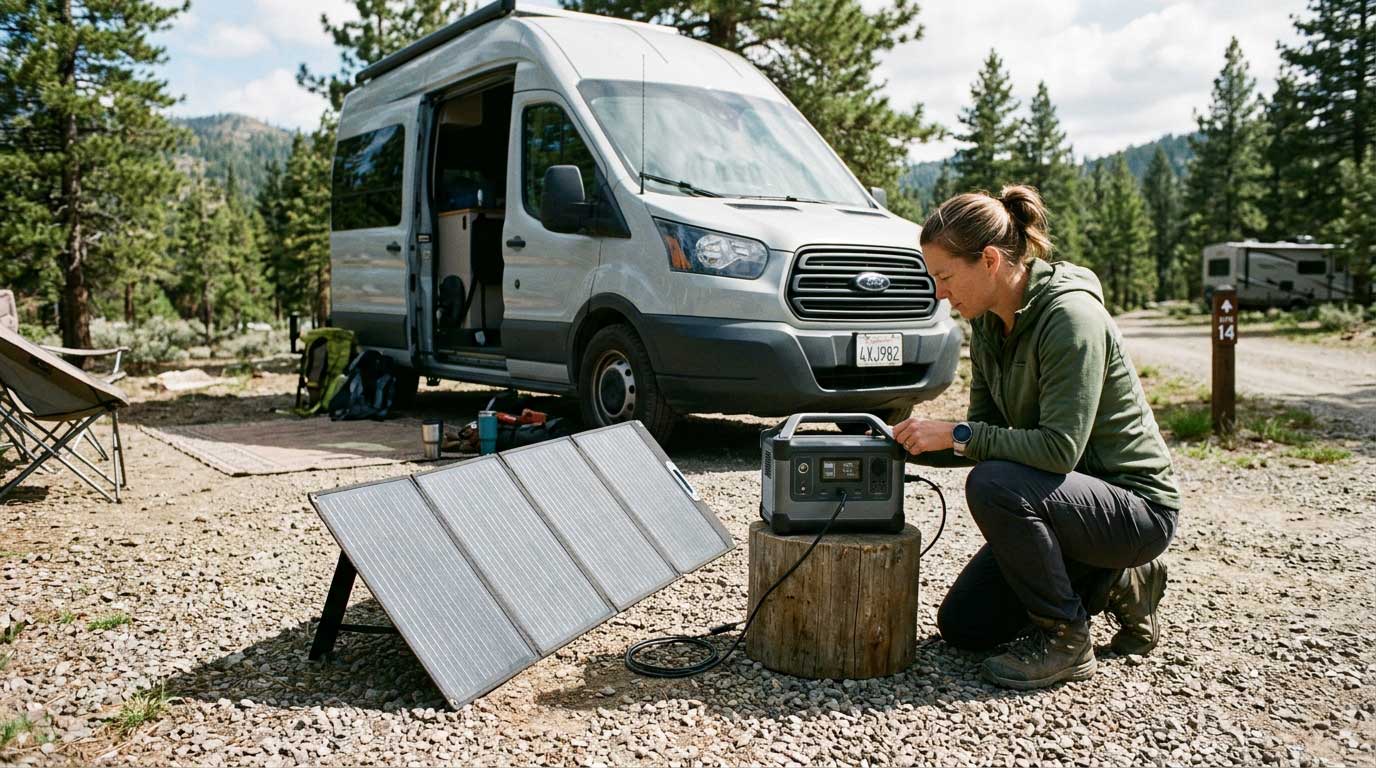
Place the panel where its active surface receives as much direct sunlight as possible. Avoid shadows from trees, awnings, roof racks, chairs, or the vehicle itself. Make sure the supports are stable and the panel cannot slide or tip over.
Step 2 — Check the System Specifications
Confirm the panel’s operating voltage and maximum open-circuit voltage, the controller’s input limits, and the battery or power station’s supported solar input. Inspect the cables and connectors for damage. Do not proceed if the connection method or polarity is unclear.
Step 3 — Follow the Manufacturer’s Connection Sequence
Some systems require the battery to be connected to the controller before the panel is connected. Other products use a different procedure. Follow the manual for your exact equipment rather than assuming every kit uses the same sequence.
A portable power station with built-in solar charging electronics may accept the panel directly through its specified input. A separate battery setup commonly requires a compatible charge controller. Do not add or bypass components without checking the system instructions.
Step 4 — Check the Actual Charging Reading
If the controller or power station displays input watts, check the reading after positioning the panel. A result below 120W is not necessarily a fault: rated output is measured under specified conditions, and outdoor sunlight changes continuously.
If the reading is unexpectedly low, inspect the panel angle, shading, connectors, and receiving device’s input limits before assuming the panel is defective.
Step 5 — Fold and Store It Carefully
Disconnect the equipment in the sequence specified by the manufacturer. Fold the panel without forcing the hinges, protect the cables from being pinched, and follow the instructions for drying and storage if the kit has been exposed to moisture or dust.
A Practical Example: Two Days of RV Charging
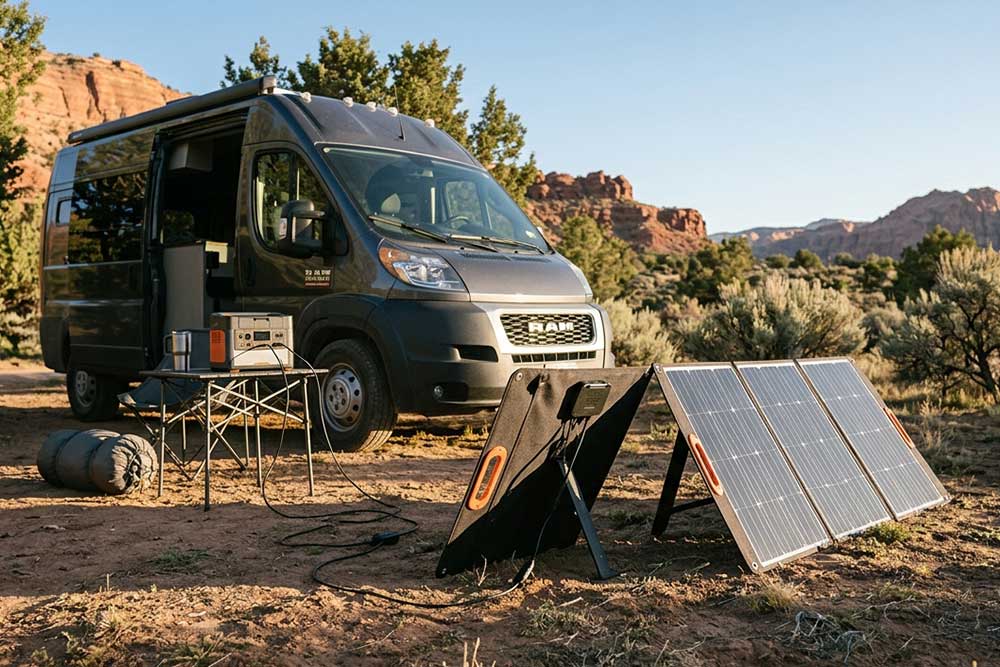
Imagine a couple spending a weekend at a campsite in the western United States. They bring a 120W foldable solar panel to replenish a portable power station used for phone charging, LED lighting, and small accessories.
Their estimated daily loads are:
| Device | Illustrative daily energy use |
|---|---|
| Two phones | 30Wh |
| LED campsite lighting | 30Wh |
| Small electronic accessories | 50Wh |
| Total daily demand | 110Wh |
Using the earlier estimate of 360–408Wh per day under four peak sun hours and the illustrative 75–85% system-efficiency factor, the panel’s estimated production exceeds the example’s 110Wh daily demand.
That does not mean every trip will produce the same result. If the couple parks under trees, receives only two peak sun hours, or spends much of the afternoon in cloudy weather, production could be considerably lower. Battery charging and device conversion also affect the amount of energy they can use.
The useful planning insight is that a 120W panel may provide a reasonable margin for modest loads in favourable conditions, but the margin shrinks quickly when larger appliances enter the picture. This is an illustrative calculation, not a measured field test or a claim about a specific Bright Solar product.
120W Foldable Solar Panel vs. Larger Solar Options
A 120W panel is not the right choice for every user. It makes sense when portability matters and daily loads are modest. If you regularly power high-consumption devices, a larger panel or a multi-panel setup may be more suitable.
| Requirement | Potentially suitable approach | Key consideration |
|---|---|---|
| Phone and light charging on weekend trips | Single 120W foldable panel | Estimate daily energy use and available sunlight |
| Frequent RV use with larger loads | Larger panel or multiple compatible panels | Verify controller limits, storage, and mounting |
| Charging when the vehicle is parked in shade | Portable panel positioned in a sunny area | Cable length and safe placement matter |
| Permanent installation on a curved surface | A compatible flexible solar module | Follow the model’s mounting and bending specifications |
| Long periods of cloudy weather | Larger generation capacity plus adequate battery storage | Extra panel capacity cannot guarantee energy during prolonged poor weather |
A larger array can collect more energy when sunlight is available, but it also needs suitable storage and compatible charging electronics. Adding panels without checking the controller’s limits is not a safe shortcut.
Where Bright Solar’s Flexible Panels Fit
Bright Solar provides flexible solar panel solutions for B2B buyers evaluating modules for specific installation conditions. Flexible panels may be suitable for compatible curved or weight-sensitive surfaces, while foldable portable panels are intended to be opened for use and folded away afterward.
The distinction matters when selecting products for RV equipment suppliers, distributors, marine applications, or OEM projects. A flexible module’s bending limit does not mean it can be repeatedly folded like a hinged camping panel. For the L Series, Bright Solar specifies a maximum bending capacity of 30%; buyers should verify the exact model’s data sheet and approved installation method before selecting it.
For a commercial project, evaluate the actual electrical parameters, dimensions, construction, mounting conditions, environmental exposure, and customization requirements. The correct panel is the one that meets the application specification, not simply the one with the most attractive wattage-to-size ratio.
FAQ About 120 Watt Foldable Solar Panel
How much power does a 120 watt foldable solar panel produce per day?
With four peak sun hours, a 120W panel has theoretical production of 480Wh. Applying an illustrative 75–85% system-efficiency factor gives an estimate of 360–408Wh per day, before additional battery-storage and device-conversion losses.
Can a 120W foldable solar panel charge a portable power station?
Yes, if the panel’s voltage, current, connector, and output are compatible with the power station’s solar input. Always check the station’s maximum input voltage and current before connecting it.
Is a 120W foldable solar panel suitable for an RV?
Yes. It can provide supplemental electricity for compatible batteries or portable power stations used for lighting, phones, and small electronics. Whether it is sufficient for an entire RV depends on daily consumption and local solar conditions.
Can a 120W solar panel run a refrigerator?
It may contribute to charging a battery that powers a refrigerator, but it may not generate enough energy to cover the refrigerator’s full daily demand. Check the appliance’s energy consumption and compare it with realistic daily solar production.
Does a 120W foldable solar panel need a charge controller?
A separate battery-charging setup generally requires a compatible charge controller. Some portable power stations include their own solar charging electronics. Follow the manufacturer’s instructions for your specific system.
Is a 120W foldable solar panel waterproof?
Not necessarily. Weather resistance varies by model, and connectors, controllers, and carrying cases may have different limitations. Check the manufacturer’s instructions before using the equipment in rain or storing it while damp.
Is a 120W foldable solar panel better than a 100W panel?
It has a 20% higher rated power than a 100W panel, but real-world energy production also depends on sunlight, temperature, panel design, and system losses. Compare folded size, weight, electrical compatibility, and expected daily output before deciding whether the additional rated power is worth it.
Conclusion
A 120 watt foldable solar panel is a useful portable charging option for camping, RV travel, and modest off-grid power needs. Its real value depends on how much energy you need each day, how much sunlight the panel receives, and whether the charging equipment is compatible.
Estimate energy consumption in watt-hours, check the electrical specifications, and allow for changing weather rather than treating rated wattage as a daily guarantee. For B2B projects that require solar modules designed around specific mounting conditions, Bright Solar’s flexible-panel solutions can be evaluated against the project’s technical requirements.
Technical References
- U.S. Department of Energy: Solar Photovoltaic Technology Basics — explains how photovoltaic cells and modules convert sunlight into electricity.
- U.S. Department of Energy: Solar Photovoltaic Performance and Efficiency Basics — background on factors affecting solar output and efficiency.
- National Renewable Energy Laboratory: PVWatts Calculator — estimates solar generation based on location and system inputs.
Related recommendations
-

Solar Panel Voltage vs Current Explained: Understanding Volts, Amps, and Power
427Understand solar panel voltage vs current explained with clear examples of volts, amps, watts, series and parallel wiring to design efficient solar systems.
View details -
12 Volt Folding Solar Panels: How to Choose and Use Them
4912V folding solar panels provide portable power for compatible batteries, RVs, camping equipment, and small off-grid systems. Safe, effective charging depend...
View details -
Fitting Flexible Solar Panels to Van Roof: A Practical Guide
220Fitting flexible solar panels to a van roof requires a suitable surface, correct positioning, approved mounting, protected wiring, and compliance with the pa...
View details -
450 Watt Solar Panel Performance and Applications Guide
348Discover how a 450 watt solar panel delivers reliable power for RVs, homes, marine and off-grid systems. Learn output, efficiency and installation tips.
View details