Are Solar Panels Flexible? Types, Bending Limits, and Uses
Are solar panels flexible? Some are, but conventional glass solar panels are rigid. Flexible solar panels use different materials and construction methods that allow controlled bending, making them useful for curved roofs, RVs, boats, portable systems, and specialized installations.
The word flexible causes confusion because not every lightweight solar panel can actually bend.
A standard framed module is built around a rigid glass surface and aluminum frame. It is designed to remain flat. Trying to curve that type of panel can crack the glass, damage cells, or compromise electrical connections.
Flexible modules are different from the beginning. Their construction is intended to tolerate a specified degree of bending without requiring a conventional rigid frame.
At Bright Solar, the practical question is rarely just whether a panel bends. The more useful question is how much it can bend, in which direction, and under what installation conditions.
That distinction becomes important when a solar module is going onto an RV roof rather than a house.
Are Solar Panels Flexible or Rigid?
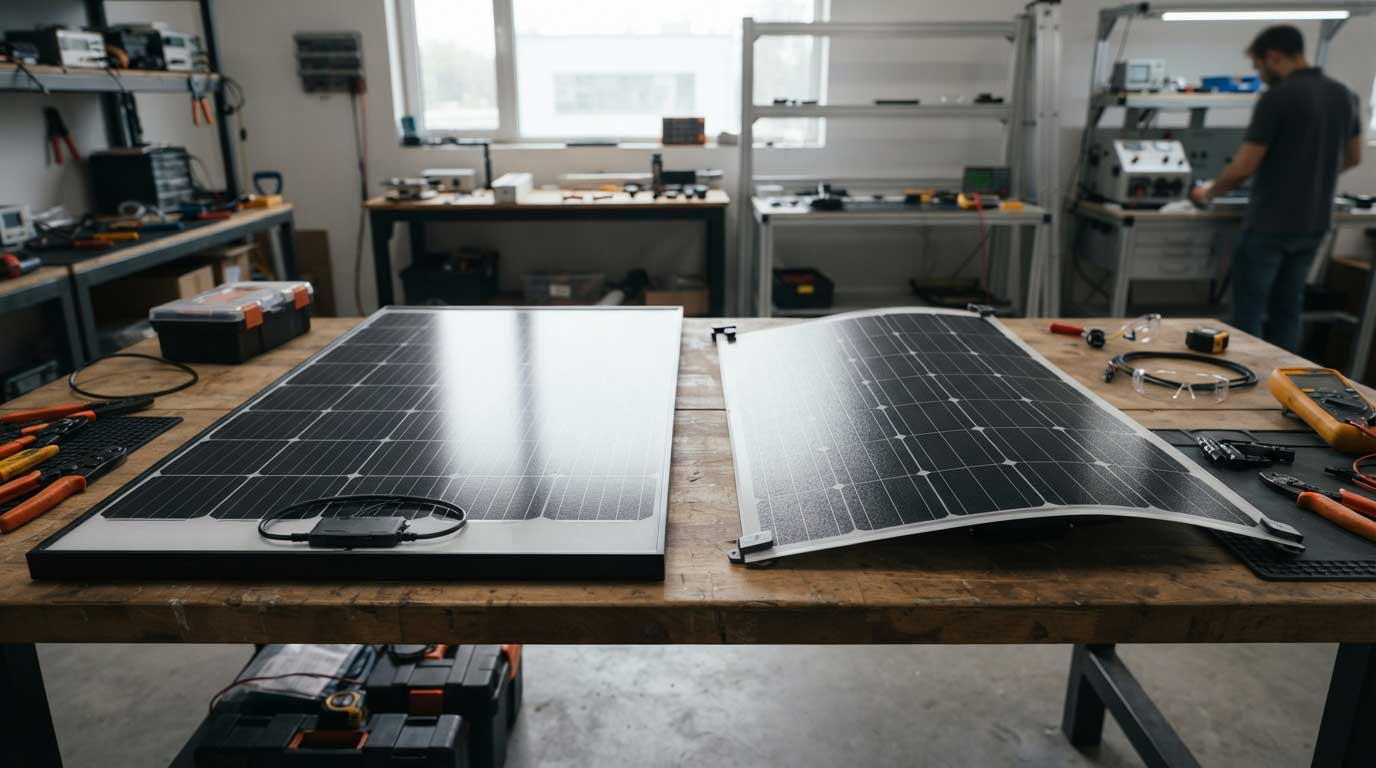
Most conventional solar panels are rigid. Flexible solar panels are a separate product category designed around lightweight materials and a bendable construction.
A conventional rigid module generally consists of:
- Tempered glass
- Crystalline silicon cells
- Encapsulant
- Backsheet
- Aluminum frame
- Junction box
The rigid frame protects the module and provides structural support.
A flexible module can use a thinner construction with fewer rigid components. Depending on the product, the solar cells may be integrated with flexible substrates and protective polymer layers.
This difference affects more than appearance.
It can change:
- Weight
- Installation method
- Surface compatibility
- Maximum bending radius
- Mechanical loading
- Heat dissipation
- Long-term maintenance
The U.S. Department of Energy identifies thin-film photovoltaic technologies as a category in which semiconductor materials are deposited in thin layers rather than being constructed solely around conventional crystalline-silicon wafers.
That manufacturing freedom is one reason flexible photovoltaic products can be designed for applications where traditional framed modules are inconvenient.
What Makes a Solar Panel Flexible?
Flexibility comes from the entire module construction, not simply from using thinner solar cells.
Several design choices contribute to a flexible module.
Flexible Substrate
Instead of relying on a rigid glass-and-frame structure, flexible modules can use lightweight substrates that allow controlled movement.
The substrate must still protect the electrical structure and withstand the intended operating environment.
Thin Solar Cell Construction
The photovoltaic layer or cells are integrated into a module structure designed around the intended mechanical behavior.
This is why a flexible panel cannot be treated like a piece of plastic.
The cells still contain electrical pathways that can be damaged by excessive stress.
Protective Surface Materials
Flexible solar panels commonly use polymer-based protective layers rather than the thick glass used on many rigid modules.
The outer layer must balance:
- UV resistance
- Weather protection
- Mechanical durability
- Optical transmission
- Flexibility
For mobile solar applications, this outer construction becomes particularly important because the module may encounter vibration, road debris, temperature changes, and repeated exposure to sunlight.
How Far Can Flexible Solar Panels Bend?
There is no universal bending angle for all flexible solar panels.
This is one of the most important points to understand before installation.
Manufacturers specify a maximum bending radius or other mechanical limitation for a particular product.
A panel rated for a relatively gentle curve should not be forced into a tight arc.
For example, if a product specification states a maximum bending radius of 1 meter, that does not mean the panel can be wrapped around a small pipe with a 10-centimeter radius.
The smaller the radius, the more severe the curvature.
Practical rule:
Never determine flexibility by physically testing how far the panel can be forced to bend. Use the manufacturer’s specified bending radius.
This matters because damage may not be immediately visible.
A module can look normal after excessive bending while internal electrical connections have already experienced mechanical stress.
Flexible Solar Panel vs Rigid Solar Panel
The right choice depends heavily on the installation.
| Feature | Flexible Solar Panel | Rigid Solar Panel |
|---|---|---|
| Construction | Lightweight flexible structure | Glass and rigid frame |
| Surface | Can suit certain curved surfaces | Primarily flat mounting |
| Weight | Generally lower | Generally higher |
| Profile | Low profile | Raised frame |
| Mounting | Adhesive or application-specific methods | Rails, brackets, clamps |
| Bending | Limited and controlled | Not intended to bend |
| RV use | Strong fit for some applications | Also widely used |
| Replacement | Product/application dependent | Generally straightforward |
| Air circulation | Depends on installation | Often has space beneath module |
Neither technology is automatically superior.
A Rigid Solar Panels may be the better choice for a large stationary rooftop where durability, ventilation, and conventional mounting are priorities.
A Flexible Solar Panels can make more sense when the installation surface is curved or when reducing weight and profile matters.
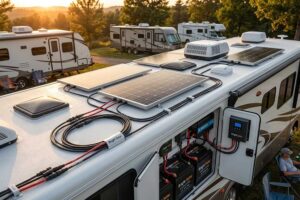
Why Are Solar Panels Flexible Useful for RVs?
RV roofs are rarely simple rectangles.
An installer may need to work around:
- Air conditioners
- Roof vents
- Skylights
- Antennas
- Satellite equipment
- Roof racks
A conventional framed module requires mounting space and hardware around the panel.
Flexible modules can offer a lower-profile alternative.
For an RV owner, that can mean:
- Less rooftop hardware
- Lower overall panel weight
- More freedom when working around roof equipment
- A cleaner visual appearance
But flexibility does not solve every RV solar problem.
Shading remains important.
The U.S. Department of Energy notes that solar resource varies with time, season, weather, location, and shading conditions.
A flexible panel installed beside an RV air conditioner can still lose production when the unit casts a shadow across the photovoltaic surface.
Are Flexible Solar Panels Good for Curved Surfaces?
Yes, within their specified bending limits.
This is one of the clearest use cases for flexible solar technology.
Potential applications include:
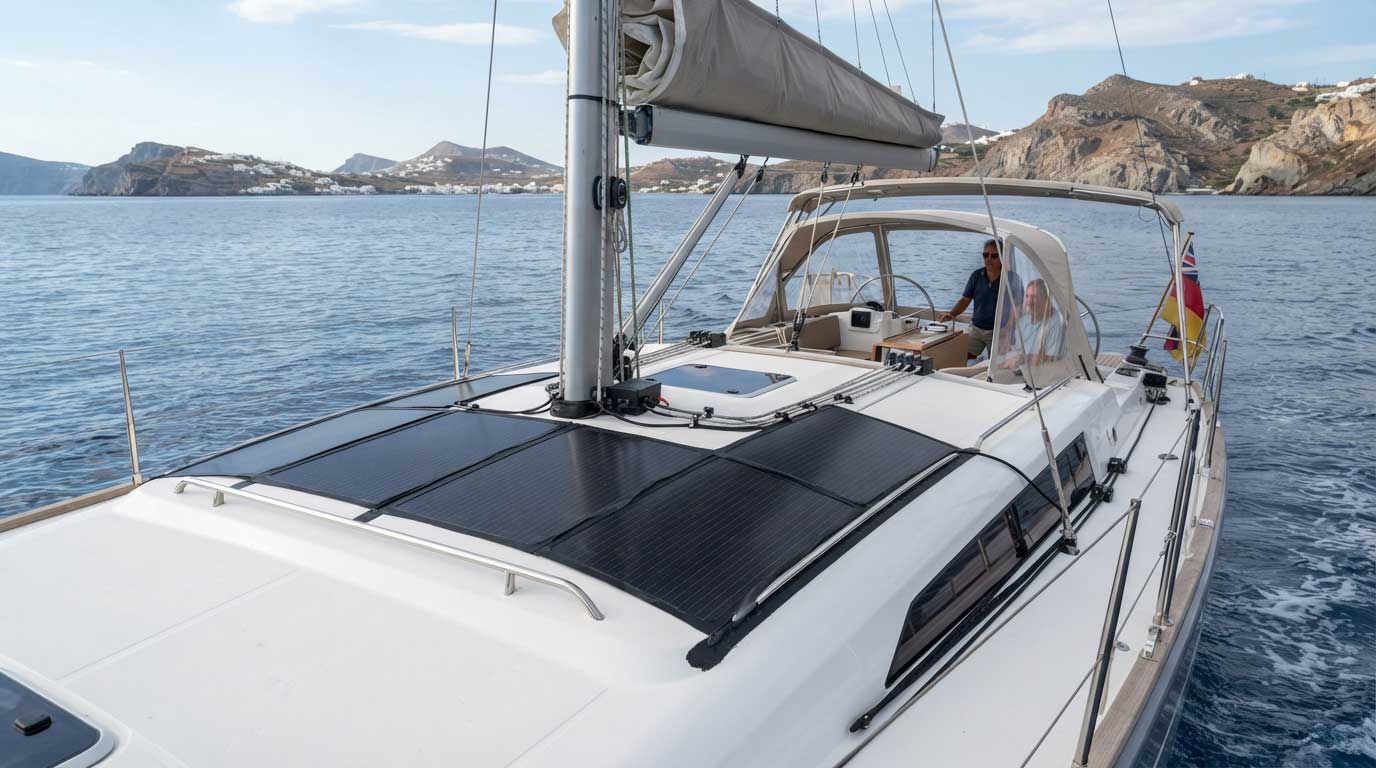
- Curved RV roofs
- Camper vans
- Boat decks
- Marine cabins
- Specialty vehicles
- Portable structures
A curved surface can make a rigid module difficult to mount without creating gaps or requiring a custom support structure.
A flexible panel can follow the intended curvature more closely.
There is an important distinction, though:
Curved is not the same as folded.
A gentle continuous curve may be acceptable.
A sharp crease is not.
Flexible solar products should never be folded like fabric unless the manufacturer specifically states that the product is designed for folding.
Does Flexibility Mean a Solar Panel Is Lightweight?
Not automatically, but lightweight construction is one of the major reasons flexible photovoltaic products are developed.
NREL has investigated lightweight and flexible photovoltaic technologies for applications including transportation and portable power. Its work highlights the potential of lightweight PV where conventional modules create weight or integration constraints.
This becomes particularly relevant on:
- RVs
- Boats
- Mobile shelters
- Portable equipment
Consider an RV roof.
The solar panel is only one item being added. The complete system can also require:
- Mounting hardware
- Cable glands
- Wiring
- Charge controller
- Battery
- Inverter
Reducing module weight can therefore be useful when the vehicle has a limited payload.
What Types of Solar Panels Are Flexible?
Several photovoltaic technologies can be manufactured in flexible formats, but they do not all behave the same way.
Flexible Monocrystalline Solar Panels
Flexible monocrystalline modules use crystalline silicon cells in a flexible module construction.
They are often selected when the customer wants:
- Higher power density
- Flexible installation
- Relatively compact dimensions
This format is increasingly common in RV and marine solar applications.
Thin-Film Flexible Solar Panels
Thin-film technologies can be manufactured on flexible substrates.
Depending on the photovoltaic material, thin-film modules may offer distinctive characteristics involving:
- Weight
- Manufacturing flexibility
- Low-light behavior
- Surface integration
The specific technology matters, so “thin film” should not be treated as a single performance category.
Are Solar Panels Flexible Enough for a Camper Roof?
In many cases, yes.
A camper roof often has a shallow curve rather than a dramatic bend. That is very different from asking a panel to wrap around a cylinder.
Before installation, measure the roof curvature.
A useful field method is simple:
- Identify the proposed panel location.
- Measure the curved section.
- Determine the approximate radius of the surface.
- Compare that radius with the panel’s specified bending limit.
- Check for roof equipment and shade.
- Confirm the mounting method.
Do not rely on visual judgment alone.
A roof can look almost flat while still creating enough curvature to matter for a rigid module.
What Should You Check Before Buying Flexible Solar Panels?
Before selecting a flexible module, review the technical datasheet rather than relying on marketing descriptions.
At minimum, check:
- Rated power
- Voc
- Vmp
- Isc
- Imp
- Module dimensions
- Weight
- Maximum bending radius
- Operating temperature
- Connector type
- IP rating
- Warranty
The maximum bending radius deserves particular attention.
For a custom RV or marine project, it should be treated as an engineering parameter rather than a marketing feature.
The same applies to weight.
A “lightweight” panel should be compared using actual module weight, not a general product description.
At Bright Solar, product selection should begin with the customer’s physical installation constraints and electrical requirements. The wattage comes after those basic parameters are understood.
How to Install Flexible Solar Panels Correctly
Installing a flexible solar panel is less about forcing the module onto a surface and more about respecting the surface and the panel’s mechanical limits.
Before installation, confirm four things:
- The mounting surface is structurally sound.
- The panel’s bending radius matches the surface curvature.
- The surface is clean and compatible with the selected mounting method.
- The electrical system is correctly sized.
For RV and marine projects, the installation environment deserves extra attention because vibration and weather exposure continue after the installation is finished.
Step 1: Measure the Surface
Lay out the proposed panel position before removing any protective film.
Check:
- Length and width
- Curvature
- Roof edges
- Existing equipment
- Cable entry location
- Shading during different times of day
A useful practical approach is to make a cardboard or thin-film template matching the panel dimensions. Place it on the roof and walk around the vehicle.
This reveals problems that a dimension drawing may not show.
An air conditioner may block a cable route. A roof vent may create a shadow across one section. A curved edge may leave insufficient clearance.
Those are installation problems, not panel problems.
Flexible Solar Panel Mounting Methods
Flexible solar panels can be installed using different methods depending on the product and application.
Adhesive Mounting
Adhesive installation provides a low-profile appearance and avoids some of the hardware associated with rigid panels.
The surface should be:
- Clean
- Dry
- Stable
- Free from loose coatings or contamination
The adhesive system must be compatible with both the panel backing and the installation surface.
Do not select an adhesive simply because it has a high strength rating. Compatibility, temperature range, UV exposure, and long-term environmental conditions matter too.
Mechanical Fixing
Some applications require mechanical attachment or additional securing points.
This can be appropriate when:
- The surface is irregular
- The operating environment is demanding
- The product specifically supports mechanical mounting
Any fastener or penetration through an RV or marine roof also creates a waterproofing consideration.
A small hole can become a much bigger maintenance problem months later.
Do Not Create Sharp Bends
This is worth repeating because it is one of the easiest mistakes to make.
A flexible panel should follow a controlled curve.
It should not be:
- Folded in half
- Creased
- Rolled tighter than specified
- Forced around a sharp corner
The product datasheet should determine the acceptable bending radius.
How Shading Affects Flexible Solar Panels
Flexibility does not make a photovoltaic module immune to shading.
This matters particularly on RV roofs.
Imagine a camper parked under partial tree cover. At 9 a.m., the roof may be almost completely exposed. By noon, the tree shadow moves across one side of the panel.
The solar resource has changed even though the panel itself has not moved.
The U.S. Department of Energy notes that photovoltaic output is influenced by sunlight availability, weather, shadows, dirt, and other environmental conditions.
For flexible panels installed on mobile vehicles, check likely shade sources before finalizing the layout:
- Air conditioners
- Vent covers
- Roof racks
- Satellite dishes
- Trees at campsites
A slightly different panel position can sometimes be more valuable than adding nominal wattage.
Temperature and Flexible Solar Panel Performance
Solar panels operate outdoors, often in direct sunlight for hours.
That means the module temperature can become considerably higher than the surrounding air temperature.
The U.S. Department of Energy identifies temperature as one of the factors affecting photovoltaic performance. Solar cell efficiency is influenced by operating temperature as well as irradiance and other system characteristics.
Flexible installation can make thermal management especially relevant.
A panel mounted directly against a surface may have less air circulation beneath it than a raised rigid module.
This does not automatically make flexible panels unsuitable.
It means the installation environment should be considered during product selection.
For a vehicle that spends summer afternoons in full sun, check the manufacturer’s specified operating temperature range and installation recommendations rather than assuming all flexible panels behave identically.
Real-World Example: Flexible Solar Panels on an RV
Consider a 24-foot travel trailer used for several weeks of off-grid travel each summer.
The owner needs electricity for:
- Refrigerator
- LED lighting
- Phones
- Laptop
- Cellular router
- Small kitchen electronics
The roof has limited usable space because of the air conditioner and two ventilation openings.
A conventional rigid-panel layout would require additional clearance and mounting hardware. It would also leave awkward unused sections around the roof equipment.
A flexible system offers another layout option.
The installer first creates a roof template, identifies the equipment locations, and checks the curvature. The proposed panel positions are then compared with the expected shade pattern.
The electrical design is handled separately.
For example, if the array is rated at 400W and receives an equivalent four hours of useful peak sunlight, the theoretical daily energy before system losses would be:
400W × 4h = 1,600Wh
That is 1.6kWh of theoretical solar energy.
It is not a promise of 1.6kWh delivered to the battery every day.
Controller losses, wiring, temperature, shading, weather, battery charging losses, and real sunlight conditions all affect the final result.
This distinction is important when explaining solar performance to customers.
A panel’s nameplate rating is a starting point for system design, not a daily energy guarantee.
Flexible Solar Panels for RV, Boat, and Off-Grid Applications
The same basic technology can be useful in several mobile applications, but the design priorities change.
| Application | Main Design Priority | Important Consideration |
|---|---|---|
| RV | Weight and roof space | Air conditioner and vents |
| Camper van | Low profile | Limited roof area |
| Boat | Marine durability | Saltwater exposure |
| Off-grid equipment | Reliability | Remote maintenance |
| Portable system | Weight and transport | Storage and handling |
Marine installations deserve particular attention.
Saltwater exposure can accelerate corrosion of unsuitable components. Protective materials, connectors, junction boxes, and installation practices should therefore be selected for the intended environment.
For a mobile product, “flexible” is only one specification among many.
Bright Solar Insight: Flexibility Is an Installation Specification
One of the more useful lessons from flexible solar projects is that “flexible” should never be treated as a yes-or-no feature.
There are several questions behind it:
How flexible?
What bending radius is permitted?
How often will the module move?
What surface will support it?
What temperatures will it experience?
A panel intended for a gently curved RV roof has a different mechanical requirement from a module intended to be repeatedly rolled and transported.
Likewise, a lightweight panel installed on a stationary structure does not face the same vibration environment as one traveling thousands of highway miles.
This is where product engineering becomes more important than a generic specification sheet.
At Bright Solar, flexible solar panel selection should begin with the application: dimensions, surface, environment, required power, and installation method. The module is then matched to those conditions.

FAQ About Flexible Solar Panels
Are solar panels flexible?
Some solar panels are flexible, but conventional glass-and-aluminum modules are rigid. Flexible solar panels are specifically engineered to tolerate controlled bending within a manufacturer’s stated mechanical limits.
Can a flexible solar panel be bent completely flat?
A flexible panel can normally be installed on a flat surface, but its ability to bend depends on its construction. The manufacturer’s maximum bending radius should always be followed.
Can flexible solar panels be folded?
Generally, a flexible panel should not be folded unless the manufacturer specifically designs and rates it for folding. A sharp crease can damage the photovoltaic and electrical structure.
Are flexible solar panels suitable for RV roofs?
Yes. They can be particularly useful when low weight, low profile, and installation flexibility are important. Roof curvature, shading, temperature, and electrical compatibility still need to be evaluated.
Are flexible solar panels better than rigid panels?
Neither is universally better. Flexible panels offer advantages for lightweight or curved installations, while rigid panels can provide strong mechanical protection and conventional mounting options for fixed systems.
Do flexible solar panels produce less electricity?
Not necessarily. Electrical output depends on the specific photovoltaic technology, rated power, sunlight, temperature, shading, orientation, and system design. Flexibility itself does not determine daily energy production.
How do I choose the right flexible solar panel?
Start with the installation surface, available dimensions, required power, weight limit, bending radius, operating temperature, electrical ratings, environmental exposure, and mounting method. Then compare suitable products.
Conclusion
So, are solar panels flexible? Some are—and flexible photovoltaic modules can solve installation problems that conventional rigid panels cannot easily address.
For RVs, camper vans, boats, portable equipment, and specialty structures, the value is not simply that a panel can bend. The useful engineering advantage comes from combining controlled flexibility with appropriate weight, dimensions, electrical characteristics, protective materials, and installation methods.
For any project, check the actual product specifications before bending or mounting the module. A flexible panel is engineered to move within a defined range, not to be treated as a foldable sheet.
Bright Solar develops flexible solar solutions for applications where conventional panel construction may not be the most practical choice, with product selection based on real installation requirements rather than the word “flexible” alone.
Related recommendations
-

Solar Panel Wiring for RV, Marine, and Off-Grid Solar Systems
188Learn solar panel wiring for RVs, boats, homes, and off-grid systems. Discover series vs parallel setups, safety tips, and real installation cases.
View details -
Enphase Expands Mini Inverter Deployment in Southern California
284Enphase expands Mini inverter deployment in Southern California, with more homes adopting IQ8 Microinverters and IQ Batteries to prepare for summer outages. Local installers from Anaheim to Riverside share how sunlight-only backup and flexible sys...
View details -
100W Flexible Solar Panel: Lightweight Solar Power That Makes Sense Off-Grid
96Discover how a 100W flexible solar panel delivers lightweight, reliable solar charging for RVs, boats, campers, and portable off-grid systems.
View details -
Solar Series vs Parallel: Which Wiring Setup Is Better?
207Solar series vs parallel explained with wiring examples, voltage and current calculations, MPPT limits, shading effects, and setup tips from Bright Solar.
View details