Solar Panels for Cloudy Days Trailers: What You Need to Know
Solar panels for cloudy days trailers can still produce electricity because photovoltaic cells use both direct and diffuse sunlight. Output falls as cloud cover becomes thicker, but a properly sized RV solar system can continue charging batteries, running lights, refrigerators, fans, and electronics. The key is designing around real weather data rather than assuming every day is sunny.
Do Solar Panels Work on Cloudy Days?
Yes, solar panels work on cloudy days, but they produce less electricity than they do under clear skies.
Clouds do not switch a photovoltaic module off. They scatter, reflect, and absorb part of the incoming solar radiation. The light that reaches the panel becomes more diffuse, and the available irradiance can change quickly as clouds move across the sky.
The U.S. Department of Energy explains that solar radiation reaching the ground consists of direct and diffuse components. Under thick clouds, direct beam radiation can be reduced dramatically, while diffuse radiation continues to reach the surface.
That distinction matters for a trailer.
An RV parked under a bright overcast sky may still show useful solar input on its charge controller. Five minutes later, a darker cloud bank can push the array output much lower. Then a gap in the clouds may bring the power back up surprisingly quickly.
The system is not broken. The sunlight is simply changing.
How Much Power Can Solar Panels Produce in Cloudy Weather?
There is no single percentage that applies to every cloudy day.
Cloud thickness, location, time of day, season, panel orientation, temperature, shading, and the type of solar resource all affect production. DOE notes that cloud cover makes solar output difficult to predict because the amount of sunlight reaching a PV array changes with cloud size, thickness, shape, and atmospheric conditions.
For this reason, it is risky to tell an RV owner that a panel will always produce “20%” or “30%” of its rated power during cloudy weather.
A 400W panel does not automatically produce a fixed 80W on an overcast day.
Instead, think in terms of available irradiance.
| Weather condition | Expected solar behavior | RV planning implication |
|---|---|---|
| Clear midday sky | Highest production potential | Good time to recharge batteries |
| Light overcast | Reduced but useful production | Normal loads may still be supported |
| Heavy cloud | Significantly reduced output | Battery reserve becomes more important |
| Fast-moving clouds | Rapid output fluctuations | MPPT controller and battery help smooth supply |
| Rainy, dark conditions | Low production | Do not depend on solar alone for high loads |
| Night | No solar production | Battery or shore power is required |
NREL’s solar modeling tools use direct normal irradiance, diffuse horizontal irradiance, ambient temperature, wind speed, and other weather inputs because real PV production depends on more than a panel’s nameplate wattage.
That is one of the most important design lessons for RV solar.
Why Cloudy Weather Reduces Trailer Solar Output
The panel does not measure “sunshine” in the everyday sense. Its photovoltaic cells respond to incoming radiation.
When clouds move between the sun and the trailer roof, several things happen.
First, direct sunlight is reduced.
Second, some sunlight is scattered through the atmosphere and arrives from different directions.
Third, the overall irradiance at the panel surface becomes more variable.
DOE describes diffuse solar radiation as sunlight that has been scattered or reflected by atmospheric elements including clouds, dust, water vapor, and air molecules.
This is why a cloudy afternoon can still produce electricity while a very dark storm cloud can cause the charging current to drop sharply.
The practical difference is easy to see on a solar controller.
On a clear day, the PV input may climb steadily toward its midday operating level. During broken cloud cover, the displayed wattage can move up and down repeatedly. A trailer owner may see 250W, then 110W, then 40W, followed by 180W a few minutes later.
That variation is normal.
Cloudy Does Not Mean Cold, and Cold Can Actually Help PV Voltage
There is another detail that is often missed in casual solar advice.
Cloudy weather is frequently cooler, and lower module temperature can be favorable for PV electrical performance. DOE notes that PV performance is affected by temperature, and real-world module conditions differ from the standard test condition used to rate panels. Standard PV ratings are based on 1,000 W/m² irradiance and a 25°C cell temperature.
So you should not assume that every cloudy day is electrically “bad” in every respect.
The major limitation is usually the reduced amount of solar radiation available, not simply the temperature.
How to Size Solar Panels for a Trailer That Gets Cloudy Weather
For trailers used in regions with frequent overcast weather, I would not size the array only around average sunny-day consumption.
Start with the daily electrical load.
A useful planning formula is:
Daily solar energy needed ≈ Daily energy consumption ÷ system efficiency
For example, suppose a trailer uses:
- Refrigerator: 700 Wh/day
- LED lighting: 120 Wh/day
- Ventilation fans: 180 Wh/day
- Phones and laptops: 250 Wh/day
- Water pump: 100 Wh/day
- Small miscellaneous loads: 150 Wh/day
Total estimated consumption:
1,500 Wh/day, or 1.5 kWh/day.
If the system experiences conversion, wiring, charging, temperature, and other losses, designing around roughly 1.7–1.9 kWh of solar energy requirement gives a more realistic starting point than simply matching the 1.5 kWh load.
The next question is how many watts of solar capacity are needed.
A 600W array may be adequate for a moderate-use trailer in a reasonably favorable solar location. But if the same trailer spends much of its time in cloudy coastal weather, adding roof capacity and battery storage can make a noticeable difference.
This is where many RV installations go wrong.
The owner buys enough solar for a perfect July day and then expects the same system to perform during three consecutive days of gray weather.
It will not.
Use Weather Data Instead of Guesswork
For serious system sizing, historical solar-resource data is more useful than a generic “hours of sunshine” estimate.
NREL provides the National Solar Radiation Database and PVWatts, which can be used to evaluate solar resources and estimate PV production. The database includes direct and diffuse irradiance data, while PVWatts estimates energy production from grid-connected PV systems using location and system parameters.
For a trailer fleet or a customer who repeatedly travels through the Pacific Northwest, northern Europe, the Great Lakes, or other cloud-prone regions, this approach is especially useful.
The question changes from:
“How many watts should I install?”
to:
“How much energy will this array realistically deliver where the trailer will actually travel?”
That is a much better engineering question.
Best Solar Panel Configuration for Cloudy Trailer Conditions
Cloudy-weather performance is not determined by panel wattage alone. Wiring and charge-controller selection also matter.
For most RV systems, an MPPT charge controller is a strong choice when the array voltage can be configured appropriately.
Series-connected panels increase voltage while current remains approximately the same. Parallel-connected panels keep voltage similar while increasing current.
For example:
| Configuration | Main effect | Potential RV advantage |
|---|---|---|
| 2 × 200W in series | Higher array voltage | Lower current through longer cable runs |
| 2 × 200W in parallel | Higher array current | Can be useful for certain lower-voltage systems |
| 3 × 200W series | Higher voltage again | More headroom for MPPT operation |
| Series-parallel | Voltage and current both increase | Useful for larger trailer arrays |
But there is a safety boundary.
The open-circuit voltage of the array must remain within the charge controller’s maximum PV voltage, including the effect of cold temperatures. The controller manufacturer’s specifications should be checked before deciding how many modules to place in series.
Why MPPT Matters on a Cloudy Day
Cloudy conditions create changing irradiance, so the panel’s operating point is not static.
An MPPT controller continuously searches for an operating point that extracts useful power from the array and converts it to the battery voltage. It does not create energy that is not present, but it can help the system make better use of available PV input.
This is particularly important when a trailer has a higher-voltage solar array feeding a 12V or 24V battery bank.
The controller should still be correctly sized for both PV voltage and current.
Do not choose a controller simply because its label says “600W solar.”
Check:
- Maximum PV open-circuit voltage
- Recommended PV array power
- Maximum charging current
- Battery voltage
- Maximum PV short-circuit current
- Temperature limits
- Wiring and connector ratings
A cloudy-weather system has little margin for poorly matched components.
Solar Panels for Cloudy Days Trailers and Battery Storage
For frequent cloudy camping, battery capacity becomes almost as important as panel capacity.
Solar panels produce energy when the sun is available. A battery separates the timing of production from the timing of consumption.
DOE specifically identifies energy storage as a way to match solar generation with electricity demand, while also noting that storage is not 100% efficient because energy is lost during charging, conversion, and discharge.
Consider a 600W trailer array.
On a favorable day, it may generate enough energy to operate the refrigerator, lights, fans, and electronics while also charging the battery.
During a dark, rainy day, the same loads may continue while the solar contribution drops sharply.
The battery absorbs the difference.
That is why adding another 200–400W of roof solar can sometimes be less useful than people expect if the battery bank is undersized. Conversely, installing a very large battery without enough solar generation can leave the battery chronically undercharged.
The two need to be designed together.
A Practical 600W Trailer Example
Consider a 600W solar installation on a travel trailer used by two people.
Typical daily consumption:
| Load | Estimated daily use |
|---|---|
| 12V refrigerator | 600 Wh |
| LED lighting | 100 Wh |
| Ventilation fans | 150 Wh |
| Phones/tablets/laptops | 250 Wh |
| Water pump | 100 Wh |
| Miscellaneous DC loads | 150 Wh |
| Total | 1,350 Wh/day |
The owner is comfortable on sunny days.
Then comes a three-day period of heavy cloud.
The solar array contributes substantially less energy, but the refrigerator still runs. Phones still need charging. The ventilation fan does not suddenly become optional.
If the battery bank has enough usable capacity, the trailer remains comfortable.
If the battery is already near its minimum state of charge, the owner may need to reduce loads, drive to a sunnier location, connect to shore power, or use another charging source.
This is why I recommend planning for the bad-weather scenario rather than designing around the best day of the year.
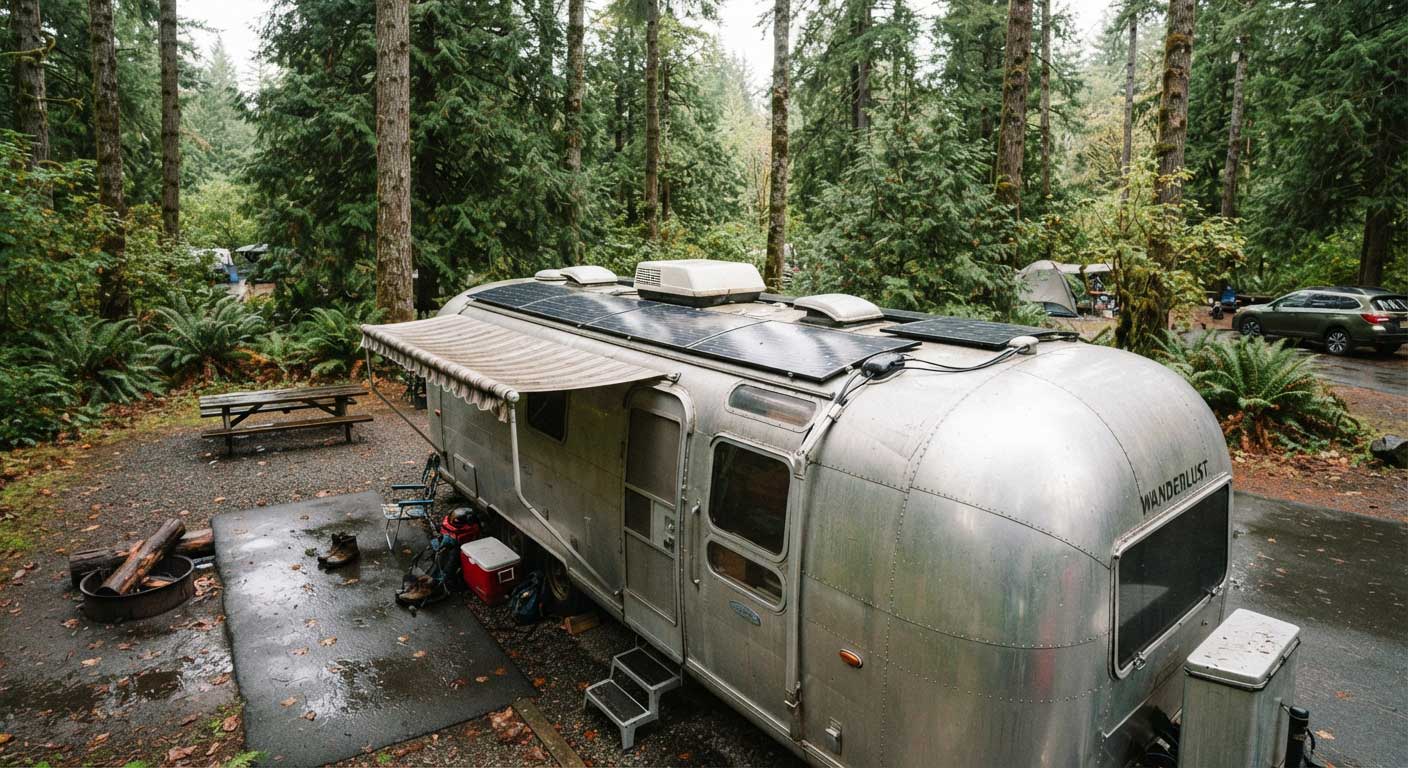
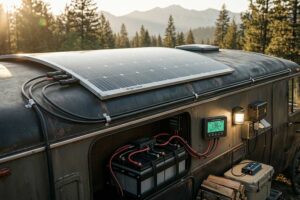
Flexible Solar Panels for Cloudy Trailer Roofs
Cloudy-weather performance does not automatically make flexible panels better than rigid panels.
The advantage of a flexible module is usually the installation surface.
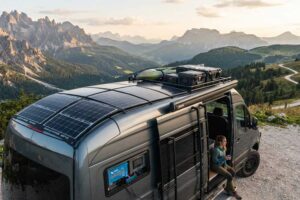
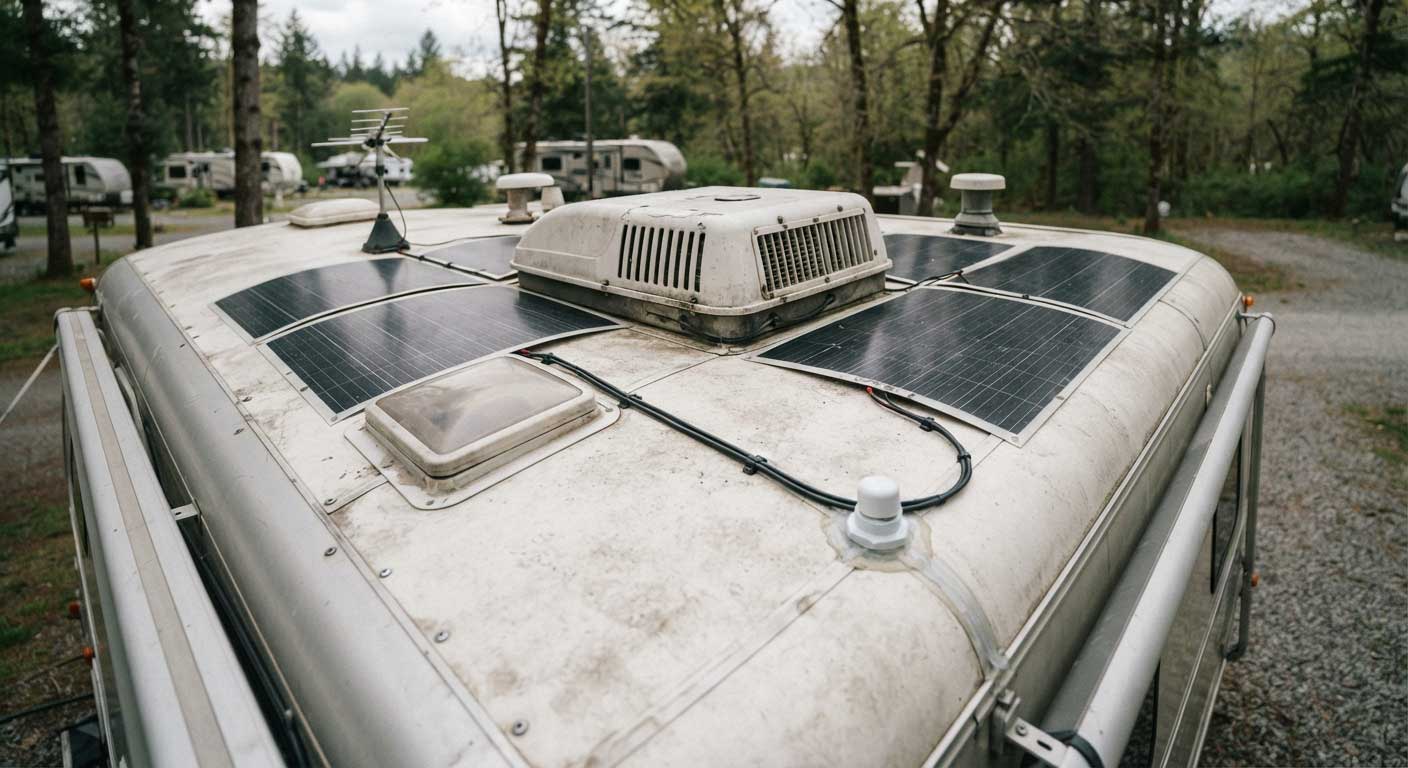
Travel trailers often have curved or weight-sensitive roof areas. A lightweight flexible panel can sometimes use roof space that would be awkward for a conventional framed module.
That matters when the design objective is to maximize usable surface area.
Bright Solar‘s flexible solar panel range is particularly suited to applications where low-profile construction, weight, and roof geometry are important considerations.
For a trailer, I would first map the roof.
Look at:
- Air-conditioning units
- Roof vents
- Skylights
- Antennas
- Satellite equipment
- Roof racks
- Walking areas
- Cable-entry locations
- Areas that become shaded at different times
Do not simply measure the roof and assume the entire surface is available.
A 12-inch vent can cast a surprisingly inconvenient shadow across part of a panel. On a small trailer roof, that can affect the practical value of an otherwise large-looking array.
Flexible Panels Need Careful Installation
A flexible panel is still a photovoltaic module with electrical connections that must survive vibration, moisture, temperature changes, and repeated road travel.
The roof surface should be properly prepared.
Cable penetrations need appropriate weatherproofing. Connectors should not be left where standing water can collect. Adhesive systems should follow the panel and roof-material manufacturer’s requirements rather than relying on a generic construction adhesive.
The installation should also account for thermal movement.
This is particularly important on trailers because the roof is not a stationary building surface. Road vibration and temperature cycling create a different mechanical environment.
How to Improve Solar Production During Cloudy Weather
There are several practical improvements that do not require replacing the entire system.
1. Keep the Panel Surface Clean
Clouds already reduce available irradiance. Dirt, dust, bird droppings, and road film add another layer of loss.
Trailer roofs are particularly exposed to dust and road grime because the vehicle moves through different environments.
Inspect the panel surface regularly, especially after long road trips.
2. Reduce Avoidable Shading
A roof vent or antenna cannot always be moved, but panel placement can often be improved.
Before installation, observe the roof at different times of day.
A shadow that looks insignificant at 8 a.m. may cross a large portion of the array at 11 a.m.
3. Use the Battery Strategically
During periods of weak sunlight, avoid unnecessarily charging high-power devices at the same time.
A microwave, induction cooktop, coffee maker, hair dryer, and inverter air conditioner can consume energy much faster than a small trailer array can replace it under heavy cloud.
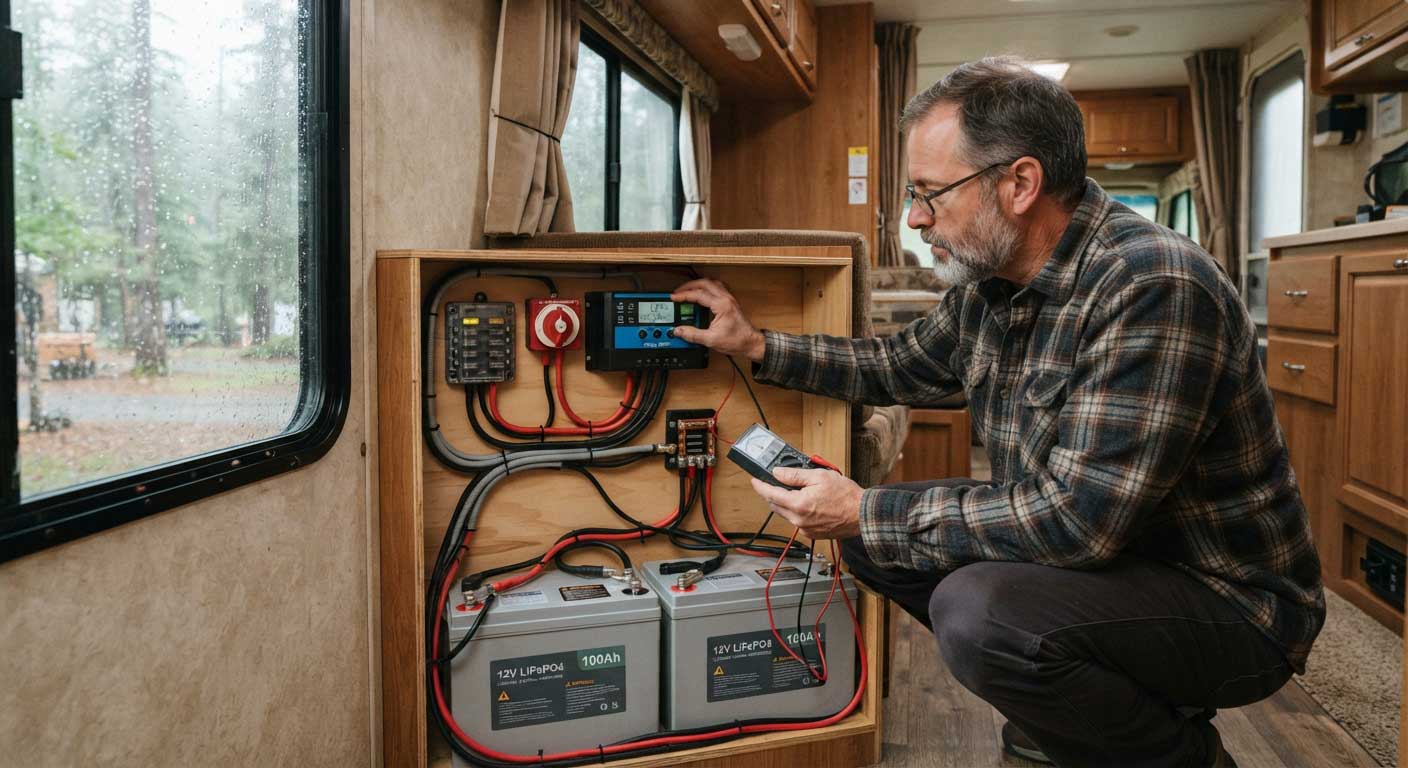
4. Monitor Real Energy Production
A solar monitoring system is extremely useful.
Record:
- PV voltage
- PV current
- Solar watts
- Daily solar Wh/kWh
- Battery voltage
- Battery state of charge
- Charging current
- Load consumption
After several trips, the owner has something much better than a theoretical estimate: actual operating data.
Case Study: A Cloud-Prone Travel Trailer
Consider a 24-foot travel trailer used for extended trips through Oregon and Washington.
The owner installs 800W of flexible solar, a properly matched MPPT controller, and a lithium battery bank sized for overnight and short-term weather interruptions.
The trailer’s daily electrical consumption is approximately 1.8–2.2 kWh depending on refrigerator duty cycle, electronics, fans, and cooking habits.
On a clear summer day, the system has comfortable production capacity.
During a gray weather period, the solar contribution becomes much less predictable.
The important observation is not that the panels “stop working.”
They do not.
The problem is that daily solar energy becomes inconsistent.
NREL identifies clouds, rapidly moving cloud cover, and high levels of diffuse light as important considerations when evaluating PV performance and forecasting.
The owner therefore uses the battery as a weather buffer rather than expecting the solar array to cover every load continuously.
That is a more realistic operating strategy for mobile solar.
How Many Solar Panels Do You Need for Cloudy RV Camping?
There is no universal number because trailer size, daily consumption, travel location, roof space, and battery capacity are different.
As a starting point:
| Trailer use | Suggested solar capacity | Typical system direction |
|---|---|---|
| Weekend, light loads | 200–400W | Basic battery charging |
| Moderate off-grid use | 400–800W | Good balance for many trailers |
| Extended off-grid travel | 800–1,200W | More useful in variable weather |
| High electrical demand | 1,200W+ | Requires careful roof and controller planning |
These are planning ranges, not guaranteed production figures.
For a trailer regularly traveling through cloudy regions, I would generally favor additional solar capacity when the roof allows it. Extra array capacity gives the system more opportunity to collect useful energy during weak irradiance periods.
But roof space has limits.
So does battery capacity.
The best design is the one where the three match:
solar generation + battery storage + daily energy consumption
FAQ: Solar Panels for Cloudy Days Trailers
Can solar panels charge an RV battery on a cloudy day?
Yes. Solar panels can still receive diffuse sunlight during cloudy weather and may continue charging an RV battery. The charging rate depends heavily on cloud thickness, irradiance, panel orientation, shading, temperature, and system design.
Do solar panels stop working when it rains?
No. Rain does not electrically switch off photovoltaic panels. However, heavy rain and dense cloud cover can greatly reduce the solar radiation reaching the modules, so output may become too low to support large RV loads.
Are flexible solar panels good for cloudy weather?
Flexible panels can work in cloudy weather just like other photovoltaic modules. Their main advantage is usually installation flexibility, low profile, and suitability for curved or weight-sensitive trailer roofs rather than a special ability to create electricity from clouds.
Should I install more solar panels if I camp in cloudy regions?
Usually, additional capacity is useful when roof space permits. More panel capacity gives the system a larger collection area during periods of weak sunlight. However, the charge controller, wiring, battery capacity, and roof layout must all be upgraded or sized accordingly.
Is battery storage important for cloudy RV camping?
Yes. A battery provides a buffer when solar production falls below the trailer’s electrical demand. This becomes particularly important during consecutive cloudy or rainy days when the array cannot replace all of the energy being consumed.
Does an MPPT controller help on cloudy days?
An MPPT controller can help the system make effective use of available PV power, especially when the array voltage is appropriately higher than the battery voltage. It cannot compensate for sunlight that is not reaching the panels, but it can improve energy harvesting within the available operating conditions.
What is the best solar setup for a trailer in cloudy weather?
A practical setup combines sufficient roof-mounted solar capacity, an appropriately sized MPPT controller, adequate battery storage, efficient wiring, good shading management, and realistic load planning. For frequent cloudy travel, designing around historical solar-resource data is more reliable than using a fixed “cloudy-day output percentage.”
Final Takeaway
Solar panels for cloudy days trailers are entirely practical, but they should be designed around variable solar production rather than perfect weather. Cloudy conditions reduce irradiance, yet diffuse sunlight can still provide useful energy. For RV owners, the strongest approach is usually enough panel capacity, sensible battery storage, an appropriate MPPT controller, careful roof layout, and real-world monitoring.
The biggest mistake is sizing an RV solar system for the best day and expecting it to behave the same way during a week of gray skies.
A good system is built for the weather you actually travel through.
Related recommendations
-

flexible solar panels for home: Lightweight Solar Power Solution for Modern Houses
129Discover flexible solar panels for home with lightweight design, high efficiency, and easy installation. Bright Solar provides durable solar solutions for modern residential energy needs.
View details -
Solar Panel for 12V Battery: How to Choose the Right Size, Power, and Setup
199Discover how to choose the best solar panel for 12V battery charging. Learn sizing, real-world performance, battery protection, and off-grid energy tips from Bright Solar.
View details -
highest watt flexible solar panel: Powerful Flexible Solar Solution for High Energy Demand
275Discover the highest watt flexible solar panel for RVs, marine, and off-grid applications. Learn power output, technology, installation, and benefits from Bright Solar.
View details -
Flexible Amorphous Solar Panels: Uses, Efficiency and Buying Guide
138Flexible amorphous solar panels use thin-film amorphous silicon in lightweight, bendable modules for curved, lightweight, or unconventional surfaces.
View details