Solar Panels for Camping Trailers: Complete Guide
solar panels for camping trailers provide reliable off-grid electricity for lights, refrigerators, fans, water pumps, electronics, and other trailer loads. The right system depends on daily energy use, roof space, battery capacity, solar conditions, and whether high-power appliances such as air conditioners are required.
A camping trailer changes the solar calculation in one important way: everything is limited by space and weight.
On a house roof, adding another panel is usually a question of roof area. On a trailer, that extra panel may compete with a roof vent, air conditioner, skylight, antenna, storage rack, or walking space. The battery is another constraint. So is the cable route.
I have worked through enough RV and portable solar configurations to know that the panel wattage printed on the module is only the beginning. A 400W panel array may look impressive on paper, but if the trailer spends most afternoons under pine trees, the number on the label becomes much less meaningful.
The U.S. Department of Energy explains that actual photovoltaic performance is affected by factors including sunlight availability, orientation, temperature, and system design. NREL likewise notes that PV modules are rated under standard test conditions of 1,000 W/m² irradiance and 25°C cell temperature, conditions that do not represent every moment in the field.
That difference between laboratory rating and campground reality is where good trailer-solar design begins.
How Many Solar Panels for a Camping Trailer?
There is no single number that works for every trailer.
A small teardrop trailer with LED lights, USB charging and a compressor refrigerator might work well with 200–400W of solar.
A larger travel trailer with a 12V refrigerator, water pump, furnace blower, televisions and several electronic devices may be more comfortable with 400–800W.
An off-grid trailer running an inverter, coffee maker, microwave or air conditioner can require considerably more PV capacity and battery storage.
Typical Camping Trailer Solar Sizes
| Trailer Use | Approx. Solar Capacity | Typical Battery Size |
|---|---|---|
| Basic weekend camping | 100–200W | 50–100Ah |
| Small trailer | 200–400W | 100–200Ah |
| Medium travel trailer | 400–800W | 200–400Ah |
| Heavy off-grid use | 800–1,200W+ | 400Ah+ |
| AC / high-power appliances | 1,000W+ | Depends heavily on usage |
These are planning ranges rather than universal specifications.
A refrigerator that cycles for several hours does not consume the same amount of energy as a microwave running for ten minutes. A furnace blower may draw modest power but run overnight. A laptop might use relatively little electricity, but five devices charging simultaneously add up.
The useful number is daily watt-hours.
Solar Panels for Camping Trailers: Calculate Energy Use First
Before choosing panels, make a simple load table.
For example:
| Appliance | Power | Daily Use | Daily Energy |
|---|---|---|---|
| 12V refrigerator | 50W average | 10h | 500Wh |
| LED lights | 20W | 4h | 80Wh |
| Water pump | 60W | 0.5h | 30Wh |
| Phone charging | 10W | 3h | 30Wh |
| Laptop | 60W | 3h | 180Wh |
| Vent fan | 25W | 5h | 125Wh |
| Total | — | — | 945Wh/day |
This trailer would need roughly 945Wh per day under these assumptions.
Now suppose the location averages five effective peak-sun-hours:
945Wh ÷ 5h = 189W
That does not mean a 200W solar array is enough.
The calculation assumes ideal production.
Real PV systems experience temperature effects, wiring losses, controller losses, inverter losses, shading and variable irradiance. NREL specifically identifies solar resource, temperature, soiling, shading, wiring and inverter efficiency among factors affecting actual PV energy delivery.
For a real trailer, I would rather start around 300–400W for this example than build a 200W array with almost no margin.
That extra capacity becomes useful on a hazy day.
Or when the refrigerator runs harder.
Or when the trailer gets parked beneath trees.
Best Solar Panels for Camping Trailers
The “best” panel depends on the trailer rather than the marketing specification.
Rigid Solar Panels
Rigid monocrystalline panels are usually attractive when the trailer has enough roof space and the owner prioritizes long-term durability and cost per watt.
Advantages include:
- High power density
- Established construction
- Good availability
- Easy electrical specification
- Suitable for larger roof arrays
- Generally strong long-term outdoor performance
The downside is obvious when you lift one onto a small trailer roof.
It is not weightless.
Flexible Solar Panels
Flexible panels make more sense when:
- roof weight matters;
- the roof is curved;
- low-profile installation is preferred;
- the trailer has an unusual roof surface;
- conventional mounting hardware is undesirable.
For Bright Solar’s flexible-panel applications, the installation surface deserves as much attention as the electrical specification.
A flexible panel sitting directly against a hot roof can experience higher operating temperatures. NREL notes that PV output decreases with increasing module temperature according to the module’s temperature coefficient.
That is easy to overlook when a trailer is parked in full summer sun.
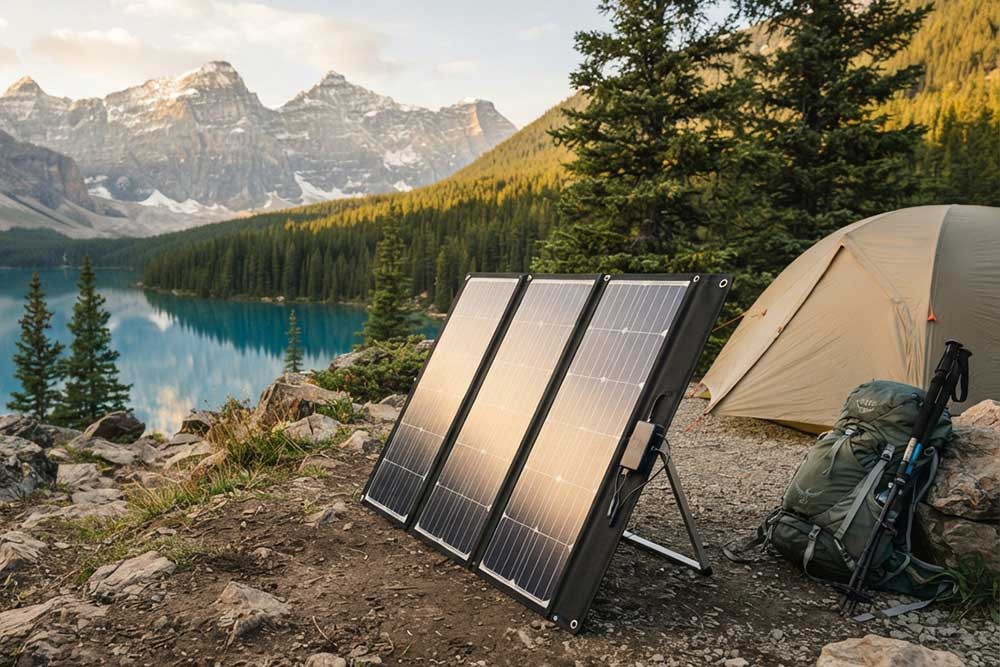
Portable Folding Solar Panels
Portable panels are useful when the trailer roof is crowded.
You can park the trailer in the shade and place the solar panel in a sunny location several feet away, provided the cable run and voltage-drop considerations are handled correctly.
That can be a surprisingly good solution in wooded campgrounds.
The roof stays cool.
The solar panel gets sunlight.
And the trailer does not need to be parked in the sun simply because the battery needs charging.
Solar Panels for Travel Trailers: Roof Space Is the Real Constraint
A travel trailer roof can look large from the ground.
It is not necessarily large once you mark the unusable areas.
Start by measuring:
- Roof length
- Roof width
- Air-conditioner footprint
- Skylights
- Plumbing vents
- Refrigerator vents
- Antennas
- Roof racks
- Existing wiring
- Service access areas
Then draw rectangles representing the panels.
Do not start with the panel count.
Start with the roof.
A common mistake is discovering that four large modules technically fit, but the fourth blocks access to a roof component or creates an awkward cable route.
A slightly smaller panel arrangement can sometimes produce a better overall system.
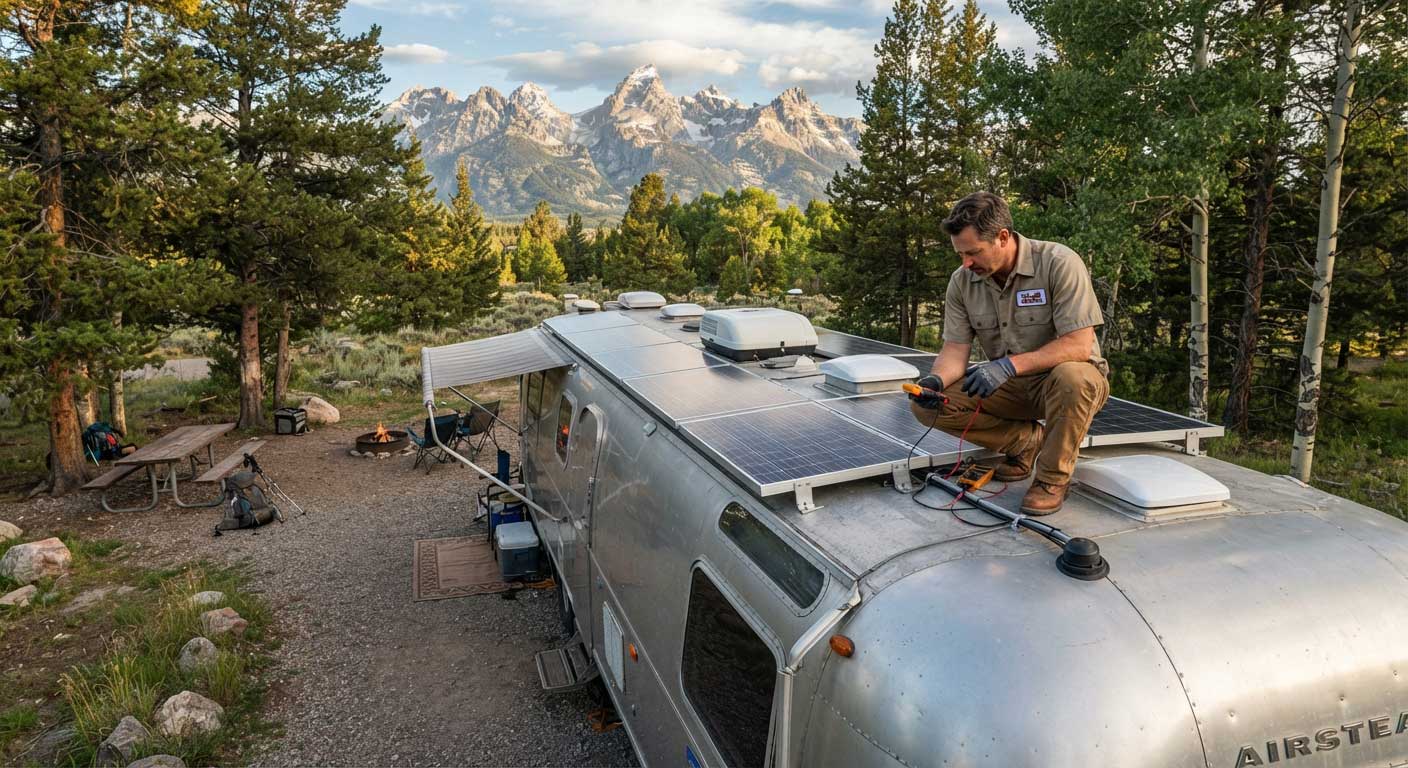
How to Install Solar Panels on a Camping Trailer
The installation method depends on the panel type and roof construction.
Step 1: Inspect the Roof
Look for:
- Existing cracks
- Sealant deterioration
- Soft spots
- Previous mounting holes
- Roof curvature
- Drainage paths
- HVAC equipment
Do not install over a questionable surface and expect the solar panel to solve the problem.
Step 2: Position the Panels Before Permanent Installation
Place cardboard templates on the roof if necessary.
This sounds excessive.
It is not.
A cardboard mock-up quickly reveals whether a panel will interfere with a vent, shadow another panel, or leave enough room for cable routing.
Step 3: Plan Cable Entry
The cable entry point should be:
- accessible;
- properly sealed;
- protected from standing water;
- mechanically secure;
- routed away from sharp edges.
A roof penetration is one of the places where I would slow down.
Solar production can be excellent.
A badly sealed roof penetration can still ruin the trip.
Step 4: Choose Series or Parallel Wiring
Series wiring increases PV voltage.
Parallel wiring increases current.
For example, two 200W panels with approximately 20V Vmp and 10A Imp can produce roughly:
Series: 40V, 10A
or:
Parallel: 20V, 20A
The correct configuration depends on the MPPT controller and cable distance.
Step 5: Connect the Charge Controller
The solar array should be connected to a properly rated charge controller, with the controller matched to the panel voltage, current and battery voltage.
For a trailer using a 12V or 24V battery system, MPPT controllers can be particularly useful when the PV array operates at a higher voltage than the battery.
How Much Battery Storage Do Camping Trailers Need?
Solar panels make electricity during the day.
The battery determines how much of that energy remains available later.
For example, if a trailer consumes approximately:
1,000Wh/day
a 12V 100Ah battery contains a nominal:
12V × 100Ah = 1,200Wh
That does not mean all 1,200Wh is necessarily available for loads.
Usable energy depends on battery chemistry and the manufacturer’s recommended depth of discharge.
A 200Ah 12V lithium battery would have approximately:
12V × 200Ah = 2,400Wh nominal
Again, actual usable energy depends on the battery specification.
For a trailer, I generally prefer to size the battery around the overnight and cloudy-day load, while sizing the solar array around the daily energy replacement requirement.
Those are related but different jobs.
Solar Panels for Camping Trailers and 12V Batteries
Many camping trailers use 12V electrical systems because lighting, water pumps, fans and refrigerators can operate directly from DC power.
This creates an important design opportunity.
If a load can run directly from the 12V battery, there is no need to convert that electricity to AC and back again.
For example:
Solar → MPPT → Battery → 12V refrigerator
is generally a simpler energy path than:
Solar → Battery → Inverter → AC adapter → Refrigerator
Every conversion introduces losses.
That does not mean an inverter should be avoided.
Microwaves, laptops, televisions, induction cookers and other AC appliances may require one.
But I would avoid powering a small DC load through a large inverter simply because the trailer already has one.
Series vs Parallel Solar Panels for Camping Trailers
This decision deserves more attention than it usually gets.
Suppose a trailer has four 200W panels.
Series Configuration
4 × 20V = approximately 80V Vmp
Current remains around:
10A
Parallel Configuration
Voltage remains around:
20V
Current becomes:
4 × 10A = 40A
2S2P Configuration
Two panels in series:
40V / 10A
Two identical strings in parallel:
40V / 20A
All three configurations represent approximately 800W of nominal panel capacity.
But they place very different demands on the controller and wiring.
For longer cable runs, higher PV voltage can reduce current and therefore reduce resistive cable losses for a given power level.
For a compact trailer with a short cable run and a controller designed for lower PV voltage, parallel wiring may be perfectly reasonable.
The controller specification decides.
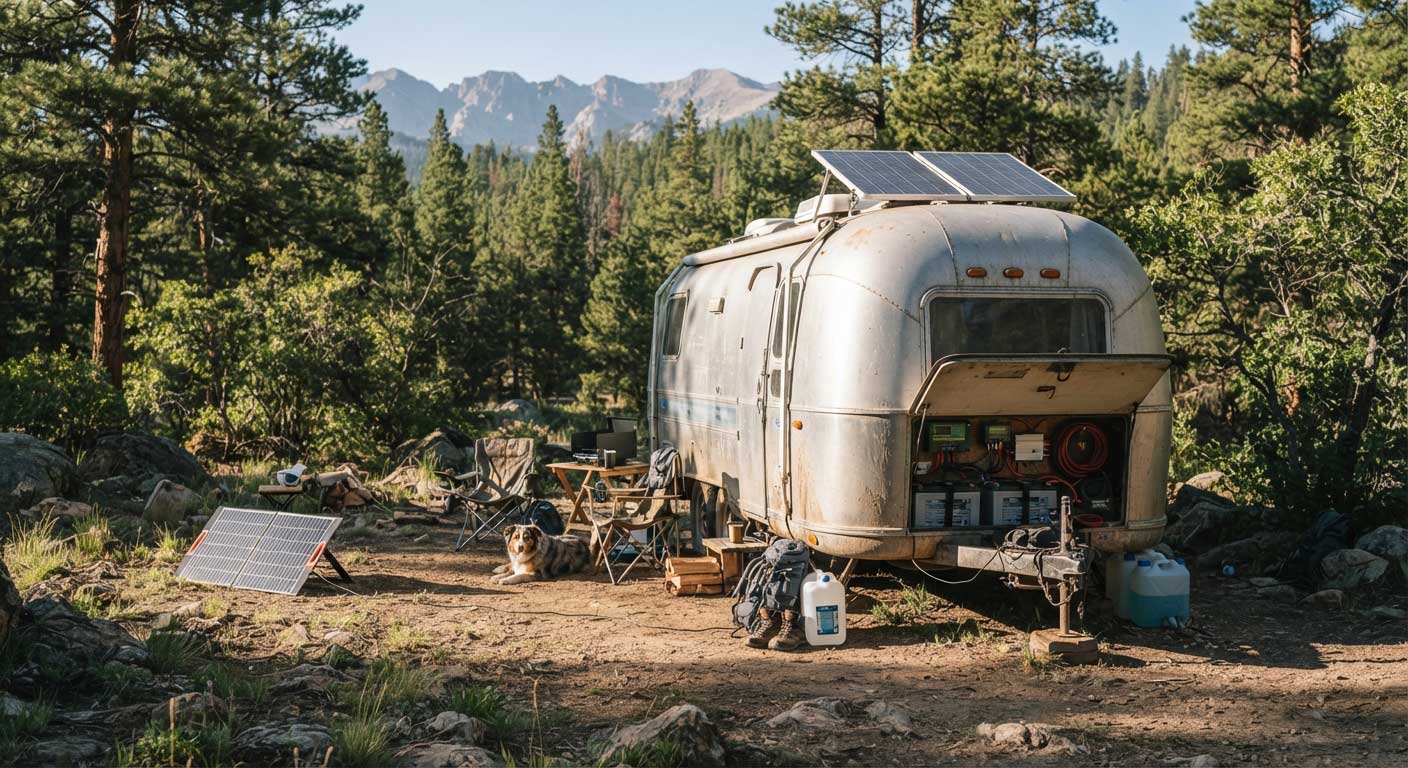
Camping Trailer Solar Example: 600W Roof Array
Consider a 24-foot travel trailer used for three-day off-grid trips.
The owner uses:
- 12V refrigerator
- LED lighting
- Water pump
- Roof vent fan
- Two phones
- Laptop
- Small television
Estimated daily consumption:
1.4kWh/day
The roof can accommodate three 200W panels.
Total PV:
600W
Assume five peak-sun-hours:
600W × 5h = 3.0kWh theoretical daily production
That looks comfortably above the 1.4kWh load.
But the owner regularly camps in wooded areas.
At one campground, the trailer can only be positioned under partial tree cover.
The solar output falls sharply.
This is where a portable fourth panel can become more useful than simply increasing the battery.
A larger battery stores energy.
It does not create energy.
The solar array has to replace what the trailer consumes.
How Much Solar Power Does a Camping Trailer Need?
A useful rough planning range is:
200–400W: basic trailer loads
400–800W: comfortable off-grid travel trailer
800–1,200W: heavier electrical use
1,200W+: high-energy systems, subject to roof space and controller limitations
But daily energy consumption is still more important than the panel number.
A trailer consuming 600Wh/day and a trailer consuming 2,000Wh/day should not receive the same solar system simply because they are the same physical size.
NREL’s PVWatts and other PV tools exist precisely because solar production varies with location, solar resource, orientation and system characteristics.
For a real project, I would use the installation location rather than assuming a generic “five hours of sunlight.”
Five hours is a useful teaching number.
It is not a site assessment.
What Appliances Can Solar Panels Run in a Camping Trailer?
A properly sized system can handle many everyday trailer loads.
Easy Loads
- LED lights
- USB chargers
- Phones
- Tablets
- Small DC fans
- Water pump
- 12V refrigerator
- Internet router
Moderate Loads
- Laptop
- Television
- Larger ventilation fans
- Small coffee maker
- CPAP machine
- Small inverter appliances
Heavy Loads
- Microwave
- Induction cooktop
- Hair dryer
- Electric heater
- Air conditioner
The last category changes the design quickly.
A microwave might operate for only ten minutes, while an air conditioner can run for hours.
Energy consumption is therefore:
Power × time
not just power.
Can Solar Panels Run an Air Conditioner on a Camping Trailer?
Yes, but the system becomes much larger.
A 1,500W AC running for four hours could consume:
1.5kW × 4h = 6kWh
That is several times the daily energy requirement of a lightweight weekend trailer.
The solar array, battery, inverter and roof space all need to scale accordingly.
For this reason, I would not treat air conditioning as just another trailer appliance.
It is a system-design driver.
A trailer owner who wants air conditioning off-grid should decide that before selecting the panel layout.
Not after.
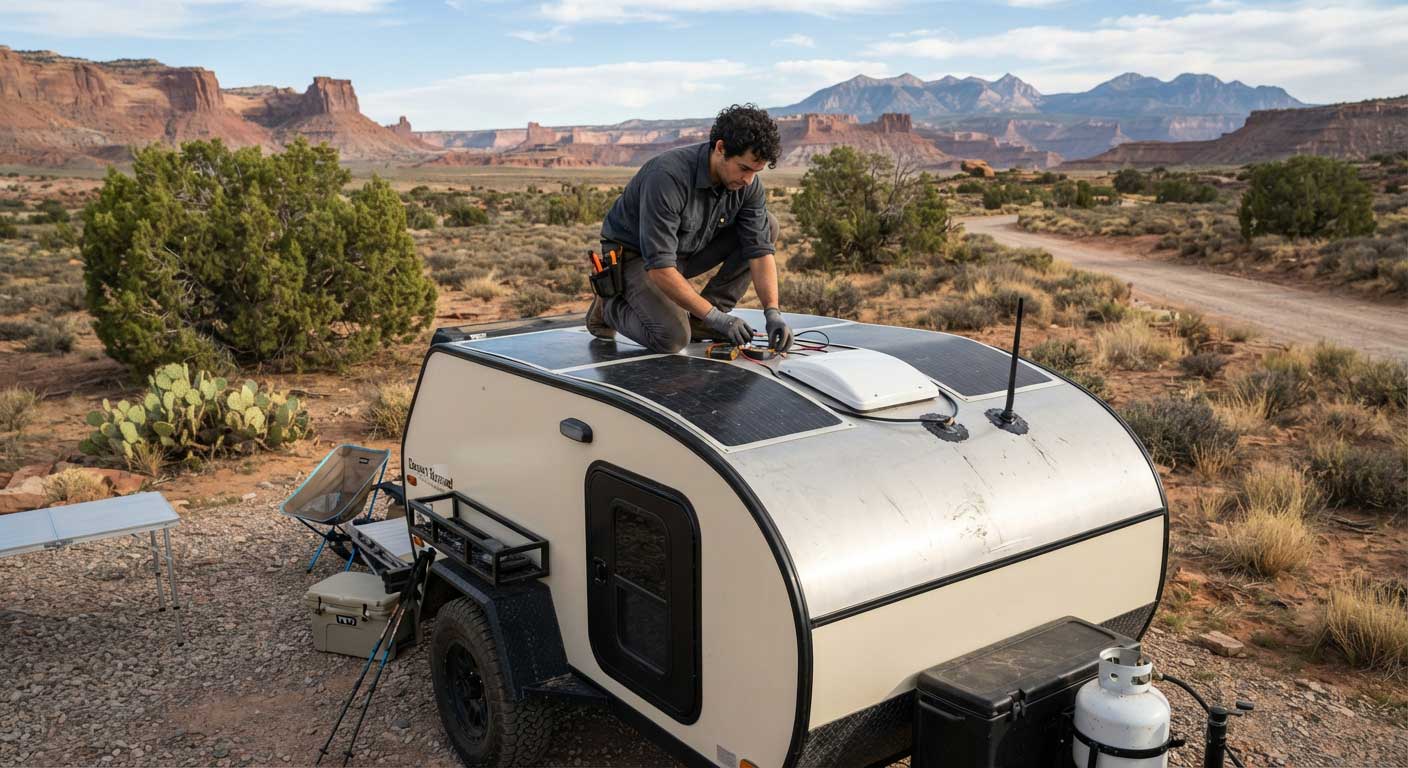
Flexible Solar Panels for Camping Trailers
Flexible solar panels can be particularly useful when the trailer roof has a curved or weight-sensitive structure.
They can offer:
- Low-profile appearance
- Lower installation height
- Reduced mounting hardware
- Flexible placement
- Suitability for curved surfaces
- Easier integration into certain trailer designs
But flexible does not mean installation-free.
The roof still needs:
- Proper surface preparation
- Reliable adhesion
- Waterproof cable entry
- Appropriate sealant
- Correct electrical connections
- Protection against abrasion
- Consideration of panel temperature
NREL’s performance research confirms that real PV output differs from standard-test ratings because actual module temperature and irradiance vary in the field.
That matters on trailers because a panel can spend hours exposed to intense sunlight on a roof with limited rear-side cooling.
Solar Charge Controller for Camping Trailer Panels
The charge controller needs to match both the PV array and battery system.
For an MPPT controller, check:
- Maximum PV open-circuit voltage
- MPPT operating range
- Maximum charging current
- Maximum PV power
- Battery voltage
- Manufacturer’s wiring requirements
For example, an 800W array connected to a 12V battery can involve substantial charging current.
A rough theoretical calculation is:
800W ÷ 12V = 66.7A
The controller does not necessarily operate at exactly this value, but it shows why controller sizing becomes important.
At 24V:
800W ÷ 24V = 33.3A
The same PV capacity becomes easier to handle on the battery side at the higher battery voltage.
This is one reason larger trailer electrical systems often move toward 24V or 48V architectures.
Solar Panel Wiring Safety on Camping Trailers
A trailer moves.
That changes the mechanical requirements.
PV cables can be exposed to:
- vibration
- roof movement
- UV radiation
- moisture
- temperature changes
- sharp edges
- repeated flexing
Cable management should therefore be treated as part of the electrical design.
Use properly rated PV cable and connectors.
Avoid loose cable loops sitting where they can rub against the roof.
Keep connectors away from standing water where possible.
Protect cable runs from mechanical damage.
And verify polarity before final connection.
A beautiful solar array with poorly secured cables is not a finished installation.
Camping Trailer Solar Maintenance
Maintenance is usually simple, but trailers introduce one extra issue: storage.
If the trailer sits unused for several months, check:
- Battery state of charge
- Controller status
- Panel surface
- Cable connections
- Roof sealant
- Junction boxes
- Mounting or adhesive condition
- Signs of water intrusion
Dust and pollen are easy to ignore.
So are small cracks around roof penetrations.
NREL maintains a PV soiling map because accumulated dirt can affect real-world PV performance, with field data collected at locations across the United States.
For a camping trailer, cleaning the panels occasionally is usually much easier than cleaning a residential rooftop array.
Take advantage of that.
Solar Panels for Camping Trailers: Common Mistakes
Buying Panels Before Measuring the Roof
The panel may be excellent.
It may simply be too large for the available roof space.
Choosing the Battery Before Calculating Daily Loads
A large battery does not compensate indefinitely for insufficient solar generation.
Ignoring Shading
A campground with beautiful trees can be a terrible solar site.
That is not a contradiction.
It is camping.
Using an Oversized Inverter for Small Loads
An inverter consumes some energy simply by operating. For a trailer with mostly 12V loads, direct DC operation can make more sense.
Forgetting the Trailer’s Roof Equipment
Air conditioners, vents and antennas occupy valuable solar real estate.
Assuming 400W Means 400W All Day
PV ratings are measured under standardized conditions. NREL notes that actual irradiance and cell temperature differ from STC and that real-world output is affected by multiple system and environmental factors.
Solar Panels for Camping Trailers: A Practical 400W Setup
For a couple traveling in a small trailer, consider:
400W solar array
200Ah 12V lithium battery
MPPT charge controller
1,000–2,000W inverter
Daily loads:
- Refrigerator
- LED lights
- Phones
- Laptop
- Water pump
- Vent fan
- Small television
A 400W array can produce meaningful daily energy under good solar conditions.
At five theoretical peak-sun-hours:
400W × 5h = 2,000Wh
or:
2kWh/day
Actual output will be lower or higher depending on the location and conditions.
If the trailer uses approximately 1.2kWh/day, there is reasonable room for normal variation.
If the owner adds a microwave and runs it heavily, the battery and inverter become more important.
If the owner adds air conditioning, the entire design needs to be reconsidered.
That is the point where a 400W weekend-camping system becomes a substantially larger off-grid power system.
FAQ: Solar Panels for Camping Trailers
How many solar panels do I need for a camping trailer?
Most basic camping trailers can start around 200–400W of solar, while larger travel trailers often benefit from 400–800W or more. The correct size depends on daily energy consumption, battery capacity and available roof space.
Are 400W solar panels enough for a camping trailer?
A 400W system can be enough for lights, refrigeration, charging electronics, fans and moderate DC loads when solar conditions are good. It may not be sufficient for heavy loads such as air conditioning or electric heating.
What is the best solar panel for a travel trailer?
The best panel depends on roof space, weight, installation method and electrical requirements. Rigid panels are practical for larger roof arrays, while flexible panels can be useful on curved or weight-sensitive trailer roofs.
Can solar panels run a camping trailer refrigerator?
Yes. A properly sized solar and battery system can support a 12V compressor refrigerator. The correct array size depends on the refrigerator’s actual average energy consumption and the local solar resource.
Should camping trailer solar panels be wired in series or parallel?
Either can work. Series wiring increases voltage and can reduce PV cable current, while parallel wiring increases current while maintaining similar voltage. The MPPT controller’s voltage and current limits should determine the configuration.
Can flexible solar panels be installed on a camping trailer?
Yes. Flexible panels are well suited to some trailer roofs because of their low profile and ability to conform to curved surfaces. Installation quality, roof preparation, temperature and waterproof cable routing remain important.
Can solar panels power a camping trailer air conditioner?
Yes, but air conditioning dramatically increases the required solar, inverter and battery capacity. A trailer AC can consume more energy in several hours than the rest of the trailer’s low-power appliances use during an entire day.
Bright Solar’s Practical Approach to Camping Trailer Solar
When I evaluate solar panels for camping trailers, I don’t begin with a panel catalog.
I begin with the camping routine.
How many days will the trailer stay off-grid?
Will the refrigerator run continuously?
Is the owner using an induction cooker?
Does the trailer have a rooftop AC?
Will the trailer be parked in open desert or beneath trees?
How much roof can actually be used?
Those questions often change the system more than another 100W of panel capacity.
For example, a 400W roof array paired with a portable 200W panel can sometimes be more useful than permanently installing 600W on the roof. The portable panel can be moved into sunlight while the trailer remains under shade.
That is a small design decision, but in real camping conditions it can make a noticeable difference.
Bright Solar‘s approach is to treat the panel, charge controller, battery, inverter, roof and actual camping behavior as one system rather than separate products.
The goal is not the biggest solar array that fits on the trailer.
It is the smallest practical system that reliably covers the loads the owner actually uses.
Final Answer: Solar Panels for Camping Trailers
solar panels for camping trailers can provide dependable off-grid electricity for refrigerators, lights, fans, pumps, electronics and other trailer appliances when the PV array and battery are sized around real daily energy use.
For many small and medium trailers, 200–800W is a useful starting range. Larger off-grid systems may require 1,000W or more, particularly when the owner wants to run high-power appliances.
The most important calculation is not simply:
“How many watts of panels can I fit?”
It is:
“How many watt-hours does the trailer use each day, and can the available roof and solar conditions reliably replace that energy?”
That is the number worth designing around.
Related recommendations
-

Lightweight Portable Solar Panels: How to Choose the Right One
42Lightweight portable solar panels provide mobile electricity for camping, RV travel, outdoor work, and off-grid use. Choose by total carrying weight, rated p...
View details -
flexible solar panels for marine use: Lightweight Solar Power Solution for Boats and Yachts
131Explore flexible solar panels for marine use with lightweight design, waterproof protection, and reliable energy output for boats, yachts, and offshore applications.
View details -
Solar Panel Series Parallel: How to Wire Panels Correctly
251Solar panel series parallel wiring combines series and parallel connections to increase both PV voltage and current while staying within equipment limits.
View details -
Floating Photovoltaic Power Plants: Solar That Actually Floats
196Floating photovoltaic power plants are moving from small lakes in Asia to large offshore projects, including a planned 610.5 MW floating solar plant in the Philippines. As land becomes scarce, FPV systems on reservoirs and coastal waters offer new...
View details