
Solar Battery Charger for Boat: Reliable Marine Battery Charging Anywhere
A solar battery charger for boat applications provides a dependable, fuel-free way to maintain and recharge marine batteries using sunlight. Whether installed on a fishing boat, sailboat, yacht, or pontoon, a properly sized marine solar charging system can reduce battery failures, extend battery life, and provide continuous power while at anchor or in storage.
Walk through any marina early in the morning and you’ll see the same scene repeated dozens of times.
Some boats start instantly.
Others struggle.
A few owners are already unpacking portable chargers.
In most cases, the problem isn’t the battery itself.
It’s neglect.
Marine batteries slowly discharge even when a boat isn’t moving. Bilge pumps, monitoring systems, GPS memory circuits, and natural self-discharge all consume energy over time.
At Bright Solar, we’ve supplied marine solar charging systems for recreational boat owners, offshore sailors, charter operators, and commercial fishing fleets. One lesson appears again and again: maintaining battery charge is significantly cheaper than replacing batteries.
That’s exactly where a solar battery charger for boat installations proves valuable.
Why Boat Owners Are Switching to Solar Battery Charging
Marine batteries face unique challenges.
Unlike vehicles that operate daily, many boats remain docked or stored for extended periods.
During these inactive periods, batteries continue losing charge.
Common causes include:
- Bilge pump standby loads
- GPS memory systems
- Security devices
- Battery self-discharge
- Corrosion-related losses
According to the U.S. Department of Energy, battery performance and lifespan are heavily influenced by charging practices and state of charge management.
Reference Source:
A solar charging system helps maintain batteries automatically.
No extension cords.
No shore power dependency.
No constant monitoring.
Just sunlight.
How a Solar Battery Charger for Boat Systems Works
The principle is straightforward.
Solar panels convert sunlight into electricity.
That electricity passes through a charge controller before reaching the battery bank.
The charge controller regulates voltage and current to prevent:
- Overcharging
- Excessive discharge
- Battery damage
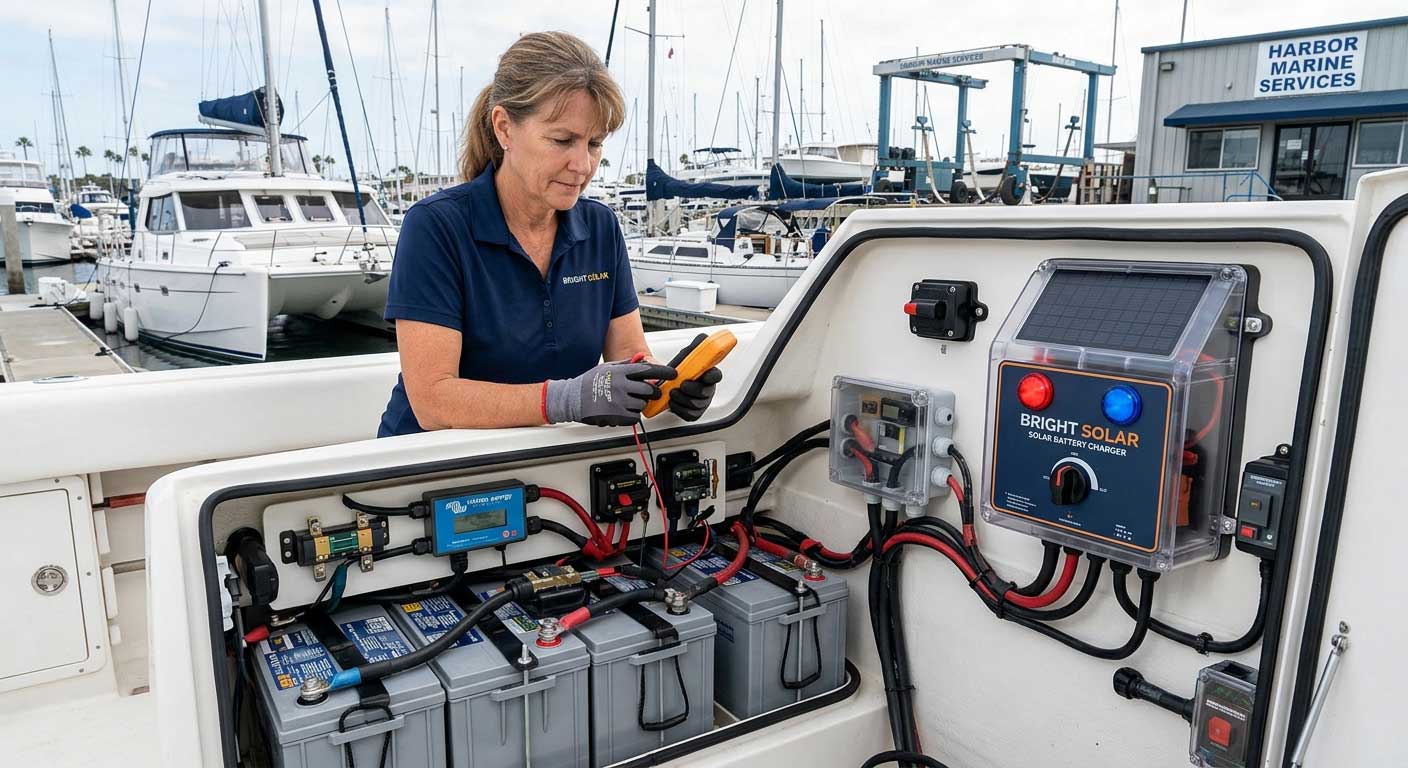
A typical marine solar charging system includes:
| Component | Function |
|---|---|
| Solar Panel | Generates power |
| Charge Controller | Regulates charging |
| Marine Battery | Stores energy |
| Wiring & Connectors | Transfers power |
| Mounting Hardware | Secures installation |
The process happens automatically.
Once installed, daily charging requires no effort from the boat owner.
Why Marine Environments Demand Specialized Solar Chargers
The ocean is unforgiving.
Equipment installed on boats must survive conditions that would quickly damage standard electrical products.
Marine solar charging systems face:
- Salt spray
- UV radiation
- Constant vibration
- Humidity
- Rain
- Temperature fluctuations
That’s why marine-grade components matter.
A low-cost charger designed for a backyard shed may fail quickly offshore.
Marine installations require:
- Waterproof connectors
- Corrosion-resistant materials
- UV-resistant cables
- Marine-rated charge controllers
Over the years, we’ve inspected numerous failed installations.
Most failures were not caused by solar panels.
They were caused by poor-quality wiring and connectors.
The weakest component usually determines system reliability.
Choosing the Correct Solar Battery Charger Size
One of the most common mistakes boat owners make is buying a charger based solely on price.
Sizing should always begin with battery capacity.
General recommendations:
| Battery Capacity | Recommended Solar Charger |
|---|---|
| 50Ah–100Ah | 20W–50W |
| 100Ah–200Ah | 50W–100W |
| 200Ah–400Ah | 100W–200W |
| 400Ah+ | 200W+ |
Actual requirements depend on:
- Battery chemistry
- Daily loads
- Climate
- Storage duration
- Vessel usage patterns
A weekend fishing boat has very different needs than a liveaboard cruising yacht.
Marine Solar Charging Options and System Configurations
Solar Power Boat Battery Charger: More Than Battery Maintenance
A solar power boat battery charger is often viewed as a simple battery maintainer, but on many vessels it becomes part of the daily energy infrastructure. On a 28-foot cruising sailboat I inspected near Phuket, the owner originally installed a small solar charger merely to prevent battery drain during storage. Within two seasons, the system had expanded to support navigation electronics, cabin lighting, and communication equipment.
That progression is common.
Many boat owners start by solving a battery problem and eventually discover that solar charging provides ongoing energy independence. Bright Solar typically recommends selecting a marine charging solution based not only on current battery capacity but also on future electrical loads that may be added later.
A well-designed solar power boat battery charger should deliver stable charging performance while tolerating salt exposure, vibration, and changing weather conditions that are unavoidable in marine environments.
Solar Panel for Marine Battery: Selecting the Right Module
Choosing the correct solar panel for marine battery charging involves more than matching wattage numbers.
Marine installations frequently face challenges that land-based systems never encounter:
- Salt mist accumulation
- Constant movement
- Partial shading from masts and rigging
- Limited mounting space
- Corrosive environments
For battery maintenance on smaller vessels, a compact solar panel for marine battery applications may be sufficient. Larger boats with refrigeration systems, fish finders, radar equipment, and onboard electronics often require significantly more solar capacity.
One mistake I see regularly is oversizing battery banks while undersizing charging sources. The result is predictable: batteries rarely reach full charge and lifespan declines over time.
Bright Solar marine panels are designed with corrosion-resistant materials and weather-resistant construction specifically because marine conditions expose weaknesses faster than almost any other environment.
Solar Panel for Boat Battery: Real-World Charging Expectations
A solar panel for boat battery charging should be evaluated based on daily energy recovery rather than peak wattage alone.
For example, a 100W solar panel may appear modest on paper. Yet in favorable conditions it can often return enough energy each day to offset standby consumption from:
- Bilge pumps
- GPS memory systems
- Monitoring equipment
- Safety electronics
- Small communication devices
During a marina inspection in southern Florida, I noticed that boats equipped with properly sized solar panel for boat battery systems consistently maintained healthier battery voltage levels during long storage periods than neighboring vessels relying solely on shore charging schedules.
The lesson was simple.
Consistent charging usually matters more than occasional charging.
Battery chemistry rewards regular maintenance.
Solar System for Boats: Building a Complete Marine Energy Solution
A modern solar system for boats goes beyond a single panel and battery connection.
Depending on vessel size and operating requirements, a complete solar system for boats may include:
- Marine-grade solar panels
- MPPT charge controllers
- Lithium or AGM battery banks
- Battery monitoring systems
- Waterproof distribution panels
- Shore power integration
Larger cruising yachts increasingly combine solar generation with lithium storage to reduce generator runtime and improve onboard comfort.
At Bright Solar, we frequently see owners begin with a basic battery maintenance setup and later expand into a more comprehensive solar system for boats as energy demands increase. The modular nature of marine solar makes that transition relatively straightforward when expansion is considered during the initial design stage.
The most successful marine installations are rarely the most complicated.
They are usually the systems designed around realistic daily energy consumption, quality components, and dependable charging performance year after year.
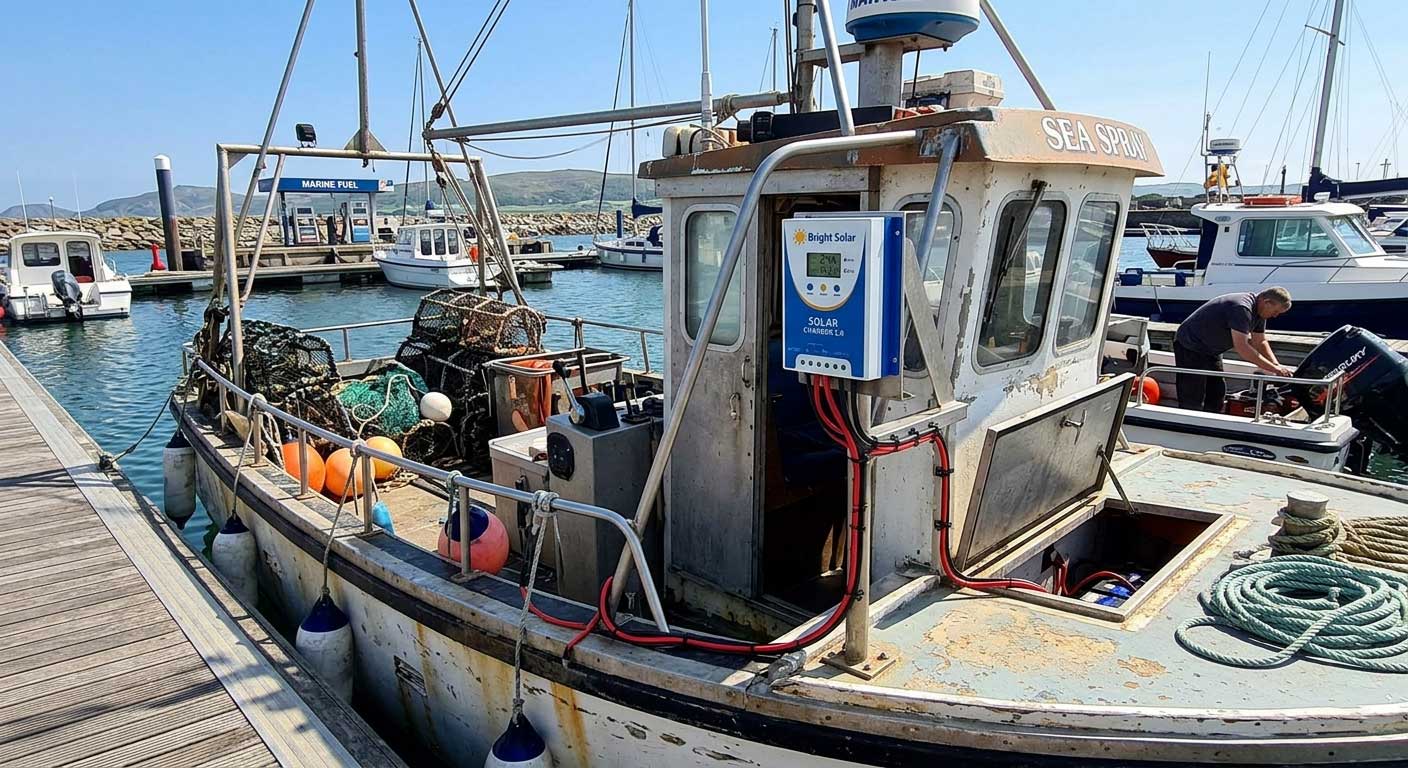
Real-World Case Study: Coastal Fishing Boat Upgrade
A commercial fishing operator on the Gulf Coast contacted Bright Solar after replacing starting batteries twice within three years.
The vessel spent long periods docked between fishing trips.
Battery testing revealed repeated deep discharge cycles.
The solution included:
- One 100W marine solar panel
- Waterproof MPPT charge controller
- Existing dual-battery bank
After twelve months:
| Metric | Before Installation | After Installation |
|---|---|---|
| Battery Replacements | Frequent | None |
| Average Battery Voltage During Storage | 12.1V | 12.7V |
| Engine Start Reliability | Inconsistent | Consistent |
The owner initially expected fuel savings.
Instead, the biggest benefit was reliability.
The boat started every time.
For commercial operators, that’s often more important than energy production itself.
MPPT vs PWM: Which Controller Is Better?
Boat owners frequently focus on solar panel specifications.
The charge controller deserves equal attention.
Two primary technologies exist:
| Feature | PWM Controller | MPPT Controller |
|---|---|---|
| Cost | Lower | Higher |
| Efficiency | Good | Excellent |
| Energy Harvest | Standard | Increased |
| Low-Light Performance | Moderate | Better |
According to research published by the National Renewable Energy Laboratory (NREL), maximizing solar energy harvest significantly improves overall system performance.
Reference Source:
For marine applications where available space is limited, MPPT controllers often justify the additional investment.
Every watt matters on a boat.
Solar Charging During Boat Storage
Storage periods create unique battery challenges.
Many boat owners assume disconnecting the battery solves everything.
Unfortunately, batteries continue losing charge naturally.
Lead-acid batteries are particularly vulnerable.
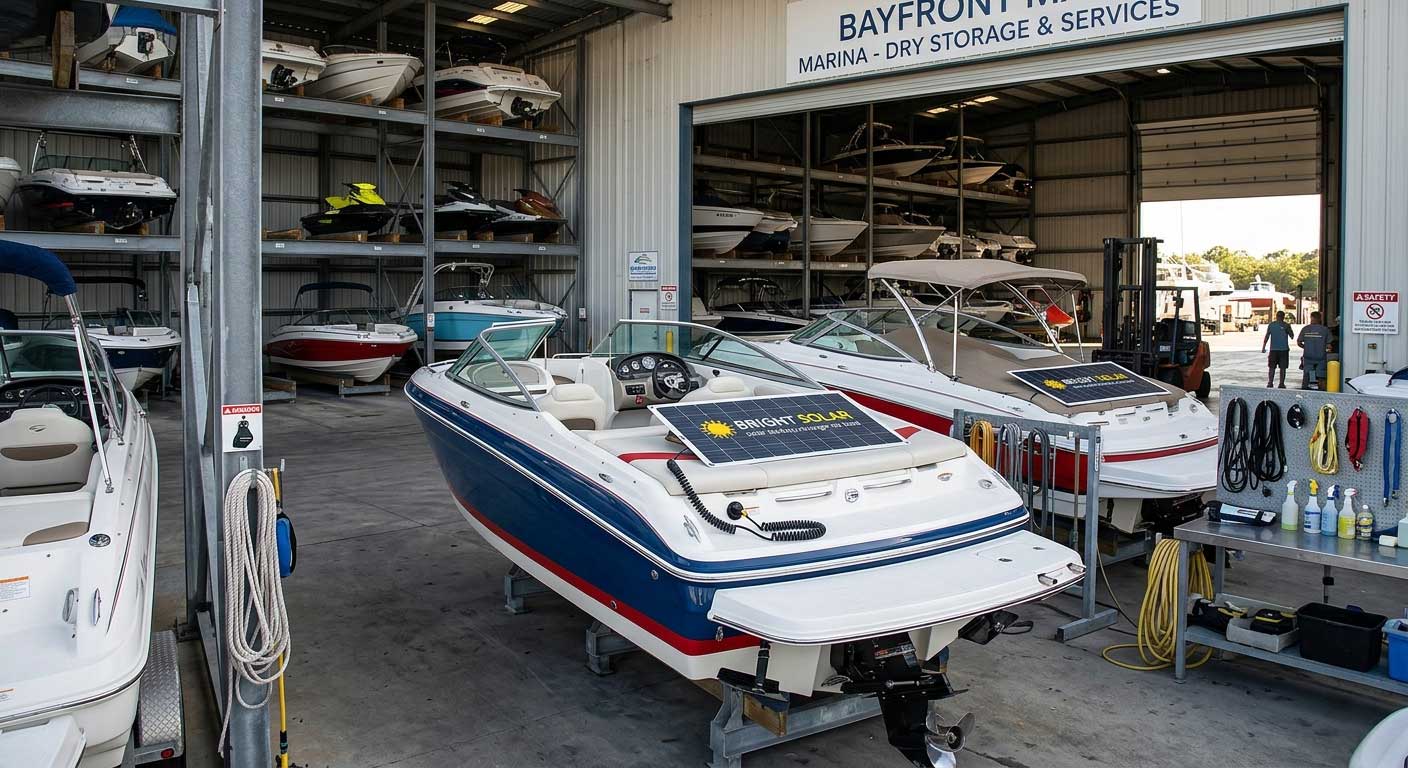
A properly sized solar battery charger for boat storage can:
- Maintain battery health
- Reduce sulfation risk
- Improve starting reliability
- Extend battery lifespan
One marina manager described solar maintenance charging as “insurance that pays for itself.”
That observation aligns closely with what we see in the field.
Battery Types Compatible with Marine Solar Chargers
Most marine solar charging systems support:
Flooded Lead-Acid Batteries
Traditional marine batteries remain widely used because of affordability.
AGM Batteries
Popular among boat owners because of lower maintenance requirements.
Gel Batteries
Suitable for certain marine applications requiring vibration resistance.
Lithium Batteries
Growing rapidly in popularity because of:
- Lower weight
- Faster charging
- Greater usable capacity
- Longer lifespan
Many modern marine solar systems are now designed specifically around lithium battery banks.
Common Installation Mistakes
After inspecting hundreds of marine systems, several mistakes appear repeatedly.
Undersized Wiring
Voltage drop reduces charging efficiency.
Marine cable sizing matters.
Poor Connector Selection
Saltwater quickly exposes weaknesses in electrical connections.
Incorrect Panel Placement
Shade from:
- Masts
- Radar domes
- Antennas
- Bimini tops
can dramatically reduce performance.
Ignoring Future Expansion
Many boat owners eventually add:
- Refrigerators
- Electronics
- Lithium batteries
Planning ahead reduces upgrade costs later.
Marine Solar Charging Performance Expectations
Average daily solar production varies based on:
- Panel size
- Geographic location
- Season
- Weather conditions
Typical marine charging estimates:
| Solar Panel Size | Daily Energy Production |
|---|---|
| 20W | 80–120Wh |
| 50W | 200–300Wh |
| 100W | 400–600Wh |
| 200W | 800–1200Wh |
For battery maintenance alone, relatively small systems often provide excellent results.
For continuous onboard loads, larger systems may be necessary.
FAQ About Solar Battery Charger for Boat Systems
Can a solar charger keep a boat battery fully charged?
Yes. A properly sized solar charger can maintain and recharge marine batteries during both operation and storage.
Are marine solar chargers waterproof?
Marine-grade systems are designed to withstand rain, salt spray, and outdoor marine conditions.
Will a solar charger overcharge my battery?
Not when used with a quality charge controller that regulates charging voltage.
Can solar chargers work on cloudy days?
Yes. Charging output decreases, but quality solar panels continue producing power under cloudy conditions.
Is solar charging suitable for lithium marine batteries?
Absolutely. Most modern solar charging systems support lithium batteries when paired with compatible controllers.
Final Thoughts on Solar Battery Charger for Boat Systems
The best solar battery charger for boat applications does more than generate electricity.
It protects batteries.
Improves reliability.
Reduces maintenance.
At Bright Solar, we’ve seen marine solar charging systems installed on:
- Fishing boats
- Cruising yachts
- Sailboats
- Pontoon boats
- Commercial vessels
Regardless of vessel type, the objective remains remarkably similar.
A battery that works when needed.
A system that operates quietly.
Power generated from sunlight instead of fuel.
For boat owners seeking dependable battery maintenance and energy independence, a solar battery charger for boat system remains one of the smartest marine upgrades available.
Related recommendations
-

Solar Panel Pergola: Combining Outdoor Living and Renewable Energy
241Explore solar panel pergola solutions that combine outdoor shade and renewable energy. Learn design options, costs, benefits, and installation tips from Bright Solar.
View details -
Flexible Film Solar Panels: Technology, Applications and Buying Guide
151Flexible film solar panels use lightweight photovoltaic structures on flexible substrates for curved, weight-sensitive, mobile, marine, and specialty surfaces.
View details -
300 W Solar Panel Performance Guide for RV, Battery and Off-Grid Systems
332Discover how a 300 w solar panel performs for RVs, boats, cabins, batteries, and off-grid systems. Learn output, applications, sizing, and real-world performance.
View details -
10W Flexible Solar Panel: Compact Power for Portable and Off-Grid Use
153A 10W flexible solar panel is a compact power source for low-energy, portable, marine, RV, and small off-grid applications.
View details