Mounting Solar Panels on RV: Complete Installation Guide for Secure Solar Power
Introduction
Mounting solar panels on RV requires choosing the right installation method based on roof type, panel design, weight, and travel conditions. RV solar panels can be installed with mounting brackets, adhesive solutions, or flexible solar panels to create a reliable mobile power system.
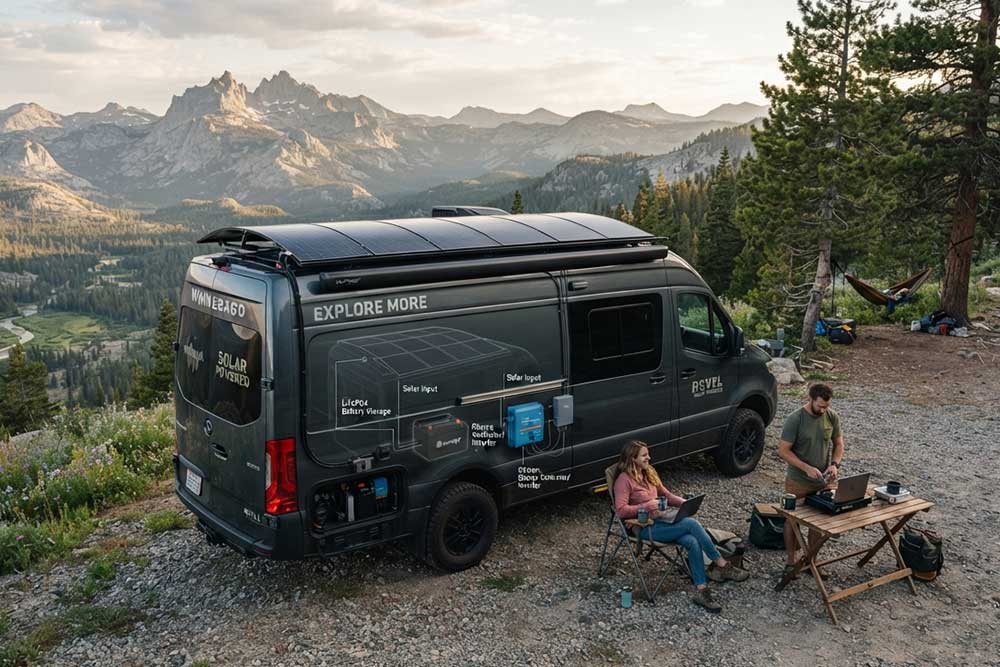
For many RV owners, solar power is the easiest way to stay connected while traveling off-grid. Whether you are camping in remote areas, exploring national parks, or living the van life, a properly installed solar system can provide clean and independent energy.
However, installing solar panels on an RV is not simply about attaching panels to the roof. The mounting method affects:
- Roof safety
- Waterproof performance
- Solar output
- Driving stability
- Long-term durability
Choosing the wrong mounting approach can lead to problems such as roof leaks, loose panels, damaged wiring, or reduced energy production.
This guide explains the different ways to mount solar panels on an RV, how to choose the right installation method, and the key factors to consider before starting your project.
For RV applications where weight and installation space are limited, Bright Solar flexible solar panels provide a lightweight solution designed for mobile energy systems.
Why Mount Solar Panels on an RV?
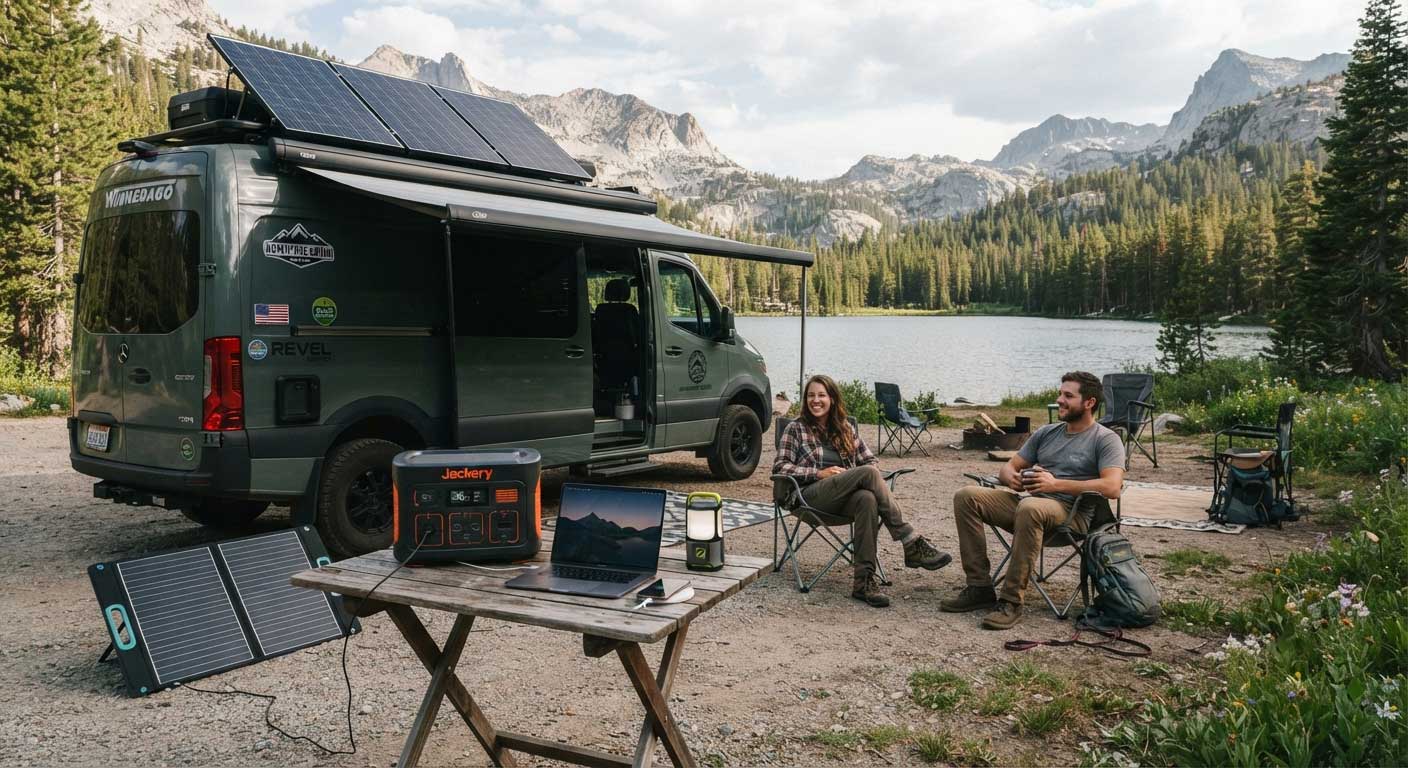
Installing solar panels on an RV provides a reliable renewable energy source that allows travelers to generate electricity without depending completely on campsites or generators.
RV solar systems are becoming increasingly popular because they offer more freedom and convenience for outdoor lifestyles.
Achieve Energy Independence While Traveling
One of the biggest benefits of RV solar panels is energy independence.
With a properly installed solar system, RV owners can power essential devices such as:
- Lights
- Refrigerators
- Fans
- Mobile devices
- Communication equipment
- Small appliances
This is especially useful when camping in locations without electrical hookups.
Reduce Generator Use and Operating Costs
Traditional RV power solutions often rely on fuel generators.
Although generators provide reliable electricity, they also create:
- Fuel expenses
- Noise
- Maintenance requirements
- Exhaust emissions
Solar panels provide silent and clean energy during daylight hours, helping reduce generator dependence.
Support Off-Grid Adventures
A well-designed RV solar system allows longer stays in remote areas.
Common applications include:
- Boondocking
- Camper van travel
- Remote camping
- Outdoor photography trips
- Mobile work setups
With enough solar capacity and battery storage, RV owners can enjoy greater freedom without searching for power connections.
What Should You Consider Before Mounting Solar Panels on an RV?
Before mounting solar panels on an RV, you should evaluate roof structure, available space, solar panel type, weight limitations, and installation method to ensure a safe and efficient system.
Every RV has different design characteristics, so there is no universal mounting solution.
Check Your RV Roof Type
The roof material determines which mounting method is suitable.
Common RV roof types include:
Fiberglass Roofs
Fiberglass roofs are common on many modern RVs.
Advantages:
- Smooth surface
- Good durability
- Suitable for adhesive mounting
However, the surface must be cleaned properly before applying adhesives.
Aluminum Roofs
Aluminum roofs are lightweight and durable.
When installing solar panels:
- Use proper mounting hardware
- Avoid unnecessary drilling
- Prevent corrosion around mounting points
Rubber Membrane Roofs
Many RVs use rubber roof membranes such as EPDM or TPO materials.
Extra care is required because:
- Incorrect drilling can damage the membrane
- Certain adhesives may not bond properly
Always use RV-compatible sealants and mounting materials.
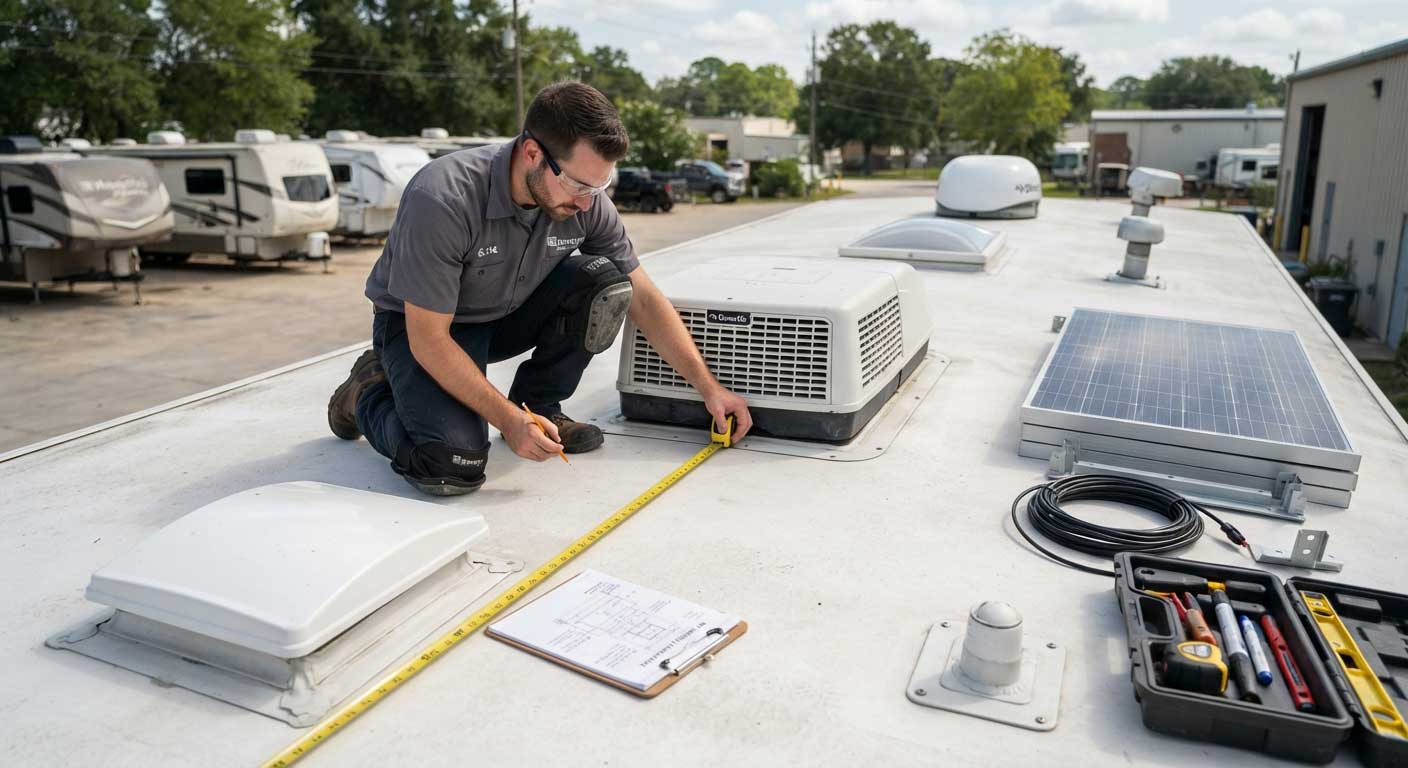
Evaluate Available Roof Space
RV roofs often have limited usable space.
Before installation, check the position of:
- Air conditioners
- Roof vents
- Skylights
- Antennas
- Satellite equipment
Solar panels should be placed where they receive maximum sunlight throughout the day.
Avoid installing panels where frequent shadows occur.
Consider Solar Panel Type
The type of solar panel affects the mounting method.
The two main options are:
Rigid Solar Panels
Rigid panels usually use:
- Aluminum frames
- Mounting brackets
- Mechanical fasteners
Advantages:
- Strong structure
- Long service life
- Better heat dissipation
They are suitable for permanent RV installations.
Flexible Solar Panels
Flexible solar panels are designed for situations where weight and installation flexibility matter.
Advantages include:
- Lightweight construction
- Low-profile design
- Easy installation on curved surfaces
- Reduced wind resistance
They are popular for:
- RVs
- Camper vans
- Boats
- Mobile applications
Bright Solar flexible solar panels are developed for users who need efficient solar generation while keeping installation weight low.
Different Ways to Mount Solar Panels on an RV
The main methods for mounting solar panels on an RV include bracket mounting, adhesive mounting, and flexible solar panel installation. Each method has different advantages depending on your RV type and usage requirements.
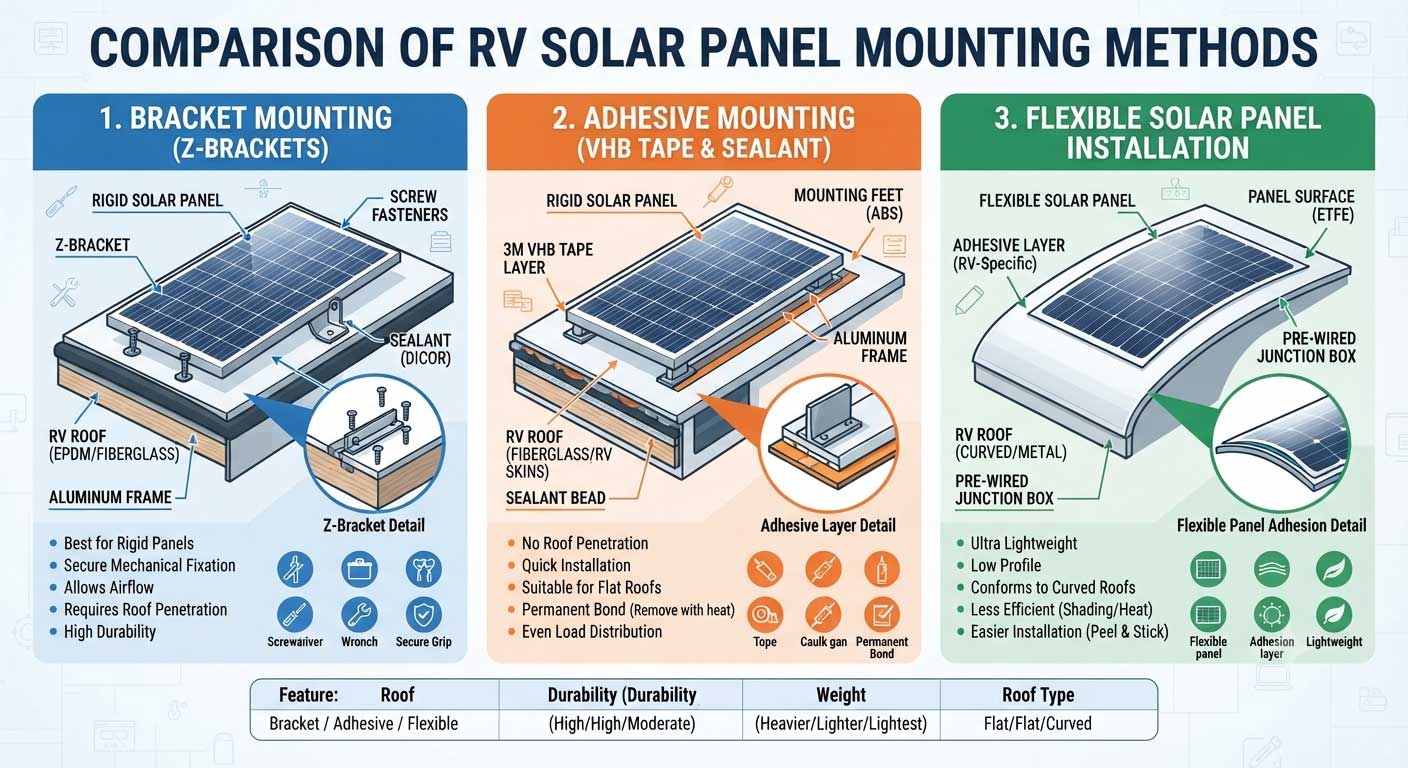
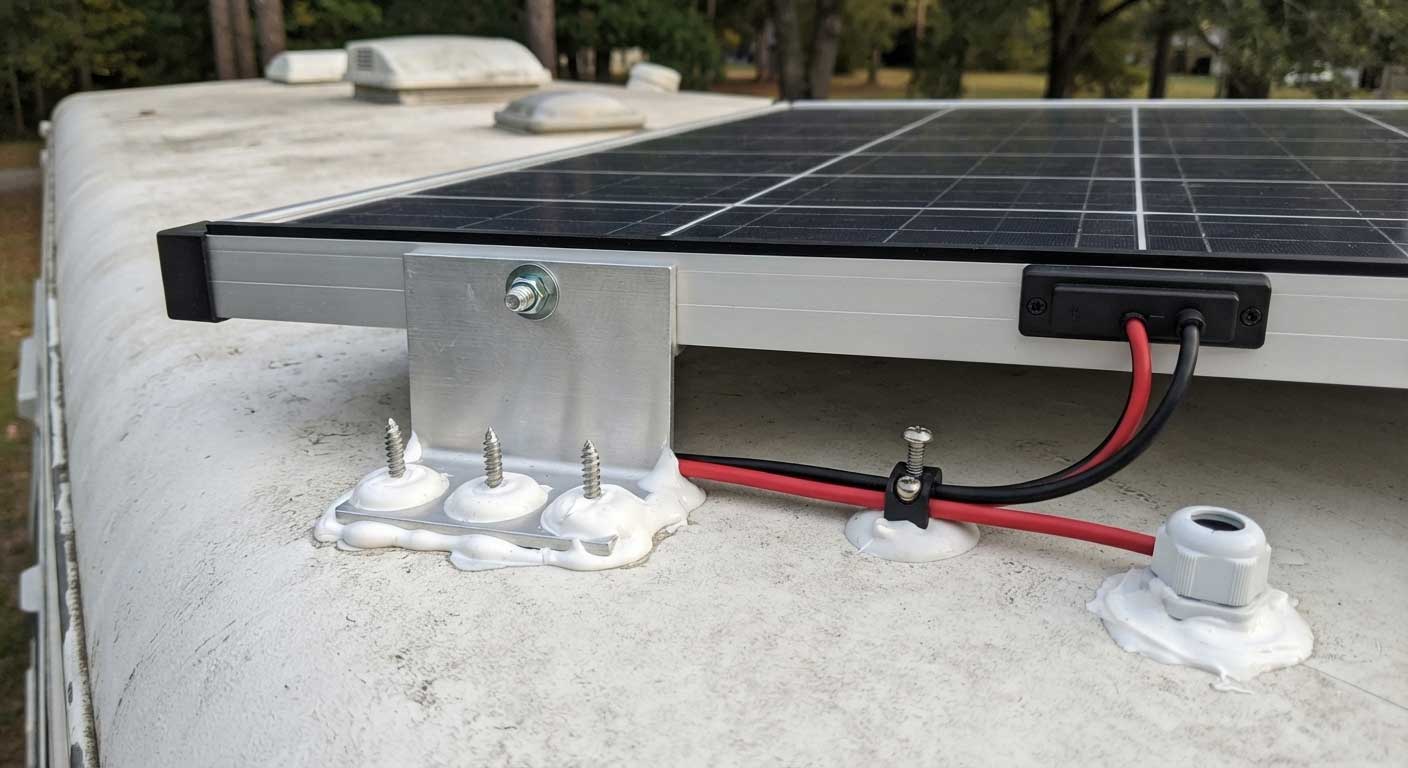
Method 1: Mounting Solar Panels With Brackets
Bracket mounting is one of the most common installation methods for rigid solar panels.
The process usually involves:
- Positioning the solar panels
- Installing mounting brackets
- Securing brackets with screws
- Sealing all roof penetrations
Advantages of Bracket Mounting
Strong Mechanical Connection
Brackets provide a secure physical attachment between the solar panel and RV roof.
This makes them suitable for:
- Large solar panels
- Heavy-duty RV systems
- Long-term installations
Better Airflow Behind Panels
Raised panels allow air movement underneath.
This helps reduce operating temperature and may improve solar efficiency.
Disadvantages of Bracket Mounting
Bracket installation also has some limitations:
- Requires drilling holes
- Requires waterproof sealing
- Adds installation complexity
- Adds some weight
Proper installation is essential to prevent roof damage.
Method 2: Adhesive Mounting Without Drilling
Adhesive mounting allows solar panels to be attached without creating roof holes.
This method is commonly used with lightweight flexible solar panels.
Installation usually requires:
- Cleaning the roof surface
- Applying suitable adhesive
- Pressing the panel firmly
- Allowing proper curing time
Advantages of Adhesive Mounting
Benefits include:
- No drilling required
- Faster installation
- Lower roof damage risk
- Cleaner appearance
This option is especially attractive for RV owners who want a simple installation process.
Disadvantages of Adhesive Mounting
However, adhesive systems depend heavily on:
- Surface preparation
- Adhesive quality
- Weather conditions
Poor installation may cause bonding failure over time.
Method 3: Flexible Solar Panel Installation
Flexible solar panels provide another option for RV owners who need lightweight and space-efficient solutions.
Unlike rigid panels, flexible panels can follow slightly curved surfaces.
They can be installed on:
- RV roofs
- Camper vans
- Marine surfaces
Advantages of Flexible Solar Panels
Key benefits include:
- Lower weight
- Thin profile
- Better aerodynamic performance
- Easier transportation
- More installation flexibility
For RV travelers who want to maximize limited roof space, flexible panels can be a practical choice.
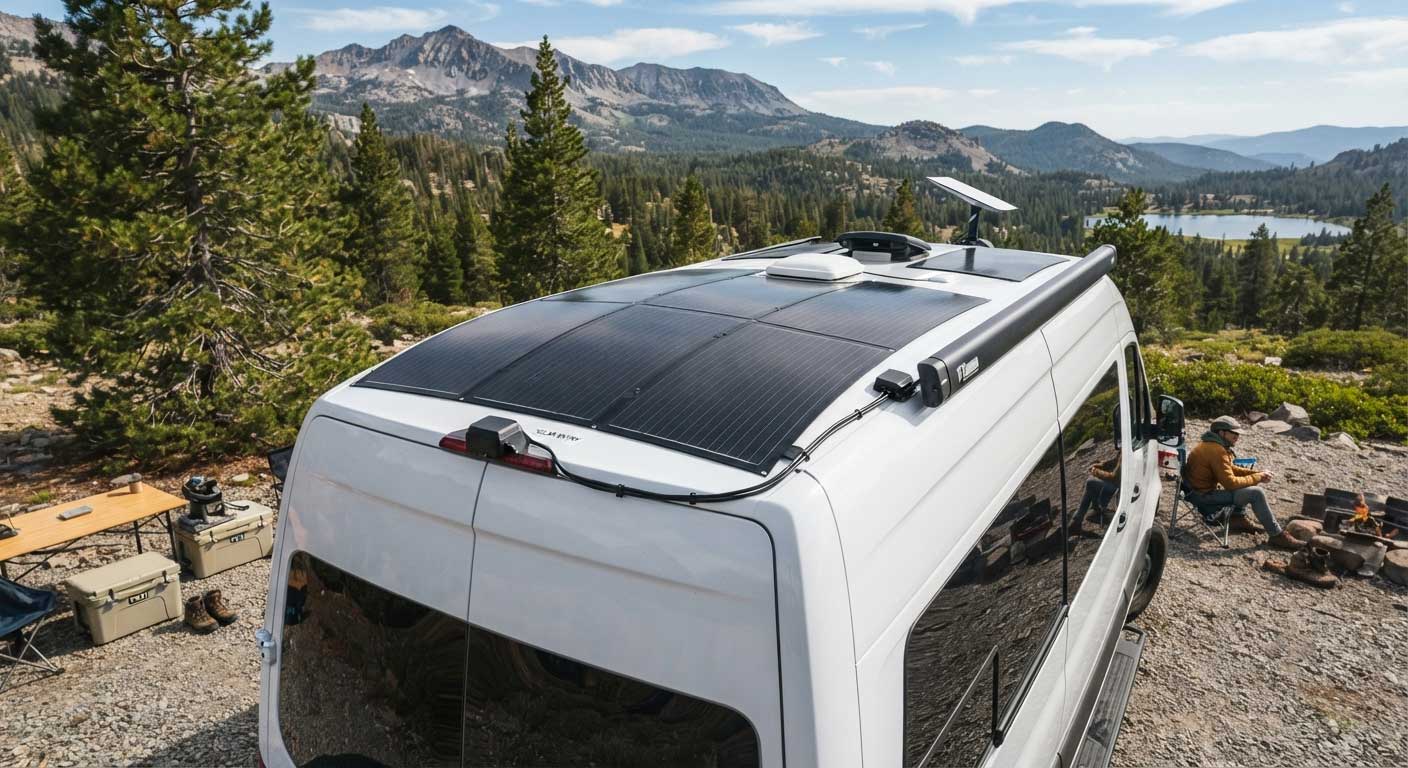
Flexible vs Rigid Solar Panels for RV Mounting
Choosing between flexible and rigid solar panels for an RV depends on your installation space, weight requirements, roof structure, and long-term energy needs.
Both solar panel types can provide reliable power, but they are designed for different applications.
Rigid panels are usually selected for maximum durability, while flexible solar panels are preferred when lightweight installation and space efficiency are more important.
Flexible Solar Panels for RV Installation
Flexible solar panels are designed to provide solar power where traditional rigid panels may not be practical.
They are manufactured with lightweight materials and can adapt to slightly curved surfaces, making them suitable for many RV designs.
Advantages of Flexible Solar Panels
Lightweight Design
Weight is an important factor for RV owners.
Reducing roof load can help maintain:
- Better fuel efficiency
- Easier vehicle handling
- Lower structural stress
Flexible panels are significantly lighter than traditional framed solar panels.
Low-Profile Installation
Flexible solar panels sit close to the RV roof.
This provides:
- Better aerodynamics
- Cleaner appearance
- Reduced wind resistance during driving
For travelers who frequently move between locations, a low-profile solar solution can be beneficial.
Easier Installation on Curved Surfaces
Many RV roofs are not completely flat.
Flexible solar panels can better adapt to:
- Rounded camper roofs
- Van conversions
- Irregular mounting areas
Bright Solar flexible solar panels are designed for mobile applications where installation flexibility and available space are important considerations.
Rigid Solar Panels for RV Installation
Rigid solar panels use a traditional framed design, usually with aluminum frames and tempered glass surfaces.
They remain a popular choice for permanent RV solar installations.
Advantages of Rigid Solar Panels
Higher Mechanical Protection
Rigid panels generally provide stronger physical protection against:
- Impact
- Heavy weather
- Long-term outdoor exposure
Better Heat Dissipation
The gap between the panel and roof allows airflow.
This can help reduce panel temperature during hot weather.
Longer Service Life
High-quality rigid solar panels often provide excellent durability for fixed installations.
Flexible vs Rigid Solar Panels Comparison
| Feature | Flexible Solar Panels | Rigid Solar Panels |
|---|---|---|
| Weight | Lightweight | Heavier |
| Installation | Easier | More complex |
| Roof Compatibility | Excellent | Requires flat mounting area |
| Drilling Required | Usually not required | Often required |
| Aerodynamics | Better | Lower |
| Heat Dissipation | Limited airflow | Better airflow |
| Durability | Good | Excellent |
| Best Applications | RVs, vans, boats | Permanent RV systems |
Step-by-Step Guide to Mounting Solar Panels on an RV
Mounting solar panels on an RV requires careful planning, correct installation materials, and proper waterproofing to ensure the system remains secure during travel.
A successful installation should focus on three goals:
- Strong attachment
- Weather protection
- Reliable electrical performance
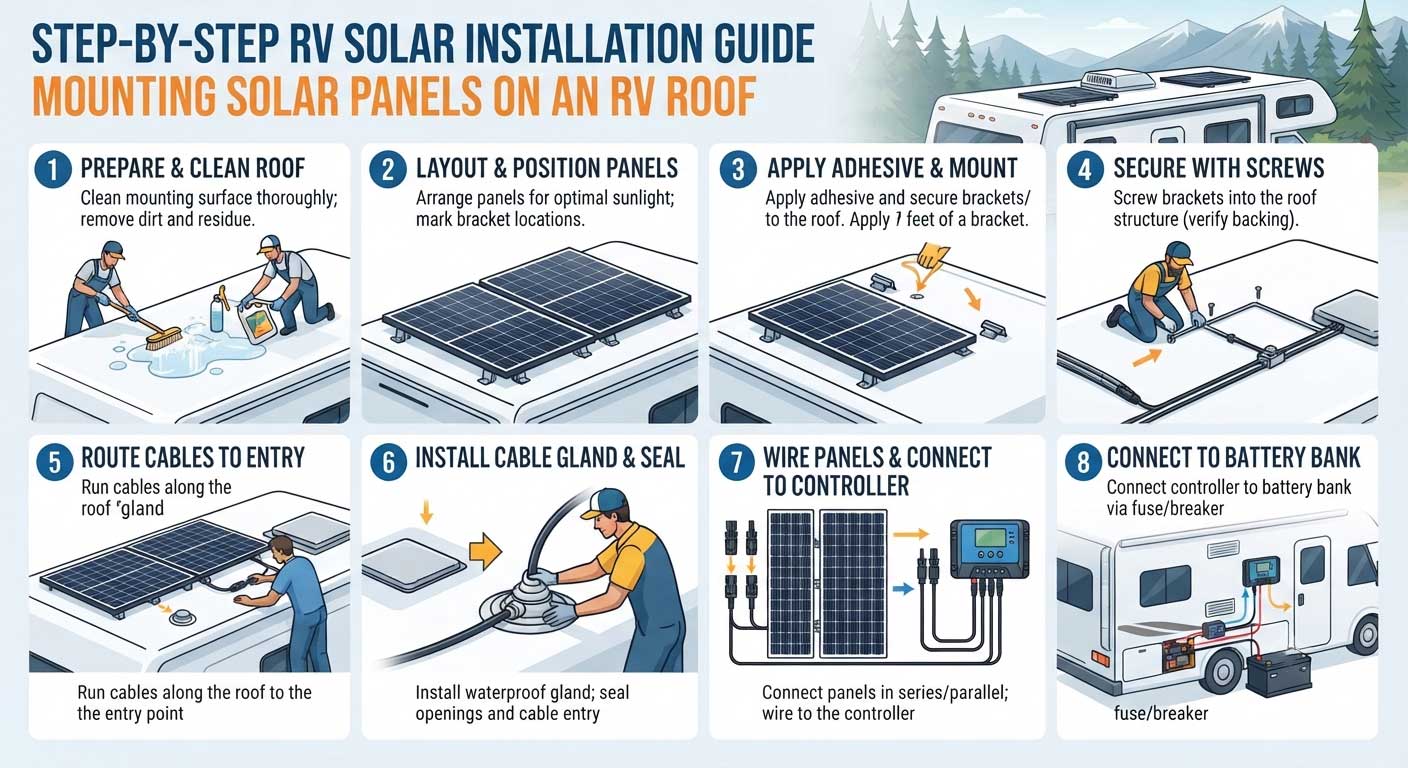
Step 1: Plan the Solar Panel Layout
Before installing anything, determine where each solar panel will be placed.
Consider:
Sun Exposure
Choose areas with maximum sunlight.
Avoid locations blocked by:
- Roof vents
- Air conditioners
- Antennas
- Storage equipment
Even partial shading can reduce solar output.
Roof Space
Measure available installation space carefully.
Check:
- Panel dimensions
- Cable routing distance
- Maintenance access
Do not cover areas that require regular roof inspection.
Weight Distribution
The RV roof has a weight limit.
Consider:
- Solar panel weight
- Mounting hardware
- Additional wiring components
A lightweight system can reduce unnecessary roof stress.
Step 2: Prepare the RV Roof Surface
Proper surface preparation is essential, especially for adhesive mounting.
Recommended preparation steps:
Clean the Installation Area
Remove:
- Dust
- Dirt
- Oil
- Wax
- Previous sealant residue
A clean surface improves bonding strength.
Dry the Roof Completely
Moisture can reduce adhesive performance.
Install solar panels only when the surface is completely dry.
Mark the Installation Position
Before applying adhesive or drilling:
- Measure the panel location
- Mark cable routes
- Confirm final placement
This prevents installation mistakes.
Step 3: Install Mounting Hardware or Adhesive System
The installation method depends on your solar panel type.
For Rigid Solar Panels
Typical process:
- Attach mounting brackets
- Position panels
- Secure fasteners
- Apply roof sealant around mounting points
Always follow the manufacturer’s installation recommendations.
For Flexible Solar Panels
Typical process:
- Apply suitable adhesive
- Position the panel carefully
- Press evenly across the surface
- Allow enough curing time
Avoid moving the panel before the adhesive fully bonds.
Step 4: Route Solar Cables Properly
Cable management is an important part of RV solar installation.
Good cable routing should:
- Avoid sharp edges
- Protect cables from sunlight exposure
- Prevent water entry
- Keep connections accessible
Common solutions include:
- Cable glands
- Waterproof entry boxes
- Protective conduit
Step 5: Connect the Solar System Components
After mounting the panels, connect the electrical components.
Typical RV solar system components include:
- Solar panels
- Charge controller
- Battery bank
- Inverter
- Monitoring system
The general connection order is:
Solar Panels → Charge Controller → Battery → Inverter
Always confirm:
- Correct polarity
- Voltage compatibility
- Connector security
before powering the system.
How to Waterproof RV Solar Panel Installation
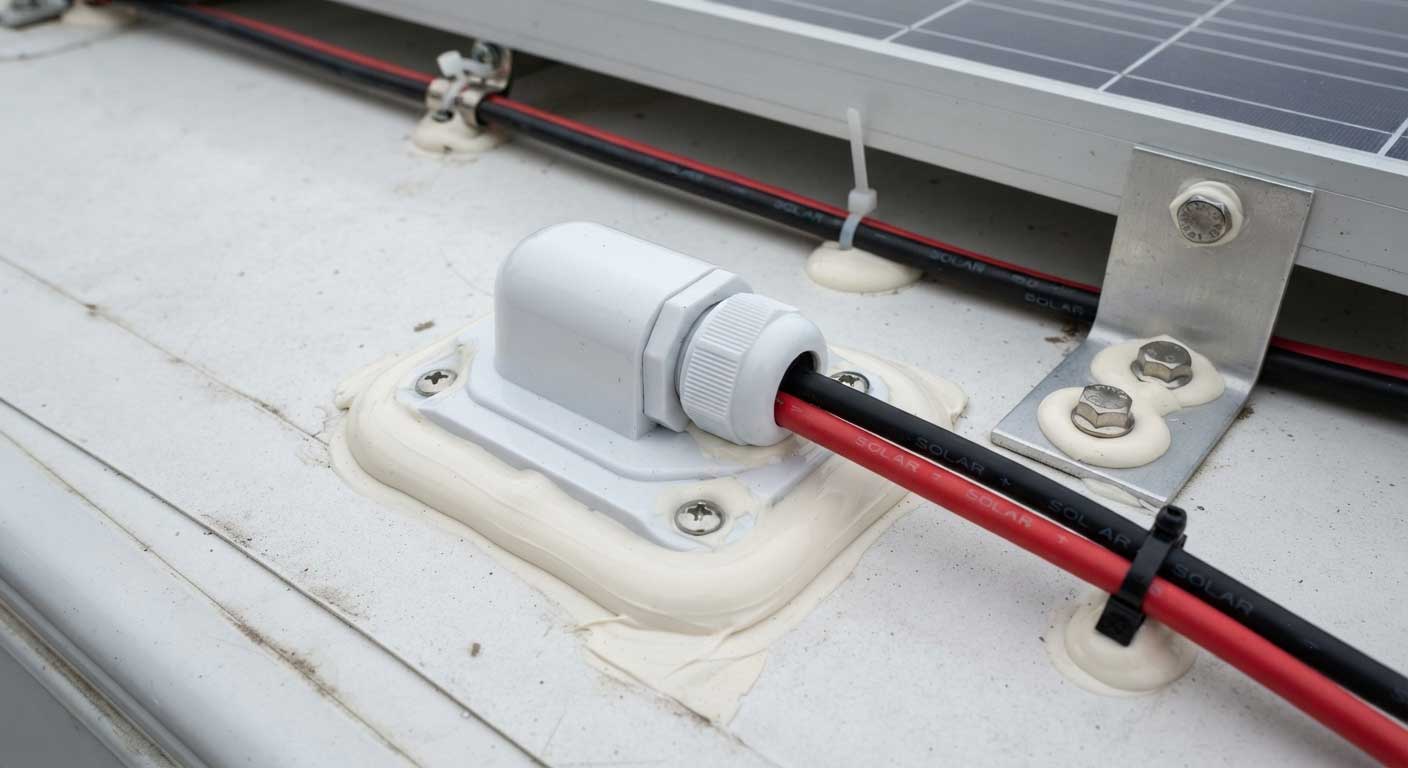
Waterproofing is one of the most important steps when mounting solar panels on an RV because roof leaks can cause expensive structural damage.
A solar installation may remain mechanically secure but still fail if water enters through mounting points or cable openings.
Seal All Roof Penetrations
If your installation requires drilling, every hole must be properly sealed.
Important areas include:
- Mounting screws
- Cable entry points
- Brackets
Use RV-compatible waterproof sealants designed for outdoor conditions.
Protect Cable Entry Points
Solar cables often enter the RV through the roof.
A proper cable entry solution should provide:
- Waterproof protection
- UV resistance
- Secure cable routing
Avoid leaving exposed cable openings.
Inspect Sealant Regularly
RV roofs experience:
- Temperature changes
- Vibration
- Weather exposure
Over time, sealants may crack or lose adhesion.
Regular inspection helps identify problems early.
Check:
- Sealant condition
- Mounting points
- Cable connections
How to Prevent RV Roof Damage During Solar Installation
Proper installation techniques help protect the RV roof while creating a secure solar mounting system.
Avoid Unnecessary Drilling
Although mechanical mounting is strong, every roof penetration creates a potential leak point.
Before drilling, consider:
- Adhesive mounting options
- Flexible solar panels
- Existing mounting locations
Use RV-Compatible Materials
Not all adhesives and sealants are suitable for RV roofs.
Choose products designed for:
- Outdoor exposure
- Temperature changes
- Vehicle vibration
Using unsuitable materials can lead to installation failure.
Do Not Overload the RV Roof
Before installation, calculate the total weight of:
- Solar panels
- Mounting brackets
- Additional accessories
A lighter solar system reduces stress on the RV structure.
Leave Space for Roof Maintenance
Avoid covering areas that need regular inspection.
Maintain access around:
- Roof vents
- Equipment covers
- Service areas
A well-planned installation makes future maintenance easier.
Common Mistakes When Mounting Solar Panels on RV
Many RV solar installation problems can be avoided by planning properly and choosing the correct mounting method from the beginning.
Mistake 1: Installing Panels Without Checking Sun Exposure
A large solar array does not guarantee high energy production.
Poor placement can reduce output if panels are frequently shaded.
Always check sunlight conditions before installation.
Mistake 2: Using Low-Quality Adhesive
For adhesive-mounted flexible solar panels, bonding quality is critical.
Poor adhesive selection may cause:
- Panel lifting
- Water penetration
- Installation failure
Choose materials suitable for outdoor automotive applications.
Mistake 3: Ignoring Waterproofing
A solar panel installation is incomplete without proper sealing.
Common problem areas:
- Screw holes
- Cable entry points
- Junction boxes
Water protection should always be part of the installation plan.
Mistake 4: Choosing the Wrong Panel Type
Not every RV requires the same solar panel solution.
Rigid panels may not suit:
- Lightweight camper vans
- Curved roofs
- Limited load capacity
Flexible panels may be more suitable in these situations.
Mistake 5: Incorrect Electrical Planning
Mounting is only one part of an RV solar system.
You must also consider:
- Panel voltage
- Battery capacity
- Charge controller type
- Wiring configuration
A correctly mounted panel system still needs proper electrical design.
Best Mounting Method for Different RV Applications
The best method for mounting solar panels on an RV depends on the vehicle type, roof structure, travel frequency, and energy requirements. There is no single installation method that fits every RV.
Some RV owners prioritize maximum durability, while others need lightweight solutions that are easy to install and maintain.
Choosing the correct mounting method before installation can improve:
- Solar performance
- Roof protection
- System reliability
- Long-term maintenance
Travel Trailers
Travel trailers usually have larger roof areas, making them suitable for different solar installation options.
Recommended solutions:
- Rigid solar panels with mounting brackets
- Flexible solar panels for weight-sensitive designs
Rigid panels are often preferred for permanent setups because they provide strong mechanical protection.
However, flexible solar panels can be a better choice when:
- Roof weight is limited
- Installation height needs to be minimized
- The roof surface is slightly curved
Camper Vans
Camper vans usually have limited roof space, so installation efficiency is important.
Recommended solution:
Flexible solar panels with adhesive mounting
Advantages:
- Lightweight
- Low-profile appearance
- Better aerodynamic performance
- Suitable for curved van roofs
For compact mobile systems, flexible solar panels can maximize available installation space.
Motorhomes
Motorhomes often require larger solar systems because they may power:
- Refrigerators
- Entertainment systems
- Air circulation equipment
- Multiple appliances
Recommended solutions:
- Multiple rigid solar panels
- Series-parallel solar configurations
- Combination of rigid and flexible panels
The mounting design should balance:
- Power requirements
- Roof capacity
- Maintenance accessibility
Off-Grid RV Systems
For long-term off-grid travel, reliability is the priority.
A suitable installation should include:
- Secure solar mounting
- Efficient panel positioning
- Proper battery storage
- Correct wiring design
Flexible solar panels are often used in off-grid RV applications because they provide installation flexibility without adding excessive weight.
Bright Solar flexible solar panels are designed for mobile and off-grid energy applications where space efficiency and lightweight construction are important.
How Many Solar Panels Can You Mount on an RV?
The number of solar panels you can mount on an RV depends on available roof space, energy consumption, panel wattage, battery capacity, and the weight limit of the RV roof.
There is no fixed number because every RV has different power requirements.
Calculate Your RV Energy Requirements First
Before installing solar panels, estimate your daily electricity usage.
Common RV energy consumers include:
| Device | Typical Usage |
|---|---|
| LED lights | Low power |
| Phone charging | Low power |
| Refrigerator | Medium power |
| Laptop | Medium power |
| Fan | Medium power |
| Air conditioner | High power |
Your total energy consumption determines the required solar capacity.
Consider Available Roof Space
RV roof space is often limited by:
- Air conditioners
- Roof vents
- Skylights
- Antennas
- Storage accessories
Measure the usable area before selecting solar panels.
A smaller number of high-efficiency panels may perform better than many smaller panels.
Common RV Solar Panel Sizes
Many RV solar systems use:
Small RV Solar System
Typical capacity:
100W–300W
Suitable for:
- Basic lighting
- Charging devices
- Small electronics
Medium RV Solar System
Typical capacity:
400W–800W
Suitable for:
- Refrigerators
- Multiple devices
- Longer off-grid trips
Large RV Solar System
Typical capacity:
1000W+
Suitable for:
- Heavy energy users
- Full-time RV living
- Extended off-grid applications
Consider Battery Capacity and Charge Controllers
Solar panels are only one part of the system.
The complete design should match:
- Solar array size
- Battery capacity
- Inverter rating
- Charge controller specifications
A large solar array without enough battery storage may not provide the expected benefits.
Bright Solar Flexible Solar Panels for RV Applications
Bright Solar flexible solar panels provide lightweight and adaptable solar solutions for RV owners who need reliable power without adding unnecessary weight to their vehicles.
RV solar installations often face challenges such as:
- Limited roof space
- Weight restrictions
- Curved surfaces
- Frequent movement
Flexible solar technology helps solve these challenges by offering a practical alternative to traditional framed panels.
Lightweight Design for Mobile Applications
Weight is an important consideration for RV owners.
Every additional kilogram can affect:
- Fuel efficiency
- Vehicle handling
- Roof load
Bright Solar flexible solar panels are designed with lightweight materials to support mobile energy applications.
Flexible Installation Options
RV roofs are not always perfectly flat.
Flexible solar panels can adapt better to different surfaces, including:
- Curved camper roofs
- Van conversions
- Marine applications
This makes installation easier in areas where traditional rigid panels may be difficult to fit.
Space-Saving Solar Solution
RV owners often need to maximize limited roof space.
Flexible solar panels provide:
- Low-profile installation
- Efficient use of available areas
- Cleaner appearance
They are suitable for users who want solar power without adding bulky equipment.
Applications Beyond RVs
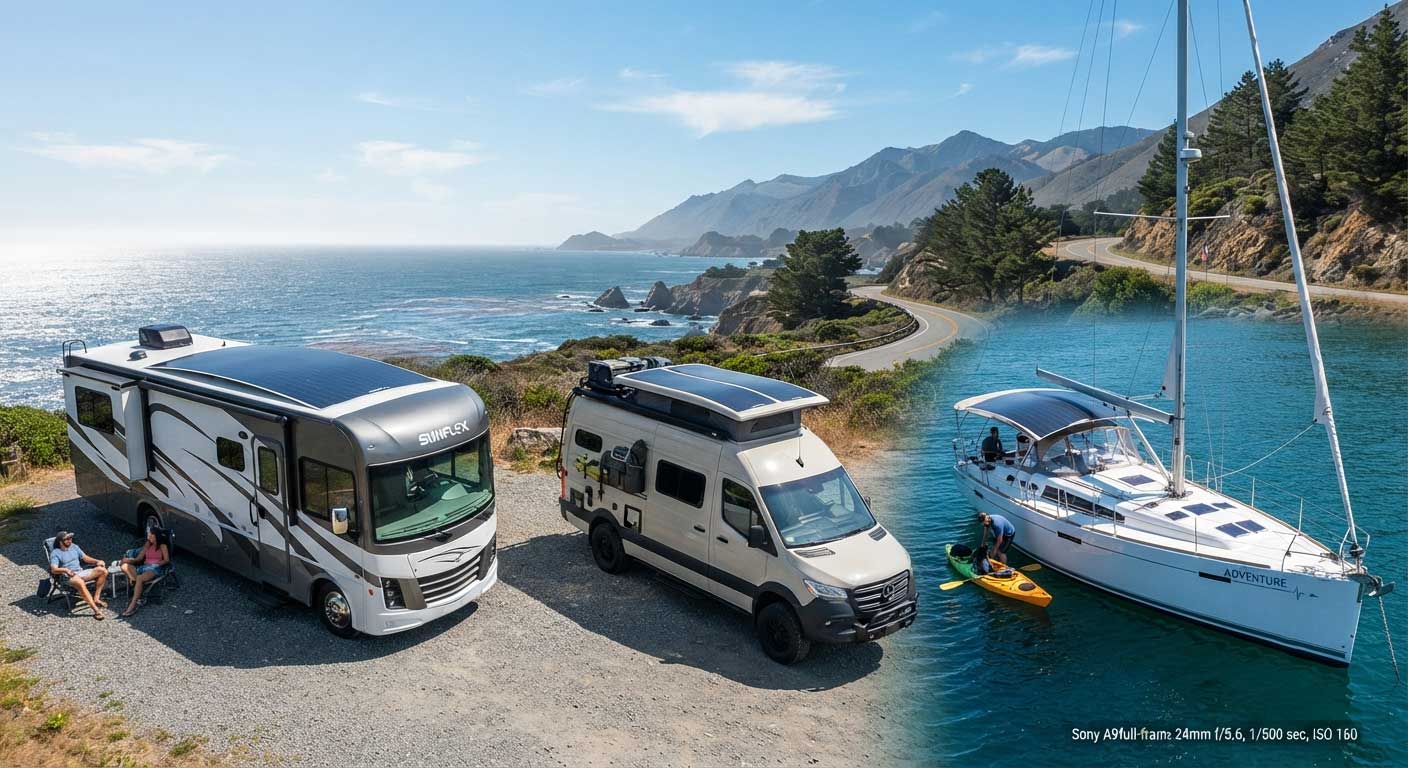
Bright Solar flexible solar panels can also support:
- Camper vans
- Boats
- Outdoor equipment
- Portable power systems
- Off-grid applications
The same lightweight design advantages make flexible panels useful across different mobile energy scenarios.
RV Solar Panel Mounting Maintenance Tips
Regular inspection and maintenance help keep RV solar panels secure, waterproof, and operating efficiently for years.
Although solar panels require little daily maintenance, RV environments create unique challenges because of:
- Road vibration
- Weather exposure
- Temperature changes
Inspect Mounting Points Regularly
Check the physical connection between solar panels and the RV roof.
Look for:
- Loose brackets
- Damaged fasteners
- Adhesive separation
- Cracked mounting areas
Early detection can prevent larger problems.
Check Waterproof Sealing
Roof seals should be inspected periodically.
Pay attention to:
- Screw locations
- Cable entry points
- Junction boxes
- Adhesive edges
If cracks or gaps appear, repair them promptly.
Clean Solar Panel Surfaces
Dust and dirt can reduce solar output.
Cleaning frequency depends on:
- Travel environment
- Weather conditions
- Location
Remove:
- Dust
- Leaves
- Bird droppings
- Road debris
Use soft cleaning materials to avoid damaging the panel surface.
Inspect Solar Wiring
RV solar systems experience constant movement during travel.
Check:
- Cable connections
- Solar connectors
- Wire protection
- Battery connections
Damaged cables can reduce performance or create safety risks.
FAQ About Mounting Solar Panels on RV
Can you mount solar panels directly on an RV roof?
Yes. Solar panels can be mounted directly on an RV roof using adhesive systems or installed with brackets.
The best method depends on:
- Roof material
- Panel type
- Weight requirements
- Long-term usage plans
Flexible solar panels are commonly used for direct mounting because of their lightweight and low-profile design.
Do RV solar panels need brackets?
Not always.
Rigid solar panels usually require brackets for secure installation.
Flexible solar panels can often be installed using suitable adhesives without drilling holes.
Can flexible solar panels be glued to an RV roof?
Yes, flexible solar panels can be attached to an RV roof using appropriate outdoor-rated adhesives.
However, proper preparation is important.
The installation surface should be:
- Clean
- Dry
- Free from contaminants
Is drilling into an RV roof safe?
Drilling can be safe when done correctly.
However, every roof penetration creates a potential waterproofing point.
If drilling is required:
- Use correct mounting hardware
- Apply proper sealant
- Inspect sealing regularly
What is the best way to mount solar panels on an RV without drilling?
The most common no-drill method is adhesive mounting.
This approach is often used with flexible solar panels because they are lightweight and can attach directly to suitable roof surfaces.
Are flexible solar panels good for RVs?
Yes.
Flexible solar panels are suitable for many RV applications because they offer:
- Lightweight construction
- Easy installation
- Low-profile design
- Better adaptability to curved surfaces
They are especially useful for camper vans and weight-sensitive RV designs.
How long do RV solar panels last?
The lifespan depends on:
- Panel quality
- Installation method
- Weather exposure
- Maintenance
A properly installed solar system can provide reliable energy for many years.
Can I install solar panels on an RV myself?
Yes, many RV owners install solar panels themselves, especially smaller systems using flexible solar panels or simple mounting methods.
A DIY installation requires basic knowledge of:
- Solar wiring
- Roof preparation
- Waterproof sealing
- Electrical safety
Before starting, make sure you understand your RV roof structure and solar system requirements.
For larger systems, professional installation may be a better choice to ensure proper mounting strength and electrical safety.
Should RV solar panels be mounted flat or tilted?
Most RV solar panels are installed flat because RVs frequently move and need a simple, secure installation.
Flat mounting advantages:
- Easier installation
- Lower wind resistance
- Less maintenance
- Better driving safety
Tilted mounts can improve solar production in certain stationary applications, but they add:
- Extra hardware
- Additional weight
- More installation complexity
For mobile RV applications, flat installation is usually the preferred option.
Can flexible solar panels be removed from an RV roof?
Yes, flexible solar panels can be removed, but the difficulty depends on the adhesive method used.
Removal may require:
- Careful separation
- Adhesive removal tools
- Roof surface cleaning
If you expect future replacement or relocation, consider the mounting method before installation.
A temporary mounting solution may provide more flexibility than permanent bonding.
How do I stop RV solar panels from overheating?
Solar panel temperature can affect performance.
To reduce overheating:
- Avoid unnecessary covering of ventilation areas
- Use proper installation spacing when using rigid panels
- Keep panels clean
- Select suitable solar technology
Rigid panels usually have better airflow underneath, while flexible panels provide advantages in weight and installation simplicity.
The best choice depends on your RV design and priorities.
How much does it cost to mount solar panels on an RV?
The cost depends on:
- Solar panel type
- System size
- Mounting method
- Installation materials
- Battery capacity
Typical costs include:
- Solar panels
- Charge controller
- Mounting hardware
- Wiring
- Battery storage
- Installation labor
A small RV solar system may cost a few hundred dollars, while larger off-grid systems can require several thousand dollars.
Planning your energy needs first helps avoid unnecessary expenses.
Can I add more solar panels to my RV later?
Yes, but the existing system must have enough capacity for expansion.
Before adding panels, check:
- Charge controller maximum input
- Battery capacity
- Inverter rating
- Roof space availability
A well-planned solar system allows easier future upgrades.
What is the best adhesive for mounting flexible solar panels on an RV?
The best adhesive depends on:
- RV roof material
- Solar panel backing material
- Weather conditions
- Installation requirements
Choose an adhesive designed for:
- Outdoor environments
- Temperature changes
- Vehicle vibration
- Long-term bonding
Always follow the solar panel manufacturer’s installation recommendations.
Final Checklist Before Mounting Solar Panels on an RV
Before completing your RV solar installation, check every part of the system to ensure safety, durability, and reliable performance.
Use this checklist before your first trip.
Installation Planning Checklist
✓ Confirm daily energy requirements
✓ Measure available roof space
✓ Select suitable solar panel type
✓ Check RV roof condition
✓ Plan cable routing
✓ Choose mounting method
Mounting Checklist
✓ Clean installation surface
✓ Confirm panel position
✓ Use correct mounting materials
✓ Secure panels properly
✓ Check all mounting points
Waterproofing Checklist
✓ Seal all roof penetrations
✓ Protect cable entry points
✓ Inspect sealant condition
✓ Prevent water accumulation around mounts
Electrical Checklist
✓ Confirm panel voltage compatibility
✓ Check cable polarity
✓ Match charge controller specifications
✓ Secure all connectors
✓ Test system output before traveling
How Bright Solar Helps RV Owners Build Reliable Solar Systems
Bright Solar provides flexible solar panel solutions designed for RV, marine, and off-grid applications where lightweight construction and installation flexibility are essential.
RV owners often need solar panels that can handle unique challenges:
- Limited installation space
- Curved surfaces
- Weight restrictions
- Frequent movement
- Outdoor exposure
Bright Solar flexible solar panels are designed to support these requirements with a practical balance of:
- Lightweight design
- Flexible installation options
- Space efficiency
- Reliable outdoor performance
Flexible Solar Solutions for Modern RV Applications
Traditional rigid solar panels are not always suitable for every RV.
Flexible solar panels provide advantages for:
- Camper vans
- Motorhomes
- Travel trailers
- Marine applications
Their lightweight structure allows RV owners to install solar power without adding excessive roof load.
Designed for Space-Limited Installations
Many RV roofs have limited usable areas.
Bright Solar flexible panels help maximize available space by allowing installation on areas where traditional panels may not fit easily.
Suitable applications include:
- Curved roofs
- Compact camper designs
- Mobile power systems
Supporting Off-Grid Travel
Reliable solar power allows RV users to explore more remote locations.
A complete RV solar solution combines:
- Efficient solar panels
- Proper mounting
- Correct wiring
- Battery storage
Bright Solar focuses on flexible solar technology that supports independent energy solutions for outdoor lifestyles.
Conclusion: Choose the Right Way of Mounting Solar Panels on RV
Mounting solar panels on an RV requires careful planning to balance installation security, roof protection, energy needs, and long-term reliability.
The best mounting method depends on your RV type and usage.
For permanent installations:
- Rigid solar panels with brackets provide strong mechanical support.
For lightweight and flexible applications:
- Flexible solar panels offer easier installation and better compatibility with curved surfaces.
Before installing an RV solar system, consider:
- Roof structure
- Available space
- Panel weight
- Mounting method
- Waterproof protection
- Electrical design
A properly installed solar system can provide reliable renewable energy for camping, travel, and off-grid living.
Bright Solar flexible solar panels offer a practical solution for RV owners who need efficient solar power while keeping installation lightweight and adaptable.
With the right solar panel choice and mounting strategy, your RV can become a more independent, efficient, and sustainable mobile energy platform.
Related recommendations
-

200 Watt Flexible Solar Panel for RV, Marine, and Off-Grid Applications
169200 watt flexible solar panel solutions provide lightweight, durable off-grid energy for RVs, boats, cabins, and mobile systems with reliable solar efficiency.
View details -
Sungrow Inverter Helps Chilean Photovoltaic Project in the Atacama Desert
190Sungrow Inverter turnkey PV inverter solutions and solar panel cleaning robots to a 480 MW photovoltaic project in Chile’s Atacama Desert, supporting the country’s Energy Policy 2050 with high-efficiency inverters, anti-PID technology, and waterle...
View details -
Durable Flexible Solar Panel: Built for Long-Term Solar Performance
149Explore durable flexible solar panel solutions designed for RV, marine and off-grid applications. Learn durability factors, materials, testing, and real installation experience from Bright Solar.
View details -
flexible solar panels for rv roof: Lightweight Solar Power Solution for RV Travel
141Discover flexible solar panels for rv roof with lightweight design, easy installation, and reliable power output. Bright Solar provides durable solar solutions for modern RV travel.
View details