140w Folding Solar Panel: Output, Battery Charging and Buying Guide
A 140w folding solar panel provides portable solar power for camping, RV travel, and small off-grid systems. Its actual daily energy depends on sunlight, panel angle, shading, temperature, and charging equipment—not rated wattage alone.
For a traveler, 140 watts can be a useful middle ground: more collection capacity than many small USB solar chargers, without the size and installation demands of a fixed rooftop array. The key is matching the panel to the devices you use and the hours of sunlight available.
What Can a 140W Folding Solar Panel Power?
A 140W panel is generally suited to charging small electronics, replenishing a compatible battery, and extending the runtime of a portable power station. It is not automatically sufficient for every appliance marketed for camping or RV use.
Common applications include:
- Camping: phones, headlamps, GPS devices, cameras, and power banks.
- RV and campervan travel: topping up a leisure battery while parked in sunlight.
- Outdoor work: supporting small electronics and communication equipment.
- Emergency preparedness: providing daytime charging when grid power is unavailable.
- Off-grid cabins or sheds: contributing to a modest battery-based power system.
The distinction between running a device and charging a battery matters. A phone may draw power through a regulated USB output, while an RV battery normally needs suitable charging control. A refrigerator may require a battery to supply power consistently after the sun moves behind a cloud.
A 140W panel’s suitability should therefore be judged against both energy demand and electrical compatibility.
Watts, Watt-Hours, and Realistic Daily Output
Watts measure power at a given moment. Watt-hours measure energy collected over time. The difference is essential when estimating how much a Portable Solar Panel can contribute during a day.
A useful first estimate is:
Daily energy (Wh) = panel power (W) × equivalent peak-sun hours × system efficiency
For illustration, assume a 140W panel receives four equivalent peak-sun hours and the overall system delivers 75–85% of the theoretical energy after losses.
140W × 4 hours × 0.75–0.85 = 420–476Wh per day
| Equivalent peak-sun hours | Illustrative energy at 75–85% efficiency |
|---|---|
| 2 hours | 210–238Wh |
| 3 hours | 315–357Wh |
| 4 hours | 420–476Wh |
| 5 hours | 525–595Wh |
| 6 hours | 630–714Wh |
These are estimates, not guaranteed output figures for a particular Bright Solar model. Actual results may be lower during cloudy weather or when the panel is shaded, poorly angled, hot, or connected to equipment that limits input power.
Peak-sun hours are also not the same as total daylight hours. Six hours between breakfast and sunset does not necessarily mean six hours of equivalent full-strength sunlight.
For solar-production planning, the U.S. Department of Energy provides an overview of photovoltaic system design, and the National Renewable Energy Laboratory’s PVWatts calculator estimates production using location and system assumptions.
Sources:
- U.S. Department of Energy, Solar Photovoltaic System Design Basics
- National Renewable Energy Laboratory, PVWatts Calculator
How to Choose a 140w Folding Solar Panel
Two panels with the same rated power can differ in folded size, weight, connector type, protective materials, and charging configuration. Those differences are easy to overlook on a product listing and much harder to ignore when equipment has to fit inside a packed vehicle.
Portability Beyond the Product Title
Before purchasing, check the panel’s folded dimensions and weight. A panel carried a few steps from a campervan to a sunny patch of ground has different requirements from one that will be carried along a hiking trail.
Look for:
- Folded dimensions that fit your storage compartment.
- Total weight, including any supplied carrying case.
- Support legs or an adjustable stand, if included.
- Cable length and a practical cable-storage arrangement.
- Hinges and protective surfaces designed for repeated folding.
- A clear description of whether the panel is intended for vehicle-based travel or backpacking.
Do not assume “folding” means waterproof, ultralight, or suitable for permanent outdoor exposure. Those are separate characteristics that must be verified from the product’s documentation.
Read the Electrical Datasheet Before Connecting
Rated power does not provide enough information to select a charge controller or connect a battery safely. Ask for the specifications of the exact model.
| Specification | What it tells you |
|---|---|
| Rated power (Pmax) | Nominal power under the stated test conditions |
| Voltage at maximum power (Vmp) | Operating voltage near the panel’s maximum-power point |
| Current at maximum power (Imp) | Operating current near maximum power |
| Open-circuit voltage (Voc) | Panel voltage when no load is connected |
| Short-circuit current (Isc) | Current measured under specified short-circuit test conditions |
| Connector and polarity | Whether the cable can connect correctly to the intended equipment |
| Controller requirements | Whether charging regulation is built in or must be provided separately |
| Weather protection and warranty | The manufacturer’s stated limits and support terms |
Use the actual Vmp, Imp, Voc, and Isc values for the model. These figures cannot be reliably inferred from “140W” alone.
Check What Is Included
Some folding panels include a controller or USB outputs. Others provide panel leads and expect the buyer to supply compatible charging equipment. A portable power station may require a specific adapter cable or connector.
Confirm the exact package contents before comparing prices. A lower-priced panel may not include the accessories required for your setup, while an integrated design may be convenient but offer fewer options for upgrading individual components.
How to Set Up a 140W Folding Solar Panel at a Campsite
A portable panel works best when setup is safe, repeatable, and easy to adjust. You do not need a complicated installation for a small camping system, but you do need to check the electrical limits before connecting it to a battery or power station.
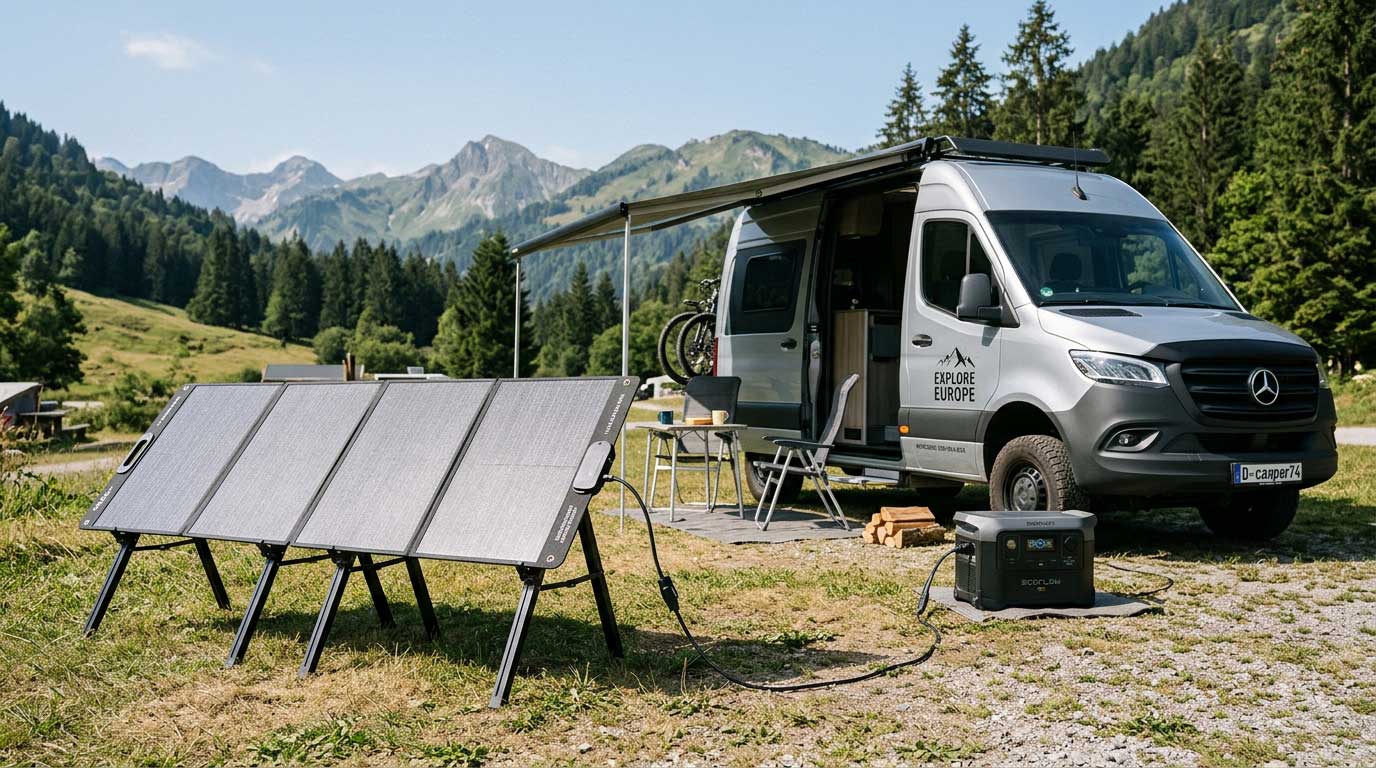
Step 1 — Find an Unshaded Location
Choose a stable area away from vehicle traffic, tent entrances, and places where people may trip over cables. Point the panel toward the sun and adjust its angle according to the manufacturer’s instructions.
Watch for shadows from awnings, roof racks, tree branches, and nearby camping equipment. Even if most of the panel remains in sunlight, shading can affect output depending on the cell layout and electrical design.
Step 2 — Confirm Voltage and Connector Compatibility
Check the panel’s voltage and current ratings against the controller or power station manual. The panel’s open-circuit voltage must remain within the equipment’s maximum solar input voltage, including any temperature-related increase specified by the manufacturer.
Do not rely solely on a label such as “12V solar panel.” Nominal system voltage and actual panel voltage are not necessarily the same.
Step 3 — Connect According to the Equipment Manual
If the system uses a separate charge controller, follow its prescribed connection sequence. Some controllers require the battery to be connected before the solar input so they can detect system voltage; other equipment may specify a different procedure.
A sensible pre-start checklist:
- Inspect the panel, cable insulation, and connectors for damage.
- Keep connectors dry unless their ratings explicitly allow the expected exposure.
- Confirm the controller’s voltage and current limits.
- Follow the manufacturer’s connection and disconnection sequence.
- Check the charging indicator or power-station display.
- Secure loose cables to reduce trip hazards and strain on connectors.
A panel can generate electricity whenever it receives light. Never allow exposed conductors to touch or create a short circuit, and do not disconnect a live circuit contrary to the equipment instructions.
Step 4 — Observe the Charging Input
Once connected, note the input power shown by the controller or power station. A reading below 140W does not automatically mean something is wrong. Sunlight intensity, cell temperature, panel angle, battery state of charge, and the connected device’s input limit can all affect the reading.
If output seems unusually low, reposition the panel, check for shadows, inspect connections, and compare the reading under similar conditions. A short record of time, weather, and input power is more useful than a single measurement without context.
Battery Charging with a 140W Folding Solar Panel
A battery can store solar energy collected during the day for use after sunset. The amount stored depends on actual panel production, charging losses, battery chemistry, and the battery’s permitted charging limits.
Consider an illustrative 12V battery rated at 100Ah:
12V × 100Ah = 1,200Wh (1.2kWh) nominal energy
That figure is the nominal stored energy, not necessarily the amount available for everyday use. Usable capacity depends on battery chemistry, allowable depth of discharge, temperature, age, and the battery manufacturer’s recommendations.
If a system delivers 420Wh of charging energy on a particular day, a simple conversion at nominal 12V gives:
420Wh ÷ 12V = 35Ah equivalent
This is a planning approximation, not a promise that exactly 35Ah will be restored. Charging voltage changes during the process, and controller and battery losses affect the result.
Estimate the Energy Your Devices Need
List the equipment you plan to use. For a device rated in watts, multiply its power by the number of hours it operates.
| Example device | Assumed power | Daily use | Estimated energy |
|---|---|---|---|
| LED camping light | 5W | 4 hours | 20Wh |
| Phone charging | 10W | 2 hours | 20Wh |
| Small USB fan | 8W | 5 hours | 40Wh |
| Laptop charging | 45W | 2 hours | 90Wh |
| Total | — | — | 170Wh |
These are illustrative assumptions, not measured figures for named products. Actual consumption depends on the device, operating mode, battery level, and conversion efficiency.
In this example, the daily load totals 170Wh. A 140W panel may cover that demand on a reasonably sunny day, with energy potentially left over for battery charging. In overcast conditions or under tree cover, production may be much lower. If your trip includes several cloudy days, plan for stored energy or an alternative charging source.
What Reduces a 140W Panel’s Real-World Output?
The number printed on the panel is a rated value under defined test conditions, not a guarantee of the power available at every campsite. The U.S. Department of Energy’s Solar Photovoltaic Cell Basics explains the underlying conversion of light into electricity; the output of a complete portable system also depends on how and where it is used.
Cloud Cover and Partial Shade
Clouds reduce the sunlight reaching the panel, although diffuse daylight can still produce electricity. Heavy cloud cover may lower output considerably. A branch or awning casting a narrow shadow can also affect production, depending on how the cells are wired and whether bypass diodes are used.
Move the panel when practical rather than accepting a shaded position all afternoon. Repositioning it once or twice during a long stop may be more useful than leaving it behind a vehicle simply because that location is convenient.
Heat, Dirt, and Ventilation
Solar cells can lose some power as their temperature rises. Avoid trapping heat around the panel or using it in a way that conflicts with the manufacturer’s ventilation instructions.
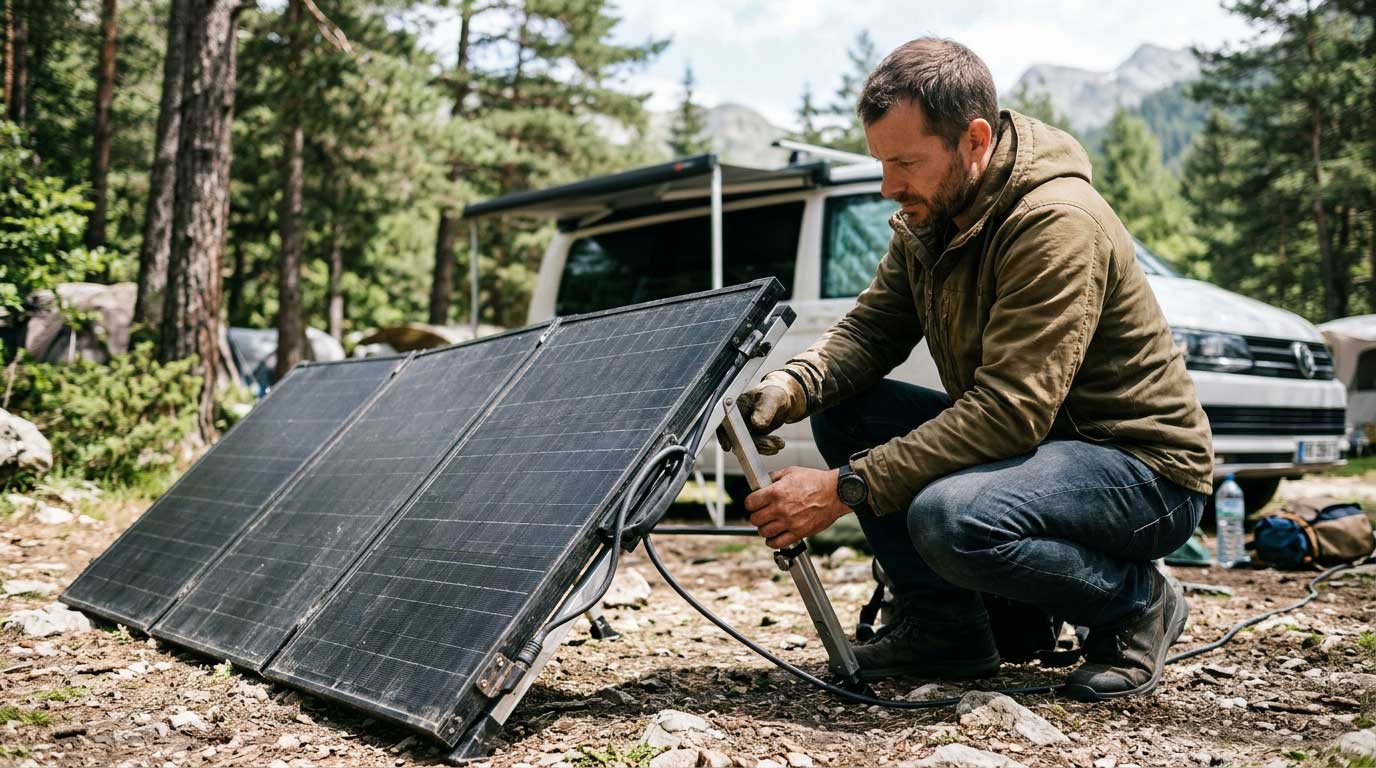
Dust, pollen, dried water marks, and bird droppings can also block sunlight. If cleaning is permitted, use the method recommended by the manufacturer and avoid abrasive materials that could damage the protective surface.
Keep a Simple Solar Log
If you use the panel for several days, record the approximate charging input, weather, time, and panel position. Consistent observations can help you understand whether a change is caused by clouds, shade, a poor connection, or the power station’s input limit.
This is particularly useful for people who travel regularly. After several trips, you will have a better idea of how much energy your setup actually collects in the conditions you encounter, rather than relying on a best-case number from a product label.
Pairing a 140W Folding Solar Panel with a Portable Power Station
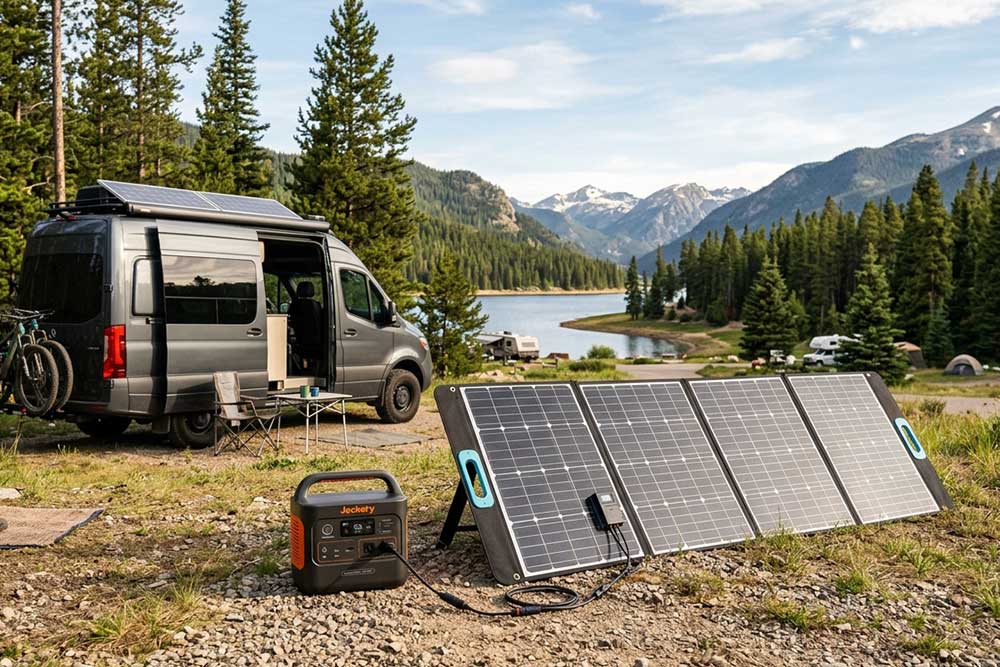
A portable power station is convenient because it combines battery storage and device outputs in one unit. Compatibility remains essential: the station must accept the panel’s voltage, current, connector, and power level.
Before connecting, check:
- Solar input voltage range: the panel must operate within the station’s permitted range.
- Maximum input voltage: the panel’s open-circuit voltage must not exceed the limit.
- Maximum accepted current and power: the station may accept less than the panel’s theoretical output.
- Connector and polarity: use the correct cable and wiring arrangement.
- Battery capacity: the station’s capacity determines how much energy it can store, not how quickly it charges.
For example, suppose a power station needs 500Wh of additional energy and accepts an average of 70W from the panel during charging:
500Wh ÷ 70W ≈ 7.1 hours
That is a simplified estimate. Actual charging may take longer because sunlight changes, conversion losses occur, and the station may reduce its charging rate at certain battery levels. The example is not a guaranteed charging time for a particular product.
Some folding panels also offer USB outputs, while others require a controller or power station. Confirm whether USB-A, USB-C Power Delivery, adapters, or other accessories are actually included. Do not connect a sensitive device directly to an output that is not designed to regulate its power.
Storage and Maintenance for Regular Outdoor Use
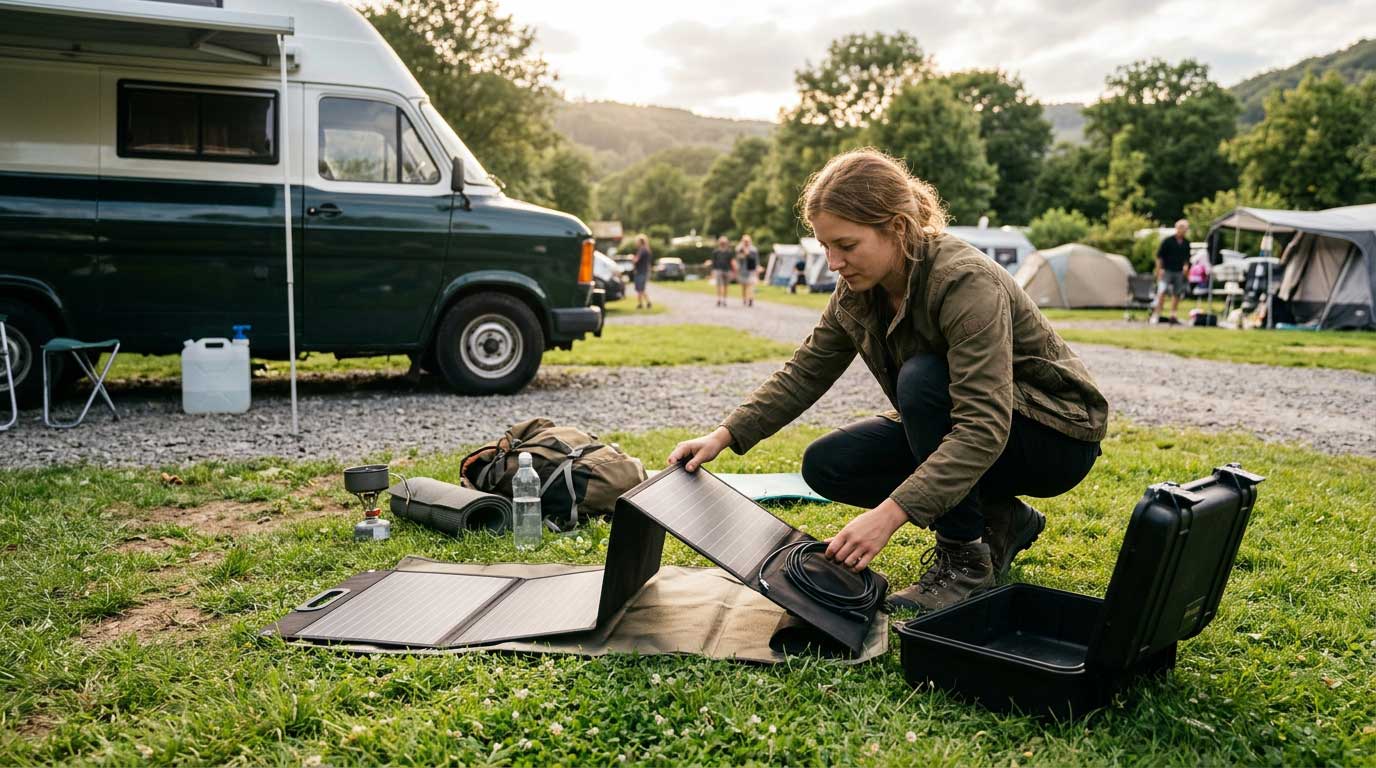
Folding panels are moved, packed, and unpacked frequently. Their hinges, cables, connectors, and protective surfaces deserve attention, especially after trips involving dust, damp ground, or long periods in a hot vehicle.
Use this short checklist:
- Allow the panel to cool and dry as directed before storage.
- Remove loose dirt before folding so grit is not trapped against the surface.
- Keep cables away from sharp bends, crushing, and tension at connectors.
- Use the supplied carrying case or another suitable protective cover.
- Avoid placing heavy equipment on top of the folded panel.
- Inspect the cable insulation, hinges, and connectors before each trip.
- Follow the manufacturer’s storage temperature and cleaning guidance.
Do not assume that every folding panel is waterproof or suitable to leave outside overnight. Check the stated weather-protection rating, and verify whether it applies to the panel, connectors, or selected components only. If the instructions do not clearly support rain exposure, store the equipment in a dry location.
Is a 140W Folding Solar Panel Right for Your Setup?
A 140W folding panel is a practical option when portability matters and the daily energy demand is moderate. It can suit campers who charge personal electronics, RV owners who supplement a battery, and travelers who want to recharge a portable power station during sunny stops.
It may be less suitable as the only power source for energy-intensive appliances or for equipment that must operate reliably through several cloudy days. In those cases, compare a larger panel or a compatible multi-panel system, and size the battery around your actual energy needs.
For businesses sourcing portable panels, Bright Solar recommends confirming the model-specific datasheet, folded dimensions, weight, connector options, charging configuration, warranty, and applicable certifications before publishing specifications or selecting components. Never infer electrical parameters from the 140W rating alone.
FAQ About 140w folding solar panel
How much electricity does a 140w folding solar panel produce per day?
With four equivalent peak-sun hours and an illustrative system-efficiency factor of 75–85%, a 140W panel could provide approximately 420–476Wh per day. Actual output depends on sunlight, shading, temperature, and system losses.
Can a 140W folding solar panel charge a 12V battery?
Yes, provided the panel and charging equipment are compatible with the battery. Use a suitable charge controller where required, check the panel’s voltage and current ratings, and follow the battery manufacturer’s charging instructions.
Can a 140W folding solar panel run a camping refrigerator?
It depends on the refrigerator’s daily energy consumption and available solar energy. A small efficient 12V refrigerator may use a significant portion of the panel’s daily production. A battery can store energy for periods when sunlight is unavailable, but the entire system must be sized around the refrigerator’s actual consumption.
How long does a 140W folding solar panel take to charge a power station?
Charging time depends on the energy needed, average solar input, and the power station’s maximum accepted input. Divide the required energy in watt-hours by average accepted watts for an initial estimate, then allow extra time for changing sunlight and charging losses.
Does a 140W folding solar panel work in cloudy weather?
Yes. Solar panels can generate electricity from diffuse daylight, but output is usually lower than in strong direct sunlight. Heavy cloud cover can substantially reduce production, so do not plan around receiving the full rated 140W in overcast conditions.
Can I leave a folding solar panel outside in the rain?
Only if the manufacturer explicitly confirms that the panel and relevant connectors are rated for the expected exposure. Check the product documentation rather than assuming all portable panels are waterproof. When protection is unclear, move the panel to a dry place.
What should I check before buying a 140W folding solar panel?
Compare rated power, Vmp, Imp, Voc, Isc, folded dimensions, weight, connectors, controller requirements, weather protection, warranty, and included accessories. Confirm that the electrical specifications match your battery or power station.
Author and Technical References
Author: Bright Solar Technical Content Team
Editorial expertise: Portable photovoltaic systems, solar panel specifications, battery-charging compatibility, and off-grid power planning.
The energy figures in this article are illustrative calculations for planning. They are not measurements from a named customer installation or claims about a specific Bright Solar model.
Technical references
- U.S. Department of Energy — Solar Photovoltaic System Design Basics
- U.S. Department of Energy — Solar Photovoltaic Cell Basics
- National Renewable Energy Laboratory — PVWatts Calculator
Related recommendations
-

Flexible solar panel 200w home: Lightweight Solar Power for Modern Homes
223Discover flexible solar panel 200w home solutions from Bright Solar. Learn how 200W flexible panels support home backup power, installation tips, output, and real applications.
View details -
Solar Camping Gear: A Practical Guide to Off-Grid Power
413Solar camping gear combines portable solar generation and battery storage for reliable off-grid power during camping, RV travel, boating, and outdoor work.
View details -
Foldable Camping Solar Panels: How to Choose and Use Them
130Foldable camping solar panels provide portable electricity for outdoor activities, RV travel, and off-grid charging. Their performance depends on sunlight, e...
View details -
RV Solar Panel Installation: Complete Guide for Off-Grid RV Power
185Learn rv solar panel installation with our complete guide covering solar panel selection, wiring, mounting, costs, and tips for reliable off-grid RV power with Bright Solar.
View details