Foldable Portable Solar Panels: A Practical Guide to Mobile Power
Foldable portable solar panels provide mobile electricity without permanent installation. They are designed to be carried, unfolded in direct sunlight, connected to a compatible battery or power station, and packed away when the power source is no longer needed.
The important difference from a fixed solar panel is not the photovoltaic principle. It is the way the generating surface is used. A fixed module stays where it is installed; a foldable portable panel can be moved toward the strongest available sunlight.
The U.S. Department of Energy notes that solar radiation changes with geographic location, season, time of day, weather, and landscape. The sun’s rays deliver the greatest energy when they strike a surface more directly. That is particularly relevant to portable solar because the user can change the panel’s location and orientation instead of accepting whatever sunlight reaches a vehicle roof, campsite, work area, or temporary installation.
What Are Foldable Portable Solar Panels?
Foldable portable solar panels are photovoltaic panels designed to reduce their storage and transportation footprint by folding multiple sections together.
When deployed, the sections create a larger active solar area. When folded, the product becomes easier to carry and store.
The photovoltaic process itself is conventional. The DOE explains that PV materials and devices convert sunlight into electrical energy, while individual cells are electrically connected into larger modules or panels to increase useful output.
The folding mechanism is therefore a mechanical and packaging solution, not a different method of generating electricity.
A typical portable system may contain:
- Foldable solar panel
- Solar cables
- Connectors
- Charge controller, where required
- Portable battery or power station
- Inverter, if AC loads are needed
- Connected loads such as lights, laptops, communication equipment or refrigeration
That distinction matters when comparing products. A panel advertised as “portable” may still be awkward to transport. A product described as “foldable” may not necessarily be designed for repeated rough handling. And a flexible panel is not automatically the same thing as a foldable panel.
For B2B buyers, these terms should be separated before specifications are finalized.
Foldable vs. Flexible vs. Rigid Solar Panels
| Panel type | Main characteristic | Typical advantage | Main consideration |
|---|---|---|---|
| Rigid solar panel | Fixed structural frame | Long-term installation | Less portable |
| Flexible solar panel | Bendable construction | Curved surfaces and low weight | Bending limits must be respected |
| Foldable solar panel | Multiple sections fold together | Storage and transportation | Hinges/folding structure need attention |
| Foldable portable solar panel | Folding construction plus mobile use | Temporary off-grid charging | Electrical compatibility is critical |
A foldable product should never be treated as something that can be folded anywhere.
If the manufacturer specifies a particular folding direction or radius, that mechanical limit is part of the product specification.
Why Foldable Portable Solar Panels Are Useful
The biggest practical advantage is control over panel placement.
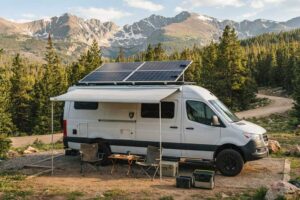
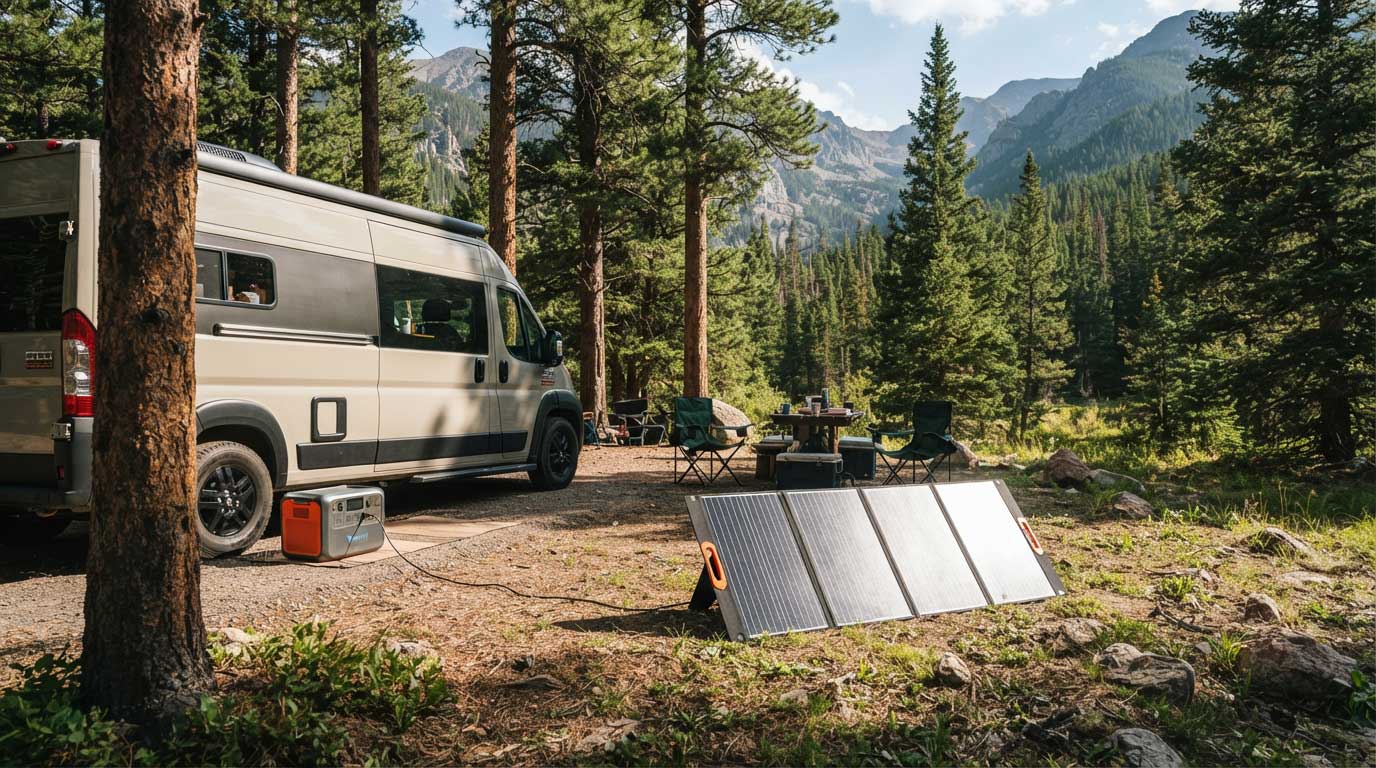
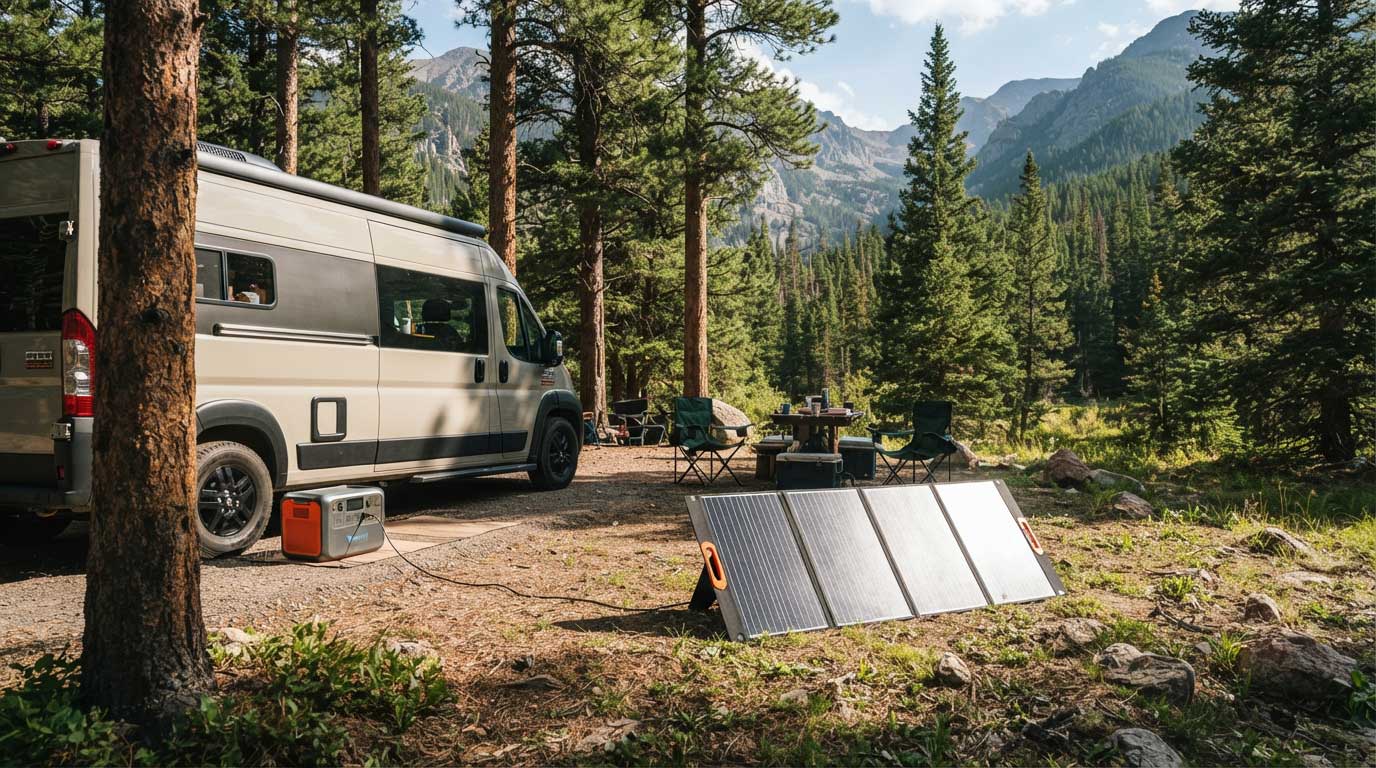
Consider an RV parked beneath trees.
The vehicle may be comfortable there. The roof may be shaded. But a clearing 20 feet away may receive direct sunlight for most of the afternoon.
A portable panel can go into that clearing.
The battery stays beside the RV.
This sounds like a small difference until you use a portable solar system in changing conditions. The DOE states that solar radiation varies throughout the day and that direct sunlight is affected by atmospheric conditions, clouds, landscape and the angle of the sun.
That makes portability an energy-management feature, not merely a convenience.
Common Applications
Foldable portable solar panels can be used for:
- RV and camper charging
- Camping
- Portable power stations
- Emergency backup
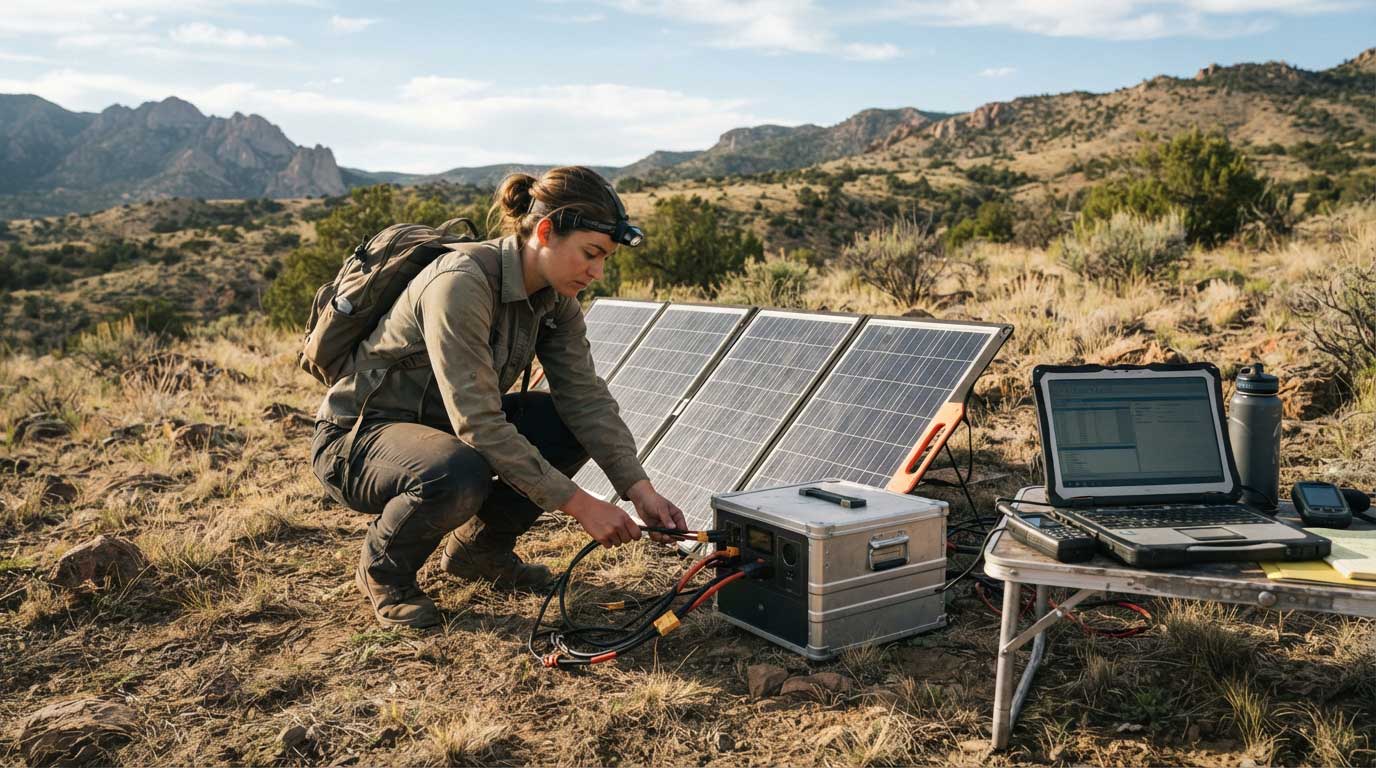
- Remote field work
- Outdoor events
- Mobile communications
- Off-grid cabins
- Boats and temporary marine applications, when the construction is appropriate
- Remote monitoring equipment
- Temporary power systems
For an outdoor user, the workflow is straightforward:
Carry → unfold → position → connect → monitor → fold → store.
For an OEM customer, however, each of those actions creates engineering requirements.
The panel must fit the storage compartment. The cable needs to reach the power station. The connector must match the target system. The folded structure must survive repeated handling. The surface construction must match the environment.
Those details determine whether a portable solar product is genuinely useful.
How Foldable Portable Solar Panels Work
The panel generates DC electricity when sunlight reaches its photovoltaic cells.
The DOE describes PV cells as semiconductor devices that absorb solar energy and create electrical current. Silicon is the most widely used semiconductor material in solar cells, with crystalline silicon forming the basis of many modern PV products.
The panel does not automatically know what the battery needs. The connected charging equipment determines how that generated electricity is accepted and managed.
A simplified portable system looks like this:
Sunlight → PV panel → charge controller / power station input → battery → electrical load
The actual configuration varies.
Some portable power stations have built-in charge-management electronics and accept solar input directly. A separate battery system may require a dedicated solar charge controller.
That is why the phrase “works with a power station” is incomplete unless the electrical specifications have been checked.
What Happens to the Solar Energy?
Not every watt of sunlight becomes usable electricity.
The DOE explains that PV conversion efficiency is affected by factors including wavelength, temperature, reflection and the characteristics of the solar cell.
Temperature deserves particular attention.
PV performance is commonly rated under Standard Test Conditions. DOE guidance identifies STC as 1,000 W/m² irradiance and a 25°C cell temperature. Real outdoor conditions are usually different.
So a panel marked 200W does not mean:
200W × every daylight hour = guaranteed energy.
It means the module has a rated electrical output under specified test conditions.
That difference should appear in any technically responsible product description.
How Much Power Can Foldable Portable Solar Panels Produce?
The answer depends on the panel rating and actual solar resource.
A simple planning equation is:
Estimated daily energy = rated panel power × equivalent peak-sun hours
For example, a 200W panel under a simplified four-hour equivalent-sun assumption gives:
200W × 4h = 800Wh
That is a theoretical energy figure before accounting for system losses and changing weather.
| Panel rating | 3 equivalent sun-hours | 4 equivalent sun-hours | 5 equivalent sun-hours |
|---|---|---|---|
| 100W | 300Wh | 400Wh | 500Wh |
| 200W | 600Wh | 800Wh | 1,000Wh |
| 300W | 900Wh | 1,200Wh | 1,500Wh |
| 400W | 1,200Wh | 1,600Wh | 2,000Wh |
These calculations are useful for planning, not promises.
Actual production can be lower because of:
- Clouds
- Shade
- Poor orientation
- High cell temperature
- Dust
- Cable losses
- Connector losses
- Charge-controller conversion
- Power-station input limitations
- Battery charging conditions
The DOE specifically notes that actual PV production is affected by solar resource variability, time of day, season, angle of sunlight and clouds.
Why Rated Wattage Can Be Misleading
Imagine two 200W portable panels.
Panel A is placed flat beside an RV under intermittent tree shade.
Panel B is carried 15 metres into an open clearing and angled toward the sun.
They have exactly the same rated power.
The second panel can have a much better operating opportunity because the available solar resource is different.
This is one of the most useful insights from working with portable solar applications: mobility can sometimes produce more practical value than another increment of nameplate wattage.
The product is not only a generator.
It is a generator that can be moved.
How to Set Up Foldable Portable Solar Panels
Step 1: Find the Best Solar Position
Do not start by placing the panel beside the battery.
Start by looking at the sunlight.
Check:
- Tree shadows
- Building shadows
- Vehicle shadows
- Hills and terrain
- Morning versus afternoon exposure
- Available space for the fully deployed panel
The DOE explains that solar radiation changes as the sun moves across the sky, with solar energy generally greatest around solar noon when the sun is highest.
A site that looks sunny at 9 a.m. can become heavily shaded by noon.
Step 2: Choose a Stable Surface
A folding panel is relatively easy to knock over compared with a permanently mounted module.
Use a stable surface appropriate to the application:
- Packed ground
- Gravel
- A camping table
- A dedicated support
- A clean deck
- A stable outdoor work surface
Avoid placing cables across the main walking route.
For environmentally sensitive outdoor locations, follow the site’s camping rules and use established durable surfaces where possible.
Step 3: Fully Deploy the Panel
Open the panel according to the manufacturer’s instructions.
Do not force hinges.
Do not sharply crease a section because the product is marketed as “portable.”
Do not assume a flexible panel can be folded repeatedly at the same point unless the manufacturer specifies that use.
The mechanical construction is part of the solar product, not an accessory detail.
Step 4: Connect the Electrical System
Check the receiving equipment before connecting:
- Voc
- Vmp
- Isc
- Imp
- Rated power
- Maximum solar-input voltage
- Maximum solar-input current
- Maximum input wattage
- Connector type
- Polarity
For a commercial OEM project, these specifications should be established before the panel design is finalized.
A connector that physically fits is not enough.
Step 5: Observe the First Charging Cycle
Watch the first few minutes.
Is the power station recognizing solar input?
Is the input wattage reasonable for the sunlight?
Does the output fall when a shadow crosses the panel?
Does it recover when the shadow moves?
This quick observation often reveals more than a product brochure.
How to Choose Foldable Portable Solar Panels
The correct panel is determined by the complete application.
Wattage is only one specification.
Power Rating
Choose a power rating based on the energy requirement and charging window.
A small electronic setup may work with a compact panel.
An RV refrigerator, laptop and communication equipment can justify substantially more generation capacity.
Folded Dimensions
This specification is surprisingly important.
Measure the actual storage compartment.
A panel that produces excellent power but cannot fit behind the RV seat is not a good portable product for that vehicle.
Deployed Dimensions
Large active areas collect more sunlight, but they also require more space.
Before buying or developing a product, consider where it will actually be opened.
A 2-metre-wide panel may work beautifully in an open campground and be awkward on a crowded campsite.
Weight
Weight changes the entire use case.
For an RV owner, another kilogram may be almost irrelevant.
For someone carrying equipment from a trailhead to a remote work location, it is not.
Cell Technology
Monocrystalline silicon is common in portable solar products because it provides a useful combination of power density and mature manufacturing.
For B2B projects, the cell selection should be considered alongside the target dimensions, output, cost and application rather than treated as a standalone marketing term.
Surface Material
The surface has to match the expected environment.
Outdoor use can involve:
- UV exposure
- Moisture
- Dust
- Temperature cycling
- Repeated folding
- Abrasion during transportation
- Occasional impact
A marine application may require a different construction from ordinary camping use.
Connectors and Cables
Connector selection should happen early.
For a custom project, cable length, connector family, routing and strain relief can influence the final mechanical design.
A short cable might work for a power station placed directly behind the panel. It may be unsuitable when the panel needs to sit in a sunny clearing 10 or 20 metres away.
Foldable Portable Solar Panels for RVs
RVs are one of the clearest applications because they combine electrical demand with mobility.
An RV may use solar energy for:
- Battery charging
- Lighting
- Electronics
- Refrigeration
- Communications
- Portable devices
- Emergency power
Roof-mounted solar has one obvious advantage: it is always there.
Portable folding solar has another: it can move.
Suppose the RV is parked under trees.
A roof-mounted panel receives whatever sunlight reaches the roof.
A foldable portable panel can be carried to the edge of the clearing.
That does not make portable solar automatically superior. It makes it complementary.
A practical RV system may use permanent rooftop solar for convenience and portable solar when campsite shading becomes a problem.
Foldable Portable Solar Panels for Camping
Camping creates a slightly different set of requirements.
The panel needs to fit into the vehicle, deploy quickly and survive repeated trips.
The user may also have very limited electrical demand.
A weekend camping setup could prioritize:
- Smartphone charging
- Camera batteries
- LED lights
- GPS and communication equipment
- Laptop charging
- Small refrigeration
The panel should be sized around the actual energy budget.
A 500W panel does not automatically make a camping system better if the user only needs a small amount of electricity and the extra size makes deployment inconvenient.
Conversely, a tiny panel may be frustrating for an RV user running a refrigerator and electronics every day.
The right answer sits between energy demand and deployment behavior.
Foldable Portable Solar Panels for Emergency Power
Portable solar becomes particularly useful when electricity is unavailable but sunlight remains available.
The system can support selected low-power loads rather than attempting to reproduce normal household electricity consumption.
For example, an emergency kit may prioritize:
- Phone charging
- Radio or communication equipment
- LED lighting
- Medical or monitoring equipment where the electrical requirements are appropriate
- Laptop or networking equipment
- Battery charging
The panel does not replace the battery.
It replenishes the battery.
That distinction is important during multi-day outages. Solar generation depends on weather and daylight, while stored energy provides electricity after sunset.
A sensible emergency system therefore considers both generation capacity and battery capacity.
Quality and Safety Considerations
Portable does not mean exempt from PV safety requirements.
IEC 61730-1:2023 specifies fundamental construction requirements for photovoltaic modules intended to provide safe electrical and mechanical operation, including considerations related to electric shock, fire hazards, personal injury and mechanical/environmental stresses.
IEC 61730-2:2023 covers the testing requirements used for PV module safety qualification and includes tests intended to detect failures that could result in fire, electric shock or personal injury.
For B2B procurement, the practical lesson is simple:
Do not treat a certification logo as a substitute for product documentation.
Ask for the applicable test reports, certificates, ratings and intended-use information for the actual construction being purchased.
What to Inspect on a Portable Panel
Before deployment, check:
- Folding sections
- Hinges or seams
- Junction areas
- Cable exits
- Connectors
- Surface condition
- Signs of impact
- Water exposure
- Unusual cable wear
After a trip, inspect the panel before folding it back into storage.
Sand and grit trapped between folding sections can become an abrasive problem over repeated handling.
A Practical Field Case: Portable Solar vs. a Shaded RV Roof
Consider a two-night RV trip.
The RV is parked under a stand of trees. The occupants want to keep the vehicle cool and enjoy the shade, but their portable battery still needs daytime charging.
A portable folding panel is placed approximately 15 metres from the vehicle in an open area.
The battery remains inside the RV.
During the first part of the day, the panel receives direct sunlight. Later, a tree shadow begins crossing one section, so the panel is repositioned.
Nothing about the panel’s rated power changed.
The battery did not change.
The weather did not suddenly become better.
The improvement came from where the panel was placed.
This is one of the most useful ways to evaluate foldable portable solar panels. Portability should not be measured only by folded dimensions. It should also be measured by the number of useful locations where the panel can realistically operate.
That is a more meaningful performance characteristic for mobile solar.
Bright Solar Foldable Portable Solar Panel Solutions
Bright Solar develops flexible and portable solar solutions for B2B applications including RVs, mobile homes, camping, boats, ships, portable power stations and off-grid systems.
For commercial buyers, a portable solar project often needs more than a standard consumer panel.
Typical customization requirements include:
- Rated power
- Folded dimensions
- Deployed dimensions
- Cell configuration
- Surface material
- Cable length
- Connector type
- Product weight
- Electrical configuration
- OEM branding
- Packaging
- Bulk procurement requirements
Bright Solar’s existing product range also demonstrates why application-specific construction matters.
The L Series supports a maximum bending capacity of 30% and is positioned for lightweight flexible solar applications. The H Series is designed for marine/yacht applications with double ETFE construction and a walkable design.
Those products should not be treated as interchangeable simply because both belong to the broader flexible solar category.
For an OEM or distributor, the better starting point is the actual application:
Where will the panel be deployed? How will it be stored? How often will it be folded? What equipment will receive the power? What environmental exposure is expected?
Once those conditions are clear, the electrical and mechanical specifications become much easier to define.
Common Mistakes With Foldable Portable Solar Panels
Leaving the Panel in Partial Shade
A high-wattage panel cannot compensate indefinitely for poor solar exposure.
If a tree is shading the active surface, moving the panel may be the simplest improvement.
Confusing Watts With Watt-Hours
Watts describe power.
Watt-hours describe energy over time.
A 200W panel is not automatically a 200Wh-per-hour or fixed daily-energy product.
Ignoring the Power Station Input Limit
A power station may have a maximum solar input.
A 400W panel connected to a system that accepts only 200W does not turn the power station into a 400W solar charger.
The receiving equipment’s specifications matter.
Folding the Panel Incorrectly
Repeated mechanical stress can damage products when users ignore the manufacturer’s intended folding method.
Fold it along the designed sections.
Buying for Maximum Wattage Instead of Actual Use
More wattage means more size, weight and storage requirements.
The best panel is the one that matches the application and is practical enough to deploy regularly.
FAQ About Foldable Portable Solar Panels
Are foldable portable solar panels worth it?
Yes, especially when portability allows the panel to be moved into better sunlight. They are useful for camping, RVs, emergency power, remote work and temporary off-grid applications where permanent solar installation is impractical.
Can foldable portable solar panels charge a power station?
Yes, provided the panel’s voltage, current, connector and maximum power are within the power station’s solar-input specifications. Physical connector compatibility alone does not guarantee electrical compatibility.
How much power can a foldable portable solar panel produce?
Its instantaneous output depends on the rated power and operating conditions. Actual energy production varies with sunlight, angle, temperature, clouds, shade and system losses. DOE guidance confirms that PV performance changes with solar resource and operating conditions.
Do foldable portable solar panels work on cloudy days?
Yes, but output normally decreases because clouds alter the direct and diffuse solar radiation reaching the panel. Thick clouds can substantially reduce direct beam solar radiation.
Can I use foldable portable solar panels for an RV?
Yes. They can provide supplementary charging when an RV roof is shaded or when a user wants to place the solar array away from the vehicle in direct sunlight.
Are foldable solar panels waterproof?
That depends on the specific product construction and environmental rating. Do not assume every portable folding panel is waterproof. Check the manufacturer’s documented IP rating and outdoor-use specifications.
What should I check before buying foldable portable solar panels?
Check rated power, Vmp, Voc, Imp, Isc, folded dimensions, deployed dimensions, weight, cell type, connector, cable length, environmental protection, mechanical construction and compatibility with the intended battery or power station.
Conclusion
Foldable portable solar panels are designed around a simple advantage: the solar generator can move.
For RV owners, campers, mobile workers and emergency-power users, that flexibility can determine whether the panel spends the afternoon in shade or direct sunlight. For B2B buyers, the product decision goes further—folded size, mechanical construction, electrical compatibility, surface material and environmental requirements all need to match the intended application.
Bright Solar provides flexible and portable solar solutions for OEM, ODM and bulk procurement projects, with product configurations developed around real application requirements rather than a one-size-fits-all specification.
Related recommendations
-

solar panel wiring guide (Field Installation Manual from Bright Solar)
167solar panel wiring guide explained with real installation steps, safety standards, wiring diagrams, and field-tested methods for off-grid and RV solar systems.
View details -
400w Solar Panel Size: Dimensions, Power Output, and Installation Guide
160A 400W solar panel typically measures about 65–82 × 39–44 inches, with actual dimensions varying by manufacturer, cell technology, and module design.
View details -
Flexible 400 Watt Solar Panel: Output, Uses and Installation
82A flexible 400 watt solar panel can suit selected RV, marine, and off-grid systems, but actual energy output depends on sunlight, temperature, shading, orien...
View details -
Flexible solar panel 300w: Lightweight Solar Solution for Mobile and Home Applications
175Explore flexible solar panel 300w solutions from Bright Solar. Learn power output, installation methods, real applications, durability, and how 300W flexible solar panels support modern energy needs.
View details