Lightweight Solar Panels: The Smart Choice for Mobile and Off-Grid Power
Lightweight solar panels provide reliable solar energy while significantly reducing roof load, installation complexity, and structural stress. They are particularly effective for RVs, campervans, boats, portable power systems, and weight-sensitive off-grid applications where traditional glass solar panels may be impractical.
A decade ago, most solar buyers focused almost entirely on wattage. Today, many experienced installers ask a different question first:
“How much does the panel weigh?”
That shift didn’t happen by accident.
At Bright Solar, we have worked on RV conversions, marine projects, portable energy systems, and lightweight commercial installations where every kilogram mattered. In some cases, reducing panel weight solved more engineering challenges than increasing panel efficiency.
One customer rebuilding a European campervan removed nearly 50 kg of rooftop equipment. The vehicle immediately handled better on mountain roads, and fuel consumption improved slightly during long-distance travel. The solar output barely changed, but the overall travel experience did.
That’s when lightweight solar panels stop being a product category and start becoming a practical design solution.
Why Lightweight Solar Panels Are Growing in Popularity
Traditional solar panels remain highly effective.
The problem isn’t performance.
The problem is weight.
A conventional 100W glass solar panel often weighs between 6 kg and 9 kg. When multiple panels are installed on a vehicle roof, sailboat deck, or lightweight structure, the cumulative load becomes significant.
Lightweight solar panels address this issue by replacing heavy glass and aluminum components with advanced composite materials.
Benefits include:
- Lower structural stress
- Easier transportation
- Faster installation
- Better suitability for curved surfaces
- Reduced mounting hardware requirements
- Improved compatibility with mobile applications
According to the U.S. Department of Energy, reducing balance-of-system costs and installation complexity remains one of the key drivers behind modern solar technology development.
Reference Source:
https://www.energy.gov/eere/solar
What Makes Lightweight Solar Panels Different?
The term “lightweight solar panels” covers several technologies.
Not all lightweight panels are identical.
Flexible Solar Panels
Flexible panels use polymer-based construction instead of tempered glass.
Common applications include:
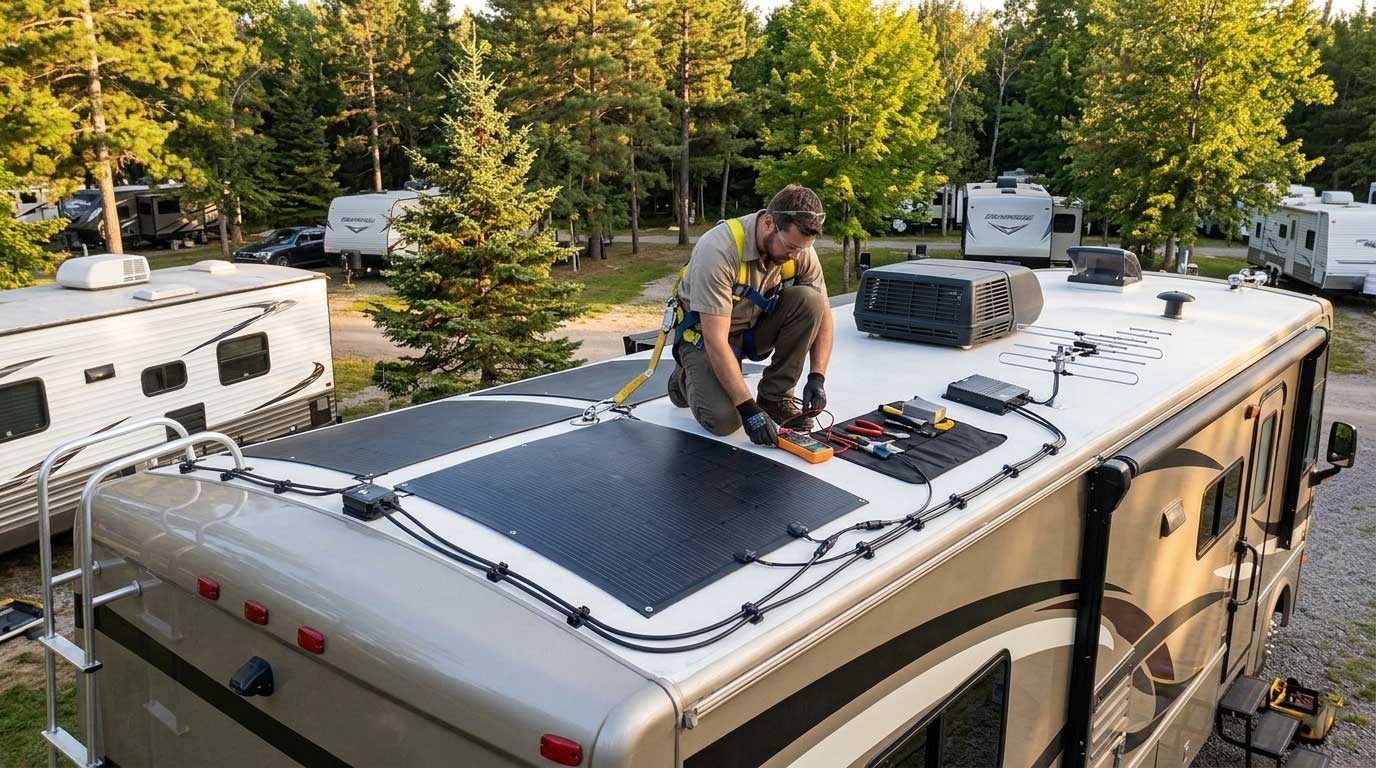
- RV roofs
- Campervans
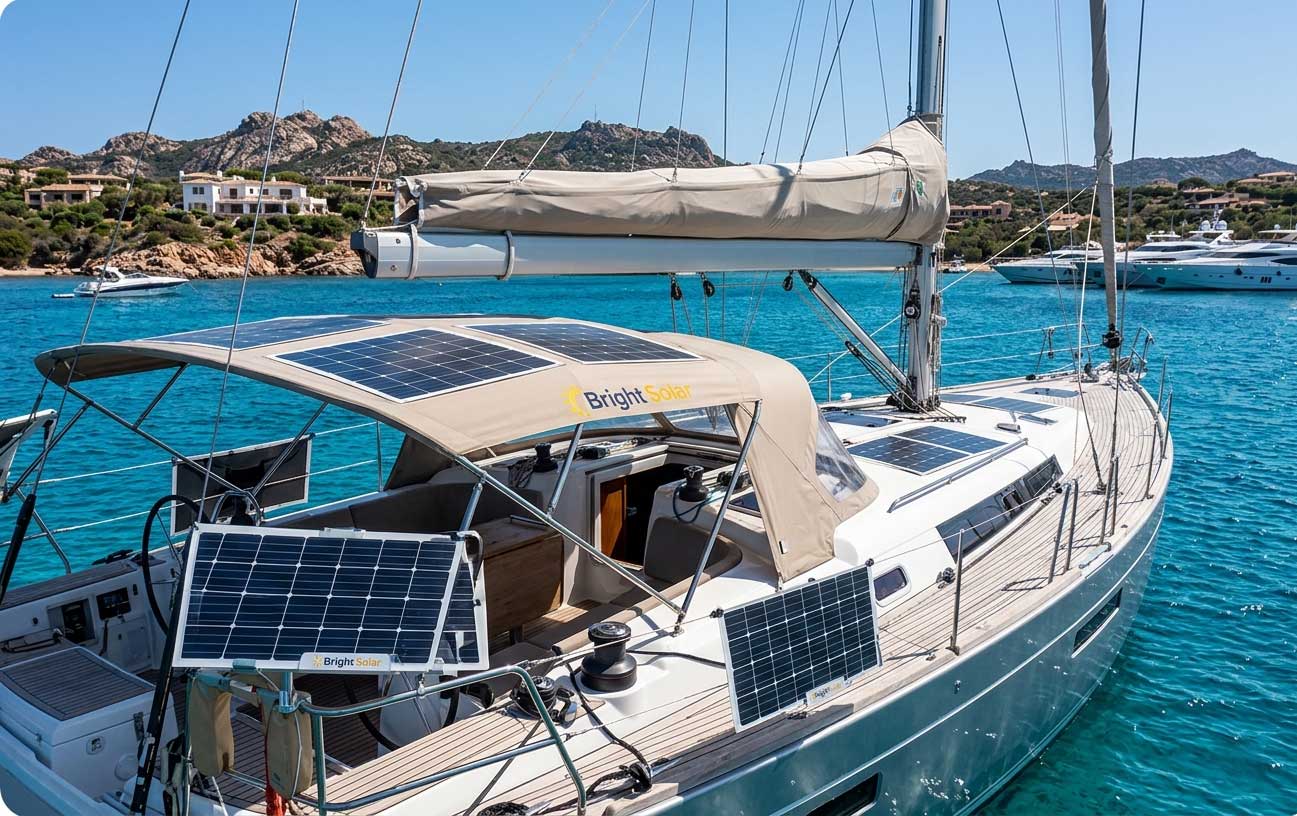
- Marine vessels
- Portable charging systems
They can often conform to slightly curved surfaces, making them useful where rigid panels cannot be mounted easily.
Composite Lightweight Panels
These panels maintain a rigid structure but use advanced composite backings to reduce overall weight.
Advantages include:
- Better durability than many flexible panels
- Higher efficiency
- Lower weight than traditional glass modules
Increasingly, commercial vehicle manufacturers are adopting this approach.
Portable Lightweight Solar Panels
Designed for temporary deployment.
Typical uses include:
- Camping
- Emergency backup
- Outdoor work sites
- Portable power stations
Many foldable solar products fall into this category.
Weight Comparison: Lightweight vs Traditional Solar Panels
The difference becomes clearer when comparing actual figures.
| Panel Type | Typical Weight (100W Equivalent) |
|---|---|
| Traditional Glass Panel | 6–9 kg |
| Composite Lightweight Panel | 2–4 kg |
| Flexible Lightweight Panel | 1.5–3 kg |
For a 600W RV solar system:
| System Type | Approximate Total Weight |
|---|---|
| Traditional Glass Panels | 36–54 kg |
| Lightweight Solar Panels | 12–24 kg |
Removing 20–30 kg from a vehicle roof may not sound dramatic.
On paper, it isn’t.
On a narrow mountain road with strong crosswinds, drivers notice immediately.
Real-World Experience: Lightweight Solar Panels on a Campervan
A customer from Germany approached Bright Solar during a campervan conversion project.
The vehicle was already close to its legal payload limit.
The original plan included:
- Six glass solar panels
- Roof rack system
- Satellite equipment
- Roof ventilation
After calculations, total roof weight exceeded target limits.
The installation team switched to lightweight solar panels.
Results:
- Roof load reduced by approximately 28 kg
- Installation time reduced by 35%
- Fuel consumption improved slightly during long-distance testing
- Vehicle center of gravity lowered
Interestingly, the owner later reported the biggest improvement wasn’t energy production.
It was handling stability.
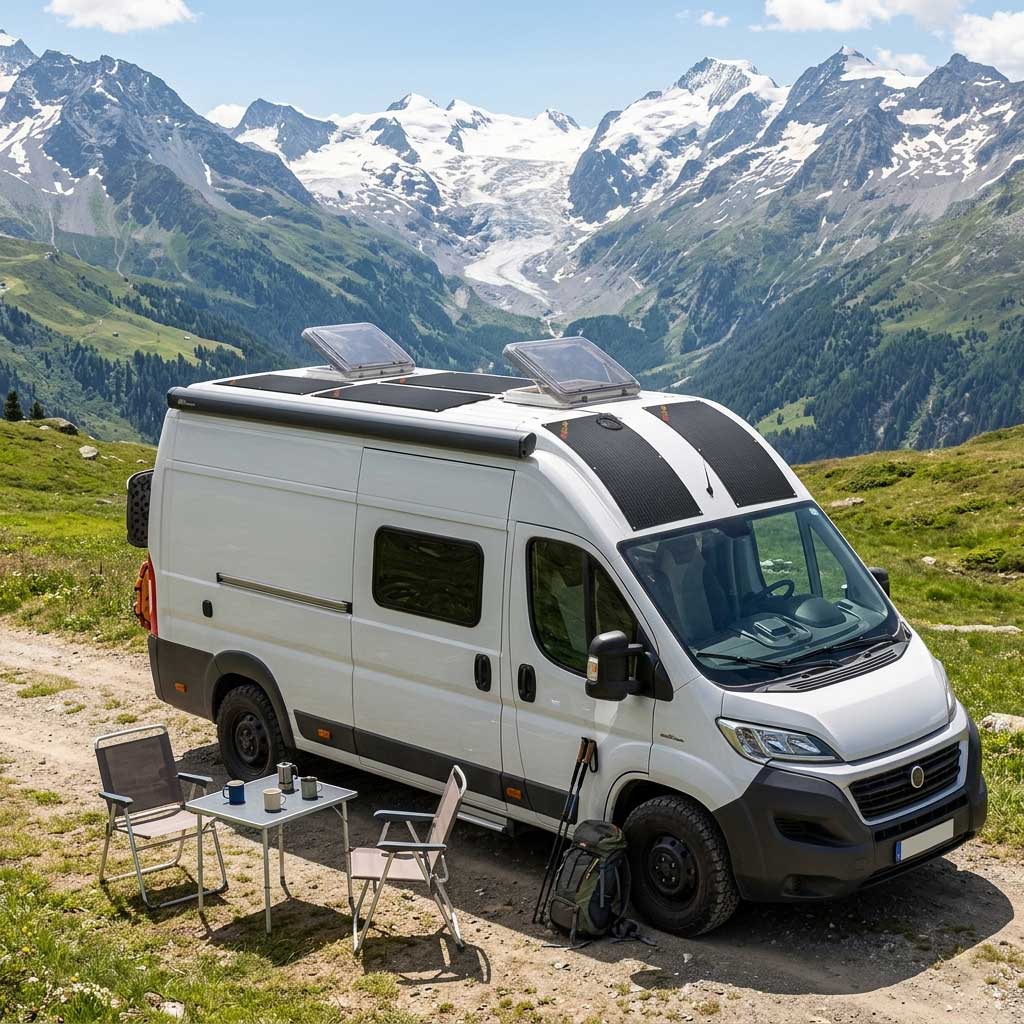
The van felt noticeably less top-heavy when crossing alpine roads.
That kind of feedback rarely appears in product brochures.
Where Lightweight Solar Panels Deliver the Greatest Value
Not every project needs lightweight technology.
Certain applications benefit far more than others.
RV and Motorhome Solar Systems
Weight savings directly improve:
- Payload capacity
- Roof safety
- Fuel efficiency
- Vehicle handling
This is one of the fastest-growing markets for lightweight solar panels.
Marine Solar Installations
Boat owners constantly balance equipment weight.
Additional roof or deck weight affects vessel performance.
Lightweight solar panels reduce this concern significantly.
Portable Solar Systems
Outdoor professionals often prioritize mobility.
Examples include:
- Survey teams
- Emergency responders
- Remote researchers
- Adventure travelers
In these situations, every kilogram matters.
Commercial Fleet Applications
Delivery vans and service vehicles increasingly use solar systems to support:
- Refrigeration
- Monitoring systems
- Auxiliary batteries
Weight reduction improves overall operational efficiency.
Efficiency: Are Lightweight Solar Panels Less Powerful?
This is one of the most common misconceptions.
Not necessarily.
Modern lightweight solar panels often use the same monocrystalline solar cells found in conventional modules.
The difference lies primarily in:
- Encapsulation materials
- Structural layers
- Weight reduction methods
Many premium lightweight panels now exceed 22% cell efficiency.
The National Renewable Energy Laboratory (NREL) regularly documents improvements in photovoltaic efficiency across multiple panel technologies.
Reference Source:
https://www.nrel.gov/
What matters most is not whether a panel is lightweight.
It is how effectively heat is managed.
Heat remains one of the biggest factors affecting solar performance.
The Hidden Challenge: Heat Management
This topic rarely appears in marketing material.
Yet it affects long-term output significantly.
Traditional glass panels often benefit from airflow underneath mounted systems.
Some lightweight solar panels sit closer to mounting surfaces.
This can increase operating temperatures.
Higher temperatures may reduce output.
Experienced installers address this by:
- Improving ventilation
- Selecting suitable mounting locations
- Avoiding excessive adhesive coverage
- Designing airflow pathways
One marine installer described it bluntly:
“Solar panels love sunlight. They hate heat.”
That statement remains surprisingly accurate.
Lightweight Solar Panels vs Flexible Solar Panels
These terms are often used interchangeably.
That creates confusion.
Not all lightweight panels are flexible.
Comparison:
| Feature | Lightweight Composite Panel | Flexible Solar Panel |
|---|---|---|
| Weight | Low | Very Low |
| Rigidity | Semi-Rigid | Flexible |
| Durability | High | Moderate |
| Efficiency | High | Moderate to High |
| Curved Surface Compatibility | Limited | Excellent |
Many buyers automatically assume flexible equals better.
In reality, project requirements determine the best option.
For long-term commercial installations, semi-rigid lightweight panels are often preferred.
For curved campervan roofs, flexible panels may be the better solution.
Durability and Lifespan Considerations
A lighter panel must still survive harsh environments.
Common exposure conditions include:
- UV radiation
- Saltwater
- Road vibration
- Thermal cycling
- Heavy rainfall
According to testing standards published by the International Electrotechnical Commission (IEC), modern photovoltaic modules undergo extensive environmental testing before commercial deployment.
Reference Source:
https://www.iec.ch/
In practical applications, panel quality matters far more than weight alone.
Cheap lightweight panels often fail because of poor materials, not because they are lightweight.
Common Mistakes When Buying Lightweight Solar Panels
Focusing Only on Weight
The lightest panel is not always the best panel.
Buyers should also evaluate:
- Efficiency
- Warranty
- Durability
- Temperature performance
Ignoring Installation Surface Conditions
Curved roofs, marine decks, and vehicle surfaces require different mounting approaches.
A panel suitable for an RV may not be ideal for a boat.
Overlooking Cable Quality
Weight savings become meaningless if poor wiring creates energy losses.
Quality installation remains essential.
FAQ About Lightweight Solar Panels
Are lightweight solar panels durable?
Yes. High-quality lightweight solar panels are designed to withstand vibration, weather exposure, and long-term outdoor operation when properly installed.
Do lightweight solar panels produce less electricity?
Not necessarily. Many modern lightweight panels use high-efficiency monocrystalline cells capable of delivering output comparable to traditional panels.
Are lightweight solar panels good for RVs?
Absolutely. Reduced roof weight improves payload capacity, installation flexibility, and vehicle handling.
Can lightweight solar panels be installed on boats?
Yes. Marine applications are one of the most common uses due to strict weight and space limitations.
How long do lightweight solar panels last?
Premium products can provide many years of reliable service, depending on installation quality, environmental conditions, and maintenance practices.
Final Thoughts on Lightweight Solar Panels
The conversation around lightweight solar panels has evolved beyond simple portability.
Today, weight affects:
- Vehicle design
- Fuel efficiency
- Structural engineering
- Marine performance
- Installation costs
At Bright Solar, we have repeatedly seen projects succeed not because they generated more electricity, but because they removed unnecessary weight without sacrificing performance.
That distinction becomes increasingly important as solar moves into mobile, marine, and space-constrained applications.
The future of solar is not only about producing more power.
It is also about producing power more intelligently.
And for many modern energy systems, lightweight solar panels are becoming an important part of that equation.
Related recommendations
-

flexible solar panels for marine use: Lightweight Solar Power Solution for Boats and Yachts
132Explore flexible solar panels for marine use with lightweight design, waterproof protection, and reliable energy output for boats, yachts, and offshore applications.
View details -
solar panel golf cart roof Solutions from Bright Solar
315Bright Solar’s solar panel golf cart roof keeps golf cart batteries topped up while driving, reducing downtime and electricity use. Ideal for eco-conscious courses with solar charging options.
View details -
Foldable Portable Solar Panel: How to Choose and Use One
37Foldable portable solar panels provide mobile electricity for camping, RV travel, outdoor electronics, and off-grid applications. Their actual output depends...
View details -
Bifacial Flexible Solar Panel: Design, Performance, and Applications
197A bifacial flexible solar panel generates power from both sides when rear-side light is available. Its value depends on clearance, reflectivity, curvature, t...
View details