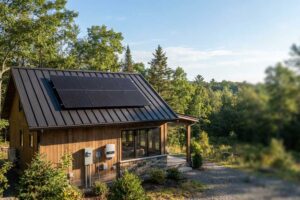
400w Flexible Solar Panels: Complete Guide for RV & Off-Grid Use
400w flexible solar panels provide up to 400 watts of rated DC power in a lightweight, low-profile format, making them particularly useful for RV roofs, boats, vans and other applications where conventional rigid modules are too heavy, bulky or difficult to mount.
That is the specification answer.
The installation answer is more interesting.
A 400W flexible array can be an excellent fit when roof weight, curved surfaces, available mounting area or portability matters. But 400W on the nameplate does not mean the system will continuously deliver 400W.
Real output changes with sunlight, module temperature, orientation, shading, wiring and the charge controller.
The U.S. Department of Energy notes that PV module ratings are measured under standard test conditions of 1,000 W/m² irradiance and 25°C cell temperature, while real operating conditions are usually different.
That distinction is especially important with flexible modules mounted directly onto vehicle roofs, where the panel can become considerably hotter than the surrounding air.
At Bright Solar, our approach to a 400W flexible system starts with the installation surface rather than the wattage printed on the product label. A panel that fits perfectly on a van roof and avoids shade can be more useful than a theoretically higher-output module squeezed into a poor location.
What Are 400w Flexible Solar Panels?
A 400W flexible solar panel is a photovoltaic module with a 400-watt nominal maximum power rating manufactured on a lightweight, bendable substrate rather than a conventional rigid glass-and-aluminum frame.Visit product page:Flexible Solar Panels
The biggest difference is mechanical.
Traditional rigid panels depend on a glass front, rigid frame and fixed structure.
Flexible modules can use lightweight polymer or other flexible construction methods, depending on the technology.
NREL research has specifically examined lightweight flexible PV modules for applications where conventional PV construction creates limitations related to weight, curved surfaces and mobile applications.
That makes the technology particularly relevant to:
- RVs
- Camper vans
- Boats
- Yachts
- Trailers
- Tiny homes
- Portable structures
- Lightweight off-grid systems
- Low-load roofs
- Custom curved surfaces
But “flexible” should not be interpreted as “indestructible.”
NREL research on glassless flexible PV also highlights an important tradeoff: removing glass reduces weight but can expose the module to environmental stresses that conventional glass provides protection against.
That is why the frontsheet, encapsulation, adhesive system and installation method deserve as much attention as the cell efficiency.
400W Flexible Solar Panel Specifications to Check
A product described simply as “400W” does not tell you enough to design a system.
Before purchasing, check the complete electrical datasheet.
| Specification | Why It Matters |
|---|---|
| Maximum Power (Pmax) | Defines the rated output |
| Voltage at Maximum Power (Vmp) | Determines operating voltage |
| Open-Circuit Voltage (Voc) | Critical for controller compatibility |
| Current at Maximum Power (Imp) | Used for operating-current calculations |
| Short-Circuit Current (Isc) | Important for electrical protection |
| Module efficiency | Helps determine required surface area |
| Dimensions | Determines physical fit |
| Weight | Important for RV and mobile applications |
| Temperature coefficient | Helps estimate hot/cold performance |
| Maximum system voltage | Important when connecting multiple modules |
| Junction-box rating | Critical for outdoor installations |
| Frontsheet material | Influences durability and environmental resistance |
One of the most common purchasing mistakes is comparing two 400W modules by wattage alone.
They may both say 400W.
Their dimensions, voltage, current, weight, temperature coefficient and construction can be substantially different.
400W Flexible Solar Panel Output in Real Conditions
A 400W panel is rated for 400W under defined test conditions, not 400W every hour of sunlight.
A simplified energy estimate looks like this:
400W × 4 peak-sun hours = 1,600Wh/day
That is a useful planning example, not a production guarantee.
Actual energy can be reduced by:
- Cloud cover
- High module temperature
- Shading
- Dirt
- Poor orientation
- Cable resistance
- Connector losses
- Charge-controller limitations
- Battery charging restrictions
- System downtime
NREL’s PVWatts model explicitly accounts for system losses including soiling, shading, mismatch, wiring, connections and availability. Its documented default assumptions produce a combined system-loss value of approximately 14%, although actual installations vary and the individual loss percentages should not simply be added together.
NREL’s current PVWatts Version 8 also uses updated weather datasets and improved PV, thermal and inverter models for estimating production at a particular location.
So when someone asks, “How much power will my 400W flexible panel make?”
The technically honest answer is:
It depends on where it is installed and how the system is designed.
For a serious project, use location-specific solar data rather than multiplying 400W by an arbitrary number of daylight hours.
400W Flexible Solar Panels for RVs
A 400W flexible array is particularly attractive for RV owners who want meaningful charging capacity without installing several heavy framed modules.
A typical RV system might look like:
400W flexible solar panels → MPPT charge controller → 12V or 24V battery bank → DC loads / inverter
The actual architecture depends on the battery voltage and electrical loads.
For a 12V battery system, 400W represents substantial charging power.
A simplified current calculation is:
400W ÷ 12V ≈ 33.3A
Actual charging current will differ because the battery voltage during charging is higher than nominal 12V and the controller has conversion losses.
That immediately tells you something important:
A 400W array should not be paired with a controller simply because the controller is advertised as “for 12V batteries.”
Check its actual maximum PV input current and maximum PV input voltage.
RV Roof Space Changes the Calculation
An RV roof rarely looks like an empty rectangle.
There may already be:
- Air-conditioning units
- Roof vents
- Skylights
- Antennas
- Satellite equipment
- Roof racks
- Plumbing vents
A flexible module can make use of space that would be awkward for a large framed panel.
But there is a catch.
A small shadow crossing part of a PV module can reduce output. The exact effect depends on the module’s internal electrical design, bypass-diode arrangement and how the array is wired.
That is why roof mapping should happen before buying the panels.

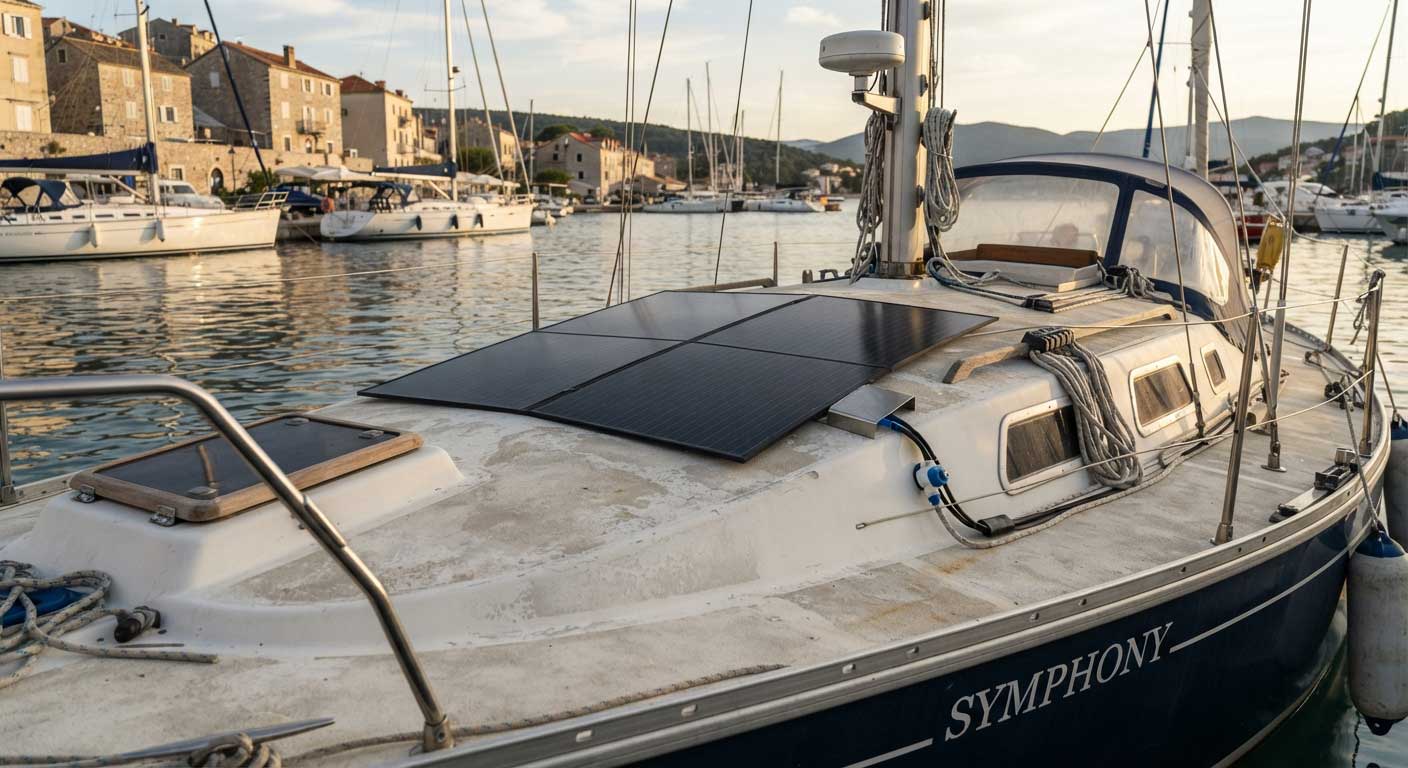
400W Flexible Solar Panels for Boats
Marine installations have a different set of priorities.
Weight matters, but so do:
- Salt exposure
- UV radiation
- Water intrusion
- Deck space
- Cable routing
- Surface curvature
- Mechanical movement
- Maintenance access
A rigid glass module can be difficult to position on certain boat surfaces.
A flexible panel can follow a suitable curved surface more naturally.
That does not mean every curved surface is acceptable.
Always follow the panel manufacturer’s specified bending radius and mounting requirements.
Do not force a module into a tighter curve simply because it physically appears capable of bending.
A panel can look fine during installation and develop mechanical stress later.
Marine Cable Entry Deserves Attention
One detail that often gets underestimated is the cable penetration.
The panel may be completely waterproof while the installation is not.
A poorly sealed cable entry can allow water into a deck, cabin or internal wiring channel.
For a marine project, I would inspect the cable route before final panel placement.
The route should be:
- Short enough to avoid unnecessary cable losses.
- Protected from abrasion.
- Properly secured.
- Sealed at penetration points.
- Positioned away from standing water.
- Accessible for future inspection.
400W Flexible Solar Panel Efficiency and Heat
This is where flexible solar panels deserve a more careful discussion.
A panel mounted directly against a roof often has less airflow underneath than a conventional framed module installed above a roof.
Heat matters because PV performance changes with cell temperature.
The DOE explains that PV performance ratings use 25°C cell temperature, while real-world module temperatures are often higher.
That means a flexible panel installed on a dark RV roof in full summer sun is operating in a very different thermal environment from the laboratory rating conditions.
The panel is not “failing.”
The operating conditions are different.
Why Installation Surface Matters
Suppose two 400W modules use similar cells.
One is installed with a ventilated mounting structure.
The other is bonded directly to a roof.
The second installation may have less heat dissipation.
This is one reason I would never compare flexible and rigid panels solely from their STC wattage.
The complete installation determines real performance.
NREL’s PV research on flexible modules also emphasizes the material and durability challenges associated with lightweight, glassless construction.
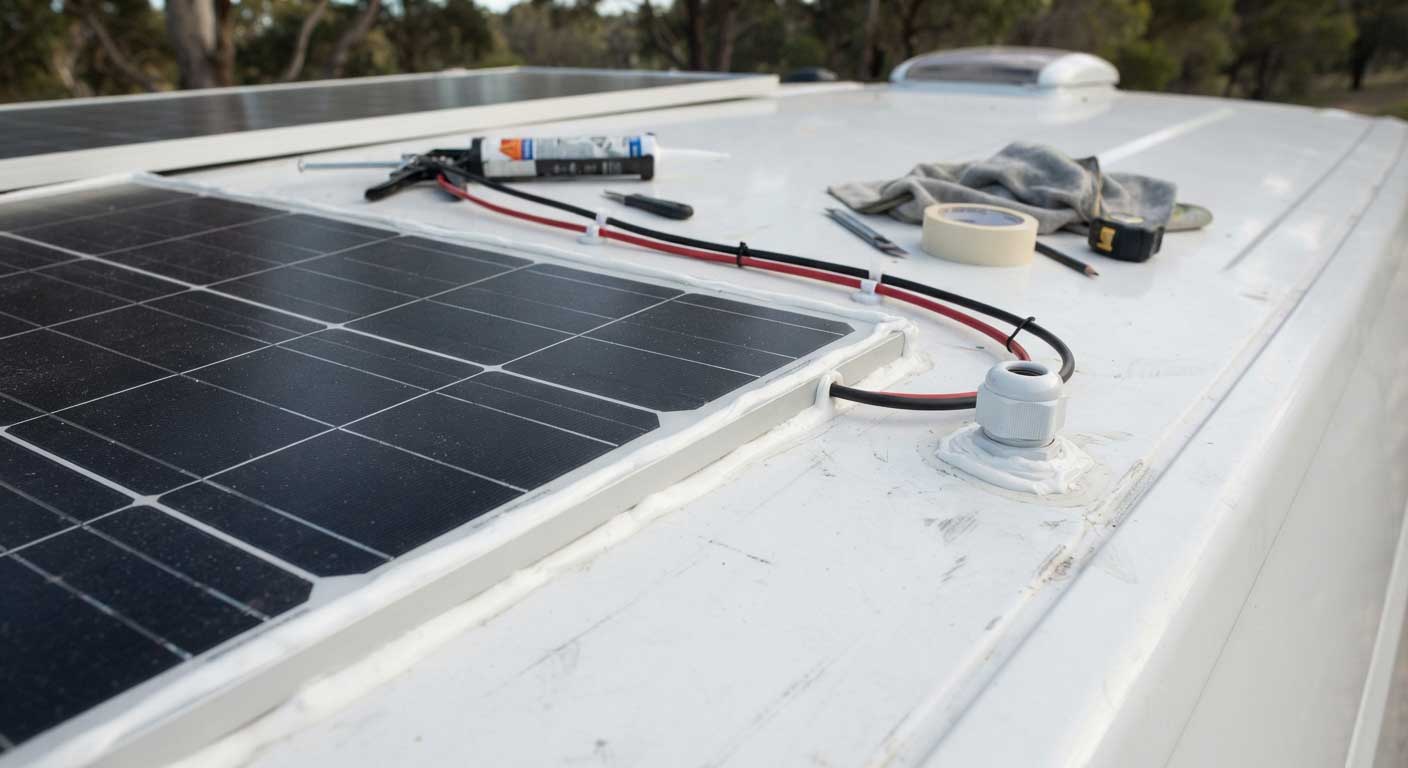
How to Install 400W Flexible Solar Panels
Installation method depends heavily on the panel design and manufacturer instructions.
For an adhesive-mounted application, the practical workflow is:
Inspect the Surface
Look for:
- Cracks
- Loose coatings
- Oxidation
- Existing sealant
- Dirt
- Wax
- Silicone contamination
Adhesive performance depends heavily on surface preparation.
Dry-Fit the Panels
Place the modules where they will actually be installed.
Do not apply adhesive immediately.
Check:
- Roof obstacles
- Cable direction
- Service access
- Shading
- Panel spacing
- Junction-box position
Plan Cable Routing
Keep cables away from:
- Sharp edges
- Moving components
- Hot exhaust areas
- Standing water
- High-friction areas
Prepare the Surface
Follow the adhesive manufacturer’s cleaning and preparation requirements.
Do not assume that ordinary household cleaner is an acceptable preparation method.
Apply the Approved Mounting System
Use only an adhesive or mounting method compatible with the panel, roof substrate and environmental conditions.
Seal Cable Entry Points
A waterproof roof penetration is a system detail, not an accessory.
Verify the Electrical System
Before connecting the array to the charge controller, verify:
- Polarity
- Voc
- Wiring continuity
- Connector condition
- Controller voltage limits
Monitor the First Few Days
Don’t stop after seeing the controller turn on.
Record:
- Morning production
- Midday production
- Battery voltage
- Charging current
- Daily energy
A baseline makes future troubleshooting much easier.
400W Flexible Solar Panels: Series vs Parallel
When multiple flexible panels are used, the wiring configuration matters.
Parallel Wiring
Parallel wiring increases current while keeping array voltage closer to the voltage of one module.
Advantages can include:
- Lower array voltage
- Higher current
- Familiar architecture for some 12V systems
The drawback is increased current, which can require larger conductors and appropriate overcurrent protection.
Series Wiring
Series wiring increases array voltage while keeping current approximately at the level of one module.
Advantages can include:
- Lower current for the same power
- Potentially lower cable losses
- Better suitability for some MPPT configurations
But the controller’s maximum PV voltage must be respected.
Cold-weather Voc is particularly important.
Don’t calculate the maximum array voltage from the panel’s room-temperature Voc alone.
Use the manufacturer’s temperature coefficient and expected minimum temperature.
How Many 400W Flexible Solar Panels Do You Need?
The answer depends on energy consumption.
| Daily Energy Requirement | Starting PV Capacity |
|---|---|
| 500Wh/day | Around 200–400W |
| 1,000Wh/day | Around 400–600W |
| 1,500Wh/day | Around 600–800W |
| 2,000Wh/day | Around 800–1,000W+ |
| 3,000Wh/day | Around 1,200W+ |
These are planning ranges, not guaranteed production figures.
For example, a 400W system with four effective solar hours gives a simple theoretical estimate of:
400 × 4 = 1,600Wh/day
But real output can be lower.
NREL’s PVWatts documentation identifies shading, soiling, wiring, mismatch, connections and system availability among factors affecting system production.
For a location-specific design, use actual weather and solar-resource data.
Realistic 400W RV Case Study
Consider a couple using a travel trailer for weekend trips and occasional longer stays.
Their estimated daily consumption is:
| Load | Estimated Daily Energy |
|---|---|
| LED lighting | 80Wh |
| Phones/tablets | 60Wh |
| Laptop | 180Wh |
| Water pump | 50Wh |
| Vent fan | 100Wh |
| Refrigerator electronics | 150Wh |
| Miscellaneous DC loads | 80Wh |
| Total | 700Wh/day |
They initially considered one 200W panel.
The problem was not whether 200W could produce electricity.
It could.
The problem was recovery after a cloudy day.
A 400W flexible array gives the system substantially more charging capacity and makes better use of the available RV roof area.
The battery bank, controller and inverter still need to be sized accordingly.
This is the type of situation where a larger panel array is not about chasing a bigger number.
It is about giving the system enough margin to recover.
400W Flexible Solar Panel Battery Sizing
For a 400W array, battery capacity should be based on the actual daily load and desired autonomy.
A simple nominal-energy calculation for a 12V 200Ah battery is:
12V × 200Ah = 2,400Wh nominal
That does not automatically mean 2,400Wh is available to the loads.
Usable energy depends on battery chemistry, permitted depth of discharge, temperature, BMS behavior and conversion losses.
This is especially important when an inverter is involved.
A 1,000W AC load on a 12V battery can require more than:
1,000W ÷ 12V = 83.3A
because inverter and battery operating conditions introduce additional losses.
For a 400W solar array, therefore, the battery is only one part of the design.
What Makes a Good 400W Flexible Solar Panel?
For mobile and off-grid applications, I would evaluate the panel in this order:
- Electrical compatibility
- Physical dimensions
- Weight
- Thermal behavior
- Surface construction
- Flexibility and bending limits
- Junction-box and connector design
- Environmental resistance
- Warranty and expected service life
- Actual installation method
Efficiency matters.
But it should not dominate the decision.
If a panel is highly efficient but cannot be installed in the available roof area without shading, its theoretical advantage may disappear.
Maintenance and Long-Term Performance
Flexible panels are not maintenance-free.
Inspect the installation periodically for:
- Surface lifting
- Cracks
- Delamination
- Cable damage
- Connector corrosion
- Sealant deterioration
- Dirt accumulation
- Water intrusion
- Unexpected output decline
DOE guidance notes that PV module efficiency generally degrades at approximately 0.5% per year, although actual degradation varies by technology, environment and product.
That number should be treated as a broad industry reference, not a guarantee for a particular flexible module.
NREL’s PVWatts documentation similarly uses approximately 0.5%/year as a typical long-term degradation assumption after initial light-induced degradation in its modeling context.
The useful habit is simple:
Measure the system while it is healthy.
If a 400W array normally produces a certain amount under comparable weather conditions and suddenly produces much less, the change is worth investigating.
FAQ: 400W Flexible Solar Panels
How much power can a 400W flexible solar panel produce?
A 400W panel has a rated maximum power of 400 watts under defined test conditions. Actual output varies with sunlight, temperature, shading, orientation, wiring, soiling and controller performance.
Are 400W flexible solar panels good for RVs?
Yes. They are particularly useful when RV roof weight, height or available mounting space makes conventional rigid panels inconvenient. A 400W array can provide substantial charging capacity for an RV battery system.
Can I install 400W flexible solar panels directly on an RV roof?
Yes, when the panel is specifically designed for direct mounting and the roof substrate and installation method are compatible. Follow both the solar-panel and adhesive manufacturer’s requirements.
How much electricity does 400W solar produce per day?
There is no universal daily figure. As a simple example, 400W multiplied by four equivalent peak-sun hours equals 1,600Wh before system losses. Actual production should be estimated using location-specific solar data.
Are flexible solar panels better than rigid solar panels?
Neither is universally better. Flexible panels are advantageous where low weight, low profile or curved-surface installation matters. Rigid panels may provide better mechanical protection, airflow and long-term suitability in some installations.
Can 400W flexible solar panels charge a 12V battery?
Yes, when paired with a properly sized solar charge controller. The controller must be compatible with the panel’s voltage and current and configured for the battery chemistry.
Can I connect two 400W flexible solar panels together?
Yes. Two compatible 400W modules create an approximately 800W array. They can generally be wired in series or parallel depending on the controller, battery architecture, voltage limits and installation requirements.
Conclusion: 400w Flexible Solar Panels
400w flexible solar panels occupy a useful middle ground between portability and meaningful solar capacity.
For an RV, boat, camper van or lightweight off-grid installation, 400W can provide a substantial amount of PV capacity without the weight and profile of a conventional framed array.
The key is not simply buying a panel marked 400W.
Check the:
- Vmp
- Voc
- Imp
- Isc
- Dimensions
- Weight
- Temperature coefficient
- Flexibility limits
- Surface construction
- Controller compatibility
- Installation method
Then design around the actual energy demand.
Bright Solar approaches flexible PV from that complete-system perspective: the module, mounting surface, electrical architecture and operating environment all affect the result.
A well-designed 400W flexible system is not just four hundred watts printed on a datasheet.
It is four hundred watts integrated into a real roof, real battery, real controller and real operating environment.
Related recommendations
-

Solar Panels for Van Life: Complete Solar Power Guide
233Solar panels for van life help power refrigerators, lights, fans, and electronics off-grid. Learn sizing, flexible panel options, installation tips, and practical solar system design.
View details -
Solar Panels for Shade: How to Reduce Power Loss
217Solar panels can work in shade, but output decreases as sunlight falls. Proper site assessment, panel placement, bypass diodes, and module-level electronics ...
View details -
48V Solar Panel: Complete Guide for Modern Off-Grid Power Systems
318Discover how a 48V solar panel improves efficiency, reduces cable loss, and powers modern off-grid systems. Learn sizing, applications, costs, and installation tips.
View details -
1000W Solar Panels: Output, Cost, Sizing & Uses
300Learn how 1000w solar panels work, how much electricity they produce, how many panels you need, battery sizing, wiring options, and real-world applications.
View details