How to wire solar panels in parallel?
To wire solar panels in parallel, connect all positive terminals together and all negative terminals together. This keeps voltage the same while increasing current output for higher power demand systems.
How to wire solar panels in parallel correctly
Understanding how to wire solar panels in parallel is important when designing solar systems that require more current without increasing system voltage. Parallel wiring is commonly used in RV solar setups, portable power systems, marine applications, and off-grid installations where battery voltage needs to remain stable.
At Bright Solar, our flexible solar panels are used in applications where wiring decisions directly affect system performance. During project discussions with RV builders and off-grid installers, one detail appears repeatedly: increasing panel quantity does not automatically mean increasing usable energy. The wiring method determines how that energy reaches the controller and battery.
In a parallel solar connection:
- Positive terminals connect together
- Negative terminals connect together
- Voltage remains similar
- Current increases
The basic formula is:
Total Current = Panel Current × Number of Panels
Example:
Two identical 100W solar panels:
| Connection Type | Voltage | Current | Total Power |
|---|---|---|---|
| One panel | 20V | 5A | 100W |
| Two panels parallel | 20V | 10A | 200W |
This configuration is useful for 12V systems because it increases charging capacity while maintaining battery-compatible voltage.
According to the U.S. Department of Energy, photovoltaic system performance depends on both solar modules and balance-of-system components, including wiring, controllers, and energy storage equipment. Proper electrical design helps reduce avoidable losses.
Understanding parallel solar panel connections
How parallel wiring works
Unlike series connections, parallel wiring does not add panel voltage.
For example:
Two 12V solar panels connected in parallel:
- Panel A: 18V operating voltage, 5A current
- Panel B: 18V operating voltage, 5A current
Combined output:
- Voltage: approximately 18V
- Current: approximately 10A
The system produces more current while keeping the same voltage range.
This makes parallel wiring suitable for:
- 12V battery banks
- RV solar systems
- Camping power stations
- Low-voltage off-grid applications
Series vs parallel solar panel wiring comparison
| Feature | Series Connection | Parallel Connection |
|---|---|---|
| Voltage | Increases | Stays similar |
| Current | Stays similar | Increases |
| Best for | Higher voltage systems | Higher current systems |
| Shading impact | Higher sensitivity | Lower impact |
| Typical use | Large arrays | RV and 12V systems |
The correct choice depends on the charge controller, battery voltage, cable distance, and system design.
Step-by-step guide on how to wire solar panels in parallel
Step 1: Check solar panel specifications
Before connecting panels, confirm:
- Rated power
- Maximum power voltage (Vmp)
- Open-circuit voltage (Voc)
- Maximum power current (Imp)
- Short-circuit current (Isc)
Panels connected in parallel should have compatible electrical characteristics.
Mixing panels with very different current ratings can reduce the performance of the overall array.
Step 2: Prepare connectors and cables
A typical parallel connection requires:
- Solar cables
- Compatible connectors
- Branch connectors (Y connectors)
- Charge controller
- Battery connection cables
Cable selection matters because higher current flows through parallel systems.
Long cables with insufficient thickness can create voltage drops and reduce charging efficiency.
For outdoor applications such as boats and RVs, connectors should also resist:
- Moisture
- UV exposure
- Temperature changes
- Vibration
Step 3: Connect positive terminals together
Connect all positive solar panel wires into a common positive connection point.
Example:
Panel 1 positive
- Panel 2 positive
- Panel 3 positive
→ Controller positive input
The voltage remains unchanged, but available current increases.
Step 4: Connect negative terminals together
Repeat the same process with negative terminals.
Example:
Panel 1 negative
- Panel 2 negative
- Panel 3 negative
→ Controller negative input
Always confirm polarity before connecting to the charge controller.
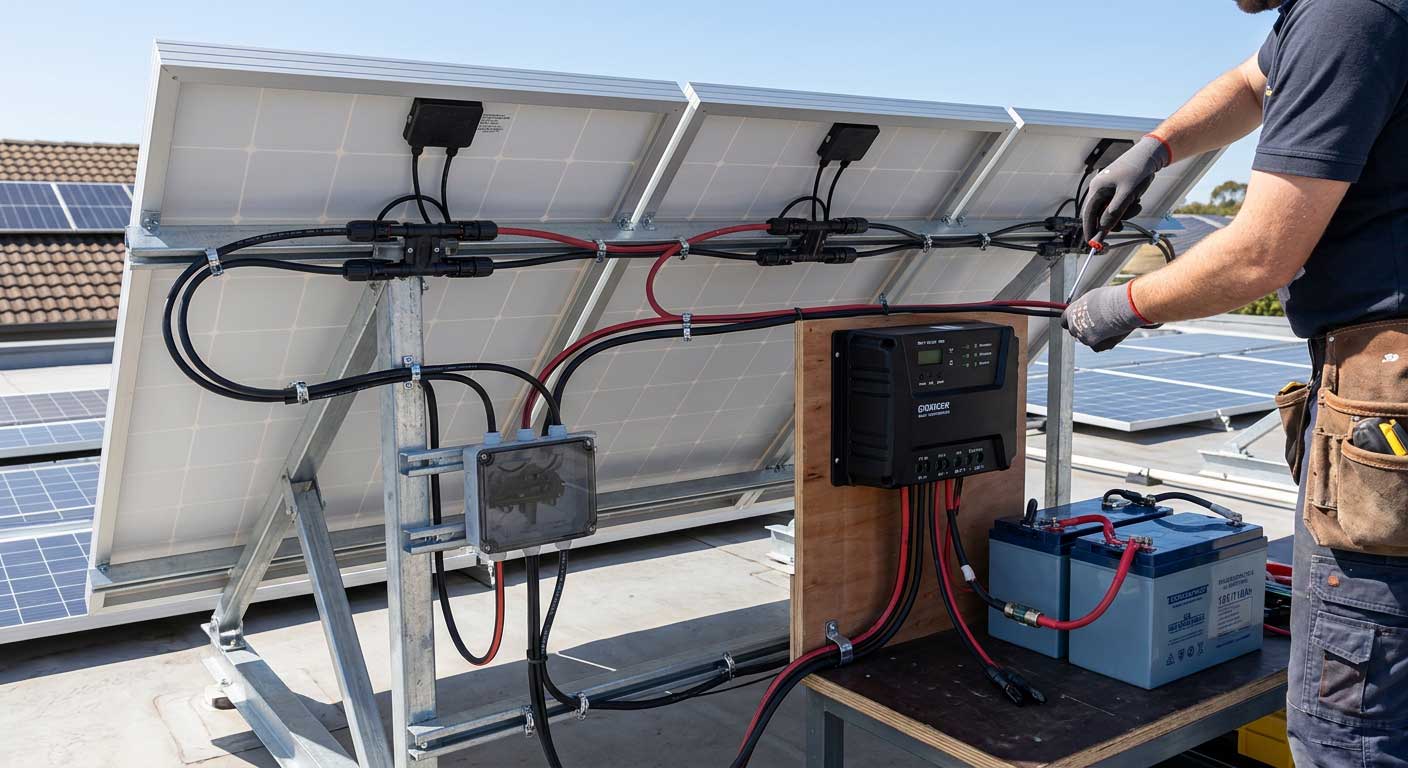
Step 5: Connect to charge controller and battery
A common off-grid wiring order is:
- Connect battery to charge controller
- Connect solar panel array to controller
- Verify charging operation
The controller manages charging current and protects the battery from overcharging.
Advantages of wiring solar panels in parallel
Better performance for low-voltage systems
Parallel wiring is popular because it maintains a familiar voltage level.
Benefits include:
- Easier battery compatibility
- Flexible panel expansion
- Suitable for 12V systems
- Lower impact from partial shading
For example, a camper owner may add another flexible solar panel later without changing the battery voltage structure.
Easier system expansion
One advantage noticed in field installations is flexibility.
A small RV solar system may start with:
- One 100W flexible solar panel
Later, the owner may add:
- Another 100W panel
- Larger battery storage
- Additional charging capacity
Parallel wiring often makes these upgrades simpler.
Common mistakes when wiring solar panels in parallel
Connecting panels with different specifications
Panels should have similar:
- Voltage ratings
- Current ratings
- Solar cell characteristics
Otherwise, stronger panels may be limited by weaker ones.
Ignoring current capacity
Because parallel wiring increases current, cables and connectors must handle the combined output.
For example:
Three 100W panels producing 5A each create approximately:
5A × 3 = 15A
The wiring system must safely support this current.
Forgetting protection devices
Professional systems may include:
- Fuses
- Breakers
- Disconnect switches
These components improve safety and simplify maintenance.
Testing a parallel solar panel connection
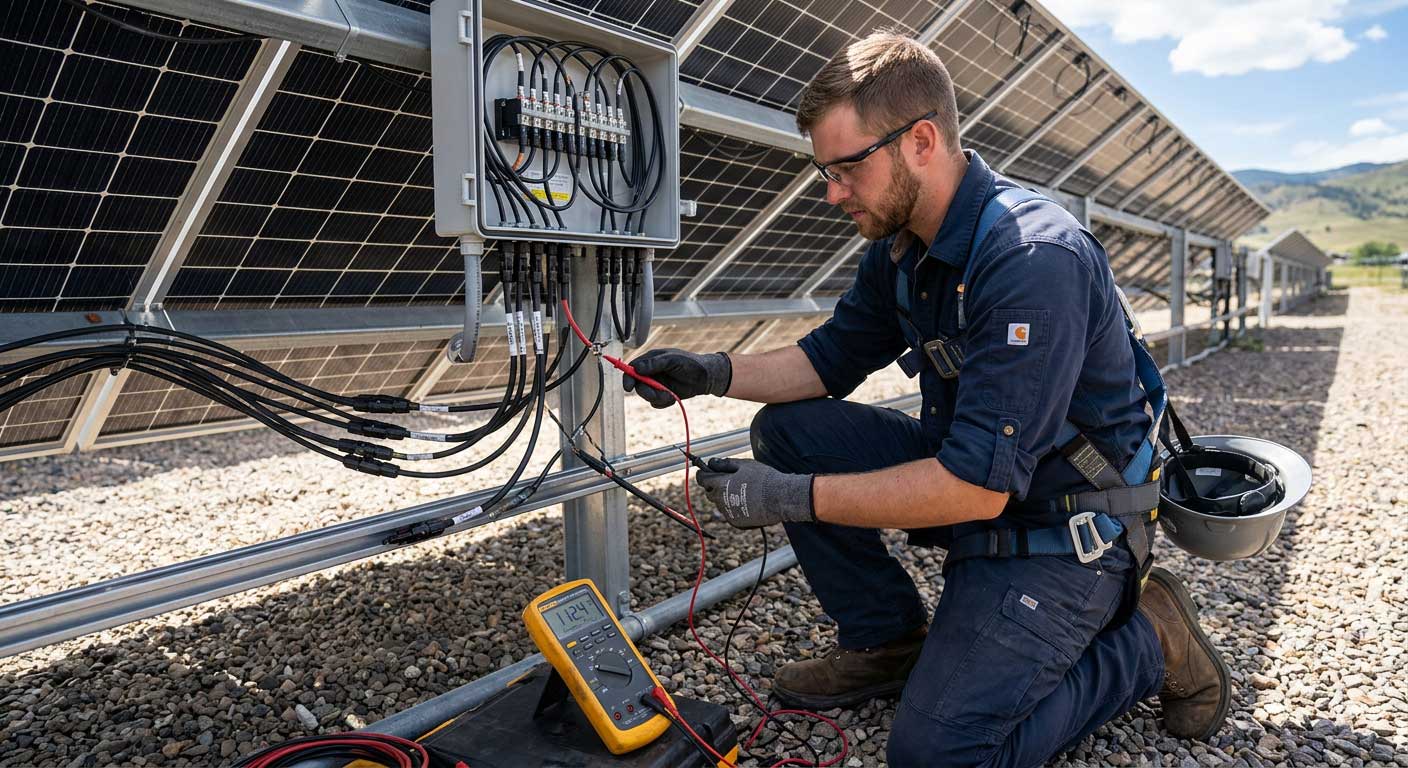
Measure voltage
Use a multimeter to check:
- Array voltage
- Controller input voltage
- Battery charging voltage
The voltage should remain close to the expected panel operating range.
Measure current
Current measurement confirms whether additional panels are contributing power.
A properly wired parallel array should show increased current compared with a single panel under similar sunlight conditions.
FAQ About Solar Panels in Parallel
What happens when solar panels are wired in parallel?
Parallel wiring increases current while keeping voltage approximately the same.
Can I connect two solar panels in parallel?
Yes. Two compatible solar panels can be connected in parallel to increase current output.
Are solar panels in parallel better than series?
Neither is always better. Parallel is suitable for increasing current, while series is better for increasing voltage.
Can different watt solar panels be connected in parallel?
They can sometimes be connected, but matching electrical specifications usually provides better performance.
Do solar panels in parallel charge batteries faster?
Yes, if the battery system and controller can accept the increased current.
What size charge controller is needed for parallel solar panels?
The controller size should match the total solar current and system voltage.
Can shading affect parallel solar panels?
Yes, but parallel systems often maintain better output when one panel experiences partial shading.
Final Answer: How to wire solar panels in parallel?
Knowing how to wire solar panels in parallel allows solar users to increase current capacity while maintaining the required system voltage. Correct panel matching, cable selection, and polarity checks are essential for reliable performance.
Bright Solar provides flexible solar panel solutions for RV, marine, portable, and off-grid applications where practical wiring design and dependable energy output are critical.
The prev: How to wire a solar panel?The next: Is my house good for solar panels?
Related recommendations
-

How Much Solar Panels?
192How much solar panels cost depends on size, efficiency, and application. Discover real solar panel prices, installation costs, and buying tips from Bright Solar.
View details -
How Much Does One Solar Panel Cost?
221How much does one solar panel cost? Discover current solar panel prices, what affects costs, and how to choose the right panel for your home with Bright Solar's expert guide.
View details -
How to Transfer Solar Energy to Electricity?
198How to transfer solar energy to electricity explained with photovoltaic technology, energy conversion steps, system components, and expert solar insights.
View details -
How Much Are Solar Panels for a Home?
280How much are solar panels for a home? Explore real solar costs, system pricing, installation factors, and expert insights to plan your home solar investment.
View details