how to mount portable solar panels?
To mount portable solar panels, unfold the panel on stable ground or secure it to a compatible support, angle it toward direct sunlight, and fasten every contact point before connecting the charge controller or power station.
Choose the Right Mounting Method for Your Portable Solar Panel
The best mounting method depends on where the panel will be used, how often it will move, and whether it needs to withstand wind, vibration, or changing weather. A portable panel should be easy to reposition without becoming unstable when sunlight or wind conditions change.
For Bright Solar customers, including outdoor equipment distributors, RV accessory suppliers, and off-grid system integrators, mounting compatibility is worth considering before selecting a panel. A suitable mounting arrangement protects the module, reduces setup time, and makes it easier for users to position the panel throughout the day.
| Mounting method | Best application | Main consideration |
|---|---|---|
| Integrated kickstand | Camping and portable power stations | Check the locking angle and leg stability |
| Adjustable ground stand | Campsites, gardens, and off-grid use | Use a level surface and secure the feet |
| Vehicle-mounted support | RVs and campervans | Confirm roof compatibility and wind loading |
| Boat-specific mounting bracket | Marine applications | Account for corrosion, movement, and salt exposure |
| Temporary clamp or frame | Field installations and outdoor work | Clamp only at approved structural points |
A folding panel with built-in support is usually the simplest option for temporary use. A separate frame offers more flexibility when the ground is uneven or the panel needs a particular angle.
One practical distinction: a portable panel intended to be moved every few hours is not necessarily designed for permanent roof installation. Check the manufacturer’s instructions before drilling holes, adding clamps, or modifying the panel.
How to Set Up Portable Solar Panels Step by Step
1. Find a Stable, Unshaded Location
Choose a firm, reasonably level surface with clear exposure to the sun. Check for shadows from trees, roof racks, awnings, nearby vehicles, and people. Even when most of the panel is illuminated, a shadow crossing part of the module can reduce output.
On a campsite, place the panel away from walking routes and vehicle doors. Keep the cable out of foot traffic, and avoid locations where rainwater collects.
2. Unfold the Panel and Lock Its Supports
Open the panel fully and inspect its hinges, legs, support bars, and cable connections. Make sure each locking point is engaged rather than relying on the panel’s weight to keep it open.
If you use a separate stand, confirm that the frame supports the panel evenly. Do not bend a rigid module or force a flexible panel beyond the manufacturer’s permitted curvature.
3. Adjust the Panel Toward the Sun
Point the panel toward the sun’s strongest available exposure. In the Northern Hemisphere, a south-facing orientation is often a useful starting point, but the best direction varies with location, season, and the hours when electricity is needed.
The National Renewable Energy Laboratory (NREL) defines standard test conditions for solar modules as 1,000 W/m² of irradiance, a cell temperature of 25°C, and an air mass of 1.5. Actual outdoor conditions vary, so a panel’s rated wattage should not be treated as guaranteed continuous output.
4. Secure the Panel Before Connecting Power
Check that the stand cannot slide, tip, or fold unexpectedly. Use compatible stakes, ballast, or manufacturer-approved tie-down points when appropriate. Keep the panel away from sharp edges and hot exhaust outlets.
Only then connect the panel to the correct charge controller or power station, following the manufacturer’s wiring sequence and voltage limits.
Portable Solar Panel Mounting Ideas for Camping, RVs, and Boats
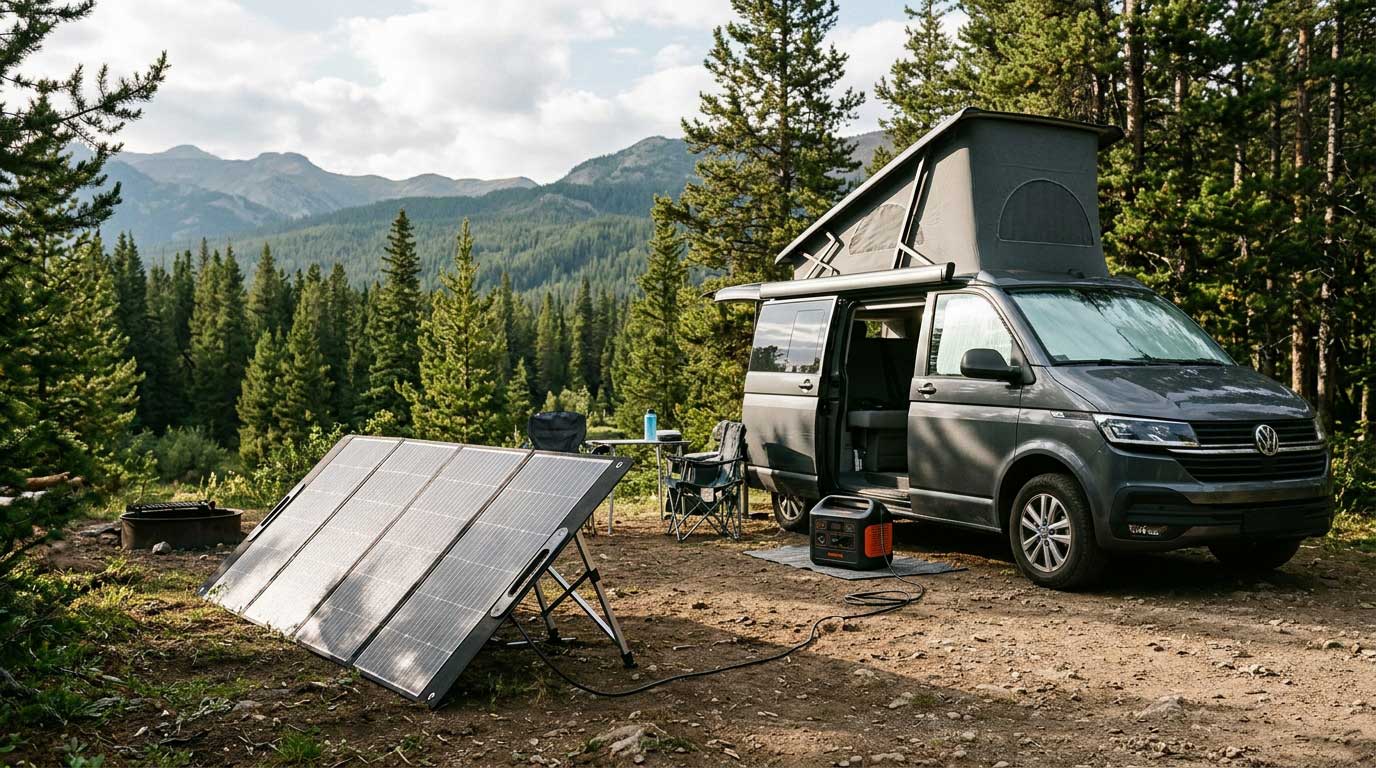
Camping: Use a Folding Stand
For tent camping, position the panel on a kickstand or lightweight adjustable frame. Keep the power station in a shaded, dry, ventilated location where its operating-temperature requirements can be met.
A useful trick is to place the panel where you can reach it without stepping over the cable. That small detail matters when the campsite gets busy or the panel needs repositioning several times a day.
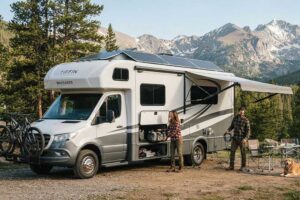
RVs and Campervans: Secure the Panel for Travel
A ground-mounted portable panel can be placed beside a parked RV and moved into sunlight even when the vehicle sits under partial shade. Use a suitable cable extension within the manufacturer’s permitted length and electrical limits.
If you want to mount the panel on the RV roof, use a compatible vehicle mounting system designed for the panel’s construction and expected wind loads. Do not assume that a portable kickstand, suction cup, or generic adhesive is suitable for highway travel.
Boats: Choose Marine-Compatible Hardware
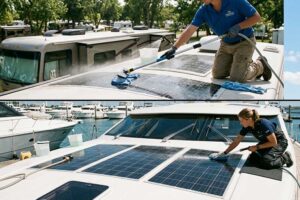
For marine applications, use corrosion-resistant mounting hardware appropriate for the boat’s environment. Keep connectors protected from water exposure, and avoid placing the panel where it interferes with deck movement, emergency access, or navigation.
A panel designed for temporary land use should not automatically be treated as suitable for permanent marine installation.
How to Secure Portable Solar Panels in Windy Conditions
Wind is a mounting issue, not just a weather inconvenience. An elevated panel catches airflow, and an unsecured stand can tip or slide even when the ground initially appears stable.
The U.S. Department of Energy identifies wind as a major cause of photovoltaic system damage and emphasizes appropriate mounting structures and secure attachments. Its guidance for permanent PV systems is not a portable-panel wind rating, but the underlying lesson applies: mounting strength must match the installation conditions.
Before leaving a panel unattended:
- Check the forecast. Fold and store the panel when conditions exceed the manufacturer’s limits.
- Secure the stand. Use approved ground stakes, ballast, or tie-down points where suitable.
- Reduce exposure when necessary. Lower or pack away the panel if gusts make the stand unstable.
- Protect the surface. Keep the module away from sharp rocks, abrasive ground, and objects that could strike it.
- Inspect cables. Prevent connectors and leads from pulling on the panel when the wind moves the stand.
Never improvise roof attachments by drilling through a module or clamping directly onto unapproved areas. If the panel will remain mounted outdoors for extended periods, choose a mounting system designed for that specific application.
Common Portable Solar Panel Mounting Mistakes
| Mistake | Why it matters | Better approach |
|---|---|---|
| Leaving the panel in partial shade | Reduces available solar energy | Check the full panel’s exposure |
| Setting the stand on loose soil | Increases the risk of tipping | Choose firm ground and secure the feet |
| Pulling cables tight | Can strain connectors | Leave suitable slack and route cables safely |
| Using unapproved clamps | May damage cells or the frame | Follow the panel’s mounting instructions |
| Leaving the panel deployed during strong gusts | Can cause movement or damage | Fold it away when conditions are unsafe |
| Mounting a flexible panel on an unsuitable surface | Can cause overheating or mechanical stress | Follow the manufacturer’s surface and airflow requirements |
A related detail is often overlooked: a panel that produces less power is not necessarily mounted incorrectly. NREL’s PVWatts model accounts for irradiance and cell temperature when estimating output. Rated power is measured under defined test conditions, not every outdoor environment.
FAQ About how to mount portable solar panels?
Can I mount portable solar panels directly on the ground?
Yes. Place them on a clean, stable surface or use the supplied stand. Avoid standing water, sharp debris, and surfaces that could damage the panel’s backing or frame.
What is the best angle for a portable solar panel?
The best angle depends on location, season, and time of day. Start by pointing the panel toward the sun and adjust it to improve exposure. For permanent systems, the U.S. Department of Energy notes that annual-energy optimization depends on latitude and orientation; portable panels benefit from being repositioned as conditions change.
Can I mount portable solar panels on an RV roof?
Yes, if the panel and mounting hardware are suitable for roof installation. Check roof compatibility, wind loading, waterproofing, and the manufacturer’s instructions. Remove portable panels before driving unless they are specifically secured for vehicle travel.
How do I keep portable solar panels from blowing away?
Use the manufacturer’s approved securing points and a stable support. Suitable stakes or ballast may help, depending on the surface and wind conditions. Fold or store the panel when conditions exceed its rated limits.
Can I mount a portable solar panel without drilling holes?
Yes. Ground stands, integrated kickstands, and suitable temporary supports usually avoid drilling. For vehicle or boat installations, choose a mounting method approved for the specific surface and expected loads rather than relying on an unverified adhesive.
Should portable solar panels be mounted flat or tilted?
Both positions can work. Tilting can improve direct sunlight exposure at certain times, while a lower profile may be more stable in windy conditions. Choose the position that balances sunlight, stability, and the manufacturer’s instructions.
Does Bright Solar offer mounting options for customized solar panels?
Bright Solar supports B2B solar panel customization, including panel dimensions and configurations subject to project requirements. Buyers should confirm the intended mounting method, installation surface, operating environment, and electrical specifications when discussing an OEM or ODM project.
How to Mount Flexible Solar Panel?
Flexible solar panels are usually mounted using industrial adhesive, VHB tape, screws with spacers, or hybrid mounting systems. The safest installation keeps airflow under the panel, prevents water buildup, and avoids over-bending the panel surface. Done correctly, a flexible solar panel can stay securely mounted for 5–10 years on RVs, vans, boats, and curved roofs.Learn more about How to Mount Flexible Solar Panels?
Conclusion
Learning how to mount portable solar panels starts with three essentials: a stable support, good sun exposure, and secure cable routing. Choose a mounting method that fits your camping, RV, marine, or off-grid application, and never leave a panel exposed to conditions beyond its limits.
For distributors and project buyers, Bright Solar recommends confirming mounting compatibility early in the product selection process so that the panel configuration matches its intended use.
References
- National Renewable Energy Laboratory, PVWatts System Design
- U.S. Department of Energy, Solar Photovoltaic System Design Basics
- U.S. Department of Energy, Install and Commission a Photovoltaic System
- Sandia National Laboratories, PVWatts Model Overview
The prev: How to draw a solar panel?The next: How to go off grid with solar panels?
Related recommendations
-

Do Solar Panels Charge on Cloudy Days?
216Yes. Solar panels can still generate electricity and charge batteries on cloudy days, but output and charging speed usually decrease as cloud cover becomes t...
View details -
How to attach solar panels to rv roof?
236Learn how to attach solar panels to rv roof with secure mounting methods, practical tips, and expert advice for long-lasting RV solar installations from Bright Solar.
View details -
How to Clean Flexible Solar Panels?
329Learn how to clean flexible solar panels safely without damaging the surface. Practical maintenance tips, real-world cleaning methods, and mistakes to avoid from Bright Solar.
View details -
How Many Solar Panels Do I Need?
107Learn how many solar panels do I need based on electricity usage, roof size, and panel wattage. Discover real examples, calculations, and expert advice.
View details