how to keep portable solar panels from being stolen?
Direct Answer :
To keep portable solar panels from being stolen, secure them with a tamper-resistant cable lock, anchor them to a fixed structure, avoid leaving them unattended in exposed locations, and store them inside the RV when practical. Add identification or tracking and choose visible, well-used campsites rather than isolated parking areas.
Why Portable Solar Panels Need a Different Security Strategy
Portable solar panels are useful precisely because they are easy to move. That is also their security weakness.
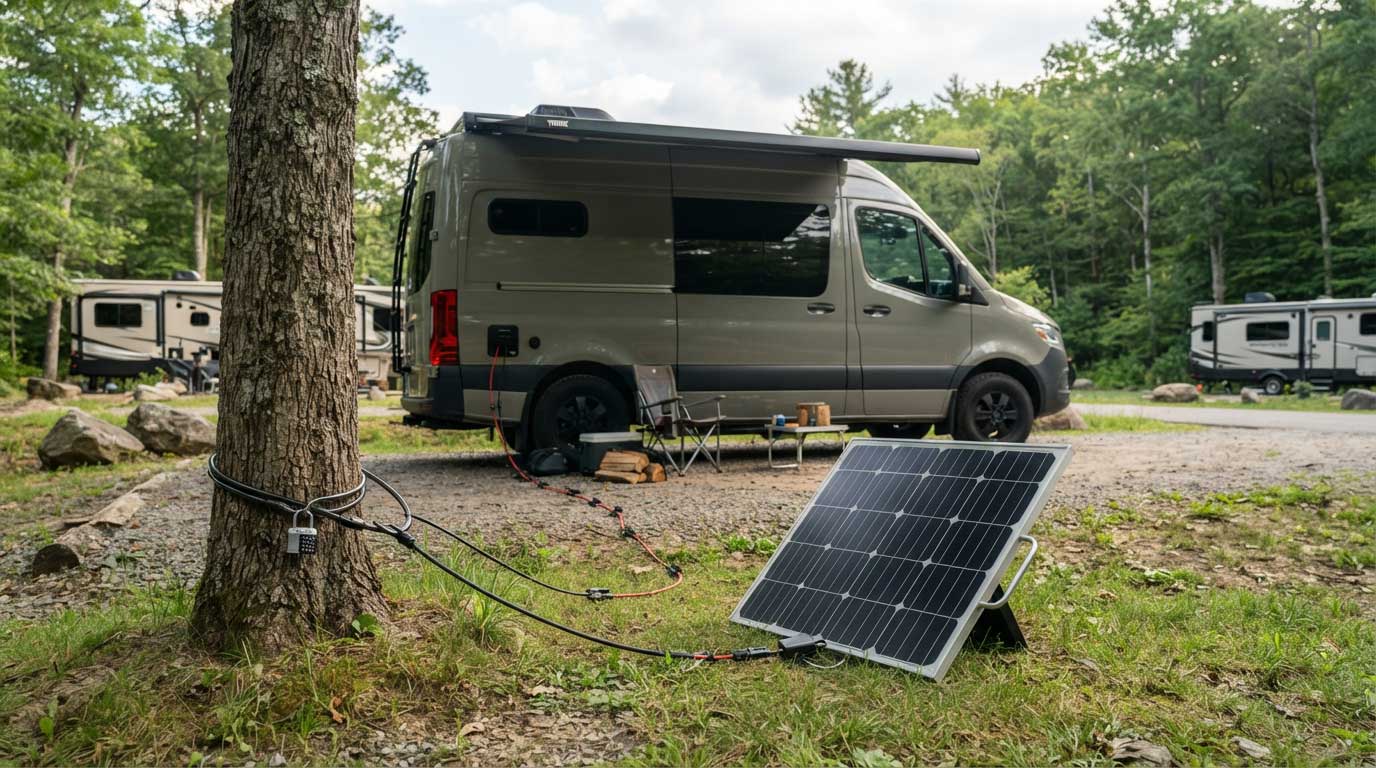
Unlike a roof-mounted solar panel, a portable panel may sit on the ground several metres from an RV, connected by a relatively long cable. During the afternoon, that setup can be perfectly practical. At night, when the campsite is empty, the same panel becomes removable equipment sitting outside the vehicle.
There is no reliable national statistic showing how many portable solar panels are stolen specifically from campsites, so it would be misleading to give a fabricated theft rate. However, theft from campsites and unattended vehicles is a documented concern. The U.S. National Park Service explicitly warns campers to protect valuables, and Big Bend National Park notes that theft from unoccupied vehicles and campsites can be a problem in remote areas.
The practical takeaway is simple: treat a portable solar panel as valuable outdoor equipment, not as campsite furniture.
Use a Physical Lock Before Adding Technology
The first layer should be physical security.
A portable panel can be secured with a steel security cable or coated aircraft cable passed through an appropriate mounting point and attached to something that cannot simply be lifted away.
The lock should secure the panel itself—not merely the solar cable.
That distinction matters.
A thief who can disconnect the MC4 connectors and walk away with the panel has not been stopped by a cable that only secures the electrical lead.
A useful portable setup can include:
| Security method | Purpose | Practical use |
|---|---|---|
| Security cable | Prevents quick grab-and-carry theft | Campsites, RV stops |
| Locking carabiner | Makes temporary securing easier | Daytime setups |
| Tamper-resistant fasteners | Makes hardware removal slower | Semi-permanent portable mounting |
| GPS/Bluetooth tracker | Helps locate equipment after loss | Higher-value equipment |
| Identification label | Establishes ownership | Recovery and identification |
| Storage inside RV | Removes the target completely | Overnight or unattended periods |
Do not attach a security cable to a lightweight camping chair, folding table, awning arm, or other object that can be carried away together with the panel.
Anchor to Something That Cannot Move
The anchor point should be substantially harder to remove than the panel.
At a campsite, that might mean an approved fixed structure or another genuinely secure anchor point. Do not drill into campground infrastructure, trees, posts, or park facilities without permission. Campground rules vary, and some parks specifically prohibit attaching lines to trees, vegetation, signs, or infrastructure.
For an RV owner, the better approach is often to design the security point around the equipment rather than improvising with campsite property.
Make the Panel Less Attractive When You Leave the Campsite
Security is not only about locks.
Visibility matters.
A bright solar panel sitting alone beside an RV can be much more noticeable than one positioned within the normal footprint of the campsite. This does not mean hiding equipment in unsafe locations or creating trip hazards. It means avoiding unnecessary exposure.
The National Park Service advises visitors not to leave valuables visible in vehicles and recommends securing valuables when camping. At Glacier National Park, visitors are specifically instructed to keep valuables locked and out of sight.
For portable solar equipment, the same principle translates into a simple routine:
- Deploy the panel when you need solar generation.
- Keep cables tidy rather than stretched across walking areas.
- Avoid leaving the panel outside when nobody is at the campsite.
- Put the panel away before sleeping if theft risk is a concern.
- Keep high-value accessories inside the RV.
- Avoid advertising expensive equipment unnecessarily.
This is particularly relevant at trailheads and dispersed camping locations. The National Park Service has documented vehicle-property theft concerns in some recreation areas; at Golden Gate National Recreation Area, for example, NPS reported 3,969 cases handled by park law-enforcement rangers and U.S. Park Police across several sites from 2015 through September 2021. That figure concerns theft-related cases from vehicles and surrounding recreation areas—not portable solar panels specifically—but it illustrates why unattended outdoor valuables deserve attention.
Do Not Rely on the Solar Cable as a Theft Deterrent
A solar extension cable is designed to carry electrical power. It is not a security device.
This sounds obvious, but it is an easy mistake when setting up an RV system in a hurry.
A thief can potentially disconnect the electrical connectors and remove the panel while leaving the cable behind. Conversely, forcing a security function onto an electrical cable can damage connectors, insulation, or the panel itself.
Keep the two jobs separate:
Electrical cable = carries power.
Security cable = resists unauthorized removal.
For Bright Solar portable solar applications, the panel should remain easy to deploy and electrically safe while the security method is independently attached to a suitable structural point.
Mark the Equipment Before Your Trip
A discreet ownership mark can help establish that the panel belongs to you.
Record:
- Panel model
- Serial number, if available
- Purchase invoice
- Photographs of the panel and connectors
- Unique identifying marks
- Approximate purchase date
Store those records digitally rather than relying on a paper receipt inside the RV.
This is especially useful if several campers are using similar-looking portable solar equipment.
Choose Where You Park With Security in Mind
A portable solar panel is harder to monitor when the RV is parked in an isolated position.
The National Park Service recommends awareness of surroundings and notes that some campgrounds have ranger patrols.
That does not mean a busy campsite guarantees security. It simply changes the circumstances.
When regulations and availability allow, consider:
- A visible campsite rather than a secluded corner
- Areas with regular camper activity
- A position where the panel remains visible from the RV
- Well-lit locations when available
- Campgrounds with established management or patrols
- Removing the panel before leaving for several hours
Avoid placing the panel where a passing person can quickly lift it and disappear behind vegetation, parked vehicles, or terrain.
What About GPS Trackers?
A tracker can be useful, but it should be considered recovery technology, not primary theft prevention.
A tracker does not stop someone from picking up the panel.
For a high-value portable solar system, a small tracker concealed in an appropriate location can add another layer. Check the tracker’s operating temperature, battery life, network coverage, and whether it requires a subscription.
The National Park Service also cautions that cell connectivity and Wi-Fi are not guaranteed in campgrounds.
That matters for connected security devices. A tracker that depends on cellular coverage may not provide continuous location information in remote camping areas.
The Most Practical Security Routine for RV Solar
For most portable solar users, the strongest approach is not one expensive anti-theft product. It is a short routine that makes the panel inconvenient to steal.
Before leaving the campsite:
- Disconnect the portable panel.
- Coil and secure the solar cables.
- Remove the security cable.
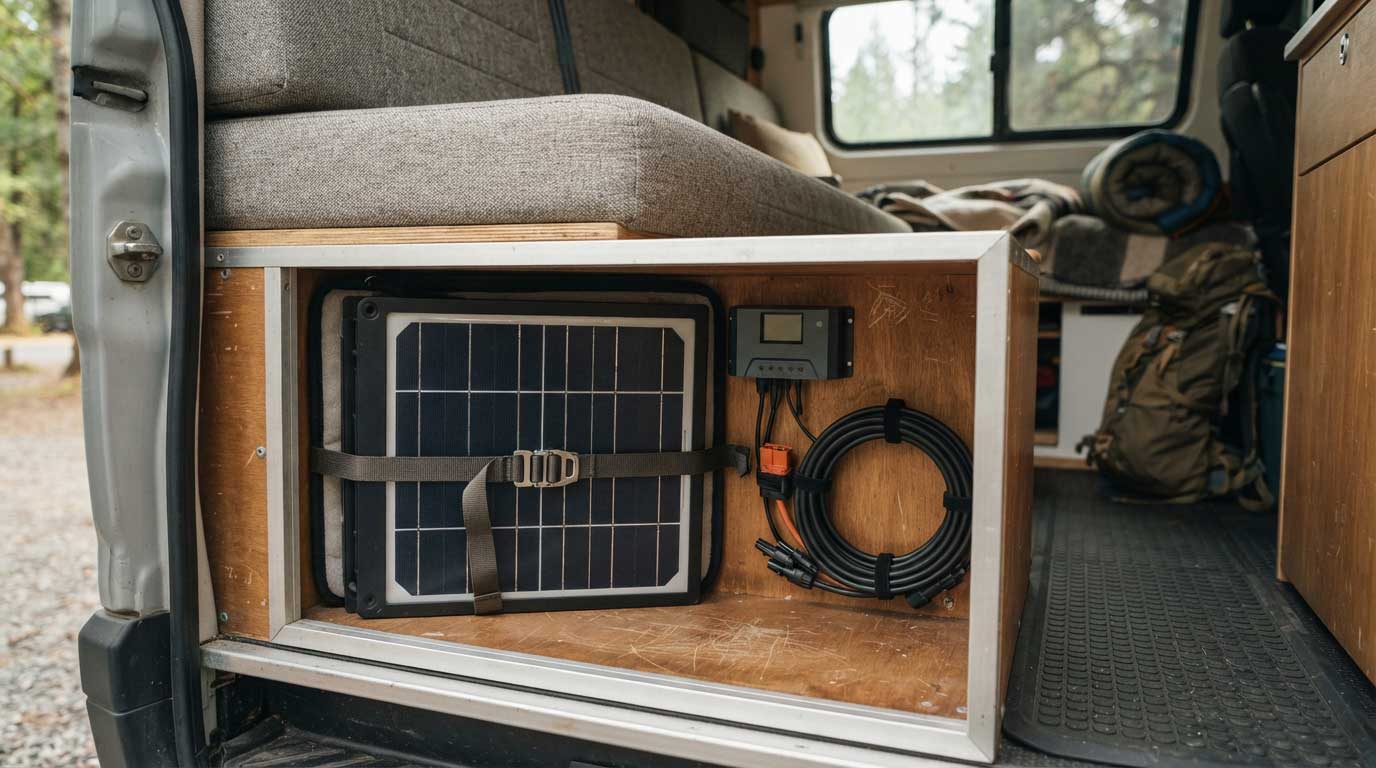
- Fold or pack the panel.
- Store the panel inside the locked RV.
- Keep the controller and connectors out of sight.
- Check that nothing valuable remains visible outside.
For overnight use, the decision is slightly different. If the panel must remain deployed, combine a physical security cable with a location that allows you to see or hear activity around the RV.
If the weather changes, pack it away anyway. Theft prevention should never create a bigger safety problem through wind, rain, or a loose cable.
Portable Solar Panel Security: What Actually Helps?
| Method | Helps prevent theft? | Main limitation |
|---|---|---|
| Steel security cable | Yes | Can be defeated with sufficient tools |
| Locking hardware | Yes | Adds setup time |
| Keeping panel inside RV | Strongly | Requires storage space |
| GPS/Bluetooth tracker | Mainly recovery | Does not physically prevent theft |
| Visible campsite | Can reduce opportunity | Not a guarantee |
| Identification marks | Helps recovery/identification | Does not stop theft |
| Solar extension cable alone | No | Designed for electrical connection |
There is an important practical difference between deterrence and recovery.
A lock increases the time and effort required to remove the panel. A tracker may help identify its location afterward. Neither should be described as theft-proof.
FAQ About how to keep portable solar panels from being stolen?
What is the best way to secure a portable solar panel?
A strong security cable attached through a suitable structural point and connected to a secure anchor is a practical first layer. For longer periods of absence, storing the panel inside the locked RV is more effective.
Can I lock a portable solar panel to my RV?
Yes, if the panel has an appropriate structural attachment point and the chosen security hardware does not damage the frame or electrical components. The attachment should be engineered for security rather than improvised around the solar connector.
Can someone steal a portable solar panel even with a cable lock?
Yes. No portable lock provides absolute theft prevention. A cable lock increases the time and effort required to remove the panel, while secure storage removes the outdoor target entirely.
Should I leave my portable solar panel outside overnight?
If theft risk is a concern, storing it inside the RV overnight is the more straightforward option. If it remains outside, use an appropriate physical security device and keep the setup visible from the RV where practical.
Are portable solar panels easy to steal from campsites?
They can be easier to remove than permanently mounted RV solar panels because they are designed to be portable. The National Park Service specifically warns that theft of property from campsites and unoccupied vehicles can occur in some remote areas.
Does a GPS tracker prevent portable solar panel theft?
No. A tracker can support recovery after equipment is lost or stolen, but it does not physically prevent removal. Coverage can also be limited in remote camping locations.
Should I hide my portable solar panel at a campsite?
The better approach is to avoid leaving it unattended rather than relying on concealment. When you leave the campsite for an extended period, disconnect and store the panel inside the locked RV whenever practical.
Conclusion
Knowing how to keep portable solar panels from being stolen is mostly about reducing opportunity. A proper security cable, a genuine anchor point, sensible campsite placement, equipment identification, and secure indoor storage can work together without making the portable solar system difficult to use.
For Bright Solar users, portability should remain the advantage—not the security weakness. Deploy the panel when you need power, secure it when you must leave it outside, and put it away when the RV will be unattended for an extended period.
Related recommendations
-

How To Set Up Solar Panel System At Home Off Grid?
107How to set up solar panel system at home off grid? Learn off-grid solar design, battery sizing, installation steps, and expert tips from Bright Solar.
View details -
How to Attach Flexible Solar Panel?
252Learn how to attach flexible solar panel systems safely on RVs, boats, and roofs. Discover mounting methods, airflow tips, and expert installation advice.
View details -
how to prepare solar panels?
172Learn how to prepare solar panels before installation with expert tips, inspection steps, tools, and Bright solar guidance for better performance.
View details -
How do solar panels work simple explanation?
42Solar panels use photovoltaic cells to convert sunlight into DC electricity, which can be used directly, converted to AC, or stored in batteries.
View details