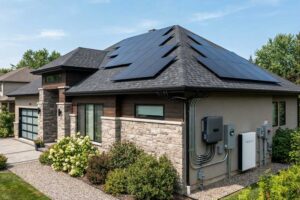
how many solar panels needed for a house?
how many solar panels needed for a house? Most U.S. homes need about 16–23 solar panels to offset typical electricity use, assuming modern panels around 400–440 W. The exact number depends on annual electricity consumption, local sunlight, panel wattage, roof space, shading, and system losses.
That range is useful, but it should not be treated as a universal answer.
A 1,500-square-foot house with heavy air-conditioning use can need more solar than a larger, energy-efficient home. I have seen this distinction repeatedly when reviewing solar system layouts: house size is a weak starting point; the electric bill is much better.
How many solar panels does a house need?
The most practical calculation starts with annual electricity consumption.
The basic formula is:
Number of panels = annual electricity use ÷ solar production ratio ÷ panel wattage
For example, EnergySage uses 10,791 kWh/year as a current U.S. household consumption figure and estimates that U.S. production ratios commonly fall between 1.1 and 1.6. Using a 440 W panel gives a range of roughly 16–23 panels.
The U.S. Energy Information Administration reports that average residential electricity consumption was about 865 kWh per month in 2024, equivalent to approximately 10,380 kWh annually.
So, for a quick residential estimate:
| Annual electricity use | 440 W panels, approximate |
|---|---|
| 6,000 kWh | 9–10 panels |
| 8,000 kWh | 12–16 panels |
| 10,000 kWh | 15–21 panels |
| 12,000 kWh | 17–25 panels |
| 15,000 kWh | 22–31 panels |
| 20,000 kWh | 29–38 panels |
These are planning estimates, not engineering designs. Your location can move the result substantially.
How many solar panels for a 2,000 sq ft house?
A 2,000-square-foot house does not automatically need a fixed number of panels.
EnergySage’s 2026 residential data gives an illustrative estimate of about 15 panels for a 2,000-square-foot home, assuming 440 W panels and a 1.5 production ratio. A 3,000-square-foot home in the same model comes out around 22 panels.
The difference is energy behavior.
A 2,000-square-foot house with:
- Electric heating
- Central air conditioning
- An electric water heater
- An EV
- A swimming pool
can consume considerably more electricity than another 2,000-square-foot house with efficient appliances and modest cooling demand.
That is why I would not size a solar system from square footage alone.

How many 400 watt solar panels does a house need?
With 400 W panels, a typical U.S. household often falls around 15–20 panels for substantial electricity offset, assuming roughly 10,800 kWh of annual consumption and a 1.4 production ratio. EnergySage’s calculation gives approximately 19 panels under those assumptions.
The equation is straightforward:
10,800 ÷ 1.4 ÷ 0.4 ≈ 19 panels
That would create a system of:
19 × 400 W = 7.6 kW
Move to 440 W modules and the panel count drops:
10,800 ÷ 1.4 ÷ 0.44 ≈ 18 panels
This is a small numerical difference, but on a constrained roof, one or two panels can matter.
EnergySage reports that 97% of home solar panels quoted in the second half of 2025 were rated between 400 and 460 W, showing how common this power range has become in today’s residential market.
How many solar panels do you need based on electricity usage?
Your electricity bill is the better measuring stick.
Look at the last 12 months of kWh consumption, rather than using one summer bill. This captures seasonal air conditioning, winter heating, guests, vacations, and changes in household behavior.
A rough example:
Annual use: 14,000 kWh
Production ratio: 1.4
Panel rating: 440 W
14,000 ÷ 1.4 ÷ 0.44 ≈ 23 panels
That produces a nominal system size of about:
23 × 440 W = 10.12 kW
But there is another wrinkle.
If you are planning to add an EV, heat pump, electric water heater, or battery system, today’s electricity bill may understate tomorrow’s demand.
I prefer to identify those loads before finalizing the panel count. It is much easier to account for a planned EV charger during system design than to discover two years later that the original array was undersized.
Does location change how many solar panels you need?
Yes—often dramatically.
EnergySage estimates U.S. production ratios generally between 1.1 and 1.6, depending largely on solar resource and system conditions.
Two homes using exactly 10,000 kWh per year may therefore require different system sizes.
For example:
| Location condition | Production ratio | Approx. 440 W panels |
| Lower solar resource | 1.1 | 21 panels |
| Moderate solar resource | 1.3 | 18 panels |
| Strong solar resource | 1.5 | 15 panels |
| Very favorable conditions | 1.6 | 15 panels |
Roof orientation, tilt, shading, temperature, inverter efficiency, and soiling also influence actual production.
This is where a simple “watts × number of panels” calculation stops being enough.
How much roof space do solar panels need?
Panel count is also limited by physical roof area.
EnergySage currently uses approximately 21 square feet per 440 W residential panel in its roof-space examples.
So:
20 panels × 21 ft² ≈ 420 ft²
25 panels × 21 ft² ≈ 525 ft²
30 panels × 21 ft² ≈ 630 ft²
That is module area, not necessarily the total usable roof area.
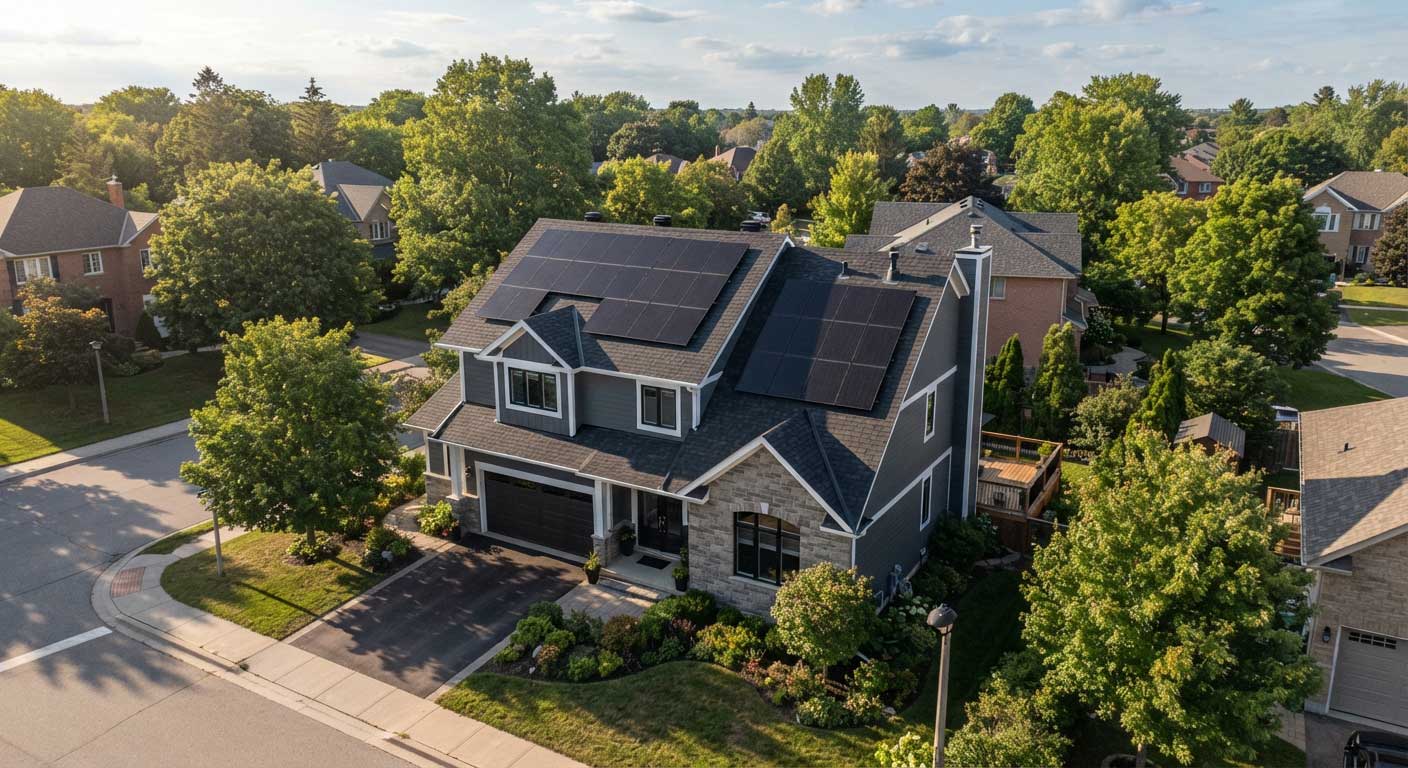
Vents, chimneys, skylights, valleys, roof edges, access pathways, and shaded sections can remove substantial space from the layout.
A roof that looks enormous from the driveway can become surprisingly tight once the actual panel dimensions are drawn over it.
Should you install enough panels to cover 100% of electricity use?
Not always.
The financially sensible system size depends on utility rates, net-metering or export rules, incentives, battery storage, future electricity demand, and the homeowner’s goals.
Some homeowners want maximum annual offset. Others prefer a smaller system because exported solar electricity is compensated at a lower rate than electricity purchased from the grid.
There is also the roof itself. If a few additional panels require moving equipment, redesigning the array, or using an unfavorable roof plane, the extra capacity may not justify the added complexity.
The highest panel count is not automatically the best solar system.
FAQ: How Many Solar Panels Needed for a House?
How many solar panels does an average house need?
A useful current estimate is 16–23 panels for a typical U.S. home seeking substantial or full electricity offset, assuming modern panels and typical U.S. solar production conditions.
How many solar panels do I need for a 1,500 sq ft house?
There is no fixed number. A reasonable starting range might be around 10–18 panels, but annual electricity consumption is much more important than square footage.
How many solar panels do I need for a 2,000 sq ft house?
EnergySage’s illustrative 2026 calculation estimates about 15 panels for a 2,000-square-foot home under specific assumptions of 440 W panels and a 1.5 production ratio.
How many solar panels are needed to power a house completely?
For many U.S. homes, approximately 16–23 modern panels can be a reasonable starting estimate, but homes with high electricity consumption may need substantially more.
Are 400 W or 440 W panels better for a home?
Higher-wattage panels can reduce the number of modules needed for the same system capacity. However, panel dimensions, efficiency, roof space, electrical design, warranty, and cost should also be considered.
Does an EV increase the number of solar panels needed?
Yes. Charging an EV adds electricity consumption, so a solar system designed to offset that additional load may require more panels or a larger system.
What is the most accurate way to calculate solar panel requirements?
Use your previous 12 months of electricity consumption, local solar production estimates, actual panel specifications, roof geometry, shading analysis, and utility requirements. A professional design should then convert those inputs into a final system size.
Conclusion
how many solar panels needed for a house is best answered from electricity consumption rather than home size. For a typical U.S. household, 16–23 modern panels is a useful starting range, while high-energy homes, less-sunny locations, or future EV and heating loads can push the number higher. Current residential panels commonly fall around 400–460 W, making panel efficiency and roof space increasingly important.
For Bright Solar, the practical approach is to start with the home’s actual kWh consumption, then work backward through local solar production, panel wattage, roof space, and future loads. The result is usually more accurate—and more useful—than choosing a panel count from house square footage alone.
Related recommendations
-

how to hook up solar panels?
195Learn how to hook up solar panels safely for home solar systems. Compare series and parallel wiring, inverter connections, voltage limits, and installation basics.
View details -
What Direction Should Solar Panels Face?
149Discover what direction should solar panels face for maximum energy output. Learn the best orientation, optimal angle, and installation tips from Bright Solar.
View details -
How Long Do Solar Panel Batteries Last?
108Learn how long do solar panel batteries last, what affects solar battery lifespan, and how to maximize battery performance for home solar systems with Bright Solar.
View details -
How Long Do Solar Panels Last on a House?
209How long do solar panels last on a house? Learn the average lifespan, degradation rates, maintenance factors, and what affects residential solar panel performance with Bright Solar.
View details