how hot do solar panels get?
how hot do solar panels get? Solar panels commonly reach 25–60°C (77–140°F) above or near ambient conditions, depending on sunlight, wind, mounting, and panel construction. Under strong midday sun, a panel can reach 50–70°C (122–158°F) even when the surrounding air feels considerably cooler.
That is the short answer. The more useful answer is what happens after the temperature rises.
A solar panel is designed to operate outdoors, so heat itself is not abnormal. The issue is that PV cells produce less electrical power as their operating temperature increases. NREL notes that under full sun, PV modules typically operate about 25–60°C hotter than ambient temperature.
For Bright Solar, this is one of the details we pay attention to when evaluating flexible solar panel applications. A panel sitting directly against a dark RV roof behaves differently from one installed with an air gap above a roof or deck. The thermometer reading beside the panel does not tell the whole story.
How hot can solar panels get?
There is no single maximum temperature for every solar panel.
A practical field range looks like this:
| Outdoor air temperature | Possible panel operating temperature |
|---|---|
| 20°C / 68°F | 45–50°C / 113–122°F |
| 25°C / 77°F | 50–55°C / 122–131°F |
| 30°C / 86°F | 55–65°C / 131–149°F |
| 35°C / 95°F | 60–70°C / 140–158°F |
| 40°C / 104°F | 65–80°C / 149–176°F |
These are practical ranges, not guaranteed limits. Wind, irradiance, mounting geometry, roof material, panel color, and ventilation can move the actual temperature substantially.
NREL’s photovoltaic modeling documentation defines NOCT conditions around 800 W/m² irradiance, 20°C ambient temperature, and 1 m/s wind speed.
An older NREL field-modeling reference also gives a useful engineering relationship between cell temperature, ambient temperature, irradiance, and NOCT. It notes that increasing wind speed generally lowers cell temperature.
Why solar panels get so hot
A solar panel does not convert all incoming sunlight into electricity.
The remaining energy becomes heat.
That is why a black PV module exposed to intense sunlight can feel surprisingly hot when touched. The glass surface may be uncomfortable long before the surrounding air reaches the same temperature.
Several factors matter:
- Solar irradiance: stronger sunlight generally raises module temperature.
- Ambient temperature: hotter air gives the panel less opportunity to reject heat.
- Wind speed: moving air improves convective cooling.
- Mounting gap: airflow behind a raised module can help remove heat.
- Roof material: dark roofs can add additional heat around the module.
- Module construction: glass, encapsulation, substrate, and frame affect thermal behavior.
- Installation angle: orientation changes both sunlight exposure and airflow.
This is why two identical panels installed on different roofs can show noticeably different surface temperatures at 1 p.m.
Does heat reduce solar panel efficiency?
Yes. Solar panel efficiency decreases as cell temperature rises, particularly for conventional crystalline-silicon modules.
NREL reports that most silicon modules have temperature coefficients between approximately −0.50%/°C and −0.38%/°C.
For example, if a module has a temperature coefficient of −0.40%/°C, increasing its cell temperature from the 25°C reference point to 55°C represents a 30°C increase.
That corresponds to roughly:
30 × 0.40% = 12%
of temperature-related power reduction, assuming the coefficient remains applicable across that range.
This does not mean the panel suddenly loses 12% of its annual energy production. Temperature is only one variable among irradiance, shading, soiling, orientation, wiring, inverter efficiency, and other system losses.
But on a bright summer afternoon, the effect is real.
Why panel ventilation matters
This is one area where installation details become more important than marketing specifications.
A conventional rigid panel mounted above a roof usually has some air movement underneath it. A low-profile flexible panel installed directly onto a surface has less opportunity for rear-side airflow.
That does not automatically make flexible solar panels unsuitable for hot climates. It means the thermal design of the application deserves attention.
For RV and marine projects, I look at the actual installation surface rather than simply asking whether the panel is rated for outdoor use.
A panel sitting on a hot, dark roof at noon is experiencing a very different thermal environment from the same panel mounted above an open structure.
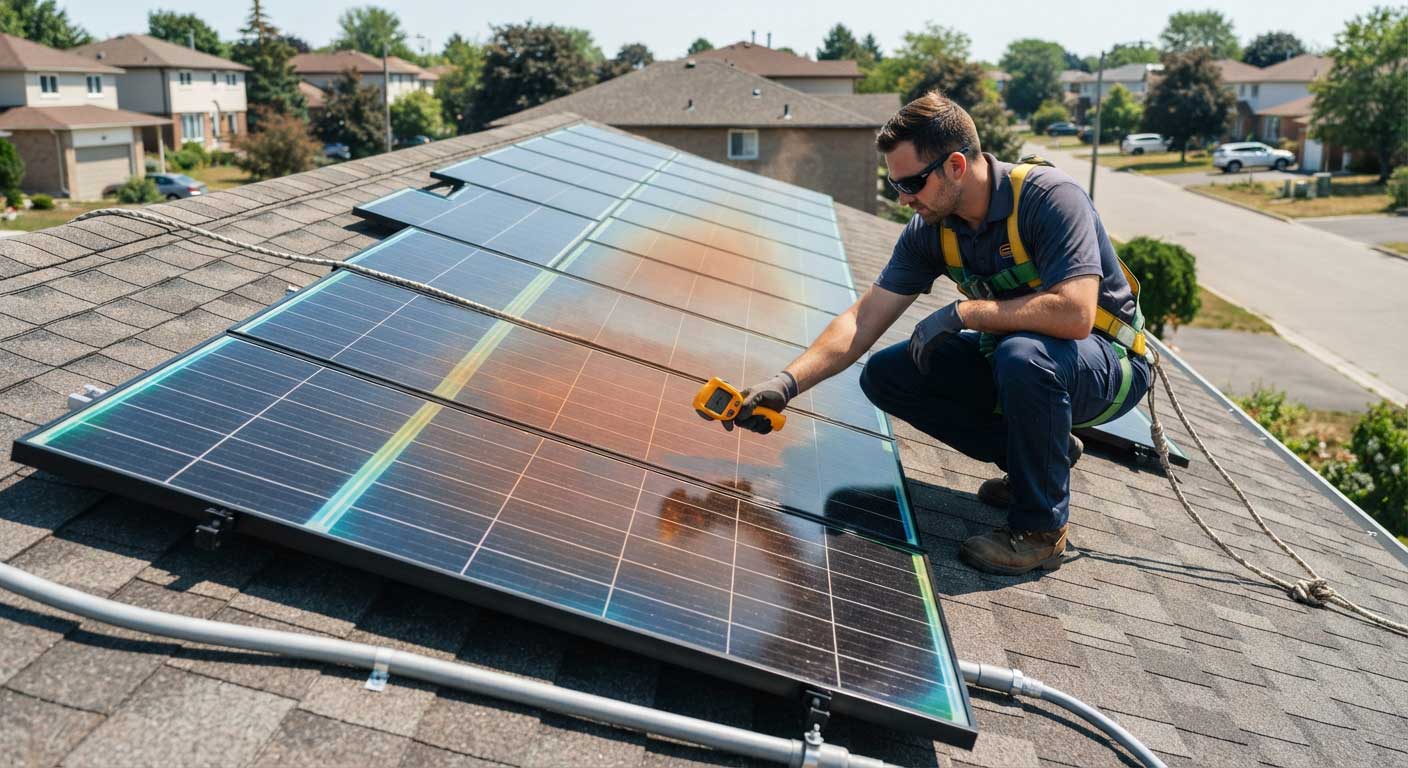
What temperature is too hot for solar panels?
Solar panels are engineered and tested for outdoor thermal stress rather than ordinary room-temperature conditions.
IEC 61215 establishes design qualification and type-approval requirements for terrestrial PV modules exposed to outdoor climates. The current IEC 61215-1:2021 framework also includes testing requirements relevant to flexible modules.
Importantly, operating temperature and damage temperature are not the same thing.
A module producing less power because it is hot is not necessarily being damaged. The immediate concern is normally reduced electrical output. Long-term reliability depends on thermal cycling, materials, encapsulation, solder connections, junction boxes, environmental exposure, and the module’s qualified operating conditions.
IEC specifically notes that in climates where the 98th-percentile operating temperature exceeds 70°C, higher-temperature testing should be considered.
How hot do flexible solar panels get?
Flexible solar panels can become hot too. Their flexible construction does not eliminate solar heat.
What changes is the thermal environment and physical construction.
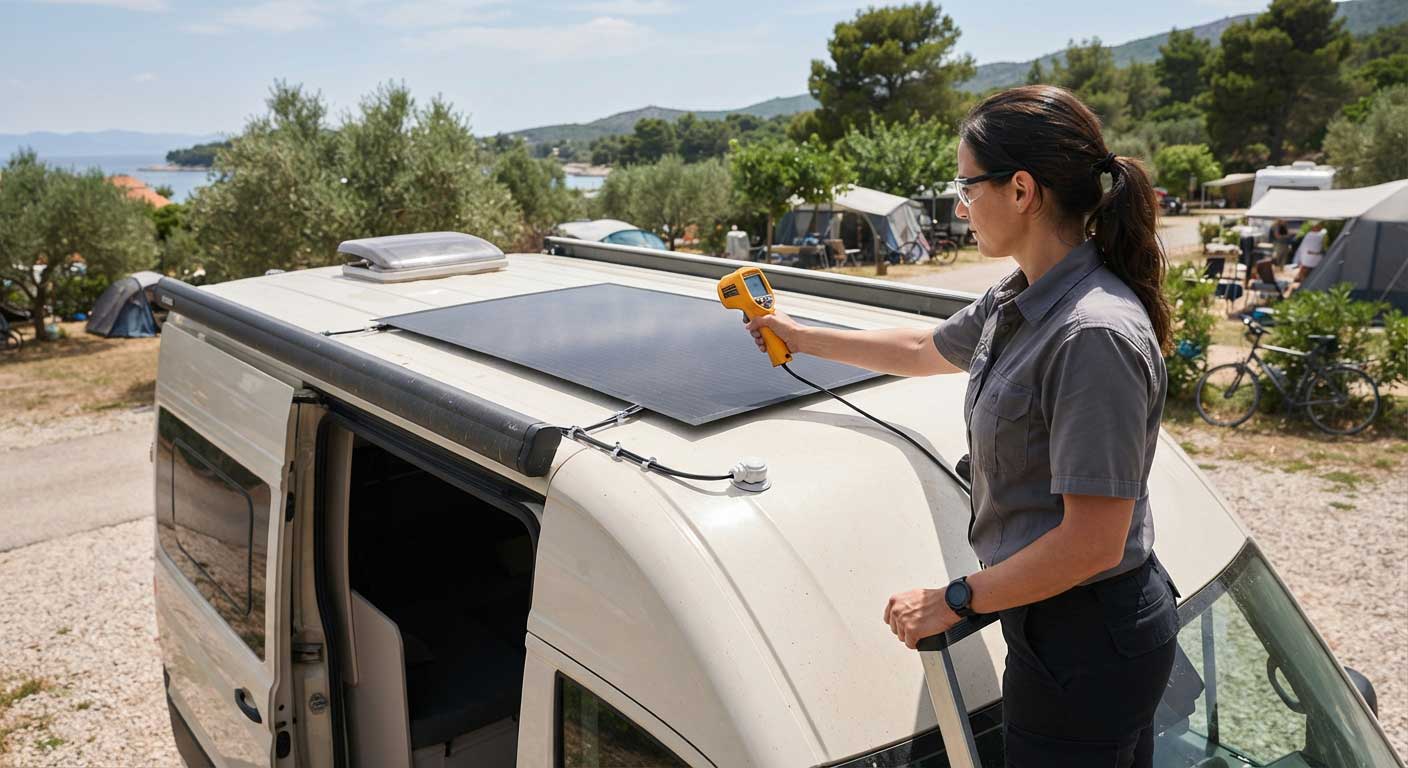
For a flexible module installed directly on an RV, van, boat, or other surface, the lack of a large rear air gap can affect heat dissipation. That is why installation design matters as much as the panel specification.
For weight-sensitive mobile applications, the trade-off can be worthwhile. The lower-profile format, lighter construction, and ability to conform to curved surfaces can solve installation problems that rigid glass modules cannot.
FAQ: how hot do solar panels get?
Can solar panels reach 70°C?
Yes. Under strong sunlight and hot ambient conditions, PV modules can reach or exceed 70°C, especially where airflow is limited. Actual temperature depends heavily on irradiance, wind, mounting, and roof conditions.
Do solar panels get hotter than the air?
Yes. NREL reports that PV modules under full sun can operate approximately 25–60°C above ambient temperature.
Does heat reduce solar panel output?
Yes. Crystalline-silicon modules generally lose power as cell temperature rises. NREL reports typical silicon temperature coefficients of approximately −0.38% to −0.50% per °C.
Do flexible solar panels overheat?
Not necessarily. Flexible panels can operate in hot environments, but direct installation against a roof or deck can reduce rear-side airflow. The application and mounting surface therefore matter.
Does wind cool solar panels?
Yes. Wind increases heat transfer from the module to the surrounding air. NREL’s thermal modeling documentation specifically accounts for wind speed when estimating PV cell temperature.
What is the best temperature for solar panels?
The 25°C cell temperature used for standard PV performance testing is a reference condition, not a normal outdoor operating temperature. Real panels commonly operate substantially hotter under strong sunlight.
Conclusion
how hot do solar panels get depends on sunlight, ambient temperature, wind, mounting, and module construction. In strong sun, a panel can become 25–60°C hotter than the surrounding air, and operating temperatures around 50–70°C are entirely possible. Heat usually reduces output before it becomes a reliability problem. For Bright Solar applications, especially RV and flexible solar installations, the practical question is not simply how hot the panel gets—it is how effectively the complete installation manages that heat.
The prev: how long does it take to get solar panels installed?The next: How Heavy Are Solar Panels?
Related recommendations
-

How Do Solar Panels Make Energy?
215How do solar panels make energy? Learn how photovoltaic cells convert sunlight into electricity, with expert insights, real data, and solar engineering experience.
View details -
How Many Kilowatts Can Solar Panels Produce?
101Solar panel capacity depends on panel wattage and quantity, while actual output varies with sunlight, temperature, shading, orientation, and system losses.
View details -
how to use portable solar panels at home?
169Use portable solar panels at home with a compatible power station or battery system. Check voltage, current, polarity, input limits, and local electrical req...
View details -
how do solar panels work explained simply?
177Understand how do solar panels work explained simply with real physics, field insights, and Bright solar breakdown of sunlight to electricity conversion.
View details