How Heavy Are Solar Panels?
how heavy are solar panels? Most standard residential solar panels weigh about 40–60 lb (18–27 kg) each. Larger high-power modules can exceed 60 lb, while lightweight flexible panels may weigh far less because they replace conventional glass and aluminum construction.
That range is useful, but it hides an important detail: panel weight has changed with module design. When we evaluate solar modules for rooftop, RV, marine, or off-grid projects at Bright Solar, we do not look at wattage alone. The glass, frame, dimensions, mounting method, and installation location all affect whether a panel is genuinely easy to handle.
How much does a solar panel weigh?
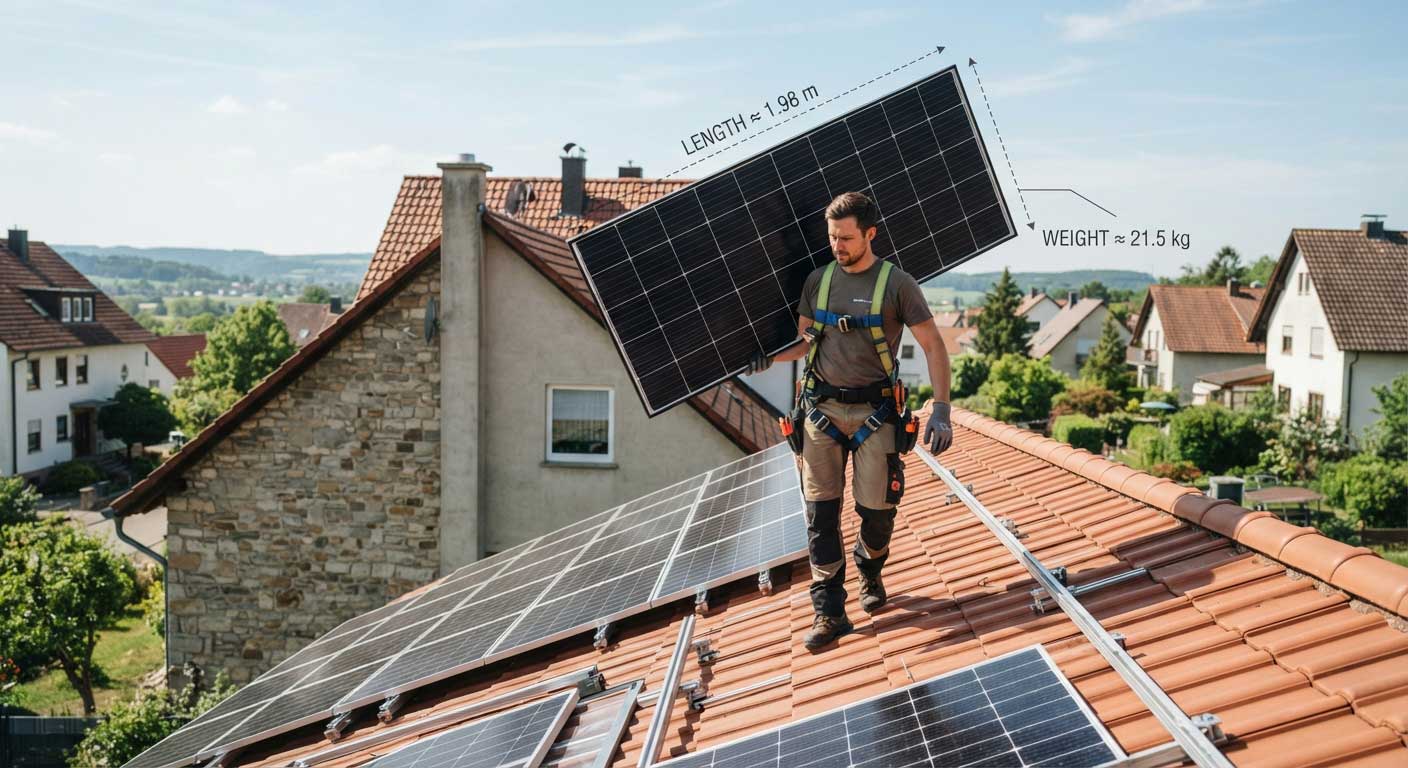
For conventional crystalline-silicon modules, 18–27 kg (40–60 lb) is a practical planning range for many residential-sized panels.
For example, Canadian Solar lists a 400–420 W HiDM module at 23.4 kg (51.6 lb) with dimensions of 2078 × 992 mm.
Another Canadian Solar rooftop module, the CS6R-MS, reaches up to 420 W while weighing 21.3 kg (47 lb). The manufacturer specifically describes its approximately 1.95 m² format as lightweight for rooftop applications.
| Solar panel type | Typical weight range | Main consideration |
|---|---|---|
| Residential glass panel | 18–27 kg | Roof handling and mounting |
| 400–450 W module | Around 20–28 kg | Larger physical dimensions |
| Large commercial module | 25–35+ kg | More difficult manual handling |
| Flexible solar panel | Often 2–10 kg | Much easier to carry and install |
| Portable solar panel | Varies widely | Designed for repeated handling |
These are planning ranges rather than universal specifications. Always check the manufacturer’s mechanical datasheet before designing the mounting system.
What makes a solar panel heavy?
The surprising part is that the photovoltaic cells themselves are not responsible for most of the weight.
A conventional module is built from several layers:
- Tempered front glass
- Encapsulant
- Silicon solar cells
- Rear protective layer or glass
- Aluminum frame
- Junction box and cables
Glass is the major contributor. That is why two panels with similar wattage can feel completely different when carried up a ladder.
At Bright Solar, this distinction becomes obvious during product handling. A rigid 400 W-class module can be awkward not because one person cannot technically lift 20-plus kilograms, but because the panel is roughly two meters long. The size changes the handling problem. A windy rooftop makes that even more noticeable.
400 watt solar panel weight: why wattage is not enough
A 400 watt solar panel weight is commonly around 20–25 kg, but there is no fixed weight associated with 400 W.
Canadian Solar’s 400 W CS3U-MB-AG, for example, is specified at 25.7 kg (56.7 lb) and measures 2022 × 992 × 30 mm.
That gives an important practical lesson: higher wattage does not automatically mean a heavier panel.
Manufacturers can increase output through larger cells, improved cell efficiency, better module layouts, and higher power density. NREL has also documented the industry’s long-term movement toward higher-efficiency monocrystalline modules.
For rooftop planning, I normally check three numbers together:
- Module weight
- Module dimensions
- Roof structure and mounting system
Ignoring the second number is an easy mistake.
Does solar panel weight matter for a roof?
Yes. But the correct calculation is not simply panel weight × number of panels.
A 10-panel array using 23 kg modules contains about 230 kg (507 lb) of module weight before adding rails, clamps, wiring, mounting hardware, and other equipment.
The load is also distributed across the roof rather than concentrated at one point. Structural assessment therefore depends on the roof design, attachment locations, span, dead load, wind conditions, snow load, and local building requirements.
For an existing building, a structural professional should verify whether the roof can support the complete photovoltaic system.
Why flexible solar panels are much lighter
Flexible solar panels take a different approach.
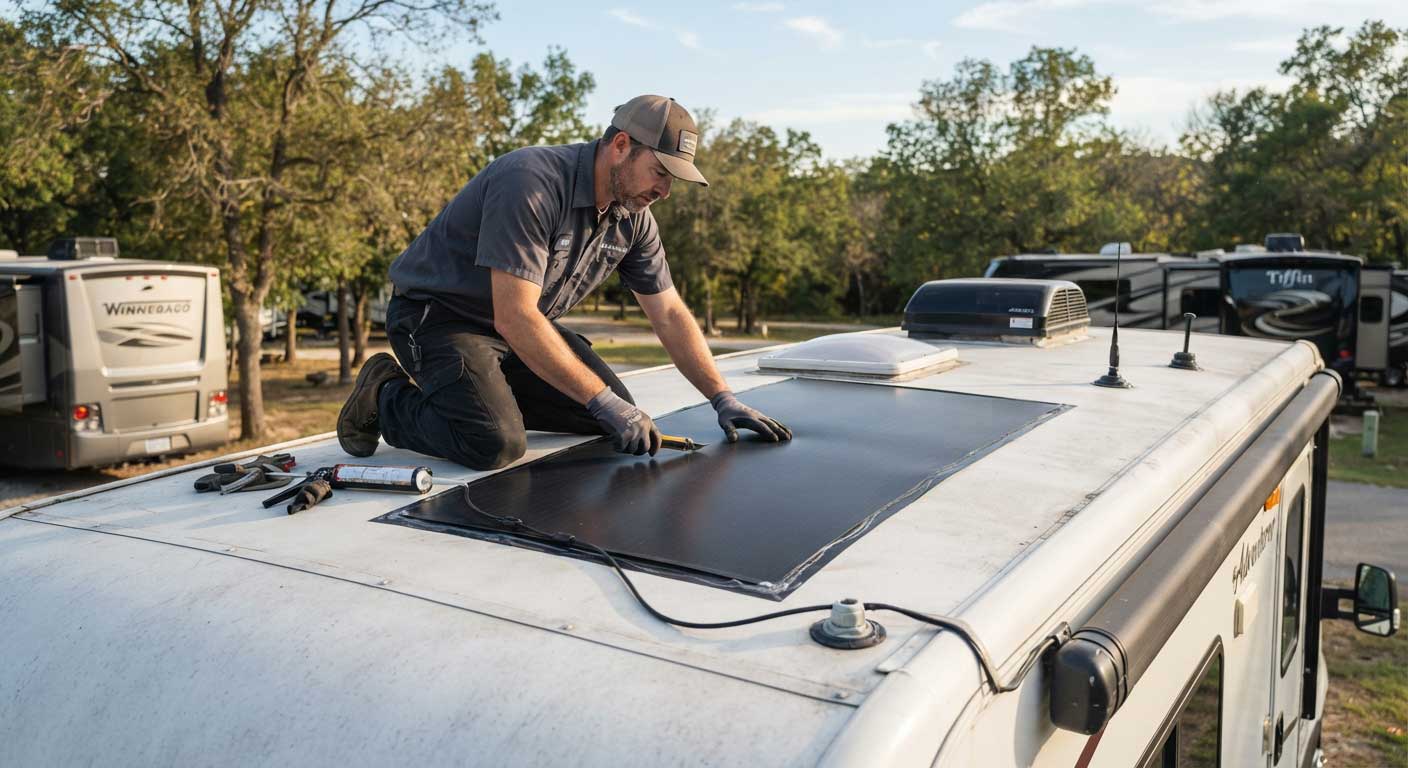
Instead of a thick glass-and-aluminum structure, flexible modules can use polymer-based protective layers and lightweight substrates. That can reduce both total weight and installation complexity.
This is especially valuable for:
- RV roofs
- Camper vans
- Boats
- Marine equipment
- Lightweight structures
- Portable off-grid systems
The benefit is not simply easier transportation. Lower module weight can also make a difference where the mounting surface has limited load capacity or where drilling is undesirable.
How heavy are flexible solar panels compared with rigid panels?
Flexible modules can be dramatically lighter because they do not need the same heavy glass-and-aluminum architecture.
That difference matters when one person has to carry equipment across a boat deck, lift panels onto an RV roof, or work in a location where every additional kilogram matters.
It is also why comparing panels only by watts per panel can give an incomplete picture. For mobile solar applications, I recommend comparing watts per kilogram as well as physical dimensions.
A lightweight panel producing slightly less power can sometimes be easier to deploy than a heavier rigid module with a higher nameplate rating.
FAQ: how heavy are solar panels?
How heavy are solar panels for a typical home?
Most conventional residential modules weigh approximately 18–27 kg (40–60 lb), although the exact figure depends on the module’s dimensions, glass thickness, frame, and power rating.
How much does a 400 watt solar panel weigh?
A 400 W module commonly weighs around 20–26 kg (44–57 lb). Canadian Solar lists one 400 W model at 23.4 kg and another 400 W-class bifacial model at 25.7 kg.
Are flexible solar panels lighter?
Yes. Flexible solar panels are generally much lighter than conventional glass modules because they use lightweight construction instead of a thick glass-and-aluminum frame.
Does solar panel weight affect roof installation?
Yes. The complete system load includes panels, rails, brackets, clamps, wiring, and other equipment. Roof structure and local wind or snow requirements should be evaluated before installation.
Does a higher-wattage panel weigh more?
Not necessarily. Modern cell technology can increase power without a proportional increase in weight. Module dimensions and construction materials often matter more than the wattage printed on the label.
What is the lightest type of solar panel?
Flexible and portable solar panels are generally much lighter than conventional framed glass modules. They are particularly useful for RVs, boats, campers, and other weight-sensitive applications.
Sources and Technical References
- National Renewable Energy Laboratory (NREL), U.S. Solar Photovoltaic System and Energy Storage Cost Benchmark — module technology and efficiency data.
- Canadian Solar, CS1U module datasheet — 400–420 W module specifications and 23.4 kg weight.
- Canadian Solar, BiKu module datasheet — 400 W-class module specification and 25.7 kg weight.
- Canadian Solar, CS6R-MS product announcement — up to 420 W and 21.3 kg module weight.
Conclusion
how heavy are solar panels depends mainly on construction, dimensions, and materials. Standard residential rigid panels typically weigh 40–60 lb (18–27 kg) each, while flexible solar panels can be substantially lighter. For rooftop projects, always evaluate the total system weight, including mounting hardware, rather than the panel alone. For RVs, boats, and other weight-sensitive applications, lightweight flexible panels can offer a practical advantage without adding unnecessary structural load.
The prev: how hot do solar panels get?The next: how do you hook up solar panels?
Related recommendations
-

How to Test a Solar Panel?
256Learn how to test a solar panel using a multimeter, solar power tester, and practical methods. Bright Solar explains how to check panel output and performance.
View details -
Do Solar Panels Work in the Shade?
132Yes. Solar panels can still generate electricity in partial shade and diffuse light, but output usually decreases as sunlight is obstructed.
View details -
How Solar Panels Manufactured?
262How solar panels manufactured? Explore the complete photovoltaic manufacturing process, from silicon wafers and solar cells to testing and quality control with Bright Solar.
View details -
how many kwh can a solar panel generate?
292how many kwh can a solar panel generate? Learn solar panel energy output, daily production factors, calculation methods, and ways to maximize solar power.
View details