How to connect solar panels in series?
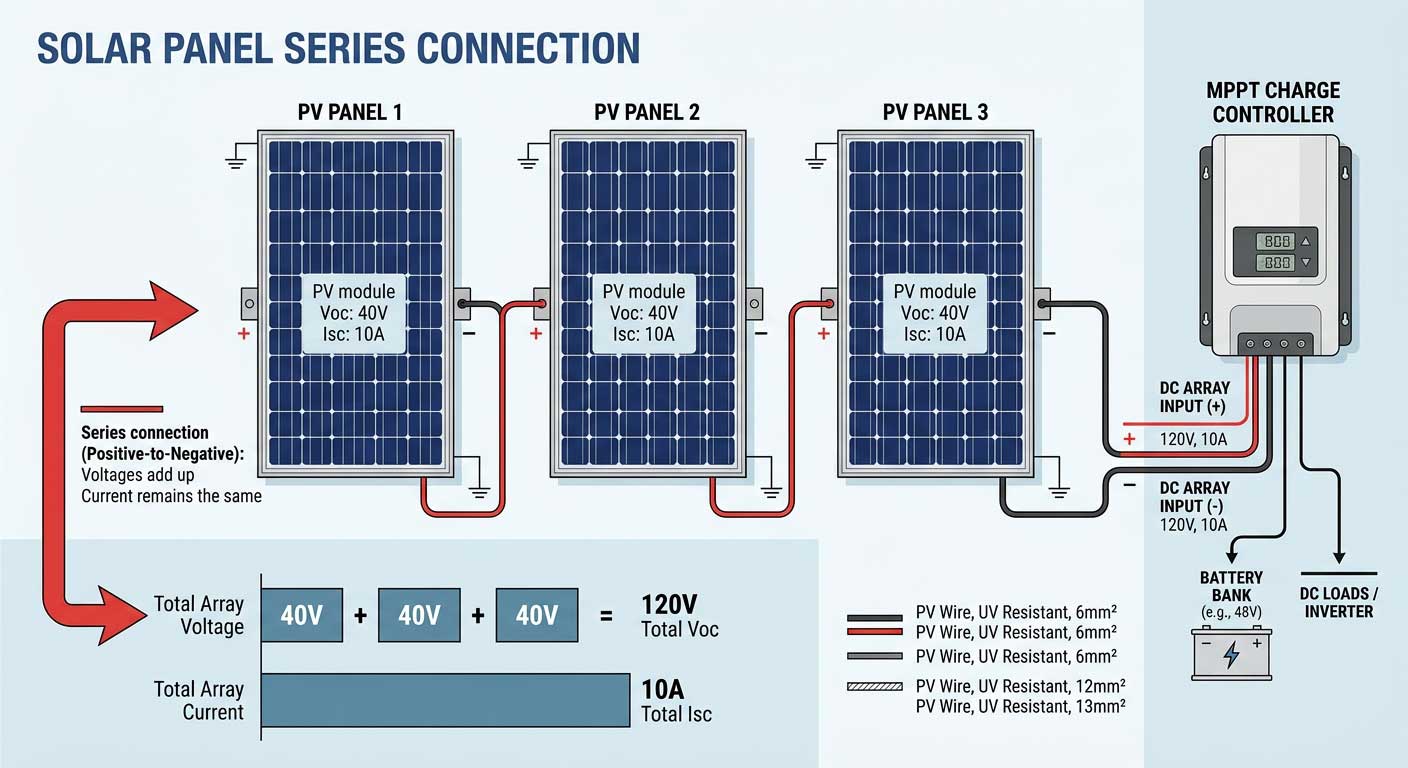
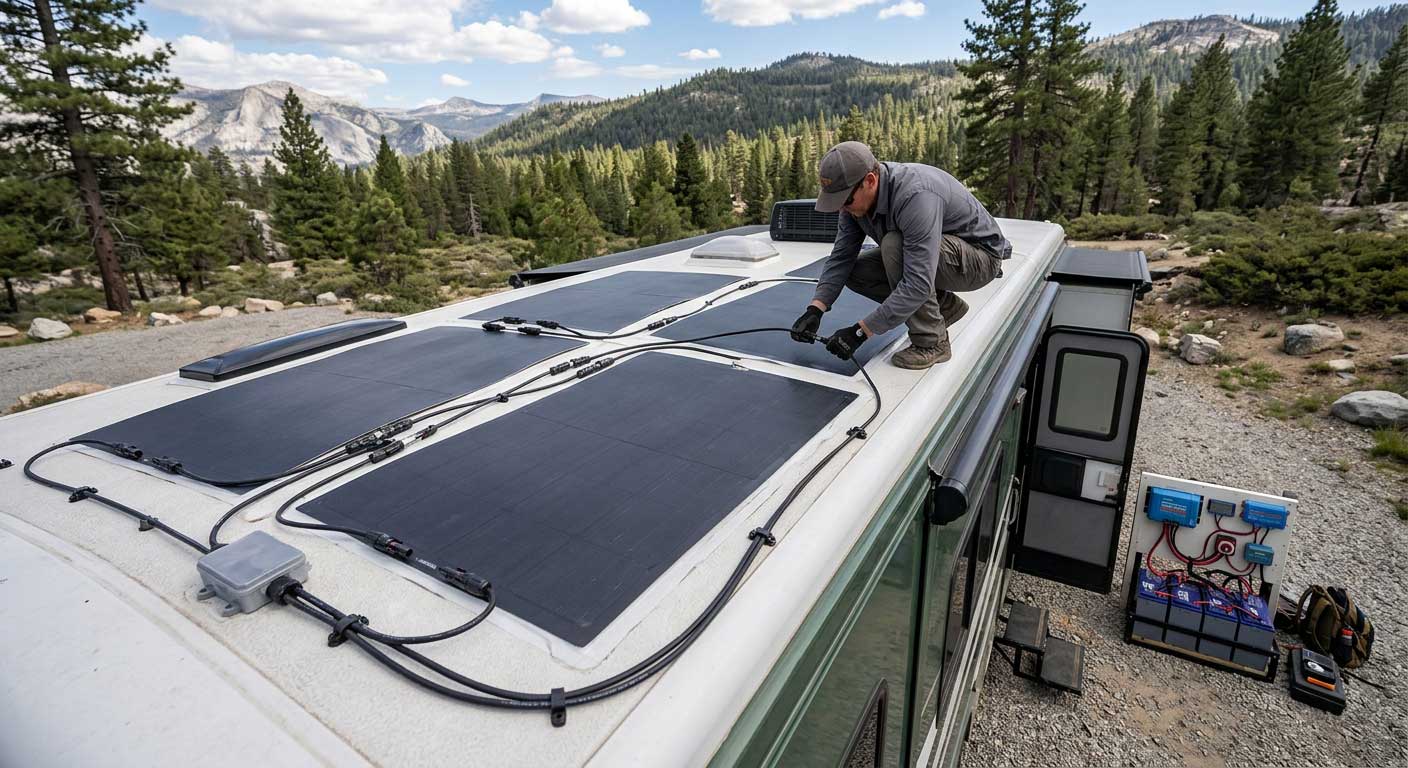
To connect solar panels in series, connect the positive terminal of one panel to the negative terminal of the next panel. This increases system voltage while keeping the current level the same.
How to connect solar panels in series step by step
The process of how to connect solar panels in series is based on increasing voltage by combining multiple solar modules in one circuit. This wiring method is commonly used when a solar system requires higher voltage to match an inverter, charge controller, or battery system.
At Bright Solar, we work with OEM customers, RV manufacturers, and off-grid system integrators where panel wiring decisions directly affect system performance. During project evaluations, we often check voltage requirements before discussing panel quantity because an incorrect series configuration can create compatibility issues even when the total wattage looks correct.
A basic series connection follows this path:
Solar Panel 1 (+) → Solar Panel 2 (-) → Solar Panel 3 (-) → System Output
The connection steps are:
- Check each solar panel specification
Review the open-circuit voltage (Voc), maximum power voltage (Vmp), short-circuit current (Isc), and maximum system voltage.
- Connect the positive terminal of the first panel to the negative terminal of the second panel
This creates a continuous electrical circuit.
- Continue connecting panels in the same pattern
Each additional panel increases the total system voltage.
- Connect the remaining positive and negative terminals to the controller or inverter
The final output voltage should remain within the equipment operating range.
According to the U.S. Department of Energy, photovoltaic system design requires proper matching between solar modules and balance-of-system components, including inverters and controllers.
What happens when solar panels are connected in series?
Series connection increases voltage
The main advantage of a series solar panel connection is higher voltage.
When solar panels are connected in series:
- Voltage increases
- Current stays approximately the same
- Total power increases
Example:
Three identical solar panels:
| Panel Specification | Single Panel | Three Panels in Series |
|---|---|---|
| Rated Power | 100W | 300W |
| Voltage | 20V Vmp | 60V Vmp |
| Current | 5A | 5A |
The total voltage is added together:
20V + 20V + 20V = 60V
The current remains:
5A
Power calculation:
60V × 5A = 300W
Why choose series wiring for solar panels?
Series connections are often selected for systems that need higher voltage and lower current losses.
Advantages include:
- Better compatibility with many MPPT controllers
- Reduced voltage drop over longer cable distances
- More efficient transmission in larger systems
- Easier wiring for some rooftop installations
The National Renewable Energy Laboratory (NREL) highlights that system design choices, including electrical configuration, influence photovoltaic system performance and energy yield.
However, series wiring is not always the best choice. Shading conditions, panel mismatch, and application environment must also be considered.
Solar panel series connection calculation example
Before connecting panels in series, calculate the total voltage.
Formula:
Total Series Voltage = Panel Voltage × Number of Panels
Example:
Four 200W solar panels:
- Vmp: 20V
- Imp: 10A
Series connection:
Voltage:
20V × 4 = 80V
Current:
10A
Total power:
80V × 10A = 800W
This configuration may work well with an MPPT charge controller designed for the correct voltage range.
Series connection vs parallel connection: what is the difference?
Many solar users confuse series and parallel wiring. The main difference is how voltage and current change.
| Connection Type | Voltage | Current | Common Application |
|---|---|---|---|
| Series | Increases | Same | Higher voltage systems |
| Parallel | Same | Increases | Higher current requirements |
| Series-parallel | Both increase | Both increase | Large solar systems |
For example:
Three 100W panels connected in series:
- Voltage increases
- Current remains unchanged
Three 100W panels connected in parallel:
- Voltage remains similar
- Current increases
Bright Solar customers often select series, parallel, or mixed configurations depending on available space, controller type, and application requirements.
Important safety considerations when connecting solar panels in series
Check maximum system voltage
Every solar component has voltage limits.
Before installation:
- Confirm inverter voltage range
- Confirm charge controller maximum input voltage
- Calculate total Voc in cold temperatures
- Check panel datasheets
Cold temperatures can increase photovoltaic voltage, which is why professional system design considers environmental conditions.
Avoid mixing unsuitable solar panels
Connecting different panels in series can reduce performance.
Avoid combining panels with major differences in:
- Wattage
- Voltage rating
- Current rating
- Cell technology
A matched panel group usually provides more predictable performance.
FAQ About Connecting Solar Panels in Series
Can I connect solar panels in series?
Yes. Solar panels can be connected in series by connecting the positive terminal of one panel to the negative terminal of another.
Does series wiring increase solar panel voltage?
Yes. Series connections add the voltage of each solar panel while keeping current approximately the same.
Do solar panels in series produce more watts?
Yes. The total wattage increases because the system voltage increases while current remains similar.
Is series or parallel better for solar panels?
Neither is always better. Series is useful for higher voltage systems, while parallel is useful when higher current is required.
Can I connect different solar panels in series?
It is possible, but mixing panels with different electrical characteristics can reduce system performance.
How many solar panels can I connect in series?
The number depends on the maximum voltage rating of the inverter, charge controller, and solar panels.
Are series solar panels affected by shading?
Yes. Shading on one panel can reduce the performance of the entire series string.
Final Answer: How to connect solar panels in series?
Understanding how to connect solar panels in series helps create a solar system with the correct operating voltage. Series wiring increases voltage by connecting panel terminals in sequence, making it suitable for many MPPT-based solar applications.
Bright Solar provides flexible solar panel solutions for RV, marine, portable, and off-grid systems, helping customers select suitable electrical configurations based on real installation conditions.
Related recommendations
-

How to Turn Off Solar Panels?
308Learn how to turn off solar panels safely using proper shutdown procedures. Discover real maintenance experience, disconnect methods, and solar safety advice.
View details -
How to Mount a Flexible Solar Flexible Solar Panels?
260Learn how to mount a flexible solar flexible solar panels correctly with real RV and marine installation experience, proven mounting methods, and long-term reliability tips.
View details -
How to Clean Flexible Solar Panels?
329Learn how to clean flexible solar panels safely without damaging the surface. Practical maintenance tips, real-world cleaning methods, and mistakes to avoid from Bright Solar.
View details -
How to Mount Solar Panels on Roof?
245Learn how to mount solar panels on roof safely with proper solar panel roof mounts, rails, and installation methods for reliable home solar power systems.
View details