How solar panels work diagram?
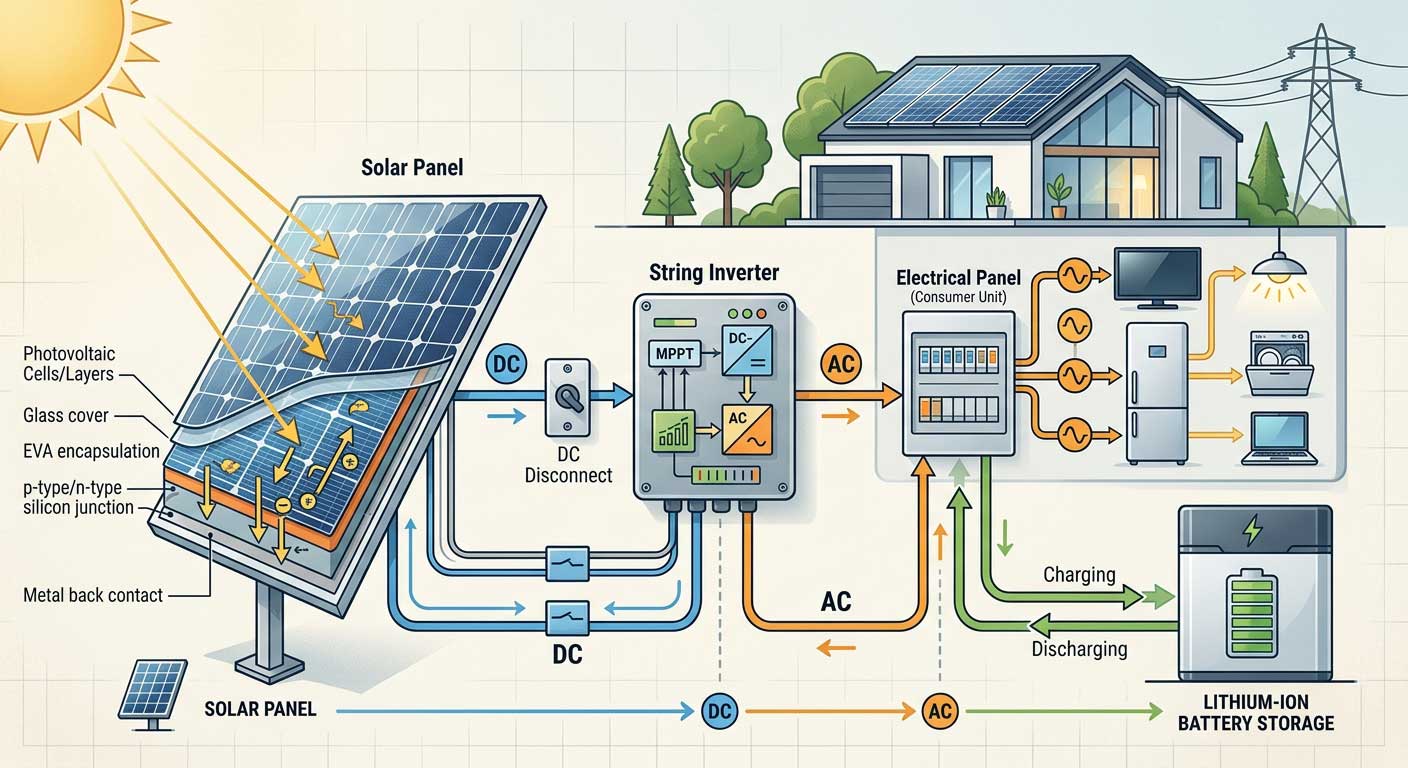
A how solar panels work diagram shows how sunlight reaches photovoltaic cells, creates direct current electricity, and moves through an inverter or controller to power homes, vehicles, and off-grid systems.
How solar panels work diagram explained step by step
A solar panel converts sunlight into usable electricity through the photovoltaic effect. The process looks simple in a diagram, but several technical stages happen inside the system.
At Bright Solar, we often explain this process to OEM partners, RV system builders, and solar integrators by starting with the physical path of energy rather than only the electrical theory. During flexible solar panel testing, seeing how sunlight, cells, wiring, and power management work together is more valuable than looking at a product label alone.
A basic solar energy flow includes:
Sunlight → Solar cells → DC electricity → Charge controller/inverter → Battery or electrical load
The main stages are:
- Sunlight absorptionPhotovoltaic cells inside the solar panel absorb photons from sunlight.
- Electric current generationThe photovoltaic material creates an electrical reaction that produces direct current (DC).
- Power regulationA controller or inverter manages voltage and converts electricity into a usable form.
- Energy usage or storageElectricity can directly power devices, charge batteries, or connect to a grid system.
According to the U.S. Department of Energy, photovoltaic technology generates electricity by converting sunlight directly into electricity through semiconductor materials. The National Renewable Energy Laboratory (NREL) also identifies photovoltaic conversion efficiency as a key factor affecting solar system performance.
Main components shown in a solar panel working diagram
Solar cells
Solar cells are the core components responsible for converting sunlight into electricity.
Most modern panels use silicon-based photovoltaic cells because silicon has suitable semiconductor properties and long-term reliability.
A typical solar module contains:
- Photovoltaic cells
- Protective front layer
- Encapsulation material
- Electrical connections
- Junction box
Bright Solar flexible panels are designed around the same photovoltaic principle but focus on applications where traditional rigid panels are difficult to install, such as curved RV roofs, boats, and portable energy systems.
Solar inverter and power controller
Solar panels generate DC electricity, but most household appliances use alternating current (AC).
The inverter performs the conversion:
DC electricity → AC electricity
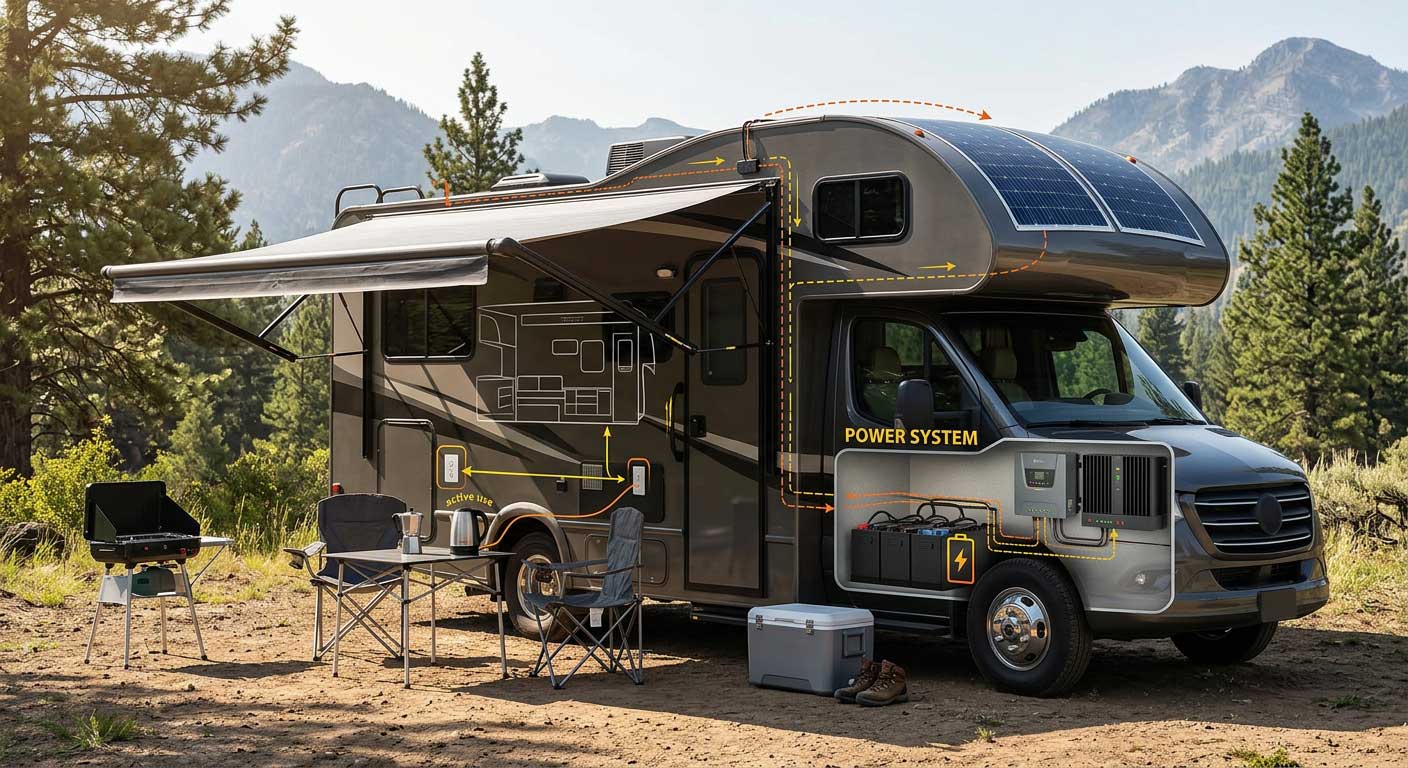
For off-grid systems, a charge controller manages energy between solar panels and batteries.
Typical energy paths:
| System Type | Energy Flow |
|---|---|
| Grid solar | Solar panel → Inverter → Home/grid |
| RV solar | Solar panel → Controller → Battery → Devices |
| Marine solar | Solar panel → Controller → Battery → Equipment |
| Portable Solar Panel | Solar panel → Power station → Electronics |
Battery storage system
Solar panels produce electricity only when sunlight is available. Batteries store excess energy for later use.
A battery system helps provide power:
- At night
- During cloudy weather
- During outdoor activities
- During grid interruptions
For RV and off-grid applications, battery capacity must match expected energy consumption. A larger solar panel does not automatically mean unlimited available power if storage capacity is insufficient.
How photovoltaic cells generate electricity
The photovoltaic effect
The photovoltaic effect is the scientific principle behind solar power generation.
When sunlight reaches a semiconductor material, photons transfer energy to electrons. These electrons begin moving, creating an electrical current.
The process involves:
- Photon absorption
- Electron movement
- Electric field separation
- Current collection
This electricity is collected by metal contacts inside the solar cell and combined with other cells inside the module.
Why solar panel efficiency matters
Not all sunlight becomes electricity. Some energy is reflected, converted into heat, or lost during electrical conversion.
Solar panel efficiency depends on:
- Cell technology
- Temperature
- Manufacturing quality
- Installation angle
- Environmental conditions
The National Renewable Energy Laboratory (NREL) tracks photovoltaic research and efficiency improvements through its solar technology research programs.
In practical applications, Bright Solar focuses not only on efficiency numbers but also on how panels perform after installation. A flexible solar panel used on a curved vehicle roof must balance weight, durability, flexibility, and energy output.
How solar panel systems work in different applications
Solar energy systems are designed differently depending on where they are installed.
| Application | Diagram Energy Path | Main Consideration |
|---|---|---|
| Home solar | Panel → inverter → home | Maximum electricity production |
| RV solar | Panel → controller → battery | Space and weight limitations |
| Boat solar | Panel → controller → battery | Marine environment protection |
| Portable solar | Panel → power station | Mobility and convenience |
| Off-grid system | Panel → battery → appliances | Energy independence |
During Bright Solar’s project discussions, customers often ask for the highest wattage panel first. In practice, the better solution usually starts with available installation area, expected energy usage, and operating environment.
FAQ About Solar Panel Working Diagrams
What does a solar panel working diagram show?
A solar panel working diagram shows how sunlight enters photovoltaic cells and becomes electricity through different system components.
How do solar panels convert sunlight into electricity?
Solar panels convert sunlight into electricity through the photovoltaic effect, where photons create movement of electrons inside semiconductor materials.
Do solar panels produce AC or DC electricity?
Solar panels produce direct current (DC) electricity. An inverter converts it into alternating current (AC) for most household applications.
What are the main parts of a solar power system?
The main parts include solar panels, inverter or charge controller, batteries when required, wiring, and electrical loads.
Can solar panels work without batteries?
Yes. Grid-connected solar systems can send electricity directly through an inverter without battery storage.
How does a flexible solar panel work?
A flexible solar panel works using the same photovoltaic principle as rigid panels but uses a flexible structure for curved or lightweight installations.
Why is a solar diagram useful?
A diagram helps users understand electricity flow, system components, installation requirements, and how solar energy becomes usable power.
Final Answer: How solar panels work diagram
A clear how solar panels work diagram explains the complete journey from sunlight to electricity. Solar cells capture solar energy, generate DC power, and connected components convert and manage electricity for practical use.
Bright Solar develops flexible solar panel solutions for RV, marine, portable, and off-grid applications, helping businesses understand and build reliable solar power systems based on real installation requirements.
Related recommendations
-

how to get my solar panels azmuth and declination?
140Learn how to get my solar panels azmuth and declination with field methods, solar geometry data, and Bright solar engineer insights for accurate panel alignment.
View details -
what are portable solar panels used for?
137Portable solar panels provide movable electricity for camping, RVs, boats, outdoor work, emergencies, remote equipment, and temporary off-grid use.
View details -
How Hot Do Flexible Solar Panels Get?
267How hot do flexible solar panels get in real-world conditions? Learn operating temperatures, heat impact on efficiency, and expert installation insights from Bright Solar.
View details -
how much do photovoltaic panels cost?
195Discover how much do photovoltaic panels cost with real market data, pricing factors, and Bright solar insights on panel types, efficiency, and system value.
View details