how to use portable solar panels at home?
how to use portable solar panels at home depends on the job you want them to do. For simple backup power, connect compatible panels to a portable power station. For a home battery system, use the correct charge controller and inverter, while checking voltage, current, polarity, and local electrical requirements.
Portable solar panels are useful at home when you need temporary, movable, or supplemental power rather than a permanently installed rooftop array. A panel can sit on a patio, balcony, garden area, driveway, or other suitable location and feed a portable battery or power station during daylight.
The U.S. Department of Energy explains that PV modules produce DC electricity, while inverters convert that electricity to AC for typical household appliances. Batteries can store solar energy for use when sunlight is unavailable.
What Can Portable Solar Panels Power at Home?
The easiest home arrangement is:
Portable Solar Panels → Portable Power Station → Home Devices
This works well for smaller loads such as:
- Phones and tablets
- Wi-Fi routers
- Laptops
- LED lights
- Cameras
- Small fans
- Small DC appliances
- Emergency communication equipment
For larger household loads, the system becomes more involved. A battery, inverter, appropriate protection equipment, and potentially a professionally installed transfer or grid-interactive system may be required.
A portable panel should not simply be plugged into a household wall outlet. A PV panel produces variable DC electricity; it is not equivalent to a stable AC utility supply.
Portable Solar Panels vs. Permanent Home Solar
| Portable setup | Permanent residential system |
|---|---|
| Movable panels | Fixed roof or ground array |
| Usually smaller capacity | Usually larger capacity |
| Portable power station often used | Inverter and electrical distribution |
| Useful for backup and temporary loads | Designed for ongoing home generation |
| Minimal installation | Permits and professional installation may apply |
| Easy to reposition | Fixed orientation and mounting |
The DOE notes that a complete PV system involves more than the panels themselves, including mounting, inverters, wiring, and potentially storage.
That distinction is important when someone searches for a way to “run a house” from portable panels. A small portable setup can supply selected devices, but it should not be confused with a code-compliant whole-home electrical installation.
How to Set Up Portable Solar Panels at Home
Start by deciding what you actually want the solar energy to run.
For a basic backup arrangement:
Portable Solar Panel → Solar Input → Power Station → Appliance
Place the panel in an area with the clearest practical view of the sun. A patio may look bright at noon but become shaded by the house or a tree two hours later.
The DOE identifies geographic location, time of day, season, landscape, and weather as factors affecting available solar radiation.
In a real home setup, I would check the panel location at several times rather than judging it from one sunny moment. Morning shade is easy to miss. So is an afternoon shadow from a neighboring building.
Before connecting, check:
- Panel Voc
- Panel operating voltage
- Maximum current
- Power station PV input range
- Maximum PV input wattage
- Connector type
- Polarity
- Cable condition
- Outdoor protection ratings
Do not rely on the wattage printed on the front of the panel alone.
Where Should You Place Portable Solar Panels?
A portable panel gives you one advantage that rooftop panels do not: you can move it.
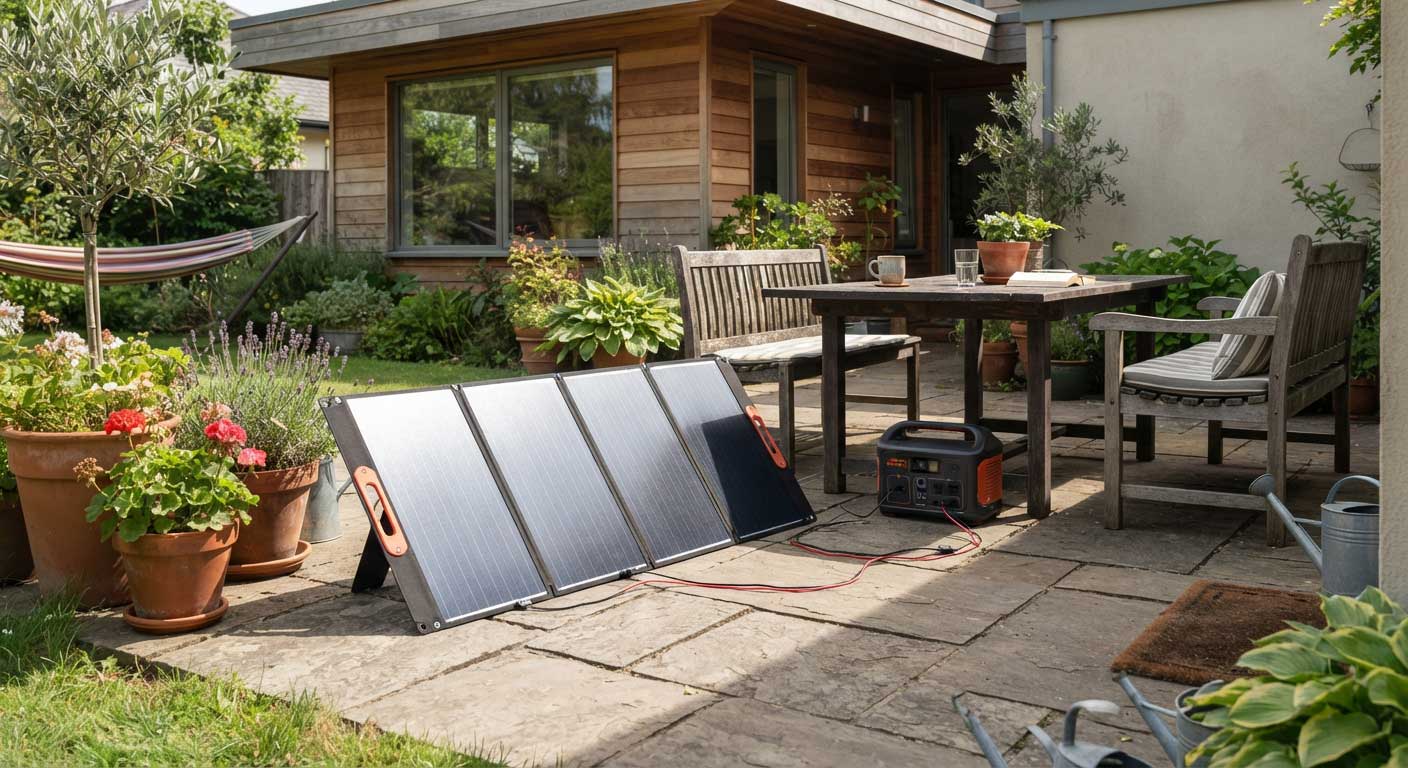
At home, useful locations may include:
- An unobstructed patio
- A sunny garden area
- A balcony where permitted
- A driveway
- A temporary ground-mount position
- A campsite-style outdoor work area
Keep the panel stable and protect the cables from doors, vehicles, water accumulation, and foot traffic.
If the panel can be moved 5–10 feet to escape a tree’s shadow, that simple change may be more useful than buying a larger panel and leaving it partially shaded.
How to Connect Portable Solar Panels to a Power Station
A portable power station is often the simplest way to use portable solar panels at home.
The general arrangement is:
Solar Panel → Solar Charging Input → Battery Storage → Device
The important part is compatibility.
For example, if a power station specifies a maximum PV input voltage, the panel or combined panel array must stay below that limit. If the station has a maximum solar input wattage, connecting more panels does not necessarily make it charge faster once that limit has been reached.
This is why the specification sheet matters more than the product’s headline wattage.
The DOE explains that PV systems use inverters to convert DC electricity into AC electricity suitable for household loads.
For a portable power station, much of this equipment is already integrated into the unit.
Can Portable Solar Panels Run Home Appliances?
They can run selected appliances when the battery and inverter have sufficient capacity.
| Device | What to check |
|---|---|
| Wi-Fi router | Continuous wattage and battery runtime |
| Laptop | Charger wattage |
| LED light | Wattage and operating hours |
| Refrigerator | Running and startup power |
| Microwave | High continuous power demand |
| Air conditioner | High running and startup demand |
| Electric heater | Very high continuous demand |
A refrigerator illustrates the point. Its average energy consumption and compressor startup demand are different numbers. The power station must be able to handle both.
The same applies to pumps, compressors, and motor-driven equipment.
How Much Electricity Can Portable Solar Panels Produce at Home?
A portable solar panel’s rated wattage is its electrical rating under defined test conditions, not a guaranteed hourly output.
The DOE explains that PV performance is affected by factors including light intensity, wavelength, temperature, reflection, and cell characteristics. Higher temperatures generally reduce voltage and can reduce overall PV performance.
NREL’s 2024 residential PV analysis gives another useful perspective. Its modeled U.S. residential PV resource classes show estimated first-year DC capacity factors ranging from 12.7% to 19.6%, with a population-weighted mean of 15.7% across the contiguous United States. These are modeled annual averages for residential PV, not a promise for a particular portable panel or location.
So a 200W panel should not be interpreted as producing 200W continuously from sunrise to sunset.
For home testing, watch the actual solar input displayed by the power station. Record it in the morning, around midday, and later in the afternoon. That tells you much more about your particular location than the number printed on the panel.
Using Portable Solar Panels During a Power Outage
This is where the distinction between portable backup and grid-connected solar becomes critical.
A typical grid-connected residential solar system is designed to shut down when the utility grid fails for safety reasons. The DOE states that solar panels alone generally cannot keep a home operating during an outage; properly configured inverter and storage equipment are required for solar-powered backup operation.
A portable solar panel connected to a portable power station is different.
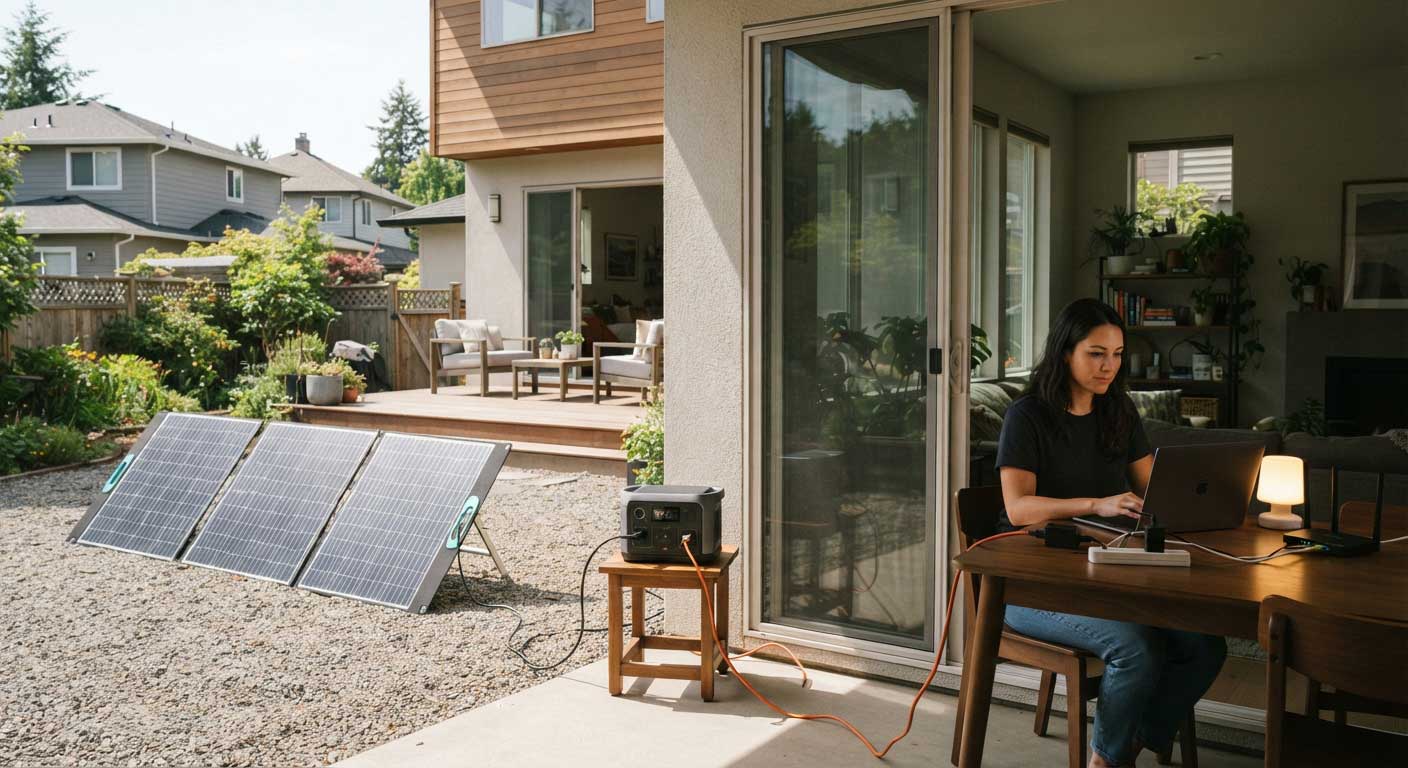
You can charge the battery during daylight and then use the stored energy for compatible devices. That makes the system useful for:
- Internet equipment
- Phones
- Emergency lighting
- Laptops
- Small medical or communication equipment where appropriately specified
- Small appliances within the power station’s limits
Never attempt to backfeed a home’s electrical wiring through a normal wall outlet.
For a system intended to power household circuits during outages, use equipment and installation methods designed for that purpose and follow applicable electrical requirements.
Common Mistakes When Using Portable Solar Panels at Home
- Connecting panels without checking Voc: Maximum PV voltage matters.
- Assuming rated watts equal actual output: Sunlight and temperature change production.
- Ignoring partial shade: A convenient location may not be a productive one.
- Connecting directly to household wiring: Portable equipment is not automatically grid-compatible.
- Choosing a battery only by capacity: Inverter output and surge capability also matter.
- Using unsuitable extension cables: Longer runs can increase voltage drop.
- Leaving equipment exposed unnecessarily: Follow the environmental rating of every component.
FAQ About How to Use Portable Solar Panels at Home
Can I use portable solar panels to power my house?
Portable solar panels can power selected devices through a compatible battery or power station. Powering household circuits requires a properly designed electrical system with suitable inverter, protection, and transfer equipment.
Can I plug a portable solar panel into a wall outlet?
No. A portable solar panel should not be connected to a normal household wall outlet. Use the solar input of a compatible power station, charge controller, or properly designed solar system.
Can portable solar panels charge a home battery?
Yes, if the battery system and charge controller are designed to accept the panel’s voltage, current, and power range. The equipment manufacturer’s specifications should determine the connection method.
Can portable solar panels work during a blackout?
Yes. They can continue generating electricity during daylight when connected to compatible standalone equipment. A portable power station can store that energy for later use.
How many portable solar panels do I need for home backup?
It depends on the devices being powered, their energy consumption, available sunlight, battery capacity, and the maximum PV input of the charging equipment. Start with the actual daily energy requirement rather than choosing a panel count by household size alone.
Can portable solar panels run a refrigerator?
They can, provided the battery and inverter can handle both the refrigerator’s operating consumption and its startup requirements. Check the appliance and power-station specifications before relying on the system for refrigeration.
Are portable solar panels suitable for apartments?
They can be useful where there is a safe, permitted location with adequate sunlight, such as a suitable balcony or terrace. Building rules, landlord requirements, local electrical regulations, wind exposure, and cable routing should be considered before installation.
Conclusion
The practical answer to how to use portable solar panels at home is to use them as part of a matched solar-and-storage setup rather than treating the panel as a replacement for household electricity. For small loads, a portable power station makes the arrangement relatively straightforward. For larger loads or whole-home backup, the inverter, battery, protection equipment, and electrical connection become equally important.
Bright Solar focuses on the panel side of that equation: rated power, voltage, flexible installation options, physical constraints, and the environment where the panel will actually operate. The better the panel matches the complete system, the more useful portable solar becomes in everyday home applications.
The prev: how to use portable solar panels?The next: what are portable solar panels used for?
Related recommendations
-

how to hook up solar panels?
194Learn how to hook up solar panels safely for home solar systems. Compare series and parallel wiring, inverter connections, voltage limits, and installation basics.
View details -
how expensive are solar panels?
129Find out how expensive are solar panels with real pricing data, installation factors, and expert insights from Bright solar for smarter solar decisions.
View details -
How to Install Flexible Solar Panels?
200Learn how to install flexible solar panels correctly on RVs, boats, vans, and roofs. Practical tips, mounting methods, wiring advice, and maintenance insights from Bright Solar.
View details -
How Much Do Solar Panels Cost Per Panel?
145How much do solar panels cost per panel? Discover residential solar panel prices, cost factors, efficiency options, and expert advice from Bright Solar.
View details