Folding Portable Solar Panels: Uses, Setup and Buying Guide
Folding portable solar panels provide a practical way to generate electricity away from a fixed solar installation. They are especially useful for camping, RV travel, emergency backup, outdoor work, and portable power stations because they can be unfolded for sunlight, repositioned during the day, and packed away when the power is no longer needed.
Unlike permanently mounted solar modules, folding panels are part of a mobile energy system. The panel, cable, charge controller or power station, battery capacity, sunlight, and positioning all affect the usable result. A 200W panel, for example, does not continuously deliver 200W from sunrise to sunset.
For B2B buyers, distributors, outdoor-equipment brands, and solar-system integrators, the construction of the folding module matters just as much as its rated wattage. Hinge durability, cell protection, folded dimensions, carrying weight, connectors, weather resistance, and compatibility with the intended power station can determine whether a portable solar product is genuinely practical in the field.
What Are Folding Portable Solar Panels?
Folding portable solar panels are photovoltaic modules designed with multiple connected sections that fold together for transport and storage. Depending on the product, the sections may be joined through flexible laminates, fabric-backed construction, hinges, or other mechanical arrangements.
When deployed, the sections form a larger photovoltaic surface. When packed, the total footprint becomes substantially smaller.
Commercial portable products demonstrate how widely the format can vary. Goal Zero, for example, currently lists foldable portable panels ranging from small models for personal electronics to 200W and 300W-class systems for larger portable power applications. Its Nomad 20 is a 20W foldable panel with a built-in kickstand, while its Ranger 300 uses four connected 75W sections.
That range is important for buyers. “Folding” describes the physical format, not a single performance category.
Folding does not mean repeatedly bending the solar cells
A folding panel should be handled according to its mechanical design.
There is a practical difference between:
- A panel designed around hinged rigid sections
- A laminate panel designed to flex at defined locations
- A fabric-backed folding module
- A semi-flexible solar module intended for limited curvature
Do not assume that a folding solar panel can be rolled, sharply creased, or folded in an arbitrary direction. The manufacturer’s handling instructions should define how the product is transported and stored.
This distinction becomes particularly important during B2B product development. A product may look flexible in photographs while still requiring a specific folding radius or storage position.
Where Are Folding Portable Solar Panels Used?
Camping and outdoor recreation
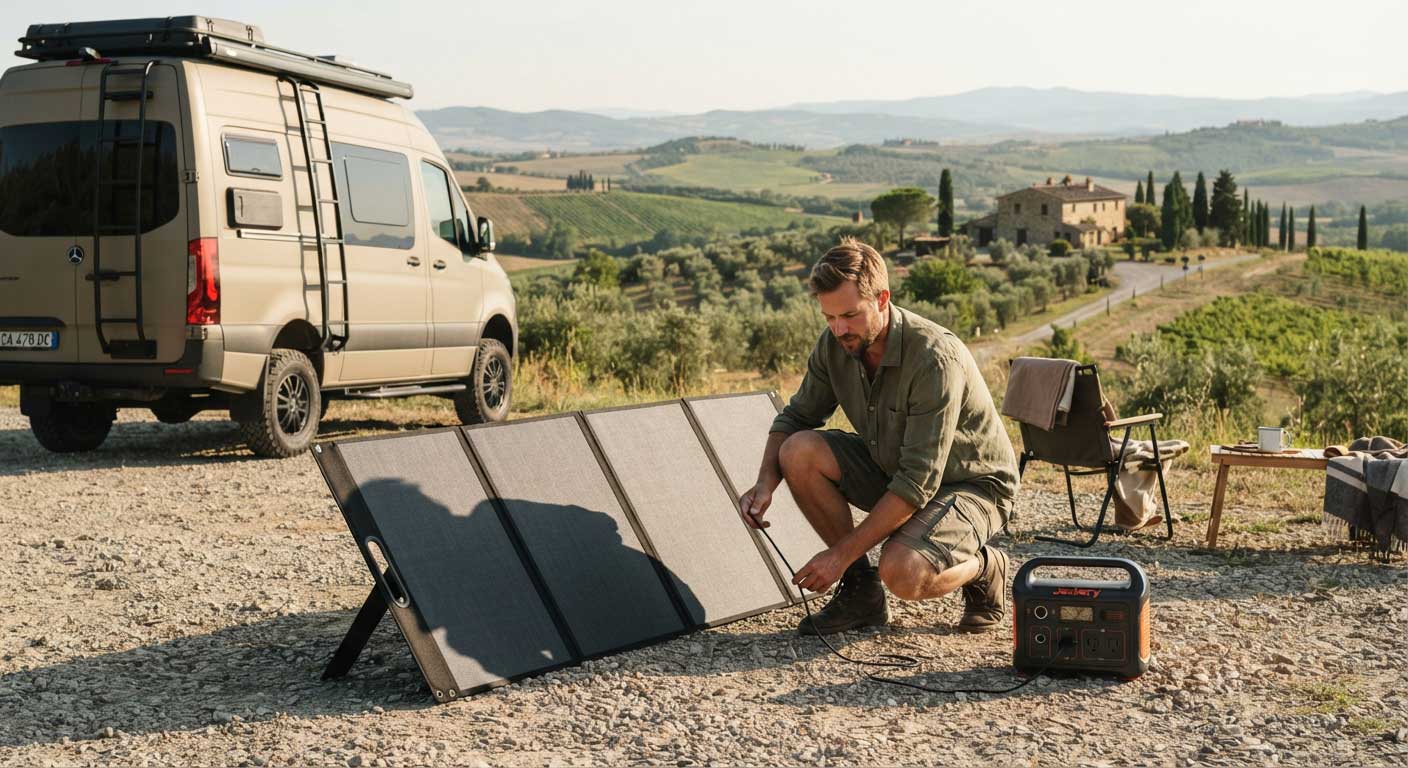
For camping, portability is usually the main reason to choose a folding solar system. The panel can be stored in a vehicle, carried to a campsite, unfolded during daylight, and packed away when leaving.
Typical loads include:
- Phones and tablets
- Cameras and camera batteries
- GPS devices
- LED lighting
- Small fans
- Portable refrigerators
- Power banks
- Portable power stations
Small panels can be paired with USB power banks, while higher-wattage systems are more appropriate for portable power stations.
Goal Zero’s current product guidance similarly separates small foldable panels intended for handheld electronics from larger portable panels intended for power stations and higher energy requirements.
RVs and campervans
A folding system can be particularly useful when the vehicle owner does not want a permanent roof installation.
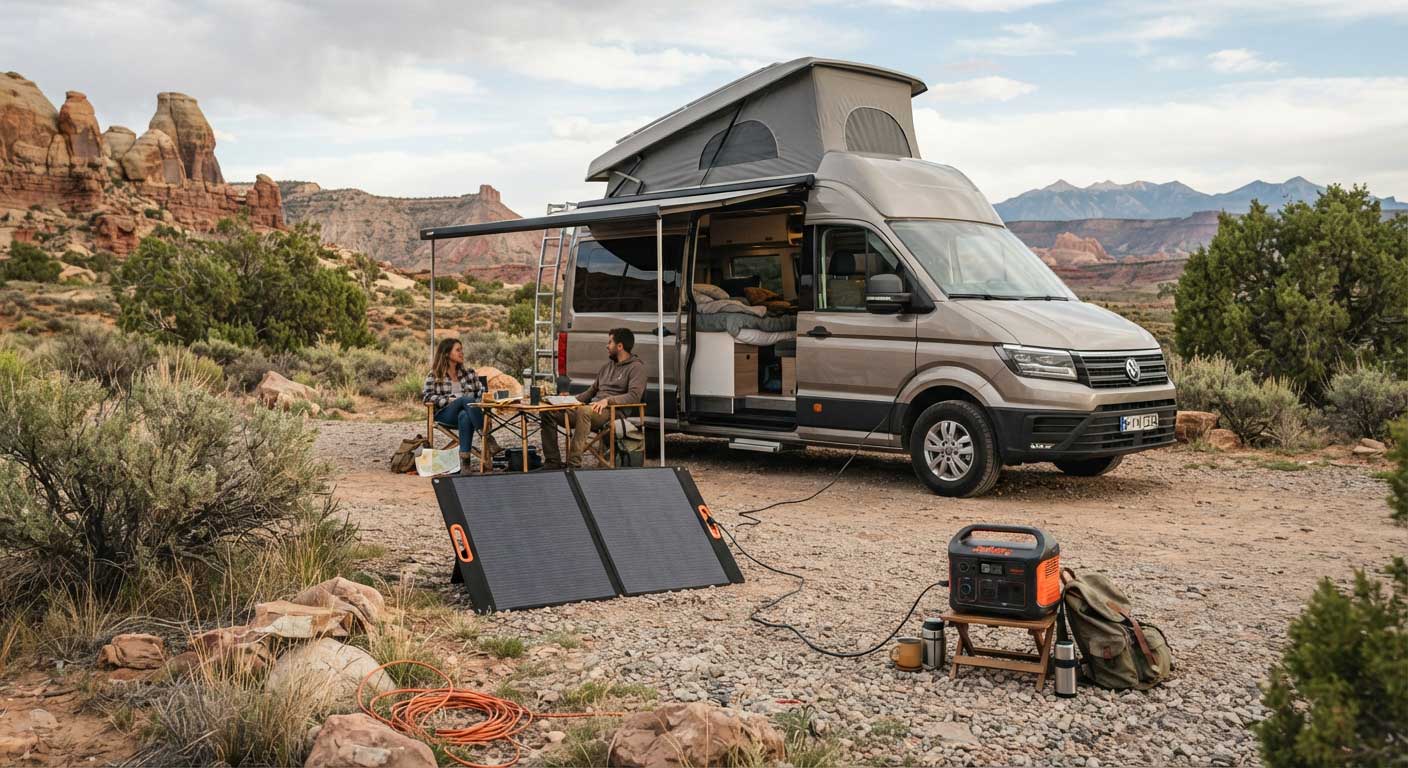
The panel can be stored while driving and deployed beside the vehicle when parked. This also allows the user to move the panel away from the vehicle if the parking position is shaded.
That last point is easy to underestimate.
A van can be parked under a tree because the occupants want shade, while the best solar position may be several metres away in direct sunlight. A portable panel gives the user the option of separating the energy collection point from the vehicle.
Emergency backup
Folding portable solar panels can also form part of a temporary backup system.
The panel does not store electricity by itself. It generates electricity when exposed to sunlight; a compatible battery or portable power station can store that energy for later use. Goal Zero explicitly notes this distinction for its portable panels.
For emergency planning, this means the panel wattage should be considered together with battery capacity and the actual loads that need to remain operational.
Outdoor work and remote applications
Portable solar can also be useful for field technicians, temporary monitoring equipment, outdoor events, remote communications equipment, and other applications where running a conventional electrical supply is inconvenient.
Here, ruggedness and transportability become more important than simply maximizing rated wattage.
How Much Power Can Folding Portable Solar Panels Produce?
Rated wattage provides the starting point, but field output depends heavily on conditions.
A simple first estimate is:
Energy = Panel Power × Equivalent Peak Sun Hours
For example:
200W × 4 peak-sun-hours = 800Wh
This represents a simplified theoretical energy calculation before accounting for system losses and environmental conditions. It should not be presented as a guaranteed daily production figure.
NREL’s PVWatts model is designed to estimate photovoltaic energy production using site and system parameters rather than assuming that rated power equals daily energy production.
For portable systems, the real-world variables can be particularly obvious because the user controls the panel position.
Sun angle changes during the day
A folding panel placed flat on the ground at 8 a.m. may receive a very different amount of usable sunlight than the same panel angled toward the sun at midday.
Goal Zero’s setup guidance recommends positioning portable panels to improve solar collection and notes that angle and position influence charging performance.
For a portable product, an adjustable kickstand or support system is therefore not merely a convenience feature. It can affect how effectively the available surface area is used.
Temperature is not the same thing as solar resource
Solar modules need light, not heat, to generate electricity. A cool, sunny day can provide useful solar conditions, while a very hot panel is not automatically producing more power.
The practical mistake is to judge a panel by air temperature alone.
When evaluating a portable product, consider:
- Solar irradiance
- Panel orientation
- Shading
- Ambient temperature
- Module temperature
- Cable length
- Connector condition
- Charge-controller efficiency
- Power-station input limits
- Battery state of charge
Shading can be surprisingly important
A small shadow from a branch, tent pole, roof rack, or nearby person can affect the electrical output of an array depending on its cell layout and bypass-diode design.
During testing, do not evaluate a panel only at one location. Move it into open sunlight and compare the result with the same panel under partial shade. This simple field check often reveals more than a specification-sheet comparison.
How to Set Up Folding Portable Solar Panels
The setup process is straightforward, but small details determine whether the panel spends the day collecting sunlight or sitting partly shaded.
Step 1 — Choose the deployment location
Look for the clearest available sunlight.
Avoid placing the panel:
- Under trees
- Behind vehicles
- Beside tall tents or structures
- Under awnings
- Against walls during peak sunlight
- Where people will repeatedly walk over it
- Where water can pool after rain
If the panel is connected to a portable power station, leave enough cable length for the panel to be positioned independently.
This is one of the strongest practical advantages of a folding portable system: the power station can remain in a protected location while the solar array moves toward better sunlight.
Step 2 — Unfold the panel completely
Place the folded unit on a clean surface before opening it.
Open each section carefully and inspect:
- Cell surfaces
- Hinges or flexible joints
- Cable connections
- Junction areas
- Carrying handles
- Kickstands
- Protective covers
Do not drag the folded panel across gravel or concrete. Small abrasions may not immediately affect output but can become long-term damage points.
Step 3 — Set the panel angle
If the product has an adjustable stand, use it to orient the panel toward the strongest available sunlight.
There is no single angle that works everywhere throughout the day and year. Portable systems are useful partly because they allow the user to make adjustments as the sun moves.
Goal Zero’s portable-panel guidance specifically describes adjustable kickstands on some of its foldable products for positioning the panel toward the sun.
Step 4 — Connect the electrical system
Before connecting, verify that the panel’s voltage and current are compatible with the receiving device.
Check:
- Solar panel rated voltage and current
- Open-circuit voltage
- Maximum power input of the power station
- Connector type
- Polarity
- Maximum allowable solar input
- Whether a separate charge controller is required
This matters particularly when combining panels.
A larger array is not automatically better if the power station has a lower maximum solar-input limit. Goal Zero explicitly advises users to check the maximum input of the portable power station when combining panels; energy above the receiving device’s input limit may not be usable.
Step 5 — Monitor the first charging session
During the first deployment, watch the system for several minutes.
Check:
- Solar input displayed by the power station
- Cable temperature
- Connector stability
- Panel position
- Unexpected shading
- Changes in input as clouds pass
If the system displays substantially less power than expected, do not immediately assume the panel is defective.
Move it into unobstructed sunlight first.
Then check the cable and connections.
Then verify the receiving device’s input limit.
That sequence saves time in the field.
Choosing the Right Folding Portable Solar Panels
Match wattage to the energy task
A useful starting point is to divide portable applications into rough categories.
| Application | Typical design consideration |
|---|---|
| Phone and small USB devices | Small portable panel + power bank |
| Camera and electronics | Moderate panel + battery storage |
| Weekend camping | Moderate panel + portable power station |
| RV auxiliary loads | Higher-wattage portable array + suitable battery |
| Emergency backup | Panel + appropriately sized battery/power station |
| Remote field equipment | Panel size based on continuous load and autonomy requirement |
These are application categories, not universal wattage prescriptions.
A 20W panel may be perfectly reasonable for a phone-and-power-bank setup but inappropriate for a refrigerator or large inverter load.
Goal Zero’s published product range illustrates this scaling: its current foldable products include a 20W Nomad designed for small and medium devices and larger 100W, 200W, and 300W-class portable systems for more substantial charging applications.
Check folded dimensions, not only unfolded dimensions
This is a common purchasing mistake.
A product can have a compact folded format but still require substantial ground area once deployed. Conversely, a larger panel may become surprisingly manageable if its folding configuration is well designed.
Record both:
- Unfolded dimensions
- Folded dimensions
- Folded thickness
- Weight
- Handle or carrying configuration
- Storage-bag dimensions
For example, Goal Zero lists the Nomad 20 at approximately 29.2 × 55.3 cm unfolded and 29.2 × 19 cm folded, with a listed weight of about 1.03 kg. These are product-specific figures, but they illustrate why folded and deployed dimensions should both be part of the purchasing decision.
Examine the folding structure
For a product that may be opened and closed hundreds of times, the folding interface deserves attention.
For B2B evaluation, inspect:
- Hinge construction
- Laminate flexibility
- Fabric reinforcement
- Edge protection
- Connector strain relief
- Carrying handle attachment
- Kickstand attachment
- Fold alignment
- Storage protection
The panel’s photovoltaic cells may perform well in laboratory testing, yet the product can still be poorly suited to mobile use if the folding structure is difficult to handle.
Realistic Example — A Weekend Van-Camping System
Consider a hypothetical van traveler using a 200W folding portable solar panel with a 1,000Wh portable power station.
The traveler uses the battery for:
- LED lighting: 60Wh/day
- Phones and laptops: 180Wh/day
- Small refrigerator: 400Wh/day
- Other electronics: 160Wh/day
Total estimated daily use:
60 + 180 + 400 + 160 = 800Wh/day
Suppose the panel’s simplified solar estimate is approximately:
200W × 4 peak-sun-hours = 800Wh/day
On paper, the numbers appear to match.
In the field, they will not necessarily match.
Cloud cover, shading, temperature, conversion losses, charging limits, and the refrigerator’s actual duty cycle can move the result substantially. If the panel spends part of the day behind the van, the theoretical 800Wh estimate becomes less useful.
The practical solution is not simply to buy a much larger panel. First, improve deployment: move the panel into open sunlight, adjust its angle, keep connectors secure, and monitor the power station’s actual solar input.
That is a recurring lesson with portable systems. Positioning can be more valuable than another specification-sheet upgrade.
Maintenance and Storage of Folding Portable Solar Panels
Portable equipment experiences a different type of wear from permanently installed solar modules.
It gets folded.
It gets carried.
It gets placed on soil, grass, concrete, picnic tables, and vehicle tailgates.
That means storage and handling deserve attention.
Keep the folding surfaces clean
Use the cleaning method specified by the manufacturer. Avoid abrasive materials that can scratch protective surfaces.
Before folding the panel, remove:
- Sand
- Small stones
- Mud
- Leaves
- Water
- Debris around hinges and joints
A small stone caught between two folding sections can create concentrated pressure when the panel is closed.
Let wet equipment dry when required
If the product has been exposed to rain or condensation, follow the manufacturer’s drying and storage instructions. Do not pack a wet panel into an enclosed bag for long-term storage unless the product is explicitly designed for that condition.
Protect cables and connectors
Do not wrap cables tightly around the folding sections. Avoid sharp bends near connectors and do not pull a connector apart by its cable.
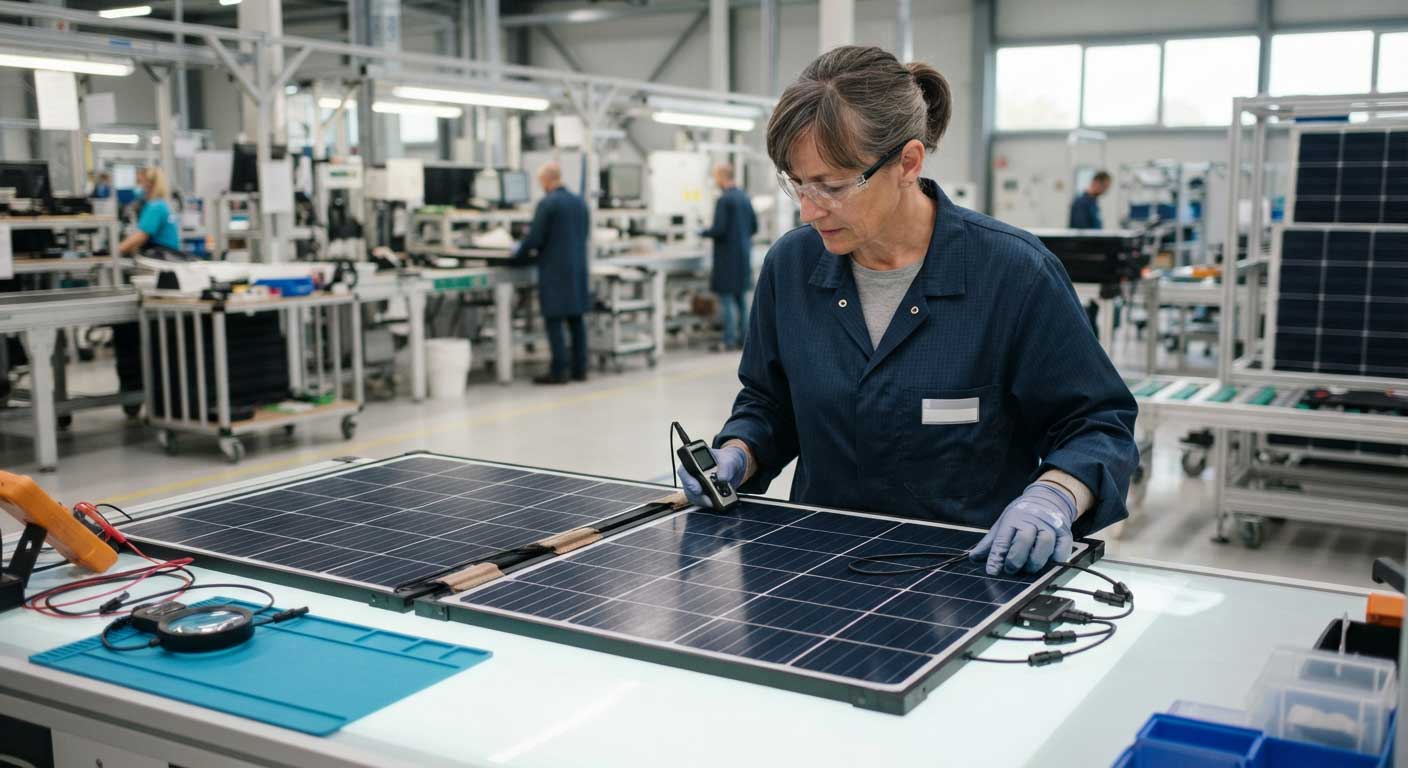
For professional fleets or rental equipment, inspect connectors periodically because repeated setup and breakdown creates more handling cycles than a fixed rooftop installation.
Bright Solar Folding and Portable Solar Applications
Bright Solar develops flexible and semi-flexible solar panel solutions for B2B applications, including RV, camping, mobile, marine, and off-grid use cases.
For a folding portable solar project, the exact product configuration should be selected according to the intended application rather than assuming that a standard flexible panel and a folding portable panel have identical mechanical requirements.
For OEM and ODM projects, buyers should provide:
- Required rated power
- Folded and unfolded size targets
- Target application
- Cell technology preference
- Connector requirements
- Cable length
- Surface material and construction
- Environmental conditions
- Expected order quantity
- Packaging and carrying requirements
This is particularly relevant when developing a portable solar product for a distributor or outdoor brand. The final product is not just a photovoltaic module. The folding mechanism, protective structure, cable management, carrying method, packaging, and user workflow all affect the field experience.
For example, if the product is intended for RV travelers, a carrying handle and compact folded footprint may matter more than saving a small amount of weight. For backpacking, the priorities can shift toward folded volume and weight. For emergency backup, electrical compatibility with the target battery or power station becomes much more important.
Folding Portable Solar Panels Buying Checklist
Before placing a bulk order or specifying a portable solar system, compare the following:
| Specification | Why it matters |
|---|---|
| Rated power | Determines the nominal electrical output |
| Cell type | Influences electrical characteristics and product design |
| Open-circuit voltage | Must remain compatible with the receiving system |
| Operating voltage/current | Important for controller and power-station compatibility |
| Folded dimensions | Determines storage and transportation requirements |
| Unfolded dimensions | Determines the available solar collection area |
| Weight | Critical for backpacking, RV, and field applications |
| Folding mechanism | Affects repeated handling and product life |
| Connector | Must match the intended system or approved adapter |
| Cable length | Determines deployment distance from the battery |
| Weather resistance | Relevant to outdoor deployment conditions |
| Kickstand | Can improve positioning flexibility |
| Carrying case | Protects the panel during transport |
| Warranty | Important for commercial procurement |
| Customization | Relevant to OEM/ODM projects |
Do not evaluate a portable panel solely by the largest number printed on its product page. A 300W panel that is too heavy for the intended user or incompatible with the receiving power station may be less useful than a smaller, properly matched system.
FAQ About folding portable solar panels
Are folding portable solar panels worth using for camping?
They can be useful when portability and temporary deployment matter. They can be unfolded during daylight, repositioned for better sunlight, and stored when not needed. The correct wattage depends on the devices and battery system being powered.
Can folding portable solar panels charge a power station?
Yes, when the panel’s electrical output is compatible with the power station’s solar input. Check voltage, current, connector type, and the station’s maximum solar-input rating before connecting.
Can I connect multiple folding portable solar panels?
Some systems allow multiple panels to be combined, but the receiving device has maximum voltage and current limits. Follow the panel and power-station manufacturers’ connection requirements rather than combining panels based only on total wattage.
Do folding solar panels work on cloudy days?
They can still generate electricity when there is available light, but output generally falls compared with strong direct sunlight. The actual reduction depends on cloud conditions, irradiance, panel characteristics, and system losses.
Should a folding solar panel be placed flat on the ground?
It can be deployed flat if the product permits it, but adjusting the panel toward available sunlight may improve collection. Keep the surface free of shading and follow the manufacturer’s positioning instructions.
Can folding portable solar panels be left outside overnight?
Follow the individual product’s weather and storage instructions. Even when a panel is designed for outdoor use, connectors, power stations, carrying cases, and other components may have different environmental limitations.
What is the difference between folding portable solar panels and flexible solar panels?
Folding portable solar panels are primarily designed for transport and temporary deployment, while flexible solar panels are generally designed around a slim construction and, for some products, limited curvature. A flexible module is not automatically designed to fold repeatedly.
Conclusion
Folding portable solar panels are most useful when solar generation needs to move with the user. Camping, RV travel, emergency preparedness, field work, and temporary off-grid applications can all benefit from a system that unfolds in sunlight and packs away afterward.
The important specification is not simply wattage. Folded size, weight, folding construction, electrical compatibility, cable design, environmental protection, and the ability to position the panel effectively all influence the actual usefulness of the system.
For Bright Solar B2B projects, these factors can be considered together during OEM and ODM development. A well-designed portable solar product should work as a complete field system—from carrying and unfolding to positioning, charging, monitoring, and packing away—not merely as a photovoltaic module.
Related recommendations
-

Flexible Amorphous Solar Panels: Uses, Efficiency and Buying Guide
61Flexible amorphous solar panels use thin-film amorphous silicon in lightweight, bendable modules for curved, lightweight, or unconventional surfaces.
View details -
100w 12v Flexible Solar Panel: Output, Wiring and Installation Guide
249Learn how a 100w 12v flexible solar panel works, its output, battery sizing, wiring, installation, RV uses, and key selection factors for mobile power.
View details -
Best Flexible Solar Panel for RVs, Boats, and Off-Grid Travel
210Find the best flexible solar panel for RVs, boats, vans, and off-grid systems. Lightweight, durable, and built for real outdoor conditions.
View details -
Solar Panels on RV Roof: Complete Guide for Off-Grid RV Power
167Solar panels on RV roofs provide off-grid electricity by combining solar generation, battery storage, charge control, and proper roof planning to meet real t...
View details