Flexible Folding Solar Panels: Portable Power, Design and Buying Guide
Flexible folding solar panels are portable photovoltaic modules designed to fold into a compact package and unfold into a larger solar array. They are well suited to RVs, camping, boats, emergency power, portable power stations and custom off-grid equipment.
What Are Flexible Folding Solar Panels?
Flexible folding solar panels combine photovoltaic modules with a folding mechanical structure. Instead of remaining flat like a conventional Rigid Solar Panels, multiple sections can be folded together for transportation and opened when electricity is needed.
The important point is that flexible and folding are related but not identical.
A flexible solar panel may bend around a curved RV roof and remain there permanently. A folding panel has to tolerate movement at specific folding points during transportation and deployment. That introduces another engineering requirement: the photovoltaic laminate, electrical conductors, protective layers and joints must work together after repeated handling.
The U.S. Department of Energy describes photovoltaic modules as assemblies of semiconductor solar cells that convert sunlight into electrical energy. DOE also supports research aimed at improving PV efficiency, reliability and manufacturing costs.
Flexible photovoltaic construction has been investigated for applications where conventional rigid modules create problems with weight, installation or shape. In 2019, DOE proposed funding for NREL and SunPower to develop a lightweight, flexible PV module for residential and commercial applications.
That development direction explains why flexible folding solar panels continue to attract interest beyond recreational camping.
Flexible Solar Panel vs. Folding Solar Panel
The difference becomes clearer when looking at how the product is used.
| Feature | Flexible Folding Solar Panels | Flexible Solar Panels | Rigid Solar Panels |
|---|---|---|---|
| Folding | Designed for folding | Normally not | No |
| Portability | Very high | Moderate | Low |
| Curved surfaces | Good, depending on construction | Excellent | Limited |
| Permanent RV installation | Possible | Strong application | Strong application |
| Ground deployment | Excellent | Possible | Less convenient |
| Storage | Compact | Full panel length | Full panel length |
| Repeated mechanical movement | Critical design factor | Usually limited | Minimal |
| Main advantage | Portability + deployable area | Shape conformity | High conventional PV performance |
| Typical use | Camping, RV, emergency power | RV, marine, specialty roofs | Residential and commercial roofs |
The folding mechanism changes the product’s life cycle.
A fixed flexible panel might be bent once during installation. A portable folding product could be opened and closed repeatedly throughout its service life.
That difference should appear in the supplier’s technical documentation.
How Flexible Folding Solar Panels Generate Electricity
The electrical process is the same basic photovoltaic process used by other solar modules.
Sunlight reaches the photovoltaic cells. Semiconductor material absorbs the incoming energy and generates electrical charge. The cells are interconnected to provide a usable voltage and current, while the portable solar system sends the DC output to a battery, charge controller, inverter or portable power station.
The folding structure does not change the photovoltaic principle. It changes how the generation surface is transported and deployed.
For example, four 100 W sections provide:
4 × 100 W = 400 W rated DC capacity
That 400 W rating does not mean the system will continuously produce 400 W outdoors.
Real output changes with:
- Solar irradiance
- Module temperature
- Sun angle
- Shading
- Surface orientation
- Wiring losses
- Controller efficiency
- Connector resistance
- Battery or power-station charging limits
This is why experienced procurement teams look at the complete electrical specification rather than choosing by wattage alone.
Electrical Specifications to Request
For a commercial flexible folding solar panel project, request:
- Rated Power (Pmax)
- Maximum Power Voltage (Vmp)
- Maximum Power Current (Imp)
- Open-Circuit Voltage (Voc)
- Short-Circuit Current (Isc)
- Module efficiency
- Power tolerance
- Temperature coefficient
- Connector type
- Cable length
- Maximum system voltage
For portable systems, Voc deserves particular attention.
The solar input of a portable power station or charge controller has a defined operating range. A panel can have the correct wattage and still be electrically incompatible.
Cold-weather operation also deserves consideration because PV open-circuit voltage changes with temperature.
Why Use Flexible Folding Solar Panels for RVs?
RV applications show the practical advantage particularly well.
A typical camper roof is rarely an empty rectangle. Air conditioners, vents, skylights, antennas and other equipment compete for usable surface area.
A permanent rigid-panel installation can work extremely well when the roof has enough clear space. But not every RV has that luxury.
A folding array creates another option.
The vehicle can remain parked in the shade while the solar panels are moved into an open area several meters away.
That distinction matters during summer camping.
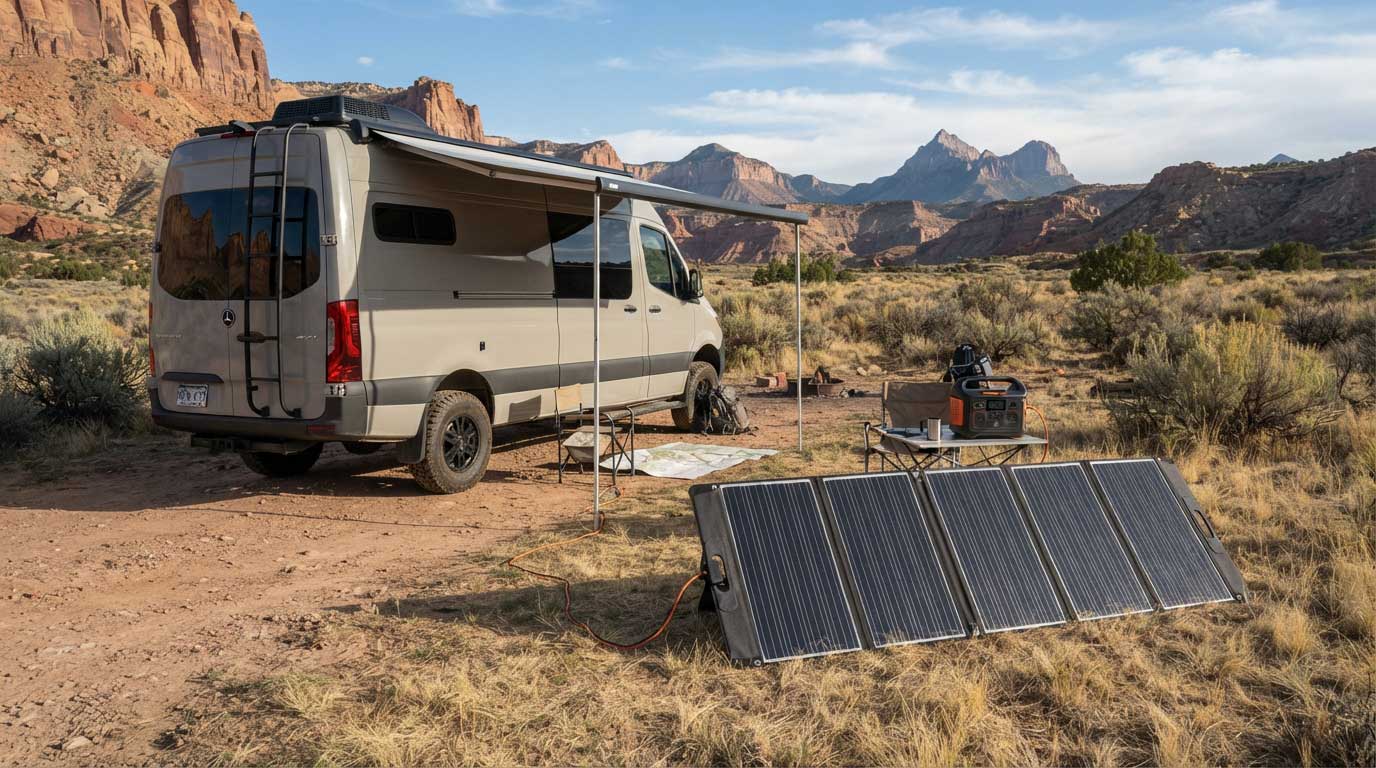
A Practical RV Setup
Imagine a campervan arriving at a campsite in southern Utah.
The vehicle is parked beneath partial tree cover because the occupants want shade. The roof therefore receives inconsistent sunlight.
Instead of moving the vehicle, they remove the folding solar array from storage.
The deployment sequence is simple:
- Place the folded solar unit on clear ground.
- Open each photovoltaic section in the manufacturer’s specified direction.
- Position the array away from vehicle shadows.
- Secure the panel against movement.
- Connect the cable to the portable power station or charge controller.
- Check the input voltage and charging status.
- Reposition the array if shading changes during the day.
- Disconnect and fold only after the system is safely isolated.
The physical details matter.
Grass can hide small stones. Gravel can scratch a protective surface. Wind can lift a lightweight panel. A cable crossing a campsite walkway creates a trip hazard.
Those are mundane problems, but they are exactly the issues that determine whether a portable solar product works well outside a product brochure.
Flexible Folding Solar Panels for Portable Power Stations
Portable power stations have made folding solar arrays useful far beyond traditional camping.
The basic arrangement is straightforward:
Sunlight → Folding Solar Panel → Solar Input → Portable Power Station → AC/DC Loads
The challenge is compatibility.
A 200 W solar panel is not automatically suitable for a 200 W portable power station. The power rating only describes nominal generation capacity. The receiving device may have limits on voltage, current or maximum solar-input power.
Match the Panel to the Solar Input
Before connecting a folding solar panel, compare:
| Panel | Power Station |
|---|---|
| Pmax | Maximum solar input power |
| Voc | Maximum solar input voltage |
| Vmp | MPPT operating range |
| Isc | Maximum input current |
| Connector | Input connector |
| Cable | Required length and gauge |
| Temperature coefficient | Cold-weather voltage consideration |
This is particularly important for a B2B product intended to work with several portable power stations.
If the product is being sold as a complete kit, the manufacturer should validate the panel and receiving electronics together rather than leaving compatibility entirely to the end customer.
Flexible Folding Solar Panels for Camping and Emergency Power
Camping is only one use case.
A folding solar array can also provide temporary charging for:
- Emergency communication equipment
- Outdoor lighting
- Portable refrigerators
- Cameras
- GPS equipment
- Field computers
- Battery-powered tools
- Remote sensors
- Disaster-response equipment
- Temporary workstations
DOE has documented research into miniature flexible solar technologies specifically aimed at overcoming the weight, installation and portability limitations of conventional solar technologies.
That is an important distinction. Portable photovoltaics are not merely a recreational product category. The same mechanical advantage—large generation surface when deployed, compact package when transported—can be useful in professional field equipment.
Temporary Power Has Different Priorities
A permanent solar array can justify substantial mounting infrastructure.
A field system usually cannot.
For temporary applications, the priorities often shift toward:
- Deployment time
- Folded volume
- Total weight
- Cable management
- Resistance to handling
- Storage protection
- Connector accessibility
- Ease of cleaning
- Setup stability
A product that takes five minutes to deploy may be acceptable for a weekend campsite. A field technician using it several times per day may value a much faster mechanism.
That is why user workflow should be part of product development.
Foldable Solar Panel Construction and Materials
The folding mechanism is only one part of the product.
The photovoltaic module must also withstand the mechanical movement created around the folding points.
Depending on the design, a flexible folding panel may incorporate:
- Photovoltaic cells
- Flexible substrate
- Encapsulation layers
- Protective surface film
- Backing material
- Flexible conductors
- Reinforced folding sections
- Junction boxes
- Connectors
- Carrying or support structures
Flexible thin-film technology has been investigated using substrates such as polyimide. NREL documentation describes lightweight flexible CIGS modules manufactured with roll-to-roll processing on polyimide substrates.
The commercial product, however, should always be evaluated as a complete module. A laboratory cell result does not describe the durability or output of the finished folding product.
Why the Folding Joint Matters
When the panel is opened, the joint experiences one mechanical position.
When it is folded, the joint experiences another.
During repeated use, the electrical connection can experience:
- Tensile stress
- Compression
- Bending
- Localized strain
- Abrasion
- Temperature-related movement
The problem may not be visible immediately.
A panel can look perfectly normal while an electrical connection inside a repeatedly stressed area gradually deteriorates.
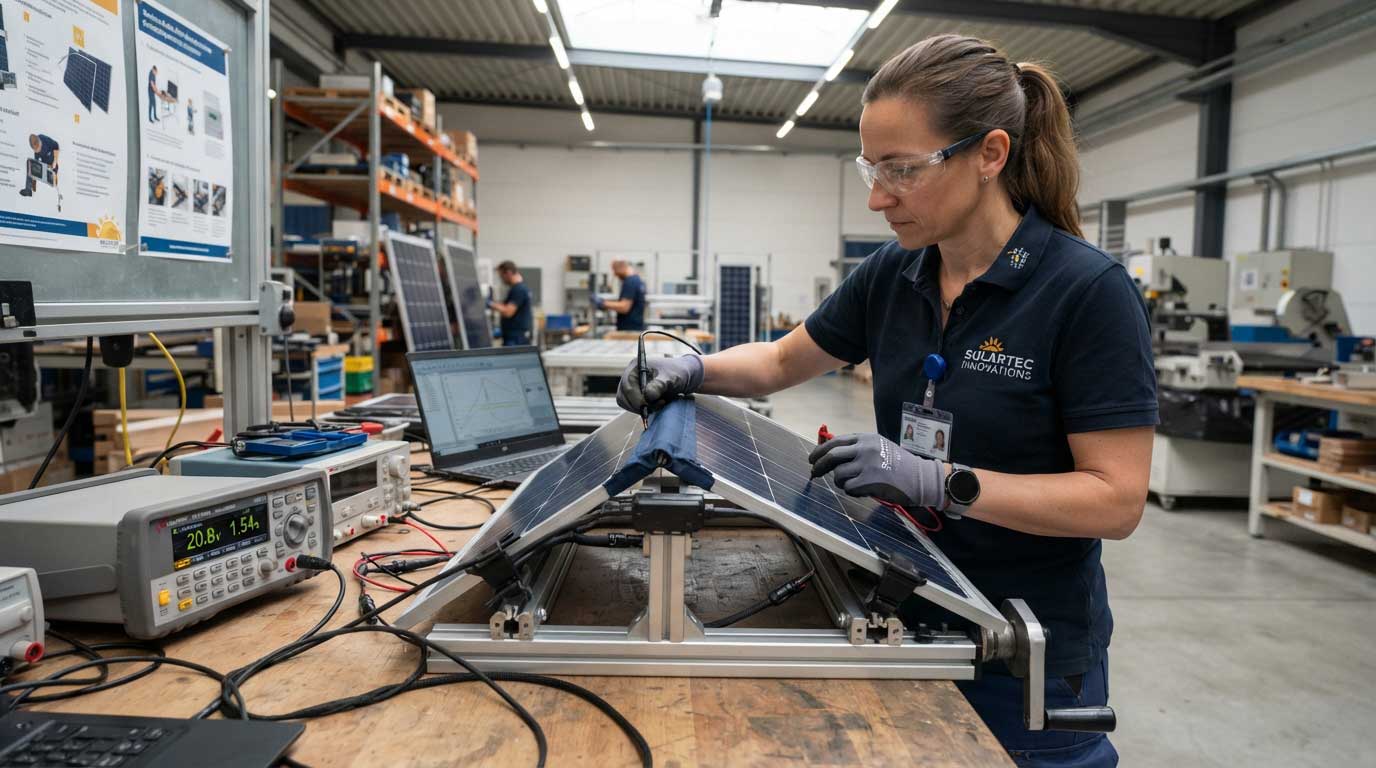
For this reason, a serious B2B evaluation should include electrical testing before and after mechanical cycling.
Flexible Folding Solar Panels and Mechanical Testing
This is one of the areas where marketing language should be treated carefully.
IEC 61215:2021 includes test methods for flexible PV modules, including bending test MQT 22. It also includes cyclic dynamic mechanical load testing. The standard explains that qualification testing demonstrates the ability to withstand defined test sequences but is not a quantitative prediction of service life.
IEC also maintains technology-specific requirements. For example, IEC 61215-1-4:2021 covers thin-film CIGS-based modules and includes the flexible-module bending test.
That does not mean every portable folding solar panel is automatically covered by every aspect of IEC 61215.
In fact, IEC 61215-1:2021 states that its scope does not apply to short-term applications such as flexible modules installed in awnings or tenting.
That wording is important for procurement.
What Should a Supplier Test?
For a foldable product, the test plan should be application-specific.
Useful evaluations include:
- Folding-cycle testing
- Electrical output before and after cycling
- Visual inspection of fold points
- Cable fatigue testing
- Connector inspection
- Water exposure
- UV exposure
- Temperature cycling
- Surface abrasion
- Edge-sealing inspection
- Storage-condition testing
A useful internal test report should identify the test conditions, number of cycles, environmental conditions and measured electrical change.
“Passed a flexibility test” is not enough information for an OEM engineer.
Flexible Folding Solar Panels vs. Portable Rigid Panels
Both product categories can provide mobile solar power, but their physical behavior is different.
| Factor | Flexible Folding Solar Panels | Portable Rigid Panels |
|---|---|---|
| Storage volume | Low when folded | Higher |
| Weight | Usually optimized for mobility | Often higher |
| Folding | Yes | No |
| Deployment | Fast | Fast |
| Mechanical joints | Important | Less complex |
| Surface durability | Product dependent | Generally robust |
| Transport | Easy | Bulkier |
| Uneven ground | Can adapt better | Requires support |
| Curved surfaces | Better | Limited |
| Long-term roof mounting | Product dependent | Strong |
| Repeated handling | Designed for it | Less central |
| Portable power station use | Excellent | Excellent |
The choice is less about which category is universally better and more about how often the product will move.
If a panel will be installed once and left on an RV roof, a foldable mechanism may add complexity without providing much benefit.
If it will travel between campsites every week, the compact storage format becomes much more valuable.
How to Choose Flexible Folding Solar Panels
Step 1 — Define the Energy Requirement
Start with the actual load.
List:
- Daily energy consumption
- Peak power requirement
- Battery capacity
- Desired charging time
- Available sunlight
- Portable power-station limits
Do not begin with the panel.
Begin with the system.
Step 2 — Define the Physical Requirement
Measure both sides of the product:
Deployed: How much solar area can be exposed?
Folded: How much space is available for transport?
For a B2B product, also specify:
- Maximum weight
- Carrying method
- Folded thickness
- Number of sections
- Handle position
- Case dimensions
Step 3 — Define the Mechanical Requirement
Ask the supplier:
- Where does the panel fold?
- What is the recommended folding direction?
- What is the minimum bending radius?
- How many cycles were tested?
- Was electrical output measured afterward?
- Are there reinforced fold zones?
- Can the panel remain partially folded during operation?
Never assume these answers.
Step 4 — Define the Environmental Requirement
A desert campsite and a coastal boat deck are not the same operating environment.
Specify:
- UV exposure
- Rain
- Saltwater
- Dust
- Temperature range
- Wind
- Surface abrasion
- Storage humidity
The encapsulation and connector system should be selected accordingly.
A Practical B2B OEM Case
Consider an outdoor equipment company developing a branded 300 W portable solar kit.
The initial request might read:
“We need a lightweight 300 W folding solar panel.”
That is only the beginning.
The engineering team needs to determine how the 300 W is physically divided.
One possible architecture is three 100 W sections. Another may use four smaller sections. The choice affects the folded package, cable routing, joint count and user experience.
The prototype review might reveal that three sections are too long for the target carrying case. Four shorter sections fit better but introduce another folding joint.
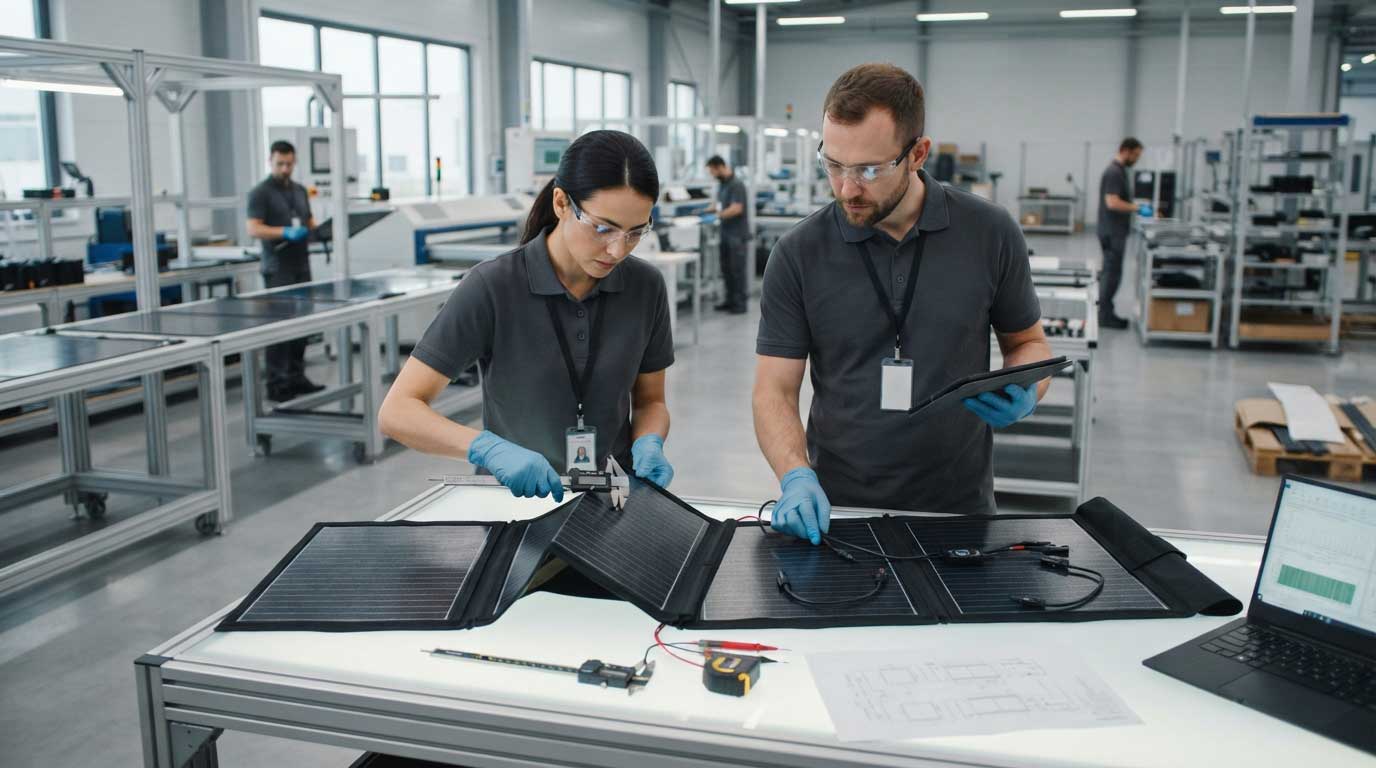
The team then measures:
- deployed dimensions;
- folded dimensions;
- total weight;
- folding time;
- cable position;
- connector access;
- electrical output;
- joint movement;
- surface temperature;
- storage fit.
This is a realistic development sequence because the product is not just a solar module.
It is a portable product containing a solar module.
That distinction changes how the manufacturer should approach OEM development.
Bright Solar Flexible Folding Solar Panel Solutions
Bright Solar provides flexible and semi-flexible solar panel solutions for B2B applications, including OEM, ODM and bulk procurement.
For a flexible folding solar project, the technical discussion can be built around the actual product requirements rather than a generic panel category.
Typical development parameters can include:
- Rated power
- Voltage configuration
- Module dimensions
- Folded dimensions
- Number of folding sections
- Cell technology
- Surface construction
- Cable length
- Cable exit position
- Connector
- Weight target
- Application environment
- Branding requirements
- Procurement quantity
Bright Solar’s flexible solar product range also addresses applications including RVs, marine environments, outdoor power and off-grid systems.
For a commercial buyer, the most useful information to provide at the quotation stage is not simply the desired wattage. A drawing, target folded size, power-system specification and intended operating environment will produce a much more meaningful engineering discussion.
What Makes a Good OEM Specification?
A practical RFQ can include:
| Requirement | Example Information |
|---|---|
| Application | RV / camping / marine / emergency |
| Rated power | Target W |
| System voltage | 12 V / 24 V / other |
| Open size | L × W |
| Folded size | L × W × thickness |
| Weight | Maximum target |
| Folding sections | Required quantity |
| Cell technology | Preferred or supplier recommendation |
| Connector | Required type |
| Cable | Length and exit position |
| Environment | Outdoor / marine / desert |
| Quantity | Prototype + production volume |
| Branding | OEM label / packaging |
That level of detail allows a supplier to evaluate the complete product rather than quote a generic stock item.
Common Mistakes When Buying Flexible Folding Solar Panels
Mistake 1 — Buying by Wattage Alone
A higher wattage rating does not guarantee system compatibility.
Check voltage, current and receiving-device limits.
Mistake 2 — Ignoring the Folded Package
The deployed size is only half the specification.
A portable product also has to fit into the vehicle, storage compartment, equipment case or backpack intended for it.
Mistake 3 — Assuming Every Flexible Panel Can Fold
Some flexible modules are designed only for gentle permanent curvature.
Repeated folding can cause damage if the construction was not designed for it.
Mistake 4 — Treating IEC Qualification as a Guaranteed Lifespan
IEC explicitly notes that qualification testing is not a quantitative prediction of service life.
Always review the actual test scope and conditions.
Mistake 5 — Forgetting Wind
A large unfolded solar surface can behave like a lightweight sail.
Ground deployment should include a practical method of preventing movement or lifting under the expected conditions.
Mistake 6 — Overlooking Cable Position
For a portable product, cable placement affects how quickly the system can be connected and packed.
For OEM products, moving a cable exit during the design stage can prevent unnecessary strain and awkward routing later.
FAQ About Flexible Folding Solar Panels
What are flexible folding solar panels?
Flexible folding solar panels are photovoltaic modules made from flexible sections that can be folded for storage and unfolded into a larger solar-generating surface. They are designed primarily for portable or temporary solar applications.
Are flexible folding solar panels good for RVs?
Yes. They are useful when roof space is limited, shaded or already occupied by RV equipment. The array can be deployed away from the vehicle in a sunnier location.
Can flexible folding solar panels charge a portable power station?
Yes, when the panel’s Voc, Vmp, Imp, Isc, connector and total power are compatible with the power station’s solar input. Compatibility should be verified from the electrical specifications rather than wattage alone.
Are flexible folding solar panels waterproof?
Some are designed for outdoor exposure, but waterproofing cannot be assumed from the word “flexible.” The complete panel, connectors, cable exits and protective construction determine environmental resistance.
How long do flexible folding solar panels last?
There is no single service-life figure for every foldable product. Durability depends on cell technology, encapsulation, environmental exposure, construction and the number of folding cycles. Testing should match the intended application.
Can flexible folding solar panels be used on boats?
They can be suitable for marine applications when the product is specifically designed for the environmental exposure. Saltwater, humidity, UV exposure, surface wear, connectors and cable sealing should all be considered.
Can Bright Solar customize flexible folding solar panels?
Bright Solar supports B2B flexible and semi-flexible solar projects and can discuss requirements such as dimensions, electrical configuration, application, OEM/ODM specifications and procurement volume. Final technical specifications depend on the individual project.
Conclusion
Flexible folding solar panels solve a very specific solar problem: how to carry a useful photovoltaic surface without carrying a rigid panel at full size.
That makes them particularly practical for RVs, camping, portable power stations, emergency equipment, field operations and custom OEM products.
The important engineering details are less visible than the solar cells themselves. Folding geometry, joint construction, cable routing, encapsulation, electrical compatibility and storage dimensions determine whether the product remains convenient after repeated use.
For B2B buyers, the strongest evaluation starts with the application. Define the power system, available space, folded package, environmental conditions and expected mechanical use before comparing suppliers.
DOE and NREL research shows why lightweight and flexible PV remains an active area of photovoltaic development, while IEC 61215 provides important qualification and flexible-module testing references.
Flexible folding solar panels are most valuable when portability is not an accessory feature but part of the solar system’s actual design.
Related recommendations
-

400 W Solar Panel: Real-World Power Output, Applications, and Buying Guide
222Discover how a 400 w solar panel performs in real-world conditions. Learn daily power production, battery charging capacity, installation methods, and expert buying advice from Bright Solar.
View details -
solar panel wiring guide (Field Installation Manual from Bright Solar)
167solar panel wiring guide explained with real installation steps, safety standards, wiring diagrams, and field-tested methods for off-grid and RV solar systems.
View details -
220w flexible solar panel (Real Field Performance Guide from Bright Solar)
124220w flexible solar panel explained with real RV field data, installation behavior, energy output range, and off-grid performance insights from Bright Solar.
View details -
Parallel vs Series Solar Panels: Which Wiring Method Actually Performs Better?
123Learn the differences between parallel vs series solar panels. Compare voltage, current, shading performance, efficiency, and real-world applications to choose the best solar wiring method.
View details