Folding Solar Panels for Camping: A Practical Guide to Portable Power
Folding solar panels for camping provide portable electricity by converting direct sunlight into power for phones, lights, GPS devices, batteries, and portable power stations. Their main advantage is easy repositioning when campsite shade changes.
For camping, the useful question is not simply “How many watts does the panel have?” It is whether the panel can be carried easily, positioned in unobstructed sunlight, connected safely to the battery or power station, and packed away without taking over the vehicle.
The U.S. Department of Energy confirms that solar radiation changes with location, season, time of day, weather, and landscape. Sunlight is strongest when it reaches a surface more directly, which is one reason a portable panel can be useful at a campsite: you can move the panel rather than moving the entire campsite.
Why Folding Solar Panels for Camping Make Sense
A fixed solar panel works from wherever it has been installed. Camping rarely gives you that luxury.
A tent might be under trees because that is where the campsite is most comfortable. The vehicle may be parked in shade. A picnic table could block part of the afternoon sun. Ten metres away, however, there may be a completely open patch of ground.
That is where a folding solar panel earns its place.
You unfold it, move it into the sun, adjust the angle, connect it to the charging system, and leave the sleeping area untouched.
NREI‘s guidance for portable solar charging makes the same practical point from an outdoor perspective: solar panels require meaningful exposure to direct sunlight, while dense forest canopy, canyons, mountains and other obstructions can significantly reduce the available solar resource.
For a camping setup, portability is therefore not just about saving storage space. It gives the user control over where the solar surface sits.
The Main Benefits at a Campsite
- Easy to transport in an RV, SUV, van or camping vehicle
- Smaller folded footprint than the deployed panel area
- Can be moved away from campsite shade
- Can be angled toward the sun
- Useful for portable power stations
- Suitable for temporary off-grid charging
- Can be packed away when rain or strong weather arrives
- Does not require permanent roof installation
There is another practical benefit that is easy to overlook: the panel does not have to stay beside the person using the electricity.
The panel can sit in the best sunlight while the power station remains under shelter.
That separation becomes particularly useful during a long afternoon at camp.
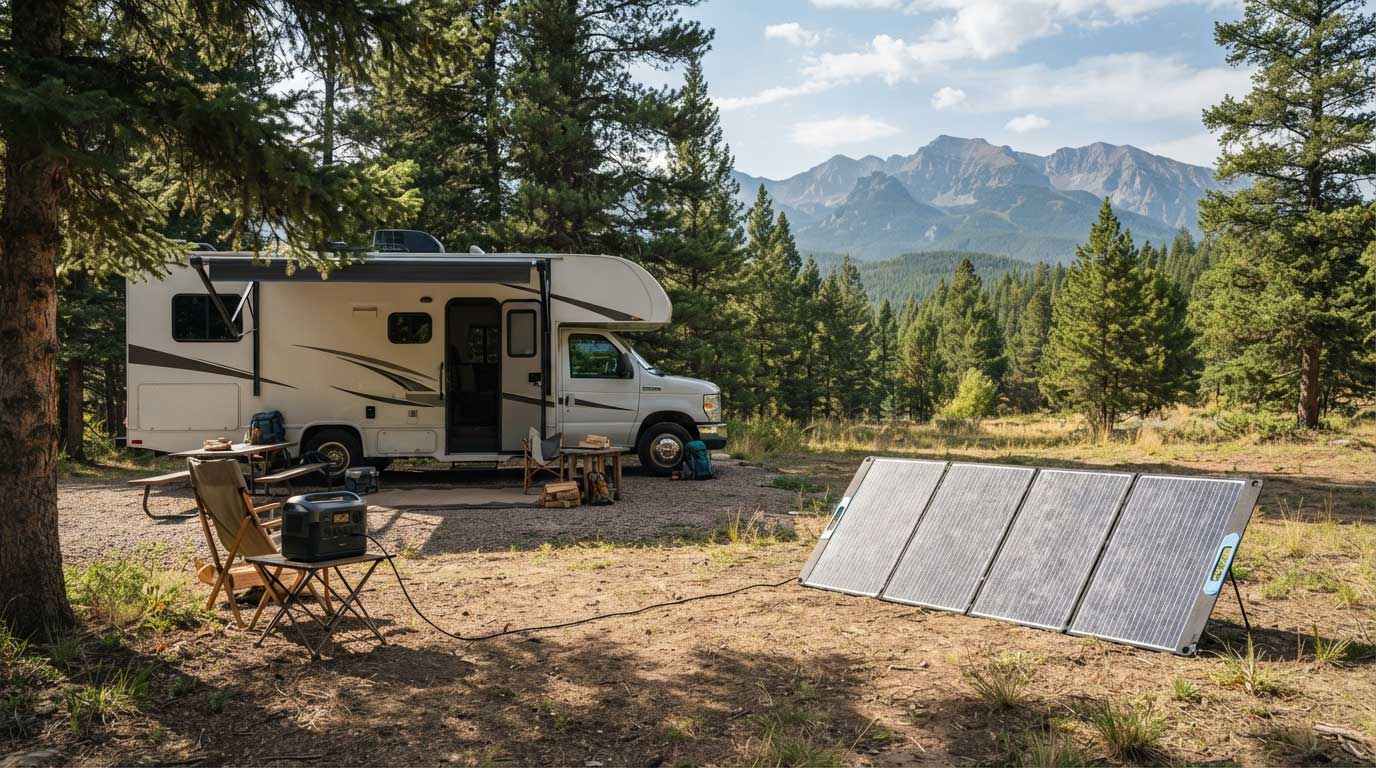
How Folding Solar Panels for Camping Work
The underlying technology is the same photovoltaic principle used in conventional solar modules.
The U.S. Department of Energy explains that photovoltaic materials convert sunlight into electrical energy. Individual PV cells are connected into larger modules or panels to increase usable electrical output.
A folding camping panel simply packages that generation area in a more portable mechanical format.
A typical setup can look like this:
Sunlight → folding solar panel → charge controller or power station → battery → camping devices
The panel produces DC electricity. Depending on the system, the electricity may go directly into a compatible battery or through a charge controller that manages charging.
A portable power station normally acts as the storage point. REI describes this portable power chain as a source supplying a storage device, which then powers electronic equipment such as phones, GPS devices and other field electronics.
What Can You Run?
The answer depends on the panel, battery and load.
Common camping loads include:
| Camping equipment | Solar suitability |
|---|---|
| Smartphone | Excellent for small portable systems |
| GPS device | Excellent |
| Headlamp | Excellent |
| Camera batteries | Very suitable |
| Laptop | Suitable with sufficient panel and battery capacity |
| LED camping lights | Very suitable |
| Portable refrigerator | Requires substantially more stored energy |
| Electric cooking equipment | Higher-demand application |
| Air conditioner | Usually requires a much larger power system |
This is why it is better to size the complete system rather than choosing a panel based only on a wattage number.
How Much Power Do Folding Solar Panels Produce While Camping?
A panel’s rated wattage is its maximum output under specified test conditions, not a promise that the same power will be delivered throughout the day.
REI specifically notes that the watt rating represents maximum power under ideal conditions, including a clean panel positioned squarely toward the sun without cloud cover or shadows.
The DOE likewise explains that PV performance depends on factors including sunlight intensity, temperature, reflection and the characteristics of the solar cell.
For a simple planning calculation:
Daily theoretical energy = panel wattage × equivalent peak-sun hours
For example:
| Panel rating | 3 equivalent sun-hours | 4 equivalent sun-hours | 5 equivalent sun-hours |
|---|---|---|---|
| 100W | 300Wh | 400Wh | 500Wh |
| 200W | 600Wh | 800Wh | 1,000Wh |
| 300W | 900Wh | 1,200Wh | 1,500Wh |
| 400W | 1,200Wh | 1,600Wh | 2,000Wh |
These figures are theoretical energy estimates, not guaranteed field production. Cable losses, controller or power-station conversion, temperature, clouds, shading and panel orientation reduce the usable amount.
That distinction matters when planning food refrigeration or overnight battery capacity.
A 200W panel should not be treated as “an 800Wh-per-day panel.” It is a 200W-rated panel that might produce around 800Wh under a simplified four-equivalent-sun-hour calculation before real-world system losses.
Why Campsite Shade Is a Bigger Problem Than Many Buyers Expect
The word “camping” can create an odd contradiction for solar.
The best campsite may be underneath trees.
The best solar location may be outside the campsite.
Dense tree cover can reduce direct sunlight substantially. The DOE notes that atmospheric conditions can reduce direct beam solar radiation by 10% even on clear, dry days and by as much as 100% during thick cloud conditions.
That does not mean a folding panel stops producing electricity every time a cloud passes. It means the available solar resource changes, sometimes sharply.
In practice, moving the panel five or ten metres can be more useful than buying a higher-rated panel and leaving it in shade.
How to Set Up Folding Solar Panels for Camping
Step 1: Check the Weather and Camping Site
Before unpacking the panel, look at the campsite rather than immediately putting it beside the tent.
Find the area with the longest period of unobstructed sunlight.
A campsite that is sunny at 9 a.m. may be shaded at 2 p.m. by a nearby tree or ridge. The sun moves; the shadow moves with it.
The DOE notes that solar radiation varies throughout the day and that the strongest solar resource generally occurs around solar noon when the sun is highest.
Step 2: Put the Panel on a Durable Surface
Do not automatically place a large folding panel in the middle of delicate vegetation just because that is where the sun looks best.
The National Park Service’s Leave No Trace guidance recommends established campsites and other durable surfaces such as rock, gravel, dry grass or snow, while discouraging unnecessary alteration of a campsite.
A folding panel can usually be positioned on:
- Gravel
- Packed soil
- A campsite’s durable ground
- A picnic table
- A dedicated support
- A clean vehicle-side area
Keep the panel stable enough that wind cannot knock it over.
Step 3: Unfold the Panel Carefully
Open each section according to the manufacturer’s intended folding direction.
Do not treat “foldable” as “bend anywhere.”
This is particularly important for products described as flexible or semi-flexible. Flexibility, folding capability and repeated creasing are three different mechanical characteristics.
For Bright Solar products, the specified construction should always be followed rather than assuming that one product’s mechanical limits apply to another.
Step 4: Aim the Panel at the Sun
A panel lying completely flat may still produce power, but it may not capture as much sunlight as a properly oriented surface.
The goal is simple: maximize direct sunlight across the active surface.
The best angle changes during the day and with location. A portable panel gives you an advantage over a fixed panel because you can physically adjust it.
For short camping trips, a practical routine is often enough:
Morning: place the panel toward the morning sun.
Late morning: check the shadow line.
Early afternoon: reposition if a tree or vehicle begins covering the panel.
Late afternoon: decide whether the remaining sunlight is worth another adjustment.
This is less complicated than trying to calculate the perfect angle every hour.
Step 5: Connect the Panel to the Correct Charging Equipment
Before connecting, verify:
- Solar panel voltage
- Maximum current
- Rated power
- Power station solar-input voltage range
- Maximum solar input wattage
- Connector type
- Polarity
- Charge-controller requirements
A connector fitting physically does not prove that the electrical specifications match.
This is particularly important for B2B buyers developing a folding panel for a particular portable power station.
Choosing Folding Solar Panels for Camping by Trip Type
Not every camper needs the same panel.
A backpacker carrying everything on foot has a different priority from a family traveling in an RV.
Backpacking and Lightweight Camping
Weight becomes the first constraint.
A small panel may be preferable even if it produces less power because carrying a large rigid folding system for several miles can quickly become impractical.
For perspective, REI lists a commercially available 10W foldable panel at about 1 lb 1.6 oz and a 20W foldable model at about 2 lb 1.6 oz. Those examples illustrate how portable charging products can be built around very different power-to-weight targets.
Car Camping
Car camping gives you more freedom.
Weight matters less because the panel travels in the vehicle. A larger deployed area can therefore make sense.
A 100W, 200W or larger system may be more practical depending on the power station and electrical loads.
RV Camping
RV users often want more energy over a longer period.
A folding panel can supplement roof-mounted solar or serve as a portable alternative when the vehicle’s roof is shaded.
It can also be deployed without modifying the RV roof, which is useful for renters, leased vehicles, temporary setups and users who do not want permanent installation.
Emergency and Remote Camping
Here reliability becomes more important than convenience.
A good emergency-oriented system should be easy to deploy without complicated tools, use compatible connectors, and have a storage method that protects the panel and cables between trips.
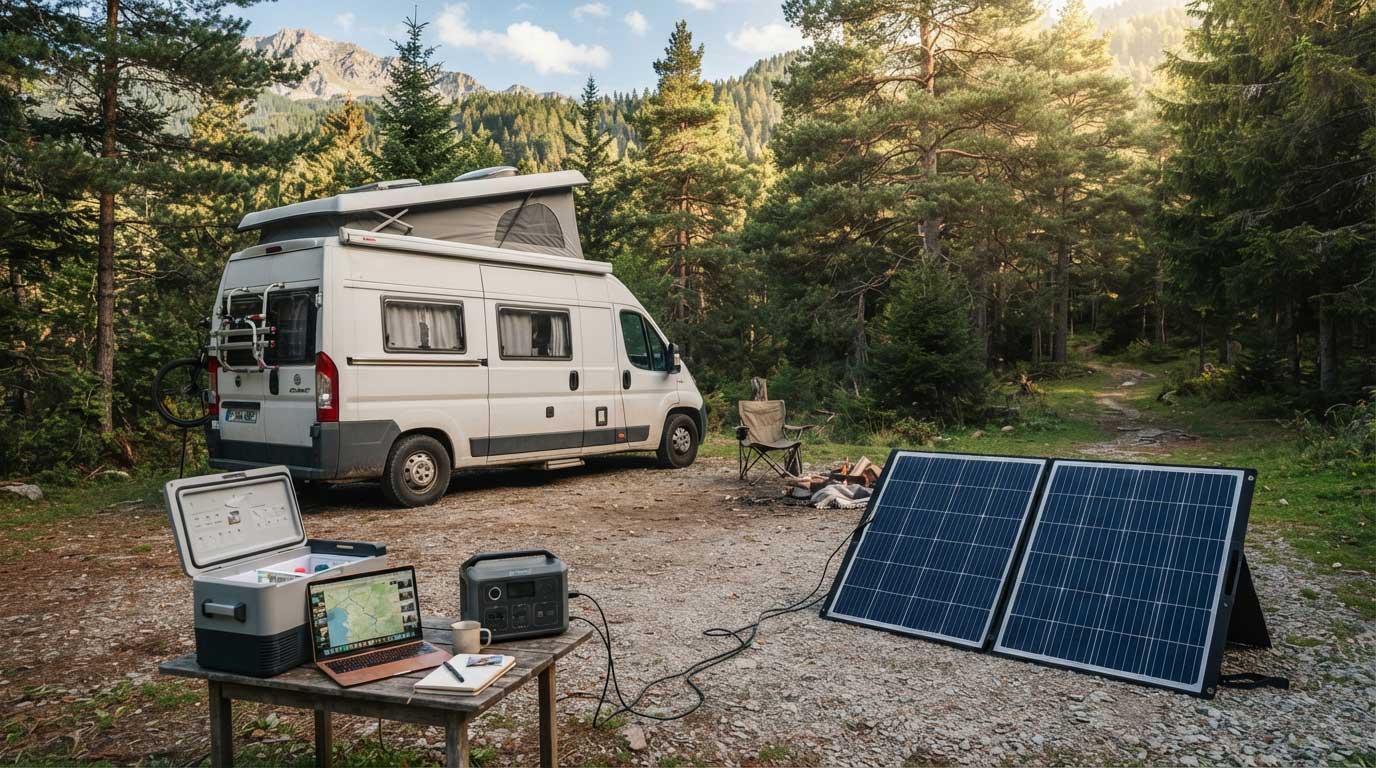
How to Match Panel Size to Your Camping Power Needs
The easiest way to avoid oversizing is to start with actual energy use.
Write down the equipment you expect to use.
For example:
| Device | Example daily energy use | Importance |
|---|---|---|
| Smartphone | 10–20Wh | Low |
| Camera batteries | 20–50Wh | Medium |
| Laptop | 50–100Wh+ | Medium/high |
| LED lighting | 20–60Wh | Medium |
| Portable refrigerator | Often substantially higher | High |
| Cooking appliances | High instantaneous demand | High |
The numbers above are planning examples, not universal consumption specifications. Actual energy use depends on device capacity, duty cycle, temperature and usage.
This is where field experience changes the calculation.
A refrigerator rated at a particular electrical power does not necessarily consume that amount continuously. A compressor cycles. A laptop’s draw changes with workload. A phone may only need a small amount of energy but can be critical for navigation or communication.
So instead of adding appliance wattages and assuming they represent daily energy consumption, measure or estimate watt-hours.
Power vs. Energy
This distinction is essential.
A watt (W) describes the rate of electrical power.
A watt-hour (Wh) describes energy over time.
A 100W load operating for one hour consumes approximately 100Wh.
A 20W device operating for five hours also consumes approximately 100Wh.
That difference matters when selecting folding solar panels for camping.
Folding Solar Panels for Camping: What to Look for Before Buying
A product page showing “200W portable solar panel” does not tell you enough.
For serious buyers, review the following specifications.
1. Rated Power
Rated power gives you a starting point for comparing products.
Do not treat it as expected daily energy production.
2. Folded Dimensions
This determines whether the panel actually fits your storage system.
Measure the available compartment rather than estimating from photographs.
3. Deployed Dimensions
A large panel can become surprisingly awkward at a campsite.
Check whether you have enough stable ground to deploy it without placing cables across walking areas.
4. Weight
Weight matters enormously for backpacking and much less for RV camping.
The right specification depends on how far the panel travels between the vehicle and the solar position.
5. Cell Technology
Monocrystalline cells are widely used in portable solar products because manufacturers can achieve useful output from relatively compact active areas.
Bright Solar supports monocrystalline and other cell configurations depending on the product and application.
6. Surface and Environmental Construction
Camping exposes products to dust, moisture, temperature changes and repeated handling.
For marine or saltwater environments, requirements become more demanding than ordinary campground use.
7. Connector and Electrical Configuration
This should be checked before purchase, not after the panel arrives.
The panel must work within the receiving equipment’s permitted voltage and current range.
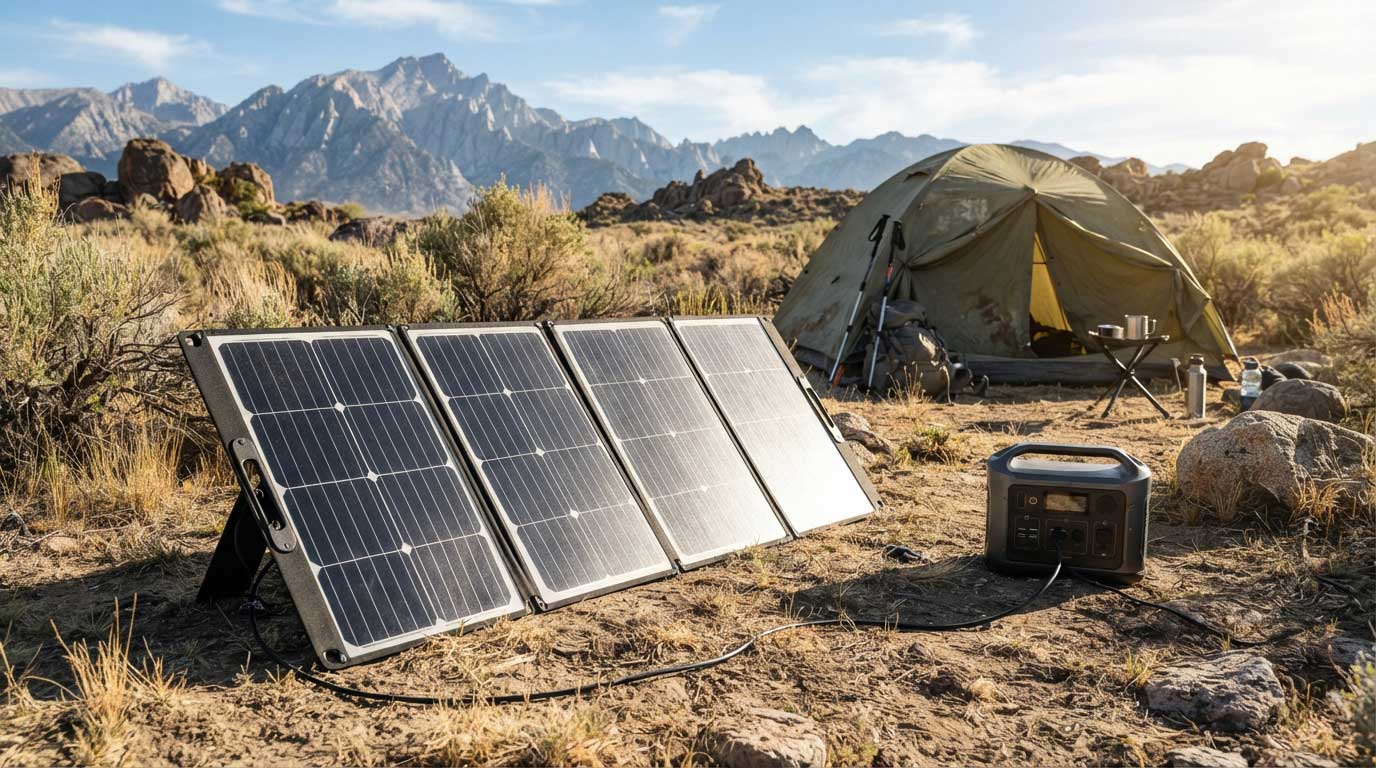
Common Mistakes When Using Folding Solar Panels for Camping
Leaving the Panel in Shade
This is probably the most common mistake.
The panel may be rated at 200W, but the number printed on the label cannot overcome a tree canopy covering much of its surface.
Move the panel.
Assuming Cloudy Weather Means Zero Output
Clouds reduce available sunlight, but they do not necessarily eliminate all solar generation.
The DOE distinguishes between direct beam and diffuse solar radiation. Clouds scatter and absorb sunlight, changing the amount and type of radiation reaching the surface.
Output will generally be lower than under clear direct sunlight.
Buying Based Only on Maximum Wattage
A larger panel that stays in the vehicle because it is inconvenient may be less useful than a smaller panel that gets deployed every day.
Portability is part of performance in a camping environment.
Ignoring the Cable Route
Do not place the cable across the main path from the tent to the vehicle.
A technically efficient solar setup is still a poor campsite setup if someone trips over the cable.
Leaving the Panel Unattended in Changing Weather
A sunny morning can become a windy afternoon.
Portable panels are lighter than permanent structures. If the weather deteriorates, pack them away or secure them according to the manufacturer’s instructions.
Realistic Camping Case: A Weekend RV Setup
Consider a two-night RV trip for two people.
The electrical priorities are:
- Phones
- Two camera batteries
- LED lighting
- Laptop
- Portable refrigerator
- Small communication devices
The RV is parked beneath trees because the site offers better shade and privacy there.
Instead of placing the solar panel beside the vehicle, the campers identify a durable open area roughly 10 metres away.
The folding panel is deployed there.
During the morning, it receives direct sunlight. Around early afternoon, the shadow from a nearby tree begins moving across one section. The panel is repositioned rather than leaving it in partial shade.
This is a small operational decision, but it changes the usefulness of the system.
The lesson is not that every camper needs to move a panel constantly. It is that portable solar should be treated as a movable energy collection surface.
That is the advantage permanent rooftop solar cannot provide.
How Bright Solar Approaches Folding Solar Panels for Camping
Bright Solar develops flexible and portable solar products for applications including RVs, mobile homes, camping, boats, ships, portable power stations and off-grid systems.
For B2B customers, camping solar is rarely just a matter of choosing an existing wattage.
A distributor may need:
- A specific folded size
- A target deployed area
- A particular weight
- Monocrystalline cell configuration
- Specific connector arrangement
- Custom cable length
- Different surface construction
- OEM branding
- Custom packaging
- Bulk procurement
- Compatibility with a designated power station
Bright Solar’s experience with Flexible Solar Panel products also makes the distinction between product categories important. The L Series, for example, has a maximum bending capacity of 30%, while marine-oriented H Series products use a different construction approach, including double ETFE. The correct product should follow the application rather than forcing one solar panel design into every environment.
For a commercial project, the useful starting information is not only the target wattage. It is the application, storage limitation, deployment environment, electrical interface and expected usage pattern.
That is where product engineering becomes more valuable than a generic “portable solar panel” specification.
FAQ About Folding Solar Panels for Camping
Are folding solar panels good for camping?
Yes. Folding solar panels are well suited to camping because they combine a relatively compact storage format with a larger deployed solar collection area and can be moved toward better sunlight during the day.
Can folding solar panels charge a portable power station?
Yes, when the panel’s voltage, current, connector and maximum output are compatible with the power station’s solar-input specifications. Always verify the manufacturer’s electrical limits before connecting the system.
What size folding solar panel do I need for camping?
The required size depends on daily energy consumption, battery capacity, available sunlight and the devices being powered. Small electronics may need a compact panel, while RV refrigeration and laptops may justify a larger system.
Do folding solar panels work in cloudy weather?
Yes, but output generally decreases because clouds reduce the direct solar radiation reaching the panel. The amount of available diffuse sunlight varies with weather conditions and cloud thickness.
Can I leave folding solar panels outside overnight?
It is generally better to follow the manufacturer’s storage and weather instructions rather than assuming outdoor overnight exposure is acceptable. Folding panels should be protected from unnecessary moisture, wind and physical damage when not generating power.
How should I position folding solar panels while camping?
Place the panel where it receives the longest practical period of unobstructed sunlight, then orient the active surface toward the sun. Reposition it when nearby trees, vehicles or terrain begin creating significant shade.
Are folding solar panels better than roof-mounted solar for an RV?
Neither is universally better. Roof-mounted solar is convenient and generates power while driving or without campsite setup, while folding solar can be moved into sunlight when the RV roof is shaded. Many RV systems can use portable solar as an additional charging source.
Conclusion
Folding solar panels for camping are most valuable when portability changes the quality of your solar exposure. A panel that can leave the shade of the RV, follow an open patch of sunlight and return to a compact storage position offers a very different camping experience from a permanently mounted module.
For campers, RV owners and outdoor-power brands, the right choice should balance power, weight, folded size, deployed area, electrical compatibility and environmental construction.
Bright Solar provides flexible and portable solar panel solutions for B2B applications, including customized configurations for RV, camping, portable power and off-grid projects.
Related recommendations
-

Solar Panels for Tiny House: Complete Guide to Off-Grid Energy Solutions
190Solar panels for tiny house provide clean, reliable power. Learn system sizing, costs, installation tips, batteries, and flexible solar solutions from Bright Solar.
View details -
Custom Shape Flexible Solar Panels: Design, Applications and Buying Guide
80Custom shape flexible solar panels are designed around project-specific installation areas, helping use irregular or limited spaces on RVs, yachts, and speci...
View details -
1000W Solar Panel Guide: What a 1000W Solar Panel Can Really Power
219Learn how a 1000W solar panel system works, what it can power, expected daily output, installation options, and whether it fits your RV, home, boat, or off-grid project.
View details -
Solar Panels for Semi Trucks: Complete Guide to Truck Solar Power Systems
150Solar panels for semi trucks provide reliable power for long-haul vehicles. Learn system sizing, installation, benefits, and real truck applications with Bright Solar flexible solar solutions.
View details