Foldable Portable Solar Panel: How to Choose and Use One
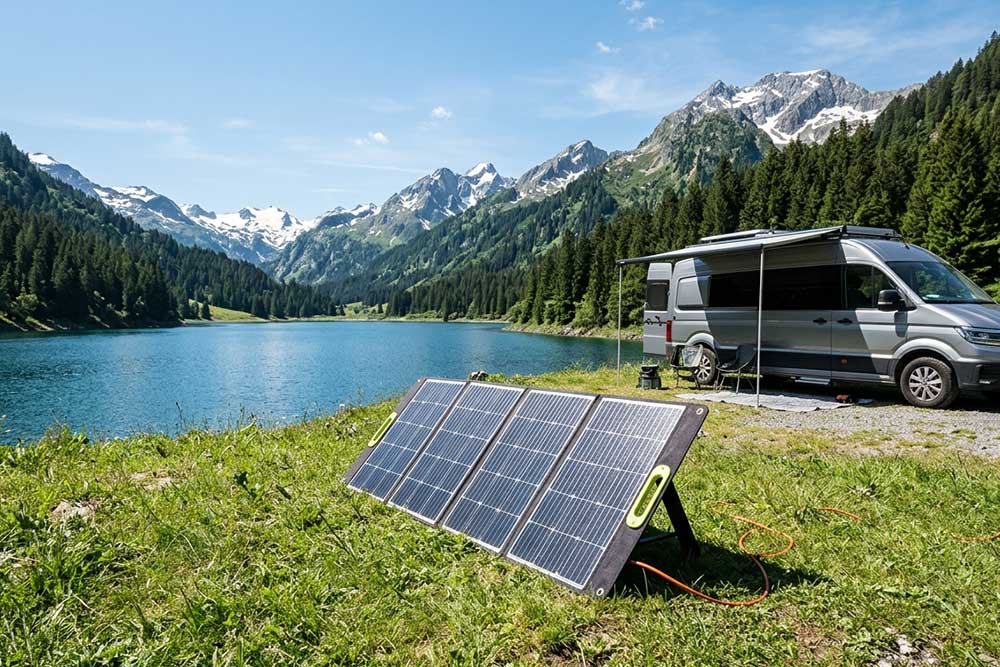
A foldable portable solar panel provides mobile solar power for camping, RV trips, outdoor electronics, and compatible off-grid systems. It unfolds for sunlight collection, connects to suitable charging equipment, and folds away for easier transport and storage.
Its biggest advantage is flexibility. You can park a camper in the shade and place the panel in a sunnier area, move it as the sun changes, or pack it away when the weather turns. Actual electricity production depends on rated wattage, sunlight, orientation, temperature, and the connected battery or power station.
Bright Solar works with B2B buyers seeking solar solutions for mobile, outdoor, and off-grid applications. For anyone comparing portable panels, the practical questions are straightforward: how much energy do you need each day, how much space can you spare, and will the panel work with your existing equipment?
What Is a Foldable Portable Solar Panel?
A foldable portable solar panel is a photovoltaic product designed to collapse into a more compact form for transport. Depending on its construction, it may contain several connected panel sections, protective outer materials, support legs, and cables for connecting to compatible charging equipment.
When unfolded, its solar cells convert sunlight into direct-current electricity. That power can charge a compatible power station, supply a suitable controller and battery system, or feed supported devices through integrated outputs where provided.
Not every model includes all the necessary charging components. Some panels have USB outputs or an integrated controller; others provide only a solar connector. Check the product specification before assuming that a battery, inverter, or charge controller is included.
Foldable vs. Flexible vs. Rigid Solar Panels
These three designs solve different problems.
| Panel type | Best suited to | Main consideration |
|---|---|---|
| Foldable portable solar panel | Camping, travel, temporary charging | Must be unfolded and positioned for use |
| Semi-flexible solar panel | Certain curved or weight-sensitive mounting surfaces | Must follow specified bending and mounting limits |
| Rigid solar panel | Fixed roof or ground installations | Usually needs a dedicated mounting arrangement |
A folding panel prioritizes portability. A semi-flexible panel is designed around different construction and mounting requirements, while a rigid panel is often selected for permanent installation. The terms should not be used interchangeably when choosing a product.
What Can a Foldable Portable Solar Panel Power?
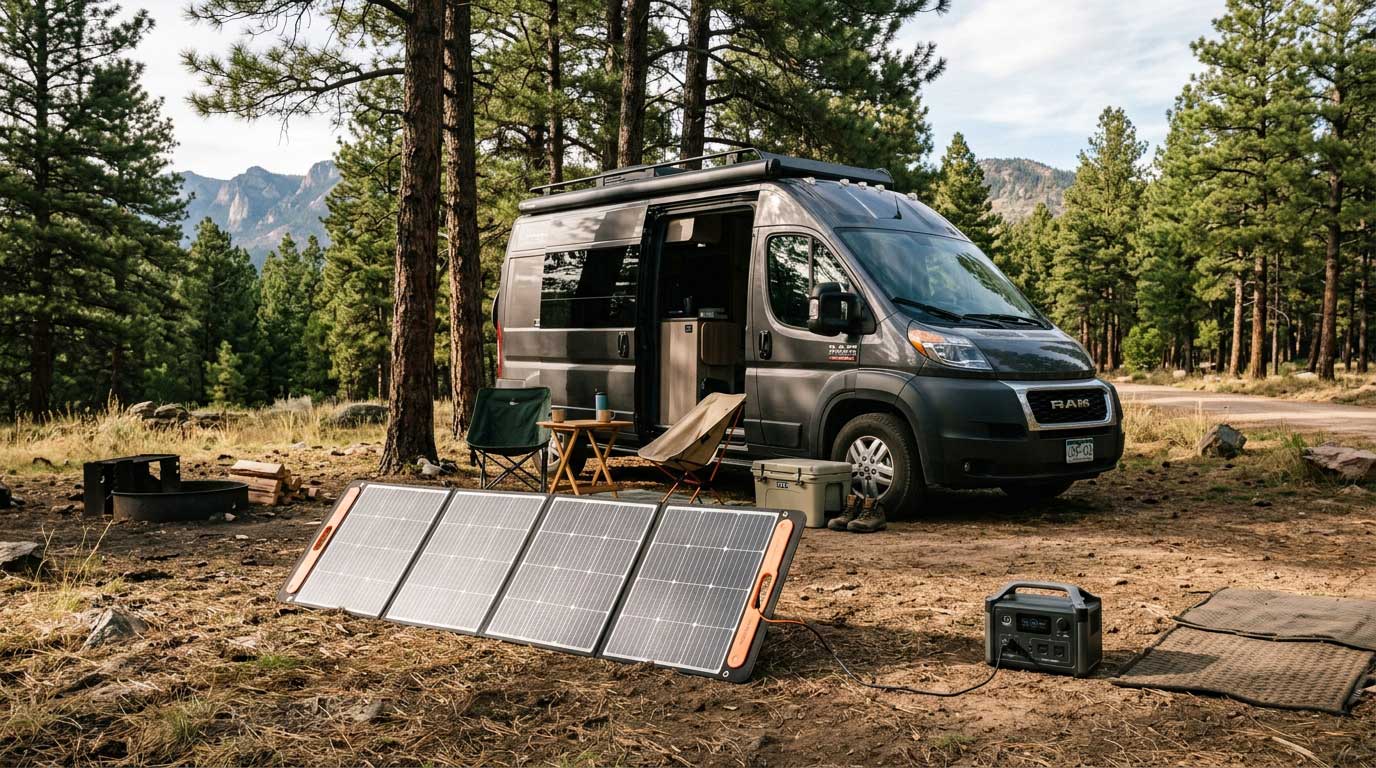
The answer depends on the panel’s wattage and the daily energy consumption of the equipment being charged. A small panel may be enough for phones and lights, while higher-wattage models can contribute more energy to a portable power station or battery-based RV system.
Estimate Daily Energy Before Choosing a Panel
A solar panel’s rated power is measured in watts (W). The energy it produces over time is measured in watt-hours (Wh) or kilowatt-hours (kWh).
For an initial estimate:
Daily energy before losses = Rated panel power × Equivalent peak sun hours
For example, a 100W panel exposed to four equivalent peak sun hours has a theoretical yield of 400Wh, or 0.4kWh, before system losses. This is an illustrative calculation, not a guaranteed daily result.
| Panel rating | 3 peak sun hours | 4 peak sun hours | 5 peak sun hours |
|---|---|---|---|
| 100W | 300Wh | 400Wh | 500Wh |
| 200W | 600Wh | 800Wh | 1,000Wh |
| 300W | 900Wh | 1,200Wh | 1,500Wh |
Actual output will differ with weather, shading, orientation, temperature, and charging losses. For location-specific solar estimates, consult the National Renewable Energy Laboratory’s PVWatts Calculator. It models photovoltaic production using location and system assumptions; its estimates should not be treated as guarantees for a portable panel moved around a campsite.
A Practical Camping Example
Imagine two people taking a weekend campervan trip. Their estimated daily electricity requirements are:
| Device | Assumed daily consumption |
|---|---|
| Two smartphones | 30Wh |
| LED camping lights | 25Wh |
| Camera batteries | 30Wh |
| Small USB accessories | 15Wh |
| Total | 100Wh |
These are illustrative estimates, not measurements of particular products. A 100W panel with four equivalent peak sun hours has a theoretical 400Wh yield before losses, giving the campers a reasonable energy margin under suitable conditions.
Now add a laptop, compressor refrigerator, or other high-demand appliance. The energy budget changes. The refrigerator’s actual consumption depends on its model, ambient temperature, ventilation, and cycling behavior, so running wattage alone is not enough to estimate daily demand.
The useful starting point is to list every device, estimate how many hours it operates, and calculate its energy requirement. Then choose a panel and battery arrangement that can cover the load with a realistic allowance for changing weather.
How to Choose the Right Foldable Portable Solar Panel
A suitable panel should fit the way you travel, the equipment you own, and the amount of energy you expect to collect. A high-wattage model may be ideal for an RV but unnecessarily bulky for someone who only needs to charge a phone during a day hike.
Compare the Features That Matter
| Buying factor | What to check | Why it matters |
|---|---|---|
| Rated wattage | Match output to daily energy needs | Helps estimate charging capacity |
| Folded dimensions | Check packed size | Determines storage convenience |
| Weight | Compare with your carrying requirements | Affects portability |
| Support legs | Look for stable, adjustable supports | Helps position the panel toward sunlight |
| Connectors | Verify compatibility with your equipment | Avoids connection problems |
| Weather suitability | Check the actual product rating and instructions | Helps determine safe outdoor use |
| Warranty | Read coverage and exclusions | Clarifies after-sales support |
A useful detail that is easy to overlook is cable reach. A campsite may have a shaded parking space but a sunny patch several feet away. A compatible extension cable can make that location usable, provided cable specifications and the receiving equipment’s limits are respected.
Consider How Often You Will Move It
For car camping, a larger panel may be manageable because you can transport it in a vehicle and unfold it at the destination. For backpacking, folded volume and weight can matter more than maximum rated output.
For frequent travel, check how the hinges, outer covering, connectors, and support legs are protected during transport. A panel that is easy to set up but awkward to pack away may become less convenient after repeated trips.
How to Improve Real-World Solar Charging
The U.S. Department of Energy identifies solar resource, cell temperature, and the angle at which sunlight reaches a photovoltaic module as factors affecting energy production. Its guidance also explains why rated output under standard test conditions should not be mistaken for guaranteed field performance.
These practical checks can help you get more from a portable setup:
- Move out of partial shade. A tree branch or awning can obstruct part of the panel. Find an open position when possible.
- Adjust the angle. Reposition the panel as the sun moves instead of leaving it at an unsuitable angle all day.
- Check the input display. If your power station shows solar input, use it to compare different positions under similar sunlight.
- Keep the surface clean. Remove dust and debris using the manufacturer’s approved cleaning method.
- Avoid unnecessary cable losses. Use correctly rated cables and follow the recommended cable length.
- Plan for cloudy periods. A battery can store surplus daytime energy, but it cannot make up for an indefinitely inadequate solar supply.
For a more location-specific estimate, NREL’s PVWatts Calculator uses solar resource and system assumptions to model energy production. NREL cautions that such predictions include assumptions and uncertainties; a portable panel’s changing orientation and campsite shading may differ from the modeled setup.
A simple field check can reveal more than guessing from the weather. If input power rises after you move the panel away from a vehicle shadow, positioning was probably limiting production. If it remains low, inspect the cable, connections, and receiving device’s input limits before concluding that the panel has a fault.
Common Mistakes When Using a Foldable Portable Solar Panel
- Choosing wattage without checking compatibility: The panel’s voltage, current, and connector must match the receiving equipment.
- Confusing watts with watt-hours: Watts measure power; watt-hours measure energy delivered over time.
- Expecting the rated output all day: Solar intensity changes with weather, time, and panel orientation.
- Leaving the panel unsecured: Wind can overturn a panel or put stress on cables and supports.
- Assuming the panel includes a battery: Many folding panels generate electricity but do not store it.
- Ignoring storage conditions: Follow the manufacturer’s instructions for moisture, temperature, folding, and transport.
For B2B buyers, there is another consideration: a folding panel and a semi-flexible solar module should not be treated as the same product. Their construction, mounting approach, and handling requirements differ. Product descriptions and quotations should use the actual model’s verified specifications.
FAQ About Foldable Portable Solar Panels
Are foldable portable solar panels worth buying?
Yes, they are useful for people who need temporary solar charging without permanent installation. Their value depends on energy demand, portability, available sunlight, and compatibility with the charging equipment.
Can a foldable portable solar panel charge a power station?
Yes, if the power station supports the panel’s voltage, current, connector, and wattage. Check the manufacturer’s solar input limits before connecting it.
How much power can a foldable portable solar panel generate?
Output depends on the rated wattage and equivalent peak sun hours. For example, a 200W panel exposed to four peak sun hours has a theoretical yield of 800Wh before system losses.
Do foldable portable solar panels work on cloudy days?
Yes. Photovoltaic panels can generate electricity from diffuse sunlight, but output generally decreases when clouds reduce the sunlight reaching the cells.
Can I connect a folding solar panel directly to a battery?
Only if the equipment manufacturer explicitly specifies that connection as safe. Most battery-charging arrangements require a compatible charge controller to regulate charging appropriately.
Are foldable solar panels suitable for RV travel?
Yes. They allow travelers to position a panel in sunlight without permanently mounting it on the RV roof. Confirm that the panel is compatible with the RV’s power station, battery, or charge controller.
How should I store a foldable portable solar panel?
Disconnect it according to the manufacturer’s instructions, clean and dry it as directed, fold it along its designated sections, and protect the connectors and surface during transport.
Foldable Portable Solar Panels for B2B and OEM Applications
For distributors, outdoor equipment brands, and portable power solution providers, a foldable portable solar panel can be part of a camping kit, RV charging package, or mobile energy product. Selection involves more than the panel’s rated power.
Bright Solar supports B2B solar panel sourcing and customized solar solutions. Buyers evaluating a product for a new market should confirm the required electrical output, dimensions, connectors, operating environment, packaging, and documentation before finalizing a configuration.
For bulk purchasing, verify that the supplied datasheet matches the actual product configuration. If a project requires customized connectors, dimensions, or other changes, confirm their feasibility and specifications with the manufacturer rather than assuming every option is available.
Conclusion — Choosing a Foldable Portable Solar Panel
A foldable portable solar panel is a practical option for camping, RV travel, and other situations where portable electricity is useful but permanent solar installation is unnecessary. Its real value comes from combining suitable output with convenient transport, correct electrical connections, and flexible positioning in sunlight.
Before purchasing, estimate your daily energy needs, check your power station or battery specifications, and consider the panel’s weight, folded size, and weather requirements. Rated wattage is only the starting point; usable energy depends on actual conditions and the complete charging system.
For individual users, the right panel is one that fits the trip and the equipment being powered. For B2B buyers, verified specifications, consistent product configurations, and clearly defined application requirements should guide the decision. Bright Solar supports businesses evaluating solar panel solutions for mobile and off-grid applications.
Related recommendations
-

Solar Panel Series Parallel: How to Wire Panels Correctly
252Solar panel series parallel wiring combines series and parallel connections to increase both PV voltage and current while staying within equipment limits.
View details -
12V Solar Panel Folding: Output, Battery Charging and Setup Guide
23A 12V folding solar panel provides portable power for RVs, camping, and off-grid battery systems. Actual output depends on sunlight, panel wattage, and syste...
View details -
Mounting Solar Panels on RV: Complete Installation Guide for Secure Solar Power
256Mounting solar panels on RV made simple. Learn installation methods, brackets, flexible panels, waterproofing tips, and expert solutions from Bright Solar.
View details -
Flexible Bifacial Solar Panels: Design, Output and Uses
126Flexible bifacial solar panels generate power from both sides when rear-side irradiance is available, making installation geometry critical to their performa...
View details