Foldable Camping Solar Panels: How to Choose and Use Them
Foldable camping solar panels provide portable electricity for charging power stations, phones, lights, and other compatible devices outdoors. Their real-world usefulness depends on sunlight, power demand, electrical compatibility, and how easily you can position them at camp.
For a weekend camper, the appeal is straightforward: unfold the panel when the sun is out, connect it to compatible charging equipment, and pack it away when it is time to move. There is no need to permanently attach it to a vehicle roof or find space for a rigid panel installation.
Bright Solar works with B2B buyers seeking solar solutions for mobile, outdoor, and off-grid applications. When evaluating foldable camping solar panels, it is worth looking beyond the wattage printed on the product. Panel construction, output specifications, folded dimensions, cable connections, and the energy required by your equipment all influence whether a particular system makes sense.
What Are Foldable Camping Solar Panels?
Foldable camping solar panels are portable photovoltaic panels designed to collapse into a smaller package for transport and storage. When unfolded, their solar cells collect sunlight and convert it into electricity that can feed compatible charging equipment.
Most portable camping setups use one of two arrangements:
- Panel to portable power station: The panel connects to a power station with a built-in battery and charging electronics, provided its solar input specifications are compatible.
- Panel to battery through a charge controller: The panel supplies energy to a suitable controller, which regulates charging for a compatible battery system.
Some foldable products include USB outputs or integrated controllers; others provide only a solar output cable. The product description should make the distinction clear. A folding panel does not automatically include a battery, inverter, or charge controller.
Foldable, Flexible, and Rigid Panels Are Different
These product categories serve different installation needs.
| Panel type | Main advantage | Main consideration |
|---|---|---|
| Foldable camping solar panel | Packs down for transport and temporary use | Requires setup and a suitable position |
| Semi-flexible solar panel | Can suit certain curved or weight-sensitive mounting surfaces | Must follow its specific bending and mounting limits |
| Rigid solar panel | Suited to many fixed installations | Takes up more space and may require permanent mounting hardware |
A foldable panel is generally a practical choice for people who want to move their charging equipment between a vehicle, campsite, and storage area. A semi-flexible panel may be more appropriate for some specialized mobile or marine installations, but it should not be treated as interchangeable with a folding camping product.
How Much Power Can Foldable Camping Solar Panels Produce?
The output of foldable camping solar panels depends on their rated wattage and the solar energy available at the campsite. A 100W panel exposed to four equivalent peak sun hours has a theoretical yield of 400Wh before system losses.
The U.S. Department of Energy explains that photovoltaic module ratings are measured under Standard Test Conditions (STC), including 1,000W/m² irradiance and a cell temperature of 25°C. Outdoor conditions vary, so the rated wattage should not be treated as continuous real-world output. See the DOE guide to solar photovoltaic performance.
Estimate Daily Solar Energy
Use this basic calculation for an initial estimate:
Daily energy (Wh) = Panel rated power (W) × Equivalent peak sun hours
| Panel rating | 3 peak sun hours | 4 peak sun hours | 5 peak sun hours |
|---|---|---|---|
| 100W | 300Wh | 400Wh | 500Wh |
| 200W | 600Wh | 800Wh | 1,000Wh |
| 300W | 900Wh | 1,200Wh | 1,500Wh |
These figures are theoretical estimates before losses, not guaranteed production figures. Actual results depend on sunlight, panel temperature, shading, orientation, cable resistance, and charging equipment.
For location-specific solar resource estimates, the National Renewable Energy Laboratory’s PVWatts Calculator provides a useful reference. Its estimates are based on location and system assumptions, although its standard modeling approach is intended for grid-connected PV systems rather than a direct prediction of every portable camping setup.
Match Panel Output to Your Camping Loads
Imagine a couple spending two nights at a campground in a camper van. Their estimated daily electrical needs are:
| Device | Assumed daily energy use |
|---|---|
| Two smartphones | 30Wh |
| LED camping lights | 25Wh |
| Camera battery charging | 30Wh |
| Small USB accessories | 15Wh |
| Total | 100Wh |
These are illustrative values, not measurements of specific products. A 100W panel receiving four equivalent peak sun hours has a theoretical 400Wh yield, which exceeds the example’s 100Wh daily demand before losses.
Now add a compressor refrigerator, laptop, or electric cooking appliance. The required energy may increase considerably. A refrigerator also cycles on and off, so its actual daily consumption cannot be calculated reliably from its running wattage alone.
The practical lesson: list your equipment, estimate watt-hours per day, and allow a margin for cloudy periods. If you need to store energy for nighttime use, size the battery as well as the panel.
How to Set Up Foldable Camping Solar Panels
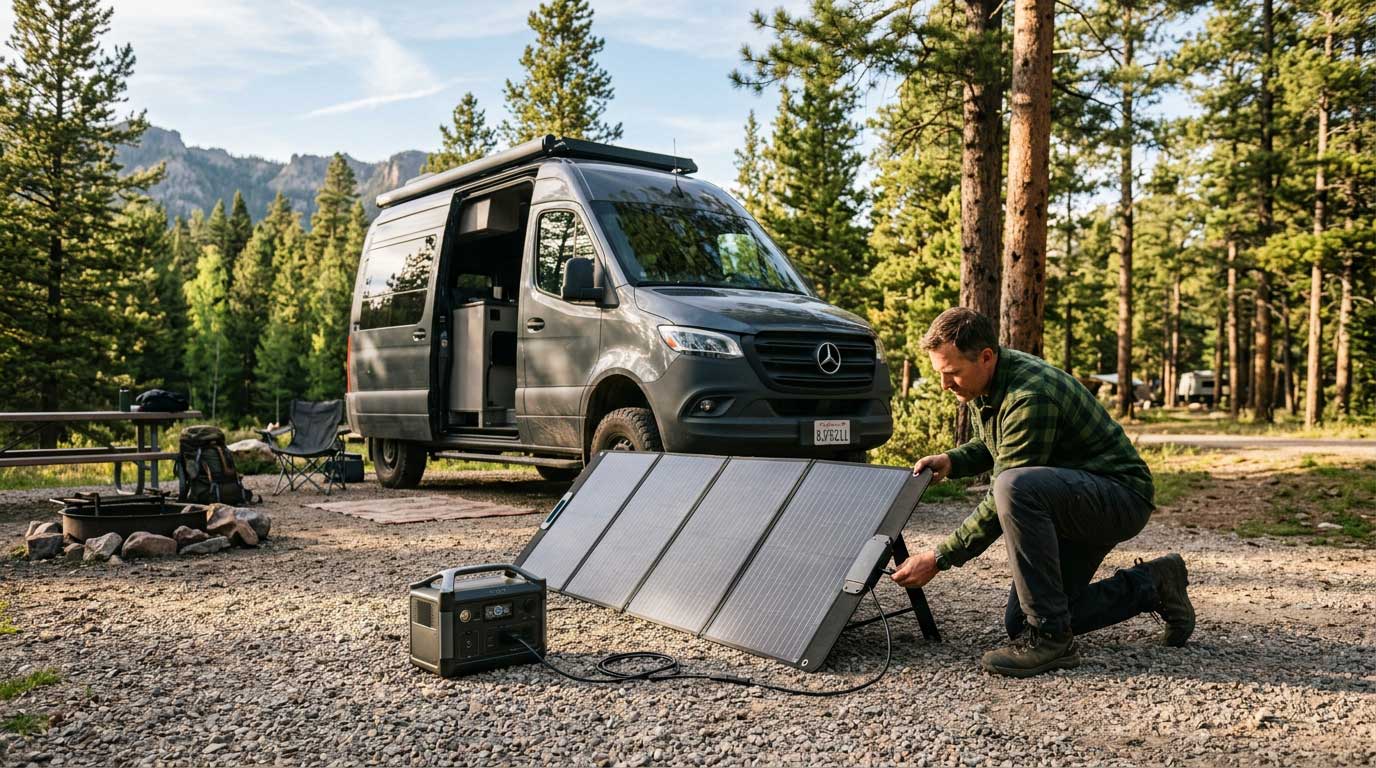
Step 1 — Check the Panel and Charging Equipment
Before unpacking, confirm the panel’s rated wattage, output voltage, current, connectors, and operating instructions.
Next, check the device receiving the electricity. A portable power station will specify an acceptable solar input range. If charging a separate battery, use a compatible charge controller unless the equipment manufacturer explicitly specifies another safe arrangement.
Matching wattage alone is not enough. Voltage limits, polarity, connector type, and maximum input current matter.
Step 2 — Find an Unshaded Position
Choose a stable area away from tree shadows, vehicle awnings, and foot traffic. Open the panel fully and extend its supports as directed by the manufacturer.
A south-facing position is often a useful starting point in the Northern Hemisphere, but the best orientation varies by location, season, and time of day. Adjust the panel when practical rather than assuming the first position will remain optimal all afternoon.
Keep the panel clear of puddles and avoid placing it where wind could easily overturn it.
Step 3 — Connect the System Correctly
Follow the connection sequence specified by the panel and power station or charge controller manufacturer. Use only compatible cables and adapters.
Check that:
- The panel’s voltage falls within the receiving device’s permitted range.
- The connector and polarity match the input.
- The receiving device’s maximum solar input current and wattage will not be exceeded.
- Any required charge controller is connected in the correct configuration.
- Electrical connectors remain dry and are protected according to their specified ratings.
Do not force a connector to fit or improvise exposed wiring outdoors.
Step 4 — Monitor Charging and Adjust
If the power station has a display, check its solar input reading after connection. Output will change as clouds pass or the sun moves.
When the reading seems unexpectedly low, look for partial shading first. Then inspect connections and check the input limits. Comparing readings at two panel positions under similar sunlight can help identify a placement problem.
Step 5 — Fold and Store the Panel
Disconnect the equipment according to the manufacturer’s instructions. Remove loose debris using approved cleaning methods, and let the panel dry before storage when necessary.
Fold along the designated sections. Keep cables away from hinges, avoid sharp bends, and do not stack heavy gear on top of the packed panel.
How to Choose the Best Foldable Camping Solar Panels
The best panel is not necessarily the one with the highest wattage. It is the one that fits your energy needs, storage space, charging equipment, and typical campsite conditions.
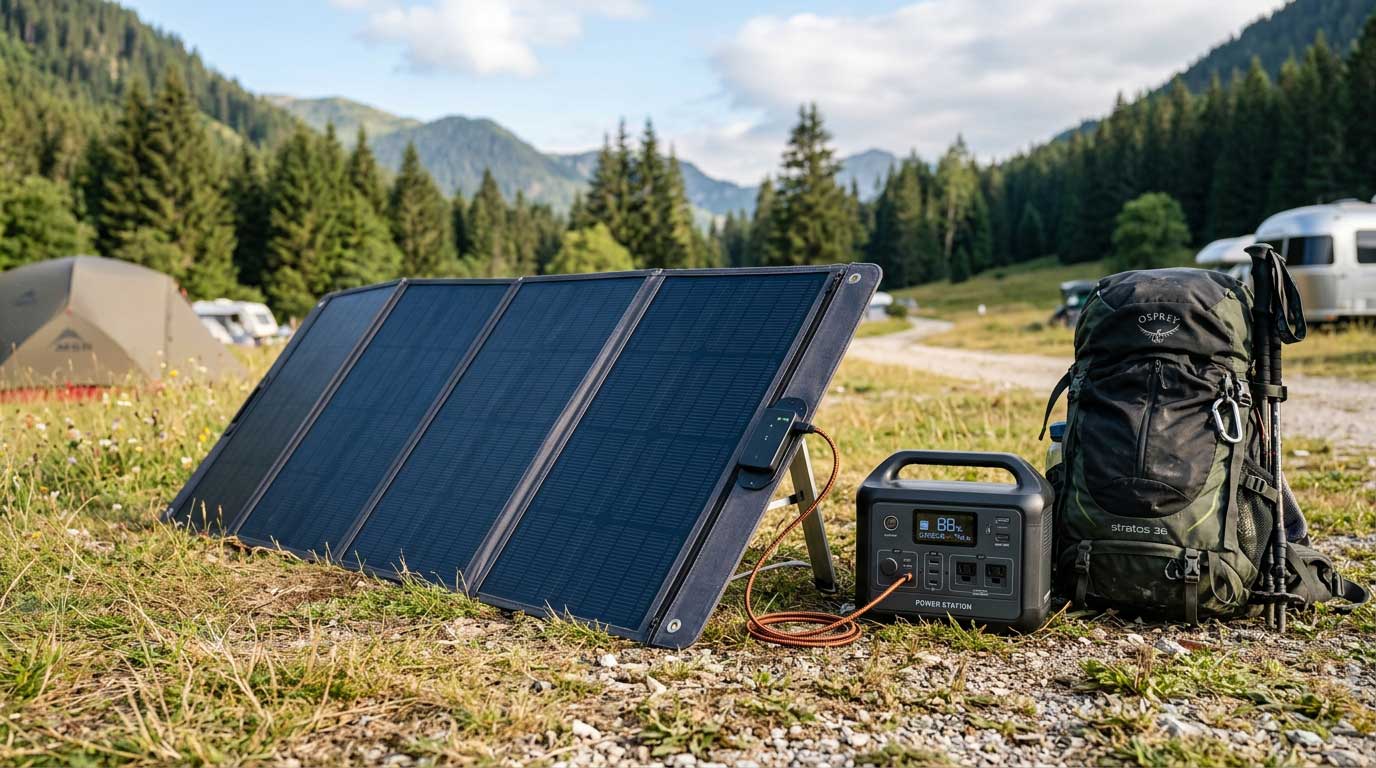
Compare the Features That Matter
| Feature | What to look for | Why it matters |
|---|---|---|
| Rated wattage | Match output to estimated energy needs | Helps determine likely charging capacity |
| Folded size | Check packed dimensions | Determines storage convenience |
| Weight | Compare with your carrying needs | Matters when moving the panel frequently |
| Kickstands | Stable, adjustable supports | Help position the panel toward sunlight |
| Output connections | Compatible cables and connectors | Prevent connection problems |
| Weather suitability | Published product ratings and instructions | Helps determine appropriate outdoor use |
| Warranty | Written coverage and exclusions | Clarifies after-sales support |
Do not assume all foldable panels are waterproof, equally durable, or suitable for unattended outdoor use. Check the actual product documentation, especially when a trip may involve rain, wind, dust, or saltwater exposure.
Consider How You Travel
For a car camper, packed dimensions and straightforward setup may be more important than minimizing every gram. For backpacking, weight and folded volume become more critical, and a panel that is convenient beside a vehicle may be too bulky for a long hike.
For RV travel, consider cable reach. A shaded parking spot does not always mean the panel itself must stay in the shade. A suitable extension cable may let you place the panel in sunlight while keeping the vehicle parked, provided cable specifications and the equipment manufacturer’s limits are respected.
Common Mistakes When Using Foldable Camping Solar Panels
A few avoidable problems can reduce useful energy or shorten the life of camping equipment.
- Buying by wattage alone: Confirm voltage, current, connectors, and power station compatibility.
- Expecting constant output: Solar power varies with the weather and the sun’s position.
- Ignoring shadows: A small shaded section can affect output, depending on the panel’s electrical design.
- Leaving the panel unsecured: Wind can tip over the panel or strain its cable.
- Confusing watts with watt-hours: Watts describe power; watt-hours describe energy accumulated over time.
- Packing a wet panel without checking instructions: Moisture trapped during storage can create avoidable maintenance problems.
- Assuming a folding panel replaces a battery: Most basic panels generate electricity only when light is available; nighttime power generally requires stored energy or another source.
FAQ About Foldable Camping Solar Panels
Are foldable camping solar panels worth buying?
Yes, they can be worthwhile for campers who need portable charging without permanent installation. Their value depends on energy demand, available sunlight, storage space, and compatibility with the charging system.
What size folding solar panel do I need for camping?
Choose a panel based on daily energy consumption and expected peak sun hours. Estimate watt-hours for each device, add the daily totals, and allow for charging losses and cloudy conditions.
Can foldable camping solar panels charge a power station?
Yes, if the panel’s voltage, current, connectors, and rated output fall within the power station’s solar input specifications. Some systems require a compatible adapter.
Do folding solar panels work on cloudy days?
They can generate electricity from diffuse sunlight, but output is generally lower than under strong direct sunlight. The amount depends on cloud cover and local conditions.
Can I leave a folding solar panel outside overnight?
Follow the manufacturer’s storage and weather instructions. Even if the panel is designed for outdoor use, wind, moisture, theft, and damage to connectors may make overnight exposure unsuitable.
Are foldable solar panels suitable for RVs?
Yes. They are useful when you want temporary ground-based charging without mounting panels permanently on the roof. Confirm compatibility with the RV’s battery, charge controller, and wiring.
How long does it take to charge a portable power station?
Charging time depends on the battery’s capacity, the panel’s actual output, charging losses, and the power station’s input limits. Divide the energy needed in watt-hours by the average charging power for a first estimate, then allow additional time for variable sunlight and conversion losses.
Foldable Camping Solar Panels for B2B and OEM Applications
For distributors, outdoor equipment brands, and portable power solution providers, product selection involves more than the end user’s camping experience. The panel must also fit the intended product configuration, packaging requirements, electrical interface, and target market.
Bright Solar supports B2B solar panel sourcing and customized solar solutions. Buyers developing portable or mobile power products should confirm the following details before placing a bulk order:
- Required rated power and electrical output parameters.
- Product dimensions, folded dimensions, and weight.
- Connector type and compatibility with the intended charging equipment.
- Required outdoor protection and operating conditions.
- Packaging, labeling, documentation, and warranty arrangements.
- Available OEM/ODM customization options and production specifications.
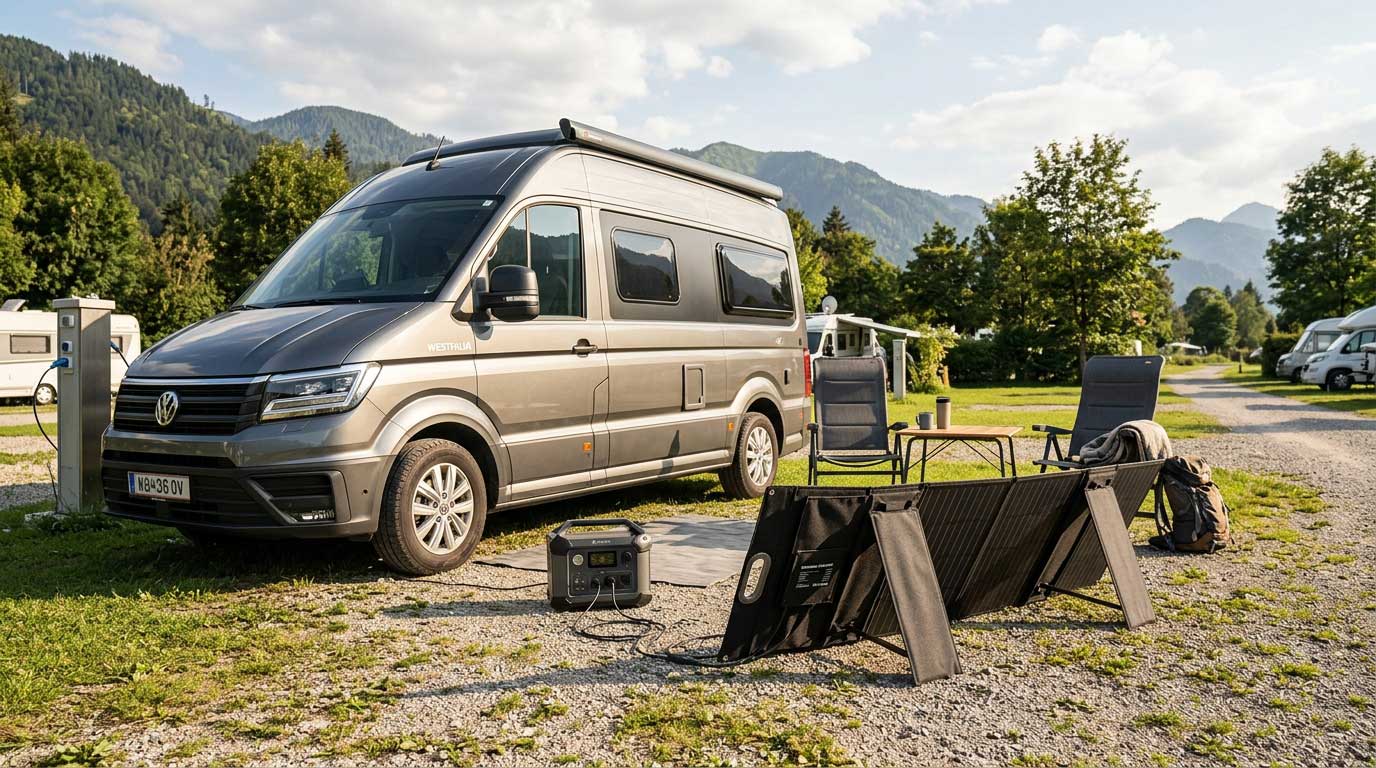
For product sourcing, the distinction between a foldable camping panel and a semi-flexible solar module should remain clear. They may serve overlapping outdoor markets, but their construction and intended handling differ. Technical specifications should come from the actual product datasheet rather than assumptions based on the product category.
Technical References and Editorial Notes
The following authoritative sources support the technical explanations and energy estimates in this article:
1. U.S. Department of Energy — Optimizing Solar Photovoltaic Performance for Longevity: Explains standard test conditions and factors that affect real-world photovoltaic production. https://www.energy.gov/cmei/femp/optimizing-solar-photovoltaic-performance-longevity
Department of Energy
2. U.S. Department of Energy — Solar Photovoltaic Performance and Efficiency Basics: Explains solar conversion efficiency and the effects of factors such as temperature and reflection. https://www.energy.gov/cmei/systems/solar-photovoltaic-performance-and-efficiency-basics
Department of Energy
3. National Renewable Energy Laboratory — PVWatts Calculator: Provides a reference for estimating photovoltaic energy production using location and system assumptions. https://pvwatts.nrel.gov/
Editorial expertise: This guide is written for camping equipment buyers, RV users, outdoor power planners, and B2B solar product purchasers. The energy calculations are illustrative, not measurements of a specific Bright Solar product. Confirm actual product performance, electrical compatibility, and environmental ratings using the applicable manufacturer’s documentation.
Related recommendations
-

mounting flexible solar panels (Field Installation Guide from Bright Solar)
253mounting flexible solar panels explained with real RV roof installations, adhesive methods, airflow design, durability insights, and field-tested mounting practices.
View details -
200W Flexible Solar Panels: Lightweight Off-Grid Power for RVs, Boats, and Van Life
204Explore how 200W flexible solar panels provide lightweight, reliable off-grid energy for RVs, boats, vans, and portable solar systems.
View details -
400W Flexible Solar Panel: High-Output Solar Power Without the Weight
181400w flexible solar panel solutions for RVs, boats, and off-grid systems. Discover lightweight ETFE solar panels with high efficiency and real-world durability.
View details -
Flexible 12 Volt Solar Panels: A Practical Guide to RV, Marine and Off-Grid Power
193Flexible 12 volt solar panels suit selected RV, marine, and off-grid systems, but compatibility depends on actual voltage, power, mounting limits, controller...
View details