Foldable 400W Solar Panel: Output, Uses and Buying Guide
A foldable 400W solar panel offers portable solar generation for RVs, camping, and off-grid power systems. Under ideal rated conditions, it can deliver up to 400 watts, while actual energy production depends on sunlight, panel positioning, temperature, and charging equipment.
For travelers running more than a phone and a camping light, 400W offers greater charging potential than a small portable panel. It can help replenish a power station, support an RV battery system through a suitable charge controller, or supply energy for a range of outdoor electronics. The important question is whether the panel’s real-world energy yield matches your daily consumption.
Bright Solar serves B2B buyers looking for solar panel solutions for mobile, outdoor, and off-grid applications. When evaluating a foldable 400W solar panel, consider more than its headline wattage. Electrical compatibility, folded size, weight, cable reach, and the conditions in which it will be used all affect its practical value.
What Is a Foldable 400W Solar Panel?
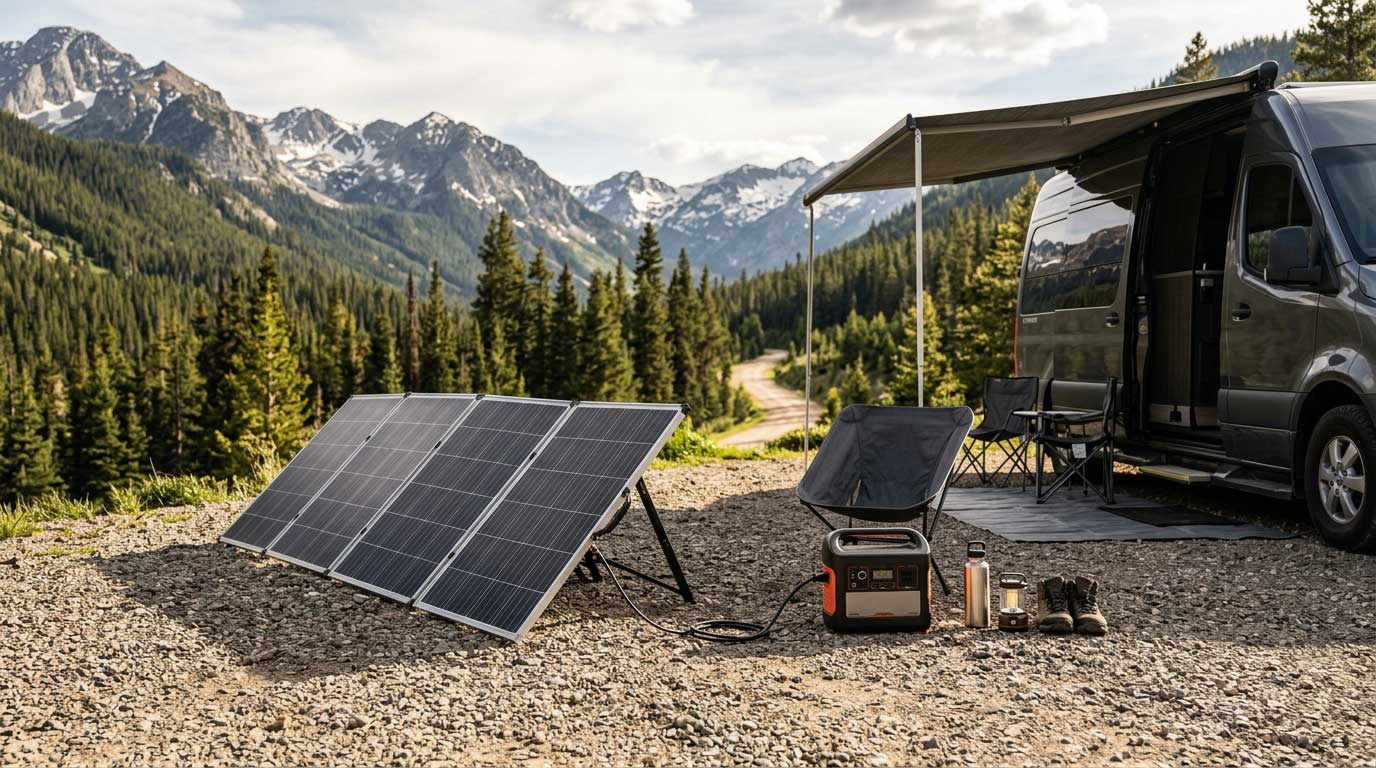
A foldable 400W solar panel is a portable photovoltaic assembly designed to open for sunlight collection and fold down for transport or storage. Depending on the product, it may contain several connected panel sections, built-in support legs, protective outer materials, and a cable for connecting to compatible charging equipment.
The 400W figure is the rated power under specified test conditions, not a promise of continuous 400W output. Solar generation changes as the sun moves, clouds pass, and panel temperature changes.
Foldable panels are particularly useful when permanent roof mounting is undesirable or impractical. You can park an RV in a suitable location, position the panel where sunlight is available, and pack it away before moving. That flexibility is the central advantage over a permanently installed system.
What Does 400W Mean in Practice?
A 400W rating describes power at a given moment under rated conditions. To estimate energy production, measured in watt-hours (Wh), you also need to estimate the equivalent peak sun hours available.
For example:
400 W×4 hours=1,600 Wh
That equals 1.6kWh before system losses. It is an illustrative calculation, not a guaranteed daily output or a claim about a specific Bright Solar product.
The U.S. Department of Energy explains that photovoltaic module ratings are based on standardized conditions, including irradiance of 1,000W/m² and a cell temperature of 25°C. Outdoor operating conditions differ from those laboratory conditions. See the U.S. Department of Energy’s photovoltaic performance guidance.
What Can a Foldable 400W Solar Panel Power?
A 400W panel can support a wider range of camping equipment than smaller portable panels, but the result depends on how much energy each device consumes and whether that energy can be stored for later use.
Example of a Daily Camping Energy Budget
Consider a hypothetical two-person RV trip with the following daily electricity requirements.
| Device | Assumed daily energy use |
|---|---|
| LED lights | 40Wh |
| Two smartphones | 30Wh |
| Laptop | 80Wh |
| Camera batteries | 40Wh |
| Ventilation fan | 120Wh |
| Total | 310Wh |
These values are planning assumptions, not measured figures for particular devices. A 400W panel receiving four equivalent peak sun hours has a theoretical yield of 1,600Wh before system losses. That provides a substantial margin over the example’s 310Wh demand under suitable conditions.
However, a cloudy day can change the calculation. So can parking beneath trees or using the panel at an unfavorable angle. A battery is also necessary if the electricity will be used after sunset.
For a more demanding setup, such as a refrigerator, consider its actual daily consumption rather than its advertised running wattage alone. Compressor cycling, ambient temperature, ventilation, and how frequently the refrigerator is opened all affect energy use.
Can It Run a Refrigerator or Air Conditioner?
A 400W panel may contribute to powering a camping refrigerator through a compatible battery and power system. Whether it can cover the refrigerator’s daily consumption depends on the appliance’s energy use and the sunlight available.
Air conditioning is a different challenge. The panel may help recharge a sufficiently large battery, but it should not be assumed to run an RV air conditioner continuously. The appliance’s power demand, startup characteristics, inverter capacity, battery storage, and available solar energy must all be evaluated.
Use this distinction when planning:
- Small electronics: Often a manageable load for a 400W portable setup.
- Fans and efficient refrigerators: Potentially suitable with sufficient solar input and battery storage.
- High-demand appliances: Require careful energy and inverter calculations.
- Air conditioning or electric heating: Usually requires a more comprehensive power-system assessment.
How to Choose a Foldable 400W Solar Panel for an RV
A 400W folding panel can be useful for RV owners who want substantial portable charging capacity without committing to permanent roof installation. Before buying, confirm that the panel can be transported, positioned, and electrically connected without creating problems at the campsite.
Compare the Important Specifications
| Specification | What to check |
|---|---|
| Rated power | Confirm the actual 400W rating and test conditions |
| Open-circuit voltage (Voc) | Must remain within the receiving equipment’s voltage limit |
| Operating voltage (Vmp) | Helps determine compatibility with the solar input |
| Operating current (Imp) | Check the permitted input current |
| Connector type | Confirm whether the required cable or adapter is included |
| Folded dimensions | Check storage space in the RV or vehicle |
| Weight | Make sure the panel is practical to move and set up |
| Support structure | Look for stable supports and secure positioning |
| Weather specifications | Verify the manufacturer’s stated operating and storage conditions |
| Warranty | Read the actual coverage and exclusions |
Do not choose a panel solely because its connector fits a power station. Electrical limits matter more than physical fit. If the product uses multiple sections or a series-connected configuration, the resulting voltage and current must be compatible with the receiving equipment.
Portable Power Station or RV Battery?
A portable power station is convenient because its battery and charging electronics are integrated. It may accept solar power directly through a dedicated input, subject to the manufacturer’s limits.
An RV battery setup usually needs a compatible charge controller and correctly designed wiring. Battery chemistry, system voltage, charging current, and the panel’s electrical characteristics must all be considered.
A nominal 12V battery system does not mean a panel can be connected directly just because the product is described as a 12V solar panel. Follow the battery and controller manufacturer’s instructions.
How to Set Up and Position a Foldable 400W Solar Panel
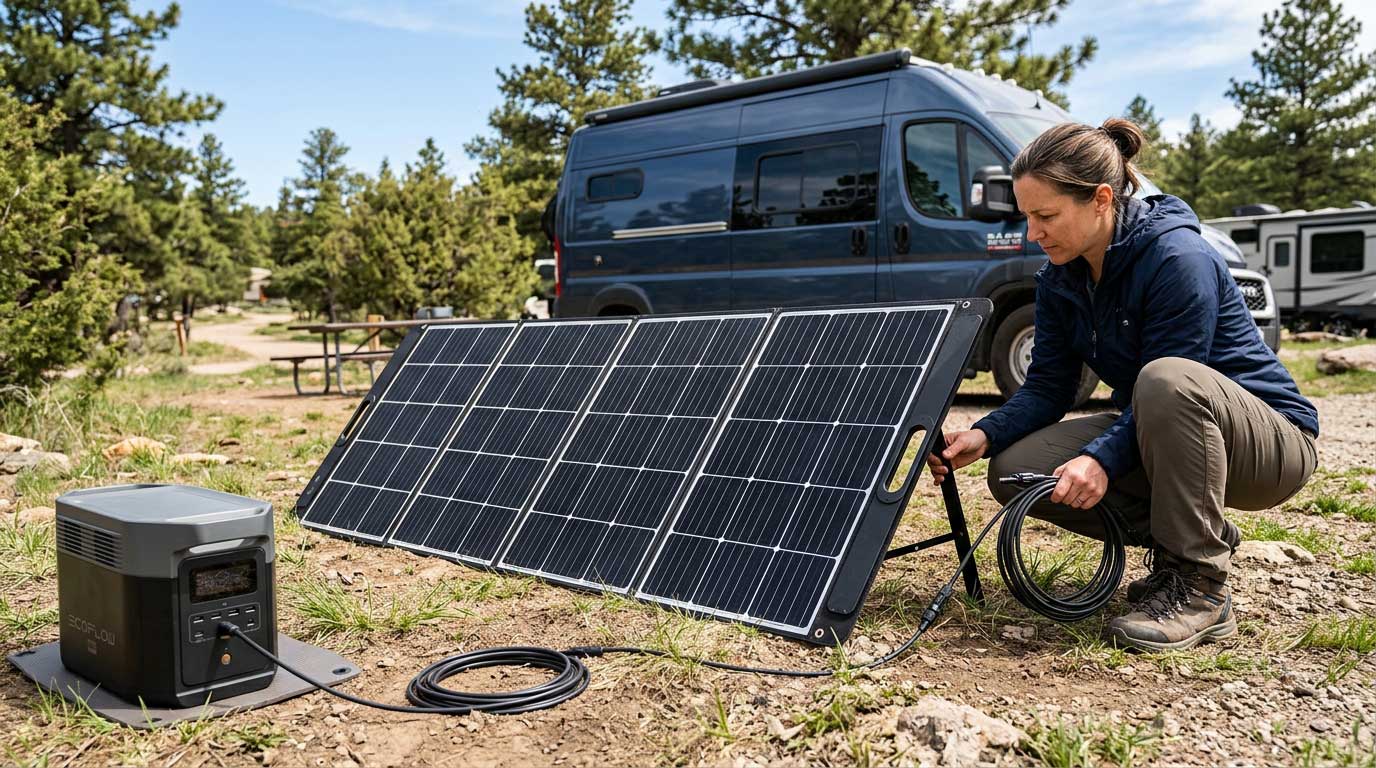
Step 1 — Check Voltage, Current, and Input Limits
Read the panel datasheet and the power station or charge controller manual before connecting anything. Confirm that the panel’s operating voltage and open-circuit voltage are within the equipment’s permitted range, and that its current and wattage will not exceed the input limits.
A 400W panel may produce a higher voltage than a smaller panel, particularly if multiple sections are electrically connected in series. Never assume that a power station rated for a particular wattage can accept every 400W panel.
Step 2 — Unfold the Panel on Stable Ground
Choose a flat location with direct sunlight and enough room to support the entire panel. Extend the supports according to the manufacturer’s instructions.
Large folding panels can catch the wind. Position the panel away from vehicle doors, walkways, and places where someone might trip over the cable. Secure it as instructed, and do not leave it standing unattended in conditions that could overturn it.
Step 3 — Connect the System Correctly
Follow the manufacturer’s specified connection sequence. Use compatible cables and adapters, and make sure connectors are clean, correctly aligned, and protected from moisture.
For a battery-based system, install the required charge controller in the correct configuration. Do not bypass protection devices or improvise connections to increase charging output.
Step 4 — Monitor the Solar Input
If the power station or controller displays input power, check the reading after the panel is connected. It may change throughout the day as the sunlight changes.
If output is unexpectedly low:
- Check whether a tree, vehicle, or awning is shading the panel.
- Adjust the panel’s orientation and tilt.
- Inspect connectors and cable condition.
- Confirm that the receiving equipment supports the panel’s electrical specifications.
- Check whether the power station’s battery is limiting its charging rate.
A low reading does not automatically mean the panel is defective. Testing under comparable sunlight and checking the equipment limits can help narrow down the cause.
Step 5 — Pack It Away for Travel
Disconnect the system according to the manufacturer’s instructions. Allow the panel to dry when needed, fold it along its intended sections, and keep cables clear of hinges.
Store the panel securely so that heavy luggage cannot press against its surface. Check the support legs and connectors periodically, particularly if the panel is frequently transported on rough roads.
What Affects the Output of a 400W Folding Solar Panel?
The U.S. Department of Energy notes that solar resource, temperature, and the angle of sunlight affect photovoltaic energy production. Its performance guidance explains that the 1,000W/m² irradiance used for standard test ratings is not always available outdoors.
Four factors deserve particular attention when using a portable panel.
- Shading: Trees, roof edges, and awnings can reduce the sunlight reaching the cells. Avoid partial shade whenever practical.
- Orientation: The best direction and tilt vary with location, season, and time of day.
- Temperature: Solar-cell temperature affects output, so strong sunshine does not guarantee the exact rated power.
- System losses: Cables, conversion electronics, charge controllers, and battery charging can reduce the energy ultimately stored.
For more detailed solar estimates, the National Renewable Energy Laboratory’s PVWatts Calculator uses location and system assumptions to estimate energy production. NREL cautions that modeled results contain assumptions and uncertainties, so a fixed-installation estimate should not be treated as a guaranteed prediction for a portable panel that is moved around a campsite.
A useful habit is to check the power station display after moving the panel into a clearer patch of sunlight. If the input increases, the original position may have been limiting production. This simple comparison is often more useful than judging performance from brightness or air temperature alone.
Common Buying and Setup Mistakes
A 400W rating can look impressive on a product page, but the details determine whether the panel will work well in practice.
- Ignoring packed size: A high-output panel may take up more storage space than expected.
- Overlooking weight: A panel that is difficult to carry may end up staying in the RV instead of being used.
- Assuming 400W means 400Wh per hour throughout the day: Power varies with the sunlight available.
- Skipping electrical checks: Voltage, current, connector polarity, and input limits must match.
- Forgetting battery capacity: Energy generated during the day needs somewhere to go if it will be used at night.
- Leaving the panel unsecured: Wind can damage the panel, supports, or wiring.
- Expecting guaranteed cloudy-weather performance: Diffuse sunlight can still generate electricity, but output usually decreases.
For businesses sourcing portable solar products, another common mistake is comparing wattage while overlooking the actual construction, connector options, folded dimensions, warranty, and consistency of the supplied specifications.
Foldable 400W Solar Panels for B2B and OEM Projects
For distributors, outdoor equipment brands, and portable power solution providers, a foldable 400W solar panel may be relevant to camping kits, mobile charging products, and off-grid power packages. Product selection should begin with the end-use requirements rather than a generic wattage target.
Bright Solar supports B2B solar panel sourcing and customized solar solutions. Buyers planning an OEM or ODM project should clarify the required output, product dimensions, electrical connections, intended environment, packaging, and documentation before confirming a configuration.
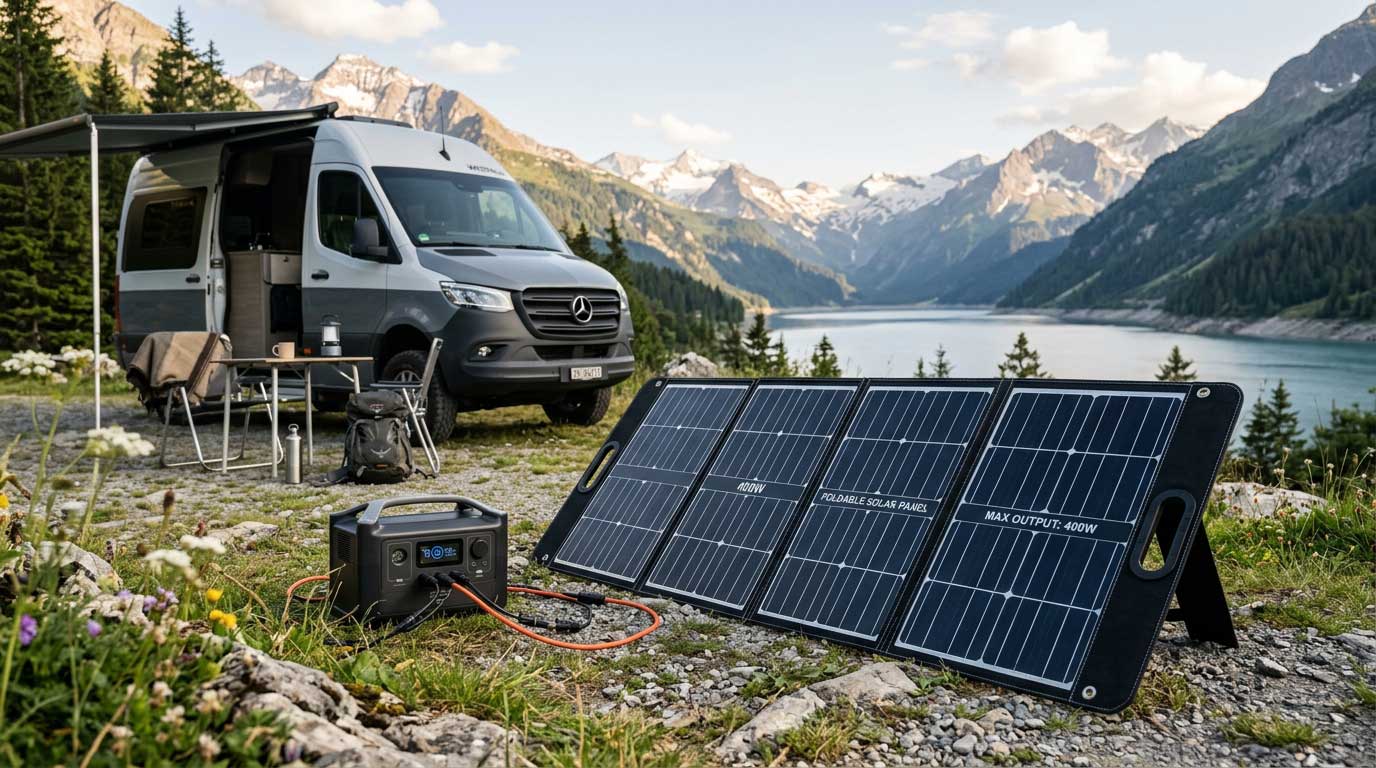
Before placing a bulk order, verify the actual product datasheet and confirm that every proposed customization is supported by the manufacturer. A portable folding panel and a semi-Flexible Solar Panel module have different construction and handling requirements, even when both are marketed for outdoor applications.
FAQ About Foldable 400W Solar Panels
How much power does a foldable 400W solar panel generate per day?
At four equivalent peak sun hours, a 400W panel has a theoretical yield of 1,600Wh, or 1.6kWh, before losses. Actual production varies with sunlight, temperature, shading, and system efficiency.
Can a foldable 400W solar panel charge a portable power station?
Yes, if the station supports the panel’s voltage, current, connector, and wattage. Check the manufacturer’s maximum solar input specifications before connecting it.
Is a 400W folding solar panel enough for an RV?
It may cover a range of RV electrical needs, particularly for electronics, lighting, fans, and some efficient appliances. Whether it is enough depends on daily energy consumption, sunlight, battery capacity, and inverter requirements.
Can a 400W solar panel run an air conditioner?
A 400W panel alone should not be assumed to run an air conditioner continuously. A suitable battery and inverter may be needed, and the complete system must be sized for the appliance’s energy demand and startup requirements.
How long does it take to charge a 1,000Wh power station?
At a hypothetical constant input of 400W, 1,000Wh divided by 400W equals 2.5 hours. Actual charging usually takes longer because solar output varies and the power station may limit its charging rate.
Can a foldable 400W solar panel work on cloudy days?
Yes, photovoltaic panels can generate electricity from diffuse sunlight, but output is generally lower than in strong direct sunlight. The amount depends on cloud cover and local conditions.
Is a foldable 400W solar panel better than a fixed solar panel?
It depends on the application. Folding panels offer portability and flexible positioning, while fixed panels are more convenient for permanent installations. Compare storage, mounting, durability, and expected energy needs before choosing.
Conclusion — Is a Foldable 400W Solar Panel Right for You?
A foldable 400W solar panel is worth considering when you need substantial portable solar charging for RV travel, camping, or off-grid power. Its main advantages are higher rated output than smaller portable panels and the ability to reposition the panel as sunlight changes.
The key is to plan around usable energy rather than the headline wattage. Estimate daily consumption, confirm compatibility with your power station or charge controller, account for battery storage, and choose a panel that fits your transport and setup requirements.
For individual campers, the best choice is the panel that meets actual energy needs without becoming cumbersome to carry or store. For B2B buyers, clear electrical specifications, dependable product documentation, and a configuration suited to the target application should guide the purchasing decision.
Bright Solar encourages buyers to evaluate the complete application before selecting a solar panel configuration. With realistic energy expectations and correct system matching, a foldable 400W solar panel can be a practical component of a portable power setup.
Related recommendations
-

Solar Panels for Van Life: Complete Solar Power Guide
233Solar panels for van life help power refrigerators, lights, fans, and electronics off-grid. Learn sizing, flexible panel options, installation tips, and practical solar system design.
View details -
100 Watt Flexible Solar Panel Kit: Complete Guide
228A 100W flexible solar panel kit combines a 100W flexible panel with compatible charging, wiring, and mounting components for small off-grid systems such as R...
View details -
solar panel golf cart roof Solutions from Bright Solar
315Bright Solar’s solar panel golf cart roof keeps golf cart batteries topped up while driving, reducing downtime and electricity use. Ideal for eco-conscious courses with solar charging options.
View details -
Flexible Solar Panels Marine Solutions for Boats and Offshore Power
160Discover how flexible solar panels marine solutions provide lightweight, durable power for boats, yachts, and offshore vessels. Learn installation, efficiency, and marine benefits.
View details