Floating Photovoltaic Power Plants: Solar That Actually Floats
When people first hear the phrase floating photovoltaic power plants, the reaction is usually: “Wait, you mean real solar panels sitting on water, not just a design rendering?” The short answer is yes. In a lot of places, you really can look out at a reservoir or lake and see long rows of solar modules quietly drifting (well, not really drifting, they’re anchored) on the surface.
This whole idea didn’t appear overnight. As the photovoltaic industry has expanded, especially in countries like China, Japan, and India, good land for large ground-mounted projects has started to feel tight. Farmland, nature reserves, urban land – all of these have strong competing uses. So developers turned their eyes to a slightly forgotten “resource”: water surfaces.
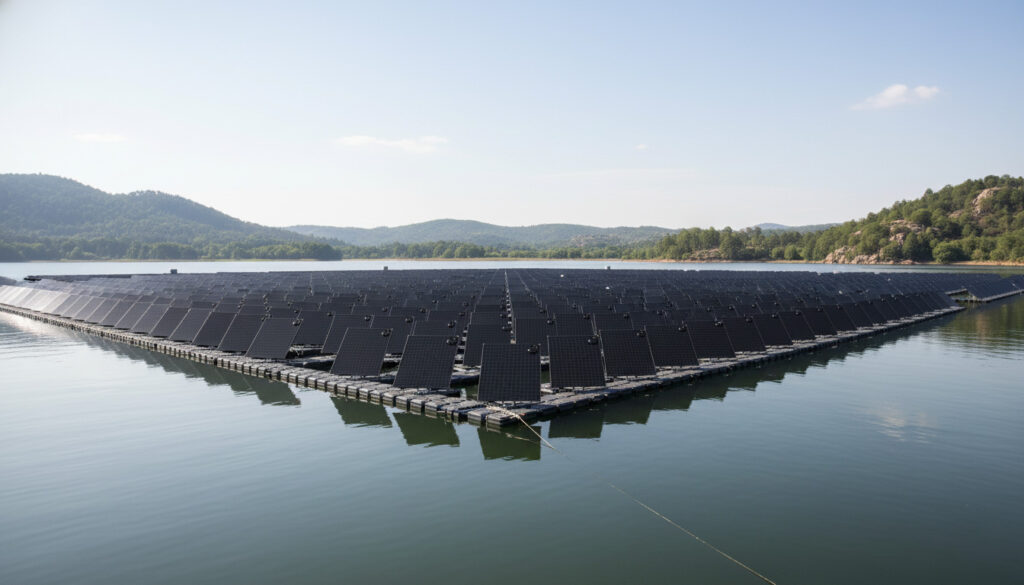
From Small Ponds to 610.5 MW in the Philippines
A few years ago, most floating photovoltaic power plants were small pilot projects: a few hundred kilowatts on an inland pond, or a 1–2 MW system on a dam reservoir. Today the numbers look very different.
- In China, the largest grid-connected floating PV plant on an inland water surface is already in the hundreds of megawatts (around 250 MW).
- In the Philippines, BlueLeaf Energy and SunAsia Energy have signed with the government to build what is being described as the world’s largest floating solar project, with a cumulative capacity of 610.5 MW. That’s not a demo – that’s a serious power station.
If you try to imagine 610.5 MW in more human terms, think of a typical rooftop system of 5 kW on a house. This one project is roughly equal to more than 120,000 such rooftops, all squeezed onto the water instead of spreading across rooftops or farmland.
Why Putting Solar on Water Sometimes Makes Sense
It sounds a bit crazy at first: electronics and water are usually enemies. So why are floating photovoltaic power plants even a thing? There are a few reasons that, at least on paper, make good sense:
- Cooling effect of water – When PV modules sit above water, the surrounding air is often slightly cooler and more humid than on bare land. That can lower module temperature by a few degrees, which in turn can increase power output. In practice, the gain is not magic, but a few percent over a year can matter for project economics.
- Saving scarce land – In places like Japan or Singapore, where land is genuinely limited, covering industrial ponds or water reservoirs with solar is sometimes easier than trying to find an extra square kilometer of free land.
- Reducing evaporation – Some water utilities like the idea that floating modules can shade part of a reservoir and reduce evaporation losses. The actual magnitude varies a lot, and not everyone agrees on the numbers, but the concept is attractive in hot, dry regions.
Of course, for every pro, someone can point out a con: anchoring complexity, impact on aquatic ecosystems, fishermen complaining about “losing” water surface, and so on. The reality is less clean than the marketing slides.
Asia as the Early Center of Floating PV
Right now, the bulk of installed floating photovoltaic power plants is still concentrated in Asia. If you look at the map, you find projects in Japan, South Korea, China, Vietnam, India, Singapore, the Philippines and a few other places. Together, these countries account for something like 80–90% of the global floating PV market.
Part of this is simply because Asia has a lot of man-made reservoirs and industrial ponds where water surface is under clear ownership and easier to permit than farmland. Part of it is policy: governments in the region have actively pushed renewables and sometimes quietly pointed developers towards water when land disputes became too messy.
Some forecasts say global floating PV capacity could reach around 4–5 GW by the mid-2020s. Personally, I would treat that as a ballpark, not a promise. Delays, financing issues, and technical surprises on water can easily shift timelines.
Offshore Floating PV: Big Potential, Big Headaches
When we move from calm inland reservoirs to the open sea, the story gets much tougher. Offshore floating photovoltaic power plants sound like a natural cousin of offshore wind, but the requirements are different and honestly more demanding in some aspects:
- Harsh marine environment – Salt spray, waves, storms, and biofouling attack everything: modules, frames, floats, cables. Materials must be corrosion-resistant, waterproof, and ideally environmentally friendly at the same time. That combination isn’t cheap.
- Anchoring and mooring design – On a sheltered lake, a simple mooring system might be enough. At sea, developers need careful layout, robust anchors, and dynamic analysis to keep the array stable under waves and currents. One lazy assumption here can literally tear the plant apart in a storm.
- Dynamic cables to shore – Power still has to get to the grid. That means floating or semi-submerged cables, flexible enough to move with waves but strong and well-protected against mechanical damage.
Some engineers are very optimistic and talk about a “GW era” of offshore floating PV. Others are more cautious and point out that we haven’t operated multi-gigawatt fleets on harsh open seas for 20–30 years yet, so long-term reliability is not fully proven. Both sides have a point.
Looking Ahead: Hype, Reality, and the “Messy Middle”
It’s easy to say that floating photovoltaic power plants are the next big growth point for solar, and in some regions that may be true. But like many new technologies, the development path is not linear. There will be projects that perform well and become reference cases, and there will be early designs that suffer from unexpected failures, maintenance headaches, or community pushback.
What seems clear is that as long as land stays precious and policy keeps pushing for more renewables, developers will continue to look at water – lakes, reservoirs, and coastal zones – as part of the answer. And somewhere between the glossy renderings and the muddy reality of installing anchors from a barge, floating PV will find its real, not perfectly clean, place in the energy mix.
Related recommendations
-

120 Watt Flexible Solar Panel: Lightweight Solar Solution for Mobile Power
114Discover the 120 watt flexible solar panel from Bright Solar. Learn how lightweight solar technology delivers reliable energy for RVs, boats, camping, and off-grid applications.
View details -
Flexible Solar Panel Installation for RVs, Boats, and Off-Grid Systems
113Learn flexible solar panel installation for RVs, boats, vans, and off-grid systems. Discover lightweight mounting methods and real-world tips.
View details -
Best RV Solar Kit for Off-Grid Travel
154Find the best rv solar kit for off-grid travel. Learn how to size solar panels, batteries, charge controllers and wiring for reliable RV power.
View details -
Solar Panels on RV Roof: Complete Guide for Off-Grid RV Power
167Solar panels on RV roofs provide off-grid electricity by combining solar generation, battery storage, charge control, and proper roof planning to meet real t...
View details